


Carnival in Germany: why Cologne, Mainz and Swabia celebrate differently
On November 11 at 11:11, carnival season kicks off in Germany. For several weeks, cities hand themselves over to the rule of fools.
From there, Germans diverge in both words and customs. On the Rhine you will hear Karneval, in Bavaria Fasching, in the southwest Fasnet. Behind the three names stands one holiday, but two completely different scripts. Let's break down who says what where, where the masks came from, and when the main parades will take place in 2026.
Karneval, Fasching, Fasnet: why the names differ
💡 In short:
- In western and northwestern Germany people say Karneval, in Bavaria Fasching, in the southwest Fastnacht and Fasnet.
- All three words are connected to Lent, but their origins differ. Karneval is interpreted as a farewell to meat, Fastnacht means "the night before Lent." Fasching has its own origin.
- The 2026 season dates have been checked against the Rosenmontag calendar (as of 09/2026).
The word boundaries are fairly clear. Bavaria, Saxony, Schleswig-Holstein, and Austria call the merry weeks Fasching. Cologne, Düsseldorf, and the entire west stick with the word Karneval. In Rhineland-Palatinate and northern Baden, Fastnacht is heard, while in Württemberg and southern Baden locals say Fasnet (according to RND).
The names point back to the Christian fast. The word Karneval is derived from the Latin "carne vale," meaning "meat, farewell." Before Ash Wednesday, people gave up meat, sweets, and alcohol, and during the days of carnival they ate and drank their fill. That made the holiday the last feast before a long period of restriction.
November 11 at 11:11: how the season opens
Every year at this hour, the fifth season begins in the Rhine cities. In Mainz, the "Narrenharta," the carnival's mock constitution, is read out at the Fastnachtsbrunnen. In Düsseldorf, Hoppeditz, the Rhenish trickster, climbs out of a mustard pot and wakes the townspeople. In Cologne, confetti flies at Heumarkt, and the new Dreigestirn is presented to the public: the trio of Prince, Peasant, and Maiden that rules the season.
In many cities, the fools symbolically occupy city halls and declare the season open. The meaning is simple: for a few weeks, you can put on a different shell and become anyone you like. That is how Diether Degreif from the carnival museum in Mainz puts it.
Who invented the modern carnival
Carnival celebrations have always existed. They were known in ancient Rome and among the Germanic tribes, and the word Fastnacht already appears in medieval documents. The holiday took its organized form in the early 19th century. In 1823, the people of Cologne created the Festkomitee, a committee that brought order to the spontaneous street parades (according to Festkomitee Kölner Karneval).
Since then, Sitzungen, staged sessions with a program and songs, and Umzüge, large parades, have emerged. They were joined by the Elferrat, a council of eleven, and Karnevalskappen, the traditional carnival caps. Before the reform, everything was far wilder: there were almost no rules, and nobody kept order.
Fasnet: masks, Häs, and driving out winter
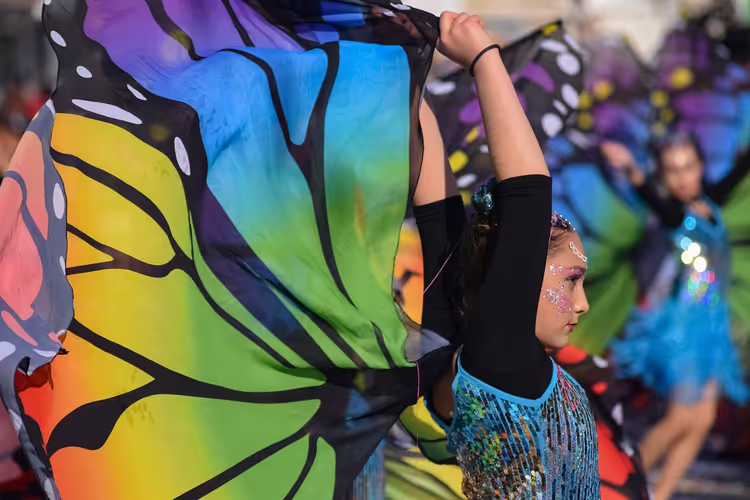
In the southwest, the holiday looks completely different. Here lives the schwäbisch-alemannische Fasnet, widespread in southern Baden-Württemberg and parts of Switzerland. Local customs are linked to pagan times: people wear Häs, a hand-sewn costume, and Larve, a mask carved from wood (according to the Black Forest tourism region).
Fools, devils, and witches walk the streets, and the forward movement is driven by a single goal: to drive out winter. Each figure belongs to its own Narrenzunft, a local guild, and the carver works on the mask for months. Identical costumes are almost nonexistent here, and that is the main difference from the Rhenish carnival.
There is also a calendar difference. The Rhineland opens the season on November 11, but Fasnet does not start that early. Here people wait for Dreikönigstag, January 6: only after that does the Häs come out of the closet. Until that day, the holiday in the southwest stays in the shadows.
November 11: tradition or commerce?
In the major carnival centers, tens of thousands of costumed people turn out for the start of the season. Large events with carnival programming begin as early as December. For the old Fastnacht, this is uncharacteristic: the main time of the holiday used to come in January, with sessions and balls held by traditional societies. Then the emphasis shifted to autumn, largely for commercial reasons.
The finale of the fifth season in 2026 falls in mid-February. On Weiberfastnacht, February 12, the street revelry begins (as of 09/2026, full season calendar on news-7.de). The climax comes on Rosenmontag, February 16: colorful columns with satirical floats, dance groups, and brass bands move through city centers. On Ash Wednesday, February 18, everything ends, and Lent begins.
Event | Date in 2026 |
|---|---|
Weiberfastnacht | February 12 |
Rosenmontag | February 16 |
Ash Wednesday | February 18 |
Opening of the next season 2026/27 | November 11 |
⁉️🤔 Frequently asked questions
Which is correct: Karneval, Fasching, or Fastnacht?
All three names are correct, but tied to regions. A Cologne resident will say Karneval, a Bavarian Fasching, a resident of southern Baden Fasnet. The meaning is the same everywhere: the time before Lent, when the city hands itself over to fools for several weeks.
When does carnival season start?
In the Rhineland, the season opens on November 11 at 11:11, and that date never changes. In the southwest of the country, Fasnet starts later, only after Dreikönigstag on January 6. Almost two months pass between the two starts.
How does Fasnet differ from Rhenish Karneval?
In the southwest, the main thing is not concerts and balls, but figures with wooden masks. Participants wear Häs, and the parade drives out winter. On the Rhine, the emphasis is on Sitzungen, Dreigestirn, and Elferrat, and the costumes are free and cheerful.
When is Rosenmontag in 2026?
Rosenmontag falls on February 16. It is preceded by Weiberfastnacht on February 12, and everything ends with Ash Wednesday on February 18. These three dates are determined by the date of Easter, so they shift from year to year.
Why does carnival pastry have different names?
Kräppel, Krapfen, Berliner: these are the names different regions give to the same fried filled doughnut. On the Rhine people usually say Kräppel, in Bavaria Krapfen, and in Berlin and the north Berliner. The argument over the name has been going on for decades.
In short: what to book
Carnival in Germany splits the holiday into two scripts, and what you see depends on your choice. If you want loud parades, confetti, and Rhenish fun, go for Cologne, Düsseldorf, or Mainz. If you want old rituals, wooden masks, and the driving out of winter, choose the southwest of Baden-Württemberg.
- If you have a couple of days in February: see Cologne on Rosenmontag.
- If traditions appeal to you more than parades: plan for the southwest after January 6.
- If you are on a budget: Weiberfastnacht on February 12 is free, and entry to the city streets is open to everyone.
Plan your trip early: for Rosenmontag, hotels in Cologne are booked up months in advance. Keep an eye on the exact program on the Festkomitee Kölner Karneval website.

A small editorial team writing guides for independent travel. We travel ourselves, but we haven’t been everywhere, so we check prices, opening hours and how to get there against official sources.