
















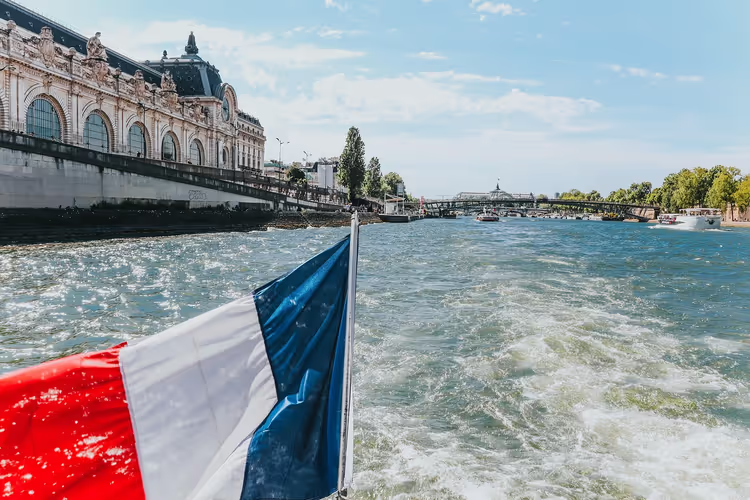
Paris catacombs: how much entry costs and what awaits underground
Paris sparkles above your head with shop windows and streetlights. Twenty meters below your feet lie the bones of more than six million people. The Paris catacombs are not a horror movie set, but an underground museum. For centuries, the city hid its dead here in former quarries.
Visits run in timed slots, and tickets are sold online only.
Ad: this article contains affiliate links, we earn a commission if you book through them, at no extra cost to you.
Why the Paris catacombs are worth a visit
💡 In short:
- An adult ticket costs 31 €, reduced 25 €, children aged 8 to 17 pay 15 €, audio guide included.
- Open Tuesday through Sunday, last entry at 7:30 PM.
- Book a morning slot, the narrow galleries get crowded during the day.
- Prices and opening hours: as of 09/2026, verified on the ticket page
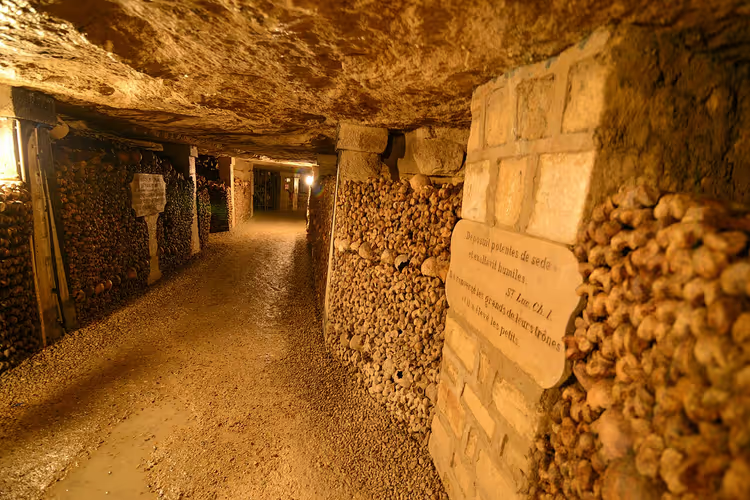
The Paris catacombs offer two experiences at once. Above ground you see an ordinary boulevard, and underground you enter another city. Inside, a real ossuary awaits you on the site of old limestone quarries. The walls here are built from bones and skulls, stacked in neat rows. The ossuary holds the remains of more than six million Parisians (according to Wikipedia).
The air underground is cool and damp even in hot July. You will not find this combination of history and darkness anywhere else in Paris.
History: from the Cemetery of the Innocents to the ossuary
The history of the catacombs begins with overcrowded cemeteries. The main one was the Cemetery of the Innocents (cimetière des Saints-Innocents) in the very center of Paris. By the end of the 18th century, a mound of earth and bones about two meters high had risen there (according to Wikipedia). In 1780, the wall of a neighboring house collapsed under the weight of the burials. After that, the inner-city cemeteries were closed, and the remains were moved.
 © Yann Caradec from Paris, France · CC BY-SAPhoto: Yann Caradec from Paris, France, CC BY-SA (https://creativecommons.org/licenses/by-sa/2.0), Wikimedia Commons
The transfer of bones began in 1786. At night, carts carried the remains to an old quarry near Tombe-Issoire street. Workers lowered them to a depth of about twenty meters and arranged them in the galleries (according to Wikipedia). This is how the ossuary came to be, whose second name is the "Empire of Death" (l'Empire de la Mort). Parisians still call it that today.
The bones were sorted and built into walls, columns, and arches. Skulls were placed in separate rows, and long bones were stacked neatly. The Ossuary opened to the public in 1874 (according to Wikipedia). Since then it has been one of the most unusual attractions in the French capital.
Underground Paris today
The network of underground galleries beneath Paris stretches for hundreds of kilometers (according to Wikipedia). It grew out of old quarries where limestone was mined for palaces and cathedrals. Nobody knows the exact length of the tunnels; some workings were abandoned and forgotten.
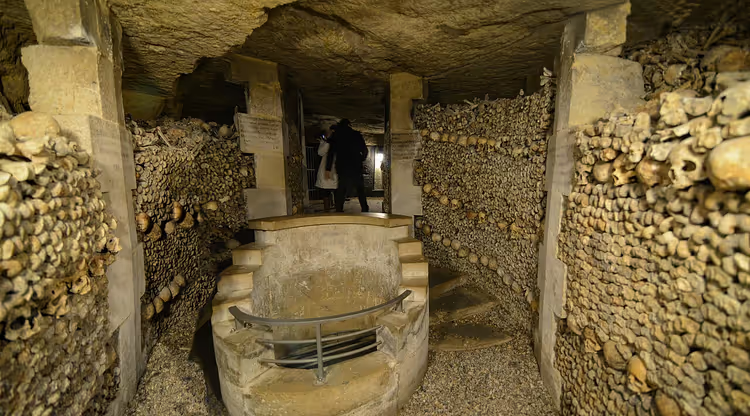 © Jorge Láscar from Melbourne, Australia · CC BYPhoto: Jorge Láscar from Melbourne, Australia, CC BY (https://creativecommons.org/licenses/by/2.0), Wikimedia Commons
By various estimates, the remains of six to seven million people lie underground (according to the English Wikipedia). Hundreds of thousands of visitors come here every year. In 2018, around 480,000 people visited the ossuary (according to Wikipedia).
What you can see inside
Inside you will see more than just bones and darkness. The gallery walls are decorated with inscriptions, drawings, and lines of poetry. Workers left their names, dates, and section numbers here. Another aid for them was called the "black line": a thin stripe on the ceiling led to the exit. Electricity was installed in the galleries much later.
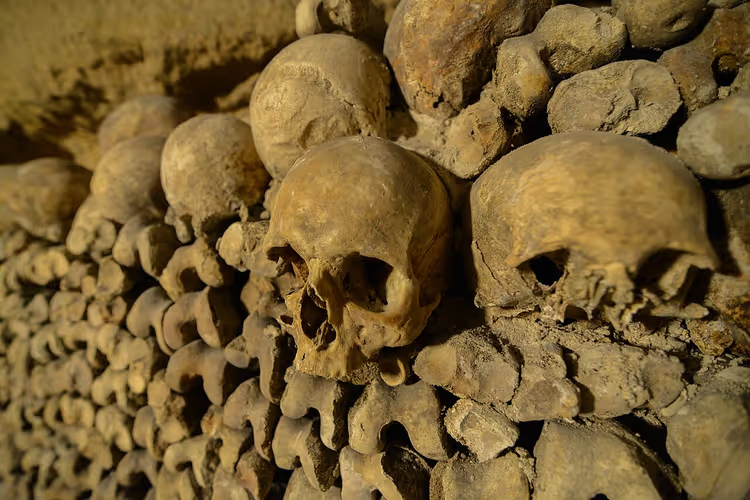 © Jorge Láscar from Melbourne, Australia · CC BYPhoto: Jorge Láscar from Melbourne, Australia, CC BY (https://creativecommons.org/licenses/by/2.0), Wikimedia Commons
Among the galleries, the Port-Mahon sculptures have survived. Landscapes and towers are carved into the stone. Many passages have barely changed over the centuries. In one of the central galleries, a well used to lift limestone has been preserved. That same stone later became the foundation of royal palaces.
Twenty meters underground
At a depth of twenty meters, you will quickly feel the difference from the surface (according to the museum website). The temperature here stays constant, and the air feels damp and heavy. The narrow walls compress the space, and footsteps sound muffled. Many visitors call this the gloomiest place in Paris.
A multi-meter layer of earth lies overhead. The constant dampness adds to the atmosphere. This is where so many legends about an underground city of the dead were born. At the same time, the route is safe and marked, so there is no reason to panic.
The descent goes down a narrow spiral staircase, and you come back up a second one. People with claustrophobia and small children may find it difficult here. Bring a light jacket even in summer; it is cool underground.
Tickets, opening hours, and address
Tickets are sold online only. We checked prices and opening hours on 13.09.2026 on the Catacombes website. A full-price ticket costs 31 €, a reduced ticket 25 €, and for children aged 8 to 17 it is 15 €. Children under 7 enter free, and an audio guide is included with any ticket.
Key information (as of 09/2026, museum data) | Details |
|---|---|
Adult ticket | 31 € |
Reduced ticket | 25 € |
Children 8-17 | 15 € |
Children 0-7 | free |
Opening hours | Tuesday-Sunday, 9:45-20:30 |
Last entry | 19:30 |
Closed | Monday |
Address | 1, avenue du Colonel Henri Rol-Tanguy, 14th arrondissement |
Booking a time slot in advance is recommended, especially on weekends and in high season. Morning slots sell out fastest. If there are no available times on the official website, check tickets with a time slot from a partner.
Tours and tickets in Paris Catacombs
Guided tours, skip-the-line tickets and activities — most offers can be cancelled free of charge.
See offers on TiqetsThe widget loads once you give your consent.
Bring water and comfortable shoes before your visit. The stairs are slippery, and it is damp inside all year round.
How to get there and visiting rules
The entrance to the catacombs is near the Denfert-Rochereau metro station. Metro lines 4 and 6 and RER line B pass through here (according to Wikipedia). It takes a couple of minutes to walk from the metro exit to the pavilion.
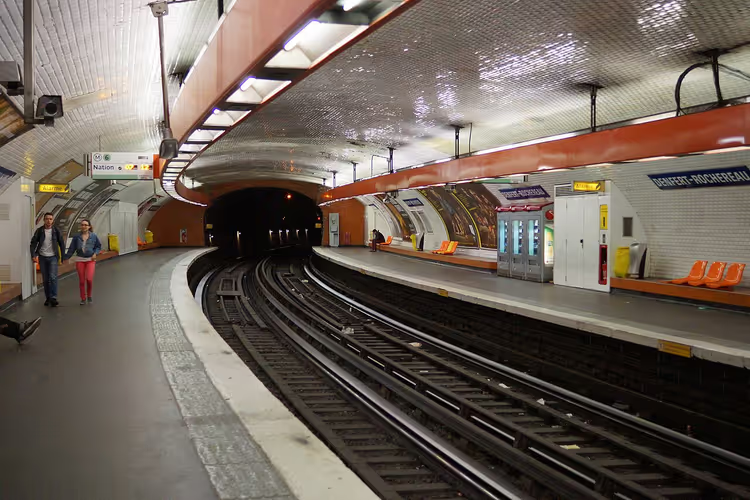 © Chris Sampson · CC BYPhoto: Chris Sampson, CC BY (https://creativecommons.org/licenses/by/2.0), Wikimedia Commons
Most of the tunnels are closed to tourists. It is easy to get lost underground and hard to get out. That is why walks through the closed galleries are prohibited, and a dedicated service keeps order. Patrols appeared after several cases of people wandering into restricted areas.
If you want to stay overnight near the entrance, check out hotels near Denfert-Rochereau. Mornings are more convenient here: fewer people are at the entrance before opening. The pavilion itself is easy to find, as signs near the metro point to it.
Unusual facts
Several facts about the catacombs surprise visitors. They will help you see underground Paris in a different light.
- In the century before last, the Catacombs cafe operated in the underground tunnels of Chaillot.
- Writer Victor Hugo studied these labyrinths and described them in his novel Les Miserables.
- During World War II, the underground headquarters of the Resistance led by Colonel Henri Rol-Tanguy was located here (according to Wikipedia).
- Some galleries were used for growing mushrooms, as the damp climate produces a good harvest.
- During the Cold War, bomb shelters were set up here.
- Since 2013, the catacombs have been part of the museums of Paris under the management of Paris Musees (according to Wikipedia).
 © Jorge Láscar from Melbourne, Australia · CC BYPhoto: Jorge Láscar from Melbourne, Australia, CC BY (https://creativecommons.org/licenses/by/2.0), Wikimedia Commons
Underground, it is easy to lose track of time. You walk past identical galleries, and it feels as if the city above has disappeared. That very feeling is what brings thousands of travelers here.
Paris catacombs on the map
The entrance is located near Place Denfert-Rochereau. Below is a map of the underground route and the surrounding area.
Catacombs of Paris
Places on the map
- Catacombs of Paris Ossuary with the remains of over six million Parisians
- Denfert-Rochereau metro station Entrance to the catacombs next to the station, lines 4, 6 and RER B
Check the opening hours the day before. The only day off here is Monday, and changes are possible on holidays.
⁉️🤔 Frequently asked questions
How much does a ticket to the Paris Catacombs cost in 2026?
An adult ticket costs 31 €, a reduced ticket 25 €, and children aged 8 to 17 pay 15 €. Time slots for each day are listed on the museum page.
Do I need to buy tickets in advance?
Yes, in advance and online. Standard tickets are not sold at the entrance, so slots sell out quickly in high season. Book a morning time and you will be able to walk through the galleries at a relaxed pace. Available times are easy to check on the museum website a week before your trip.
What days are the Catacombs closed?
The Catacombs are closed on Mondays (as of the official page). Check public holidays in advance.
How do I get to the Catacombs entrance?
The nearest metro station is Denfert-Rochereau, and the entrance pavilion is a couple of minutes on foot from there. See the metro lines and the exact address in the sections above.
How long does the visit take?
The route itself usually takes about an hour. You walk slowly because of the narrow passages and short stops inside. Add time for the descent and the climb back up the stairs. Allow an hour and a half including getting there and looking around.
In short: what to book
The Paris Catacombs are easy to fit into any city itinerary. If this is your first visit, book an online ticket for the morning and leave yourself some buffer time. If you want to see more, add city museums with the Paris Museum Pass. Below are tips for different situations.
- If you are short on time, book a timed ticket for the morning.
- If you plan to visit many museums, get the Paris Museum Pass.
- If you are looking for accommodation nearby, check out hotels near Denfert-Rochereau.
One last tip: arrive at opening time. That way you will see the ossuary almost without the crowds.

A small editorial team writing guides for independent travel. We travel ourselves, but we haven’t been everywhere, so we check prices, opening hours and how to get there against official sources.