















20 Paris rules tourists learn too late
Paris forgives a lot, but not carelessness. A single metro ticket costs €2.55 (as of 09/2026, official Île-de-France Mobilités fares), and tourist mistakes cost noticeably more.
Locals have known the rules here since childhood, while visitors usually learn from their own mistakes. We have put together 20 habits that make a trip more expensive and ruin your mood.
Below you will find exactly what not to do in Paris and what to replace each misstep with.
Ad: this article contains affiliate links, we earn a commission if you book through them, at no extra cost to you.
What to know about Paris
💡 In short:
- Keep your phone and wallet close to your body: pickpockets work in the metro and near attractions.
- Buy transit passes only from machines and ticket offices, not from people on the street.
- Ask permission before taking a table at a restaurant.
- Say hello and try a few words in French: it changes how people treat you.
- Transport and tickets: 09/2026, verified on the official Île-de-France Mobilités website.
Some mistakes only earn you dirty looks, others cost money and time. Keep the essentials in mind.
What tourists do | What it leads to |
|---|---|
Drive into the center in their own car | paid parking, towing |
Stand on the left on the escalator | remarks and shoves in the back |
Hold a phone near the metro door | theft in a crowd |
Round up the bill generously | overpaying for no reason |
Take a tuk-tuk near an attraction | a per-passenger price |
1. Do not come to Paris in your own car
A car in Paris becomes a burden from the first minutes. Traffic in the center is dense, long jams are the norm here, and parking is expensive and hard to find. You will hardly be able to park for free near attractions.
A separate challenge awaits you at Place Charles de Gaulle with the Arc de Triomphe. The roundabout with a dozen exits confuses even experienced drivers, and the center has restrictions based on the car's environmental class.
A car left in the wrong place is quickly towed to an impound lot. Tow trucks work without delay, and getting your car back costs a hefty sum.
Arrive by train or plane, and get around the city by metro, bus, or on foot. For short distances, walking is often faster than a taxi.
- The catch: without a car it is harder to get out of the city, to chateaux and distant suburbs.
2. Cross the road, even at a crosswalk, with caution
Drivers here treat a pedestrian crossing as a polite request, not a strict rule. If you step onto the crosswalk without looking around, the risk of getting hit rises sharply.
Before crossing, look left, then right, and make eye contact with the driver. It is better to keep your phone in your pocket at that moment.
This way you protect both your health and your nerves. Cars in Paris brake reluctantly, especially at rush hour.
3. Do not stand on the left on the escalator
In the Paris metro there is a simple rule: stand on the right, walk on the left. The left side is reserved for those rushing to a connection or to work.
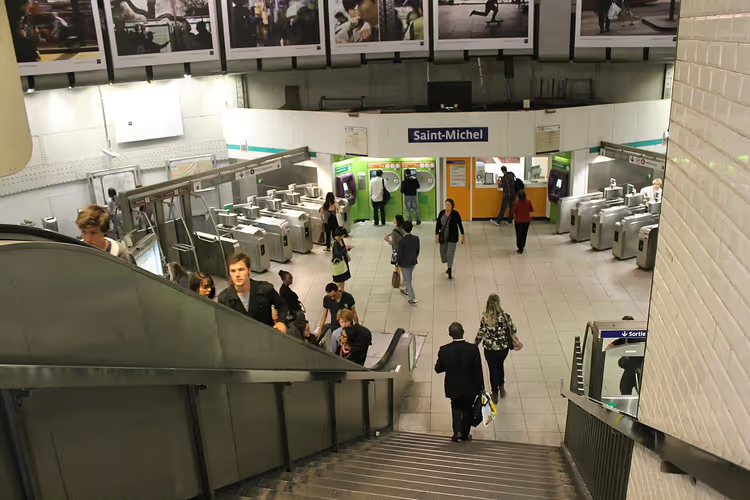 © Connie Ma from Chicago, United States of America · CC BY-SAPhoto: Connie Ma from Chicago, United States of America, CC BY-SA (https://creativecommons.org/licenses/by-sa/2.0), Wikimedia Commons
If you stand on the left, people will quickly and not always politely point out your mistake. Locals see it as a breach of order, not a minor slip.
The rule is especially noticeable in the morning, when thousands of people rush to their trains. A little awareness will save you from conflict in a crowd.
Keep to the right side if you are not in a hurry. Place your bag or suitcase so that it does not block the way for other passengers.
The rule holds without signs or announcements, purely out of habit. Watch the flow for a couple of seconds and stand where people are standing. You will see the same order in RER corridors and on stations between lines.
4. Avoid the metro and buses at rush hour
From roughly 7:30 to 9:30 and from 16:30 to 19:00, the metro and buses are packed to the brim. In the car you stand shoulder to shoulder, and at transfer points crowds of people create jams.
Plan your day so you do not travel during these hours. Sightseeing is also better left for weekend mornings or late evenings.
If you do have to travel at peak time, leave early and allow extra time. One missed train can easily cost you half an hour.
- The catch: during quiet hours some museums are already closed, and intervals between trains are longer.
5. Fold up the jump seat in a full car
Paris metro cars have fold-down seats near the doors. While the train is half empty, sit comfortably. As soon as it gets more crowded, people are expected to fold them up.
If you keep sitting, passengers will start looking at you with disapproval. Standing people are waiting for free passage, not for a seat for you.
Stand up when the car fills up. This is one of the unwritten rules that people in Paris follow without reminders or arguments.
- The catch: standing in an overcrowded car is uncomfortable, especially with a bag or a child.
6. Keep your phone away from metro doors
A phone in your hand near the metro door is an invitation for a pickpocket. The scenario repeats daily: the signal sounds, the doors close, and at that moment the phone is snatched from your hand.
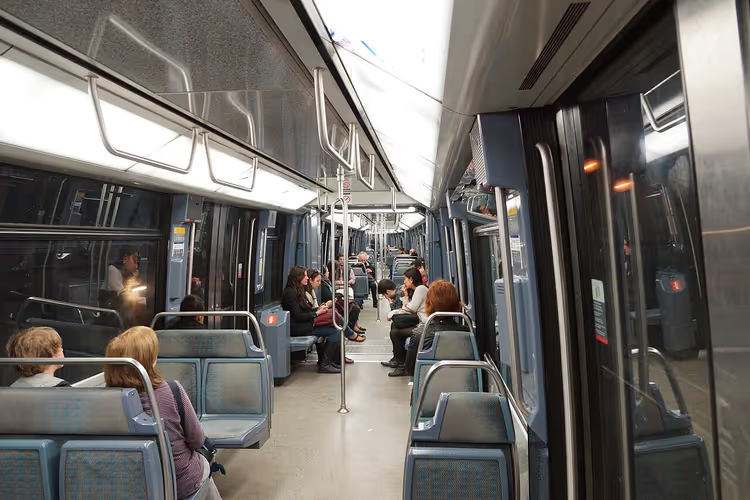 © Chris Sampson · CC BYPhoto: Chris Sampson, CC BY (https://creativecommons.org/licenses/by/2.0), Wikimedia Commons
Before you can react, the thief is gone and the train moves on. This happens especially often at crowded stations and at rush hour.
Keep your phone in your pocket or in a crossbody bag, especially near the car doors. Take it out after you exit, once you are on the platform.
On the platform, also look around. Thefts at turnstiles and on stairs happen just as often as inside the car.
- The catch: without your phone at hand, it is harder to check your route in an unfamiliar transfer corridor.
7. Do not take a table at a restaurant without permission
In a French restaurant, you wait for the waiter to seat you. A free table does not mean you can sit at it.
If you seat yourself, it will be considered rude, and the service may turn cold. Wait a couple of seconds at the entrance and say hello.
This is especially noticeable at lunchtime, when the dining room fills up quickly. Ask calmly: "Une table pour deux, s'il vous plaît."
- The catch: at a popular place you will have to wait until a suitable table frees up.
8. Do not round up the bill generously
In France tips are already included in the bill as "service compris". You pay the exact amount, and leave coins on the table only if you want to.
Large round-ups are not the custom here. A couple of coins instead of change is the polite maximum, not an obligation.
9. Do not leave valuables on the table
On a cafe terrace, a phone, camera, or bag in plain sight attracts thieves. A brief moment of inattention is enough for the item to disappear along with a passerby.
Keep valuables on you or strap your bag to the chair. Do not keep your wallet in your back pocket.
Even if you are sitting down for just a minute, do not put your phone on the table screen up. This way you keep both your item and your peace of mind during dinner.
- The catch: a crossbody bag takes up your hands and gets in the way when eating at a small table.
10. Do not go shopping on the Champs-Élysées
The Champs-Élysées seems like the best place for shopping, but it disappoints many visitors. It is one of the most expensive shopping streets in the world, and the selection repeats from store to store.
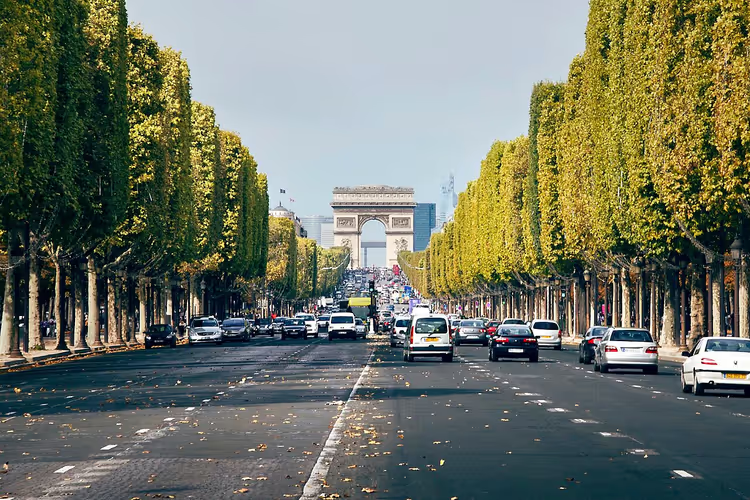 © SoWhat · CC BY-SAPhoto: SoWhat, CC BY-SA (https://creativecommons.org/licenses/by-sa/2.0), Wikimedia Commons
Because of the crowds, you cannot browse boutiques calmly. There is almost no individuality or local flavor here.
If you want interesting and affordable shopping, turn into neighborhoods like the Marais. There you will find more small shops, local brands, and ordinary Parisian life.
- The catch: in other neighborhoods, shops keep their own hours and close earlier.
11. Do not sign petitions on the street
Near the stairs to Sacré-Cœur and by the Eiffel Tower, signature collectors are especially active. First they persuade you to sign a "social" initiative, and immediately after that they ask for money.
It is better not to make eye contact, not to stop, and to keep walking. This way you avoid one of the city's classic traps and keep your wallet.
- The catch: refusing to sign can feel awkward, and you have to be firm.
12. Do not play shell games on the square
Shell games on the streets of Paris are a well-oiled team, not random players. Shills first win small amounts so you believe in luck and bet more.
The outcome is always the same: the tourist loses. The result of the game is predetermined, and you cannot win fairly.
When the stakes rise or a crowd gathers, someone shouts "Police!" loudly. Within seconds the players roll up the mat and disappear, and the real police never show up.
Walk past, do not stop, and do not look at the table. You will not get your money back.
- The catch: out of curiosity it is easy to linger at the table for a couple of minutes and get drawn into the game.
13. Do not eat at restaurants right next to major attractions
Establishments right by the main monuments live off foot traffic, not regular guests. The menu here is often shorter, prices higher, and the food worse than in neighborhoods a couple of streets away.
Waiters at such places sometimes call out to you from the street. If someone is pulling you by the arm into the dining room, that is a reason to keep walking.
Walk 5-10 minutes away from the square, into a residential neighborhood. There you will find the same dishes at normal prices and with locals at the neighboring tables.
Look at where Parisians themselves eat. A full terrace and a short menu on a chalkboard say more than a bright sign.
- The catch: in quiet neighborhoods some cafes are closed at lunchtime or only open until the evening.
14. Do not get into a taxi without a Taxi Parisien sign
Near train stations and major squares, cars that look like taxis are waiting, but they are not official. The price is quoted on the spot, and it often comes out higher than usual.
An official Paris taxi is recognized by the illuminated Taxi Parisien sign on the roof. Below it, the letters A, B, or C are lit.
If there is no sign, do not get in. This way you avoid a dispute over the price and extra expenses on the road.
- The catch: at a train station at rush hour, the line for an official taxi can be long.
15. Do not ride around Paris in a tuk-tuk
A tuk-tuk looks like a convenient way to see the city, but it often turns into an expensive mistake. Many of these vehicles in Paris operate illegally, without insurance and the required permits, as local guides warn (as of 09/2026, Secretsofparis).
The price is not always announced upfront. It is important to know: the fare is charged per passenger, not for the whole ride.
If the driver has no visible price list, refuse the ride. The money you save is better spent on a museum or a good dinner.
16. Buy metro tickets only from machines
Near large stations, people sometimes offer "bargain" tickets on the street. In reality they turn out to be invalid, damaged, or already used.
Buy transit passes only from machines or RATP ticket offices. Current fares are published by Île-de-France Mobilités.
This way you avoid arguing with a fare inspector and paying a fine for someone else's scam.
- The catch: lines at machines at major stations at rush hour can be long.
17. Do not accept "friendship bracelets" on the street
Near Sacré-Cœur and the Eiffel Tower, strangers try to put a bracelet on your wrist. It looks like a gesture of friendship, but a demand for payment follows almost immediately.
The pressure can be intense, and refusals are met with rudeness. It is better not to stop and not to let them touch you.
Keep walking and do not take anything from strangers' hands. This way you avoid one of the most unpleasant situations in the city.
- The catch: persistent sellers may walk alongside you for several more minutes.
18. Do not underestimate pickpockets
Pickpockets are active in the metro, on crowded buses, and near attractions. They work in groups and skillfully use crowding and distraction.
Keep your phone, wallet, and documents in an inside pocket or a zippered bag. It is better to take off your backpack and wear it on your chest.
In a crowd, keep a hand on your bag and do not carry everything in one place. Then even if a theft happens, it will not strip you of all your money and documents at once.
- The catch: a backpack worn on your chest draws attention and gets in the way while traveling.
19. Start a conversation with "Bonjour", not with English
Many Parisians speak English, but they expect a polite start in French. A simple "Bonjour" and the question "Parlez-vous anglais?" immediately change the tone of the conversation.
If you address someone in English without a greeting, the response may be cold. Even a couple of French words make locals warm up to you.
Learn a few phrases before your trip. That is enough to be received more warmly.
- The catch: uncertain pronunciation sometimes draws a smile, but that is no problem at all.
20. Say hello when entering a shop or cafe
In France it is customary to say a brief hello when entering a shop, bakery, or restaurant. "Bonjour" during the day and "Bonsoir" in the evening is enough.
If you stay silent, the staff may respond in a reserved or distant way. This happens even when you do not mean anything by it.
A greeting takes a second but sets the tone for the whole visit. It is the start of a polite conversation about what you need.
⁉️🤔 Frequently asked questions
How much does a ride on the Paris metro cost?
In 2026, a single metro and RER ride costs €2.55, or €1.30 at the reduced fare (as of 09/2026, Île-de-France Mobilités). Buy tickets from machines or ticket offices, not from people on the street. Riding without a ticket carries a fine that is noticeably higher than the ride itself, so keep your ticket until you exit the station.
Is the metro and buses in Paris safe?
Generally yes, but pickpockets work precisely in transit and near attractions. Keep your phone and wallet close to your body, and do not leave things in open pockets or bags. At rush hour it is better not to take your phone out near the car doors at all: a theft happens in a second, and getting the item back is almost impossible.
Should you tip in Paris?
There are no mandatory tips: service is already included in the bill as "service compris". At a counter-service cafe, tips are usually not left at all.
Is it true that the Champs-Élysées is expensive?
Yes, it is one of the most expensive shopping streets in the world. People come here for shopping more for the atmosphere than for the prices.
How do you tell an official taxi from an unlicensed one?
The main sign is the illuminated Taxi Parisien sign on the roof. Without it, do not get into the car. Go to a taxi stand or order a car through an app.
Tours and tickets in Paris
Guided tours, skip-the-line tickets and activities — most offers can be cancelled free of charge.
See offers on GetYourGuideThe widget loads once you give your consent.
In short: what is worth booking
Paris rewards the attentive. If you know about rush hours, ticket prices, and table manners, your trip goes smoothly and without extra expenses.
Here is a short matrix for your trip:
If you are visiting Paris for the first time and want to cover the main sights, take a city sightseeing tour.
If you have little time, plan your route along a single metro line.
If you are coming with family, choose accommodation away from the Champs-Élysées: it is calmer and cheaper there.
If you love museums, buy timed-entry tickets in advance.
Tours and tickets for Paris are easy to compare in the selection on GetYourGuide.

A small editorial team writing guides for independent travel. We travel ourselves, but we haven’t been everywhere, so we check prices, opening hours and how to get there against official sources.