
















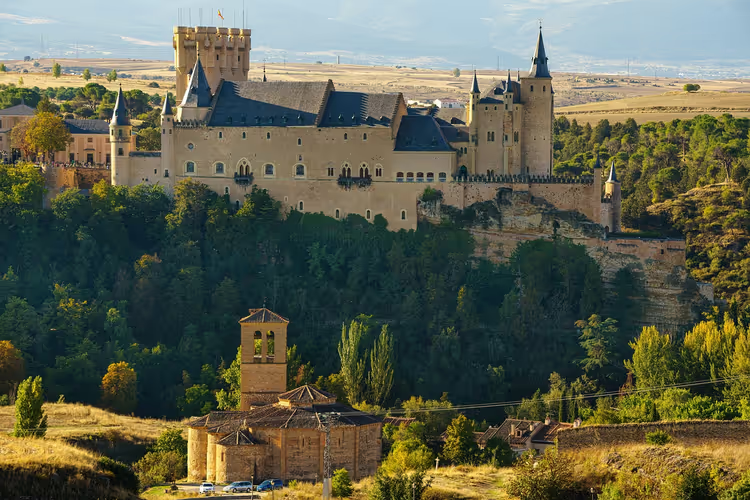
Day trips from Madrid: 20 cities and castles of Castile
Madrid is a convenient base for day trips. From Atocha and Chamartín, trains depart for Toledo, Segovia, Aranjuez, and Valladolid, while buses from the bus stations head to the castles and monasteries of Castile. In the evening, you return to your hotel.
We've put together twenty destinations around the capital: from a Roman aqueduct to windmills. Travel time ranges from half an hour to three hours (according to Renfe and ALSA schedules). For each place below, you'll find the distance, transport, main sights, and an honest catch.
How to choose a day trip from Madrid
💡 In short:
- Direct trains run from Atocha to Toledo (about 30 minutes) and Aranjuez, and to Segovia from Chamartín.
- El Escorial, Aranjuez, and San Ildefonso belong to Patrimonio Nacional: book your ticket and time slot in advance.
- Pedraza, Cuenca, Buitrago del Lozoya, and the Valley of the Fallen are easier to reach by car.
- Prices, hours, and closing days of royal residences: 09/2026, verified on the official Patrimonio Nacional website.
In one day, you can realistically cover one or two places. Choose by interest, not by the size of the city.
Keep the schedule handy: the last train from Toledo and Segovia leaves late, but buses to Sigüenza, Consuegra, and Medinaceli run infrequently, so it's best not to linger on the way back. Buy tickets to royal palaces for a specific time; in summer, available slots run out quickly.
If you care about | Go to |
|---|---|
A complete medieval city | Toledo |
A Roman aqueduct and a royal castle | Segovia |
A Versailles-style palace and gardens | Aranjuez, San Ildefonso |
Fortress walls with towers | Ávila, Buitrago del Lozoya |
The castle of the Mendoza family | Manzanares el Real |
Don Quixote's windmills | Consuegra |
Spain's oldest university | Salamanca, Alcalá de Henares |
1. Toledo
 © Dmitry Dzhus from London · CC BYPhoto: Dmitry Dzhus from London, CC BY (https://creativecommons.org/licenses/by/2.0), Wikimedia Commons
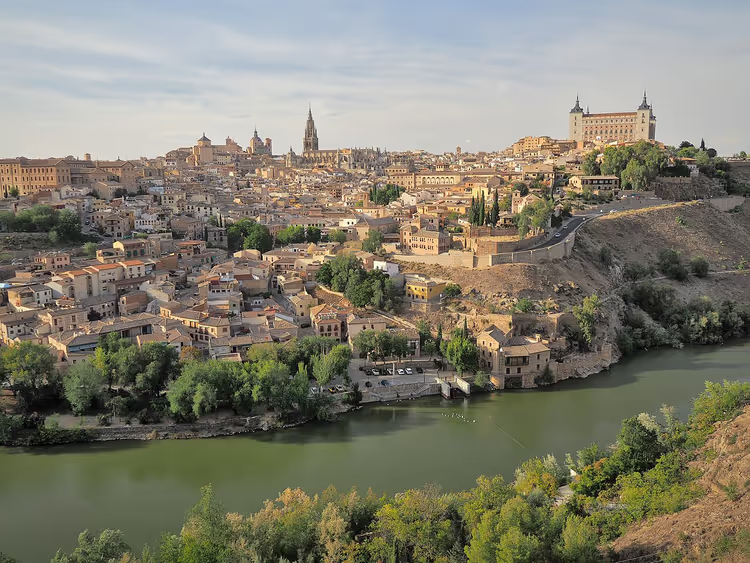
Toledo sits on a rock above the Tagus River, 70 km south of Madrid (as the map goes). The entire old town is on the UNESCO list, and its streets are home to a cathedral, synagogues, and mosques standing side by side. That's why Toledo is called the city of three cultures.
The main cathedral (Catedral Primada) took more than two centuries to build; inside you'll see works by El Greco. At the city's highest point stands the Alcázar: once a fortress and royal palace, now an army museum. Nearby, the El Greco Museum houses a large collection of his paintings.
- How to get there: the train from Atocha station takes about half an hour, with departures every thirty to sixty minutes (according to the Toledo train schedule). ALSA buses take about an hour.
- Who it's for: for a first introduction to Castile and for a trip without a car.
- The catch: in summer, the narrow streets are packed with tour groups; arrive at opening time.
2. Segovia
 © Bernard Gagnon · CC BY-SAPhoto: Bernard Gagnon, CC BY-SA (https://creativecommons.org/licenses/by-sa/3.0), Wikimedia Commons
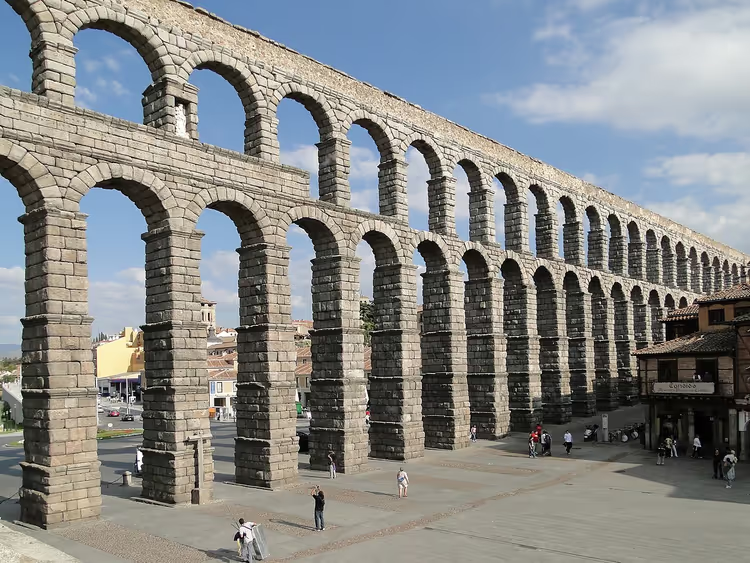
Segovia lies 90 km north of Madrid (as the map goes), and the old town and aqueduct are on the UNESCO list. The city's main symbol, the Roman aqueduct, stretches 818 meters: 167 granite arches stand without mortar (according to the Spanish tourism office).
Over the city rises the Alcázar, the favorite castle of the Castilian kings, with its pointed towers, tapestries, and armory. You'll see halls with stucco ceilings and stained glass. Tickets are sold on the official website Real Alcázar de Segovia (as of 09/2026).
- How to get there: the AVE train from Chamartín takes about thirty minutes, but the station is six kilometers from the center, then fifteen minutes by bus. The AVANZA bus takes about an hour and a half.
- Who it's for: families and those who love Roman engineering.
- The catch: the station is far from the old town, which is inconvenient with luggage.
3. El Escorial
 © Zvonimir Stamenov · CC BY-SAPhoto: Zvonimir Stamenov, CC BY-SA (https://creativecommons.org/licenses/by-sa/4.0), Wikimedia Commons
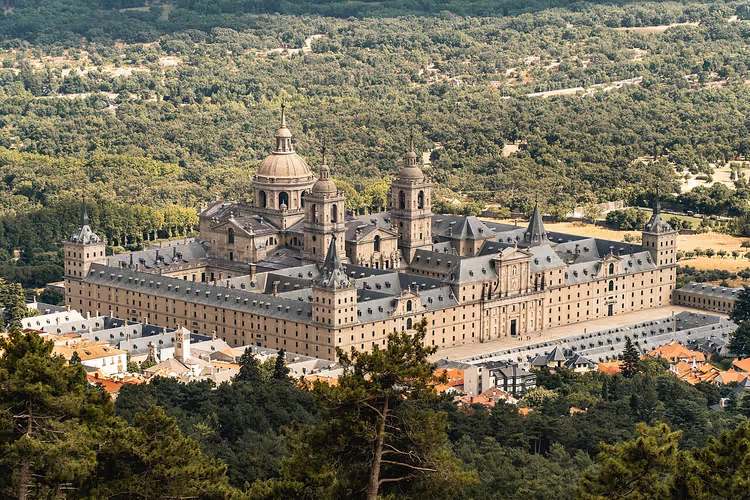
El Escorial stands at the foot of the Sierra de Guadarrama, 62 km from Madrid (on the map). The monastery, palace, and burial place of Spanish kings were built in the 16th century, and the entire complex is a UNESCO site.
At the center stands the Basilica of Saint Lawrence. Inside you'll see the library, the Pantheon of Kings, and halls with paintings by Titian, El Greco, and Velázquez. The north side is occupied by the Infantes' Palace, the south side by the monastery buildings.
- How to get there: the Cercanías commuter train from Atocha to El Escorial station, then about twenty minutes on foot uphill. Buses 661 and 664 run from the Madrid bus station (according to the Cercanías schedule).
- Cost: monastery ticket from 7 €, closed on Mondays (as of 09/2026, monastery tickets and hours).
- The catch: in high season you need an entry time slot, without one you may not get in.
4. Valladolid
 © Emilio J. Rodríguez Posada · CC BY-SAPhoto: Emilio J. Rodríguez Posada, CC BY-SA (https://creativecommons.org/licenses/by-sa/2.0), Wikimedia Commons
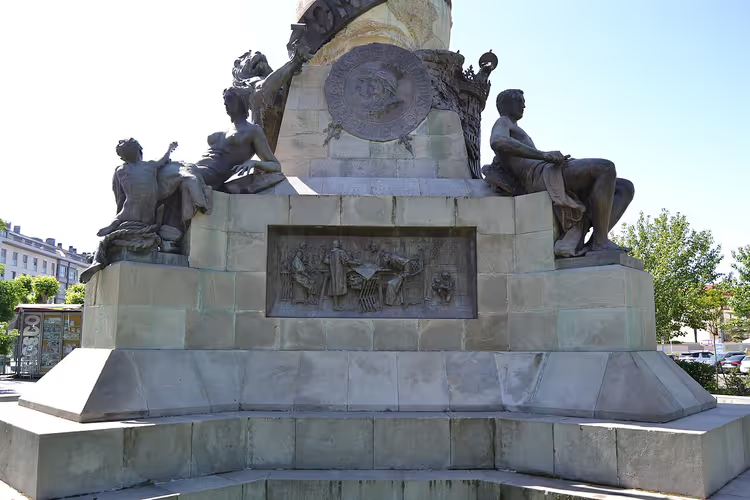
Valladolid lies 195 km north of Madrid (on the map) and was the capital of Spain before the royal court moved. Columbus lived and died here.
The city's main site, the National Sculpture Museum (Museo Nacional de Escultura), occupies three old buildings. The halls display carved altars, statues of saints, and wooden sculpture. Nearby are the Cervantes House Museum and the Columbus House Museum, and in Campo Grande Park you can relax by the fountains and royal peacocks.
- How to get there: AVE train from Chamartín station, about an hour's journey (according to the AVE schedule).
- Who it's for: museum lovers and those who enjoy quiet cities without crowds.
- The catch: the bus takes almost two hours, so the train is more convenient.
5. Alcalá de Henares
 © santiago lopez-pastor · CC BY-SAPhoto: santiago lopez-pastor, CC BY-SA (https://creativecommons.org/licenses/by-sa/2.0), Wikimedia Commons
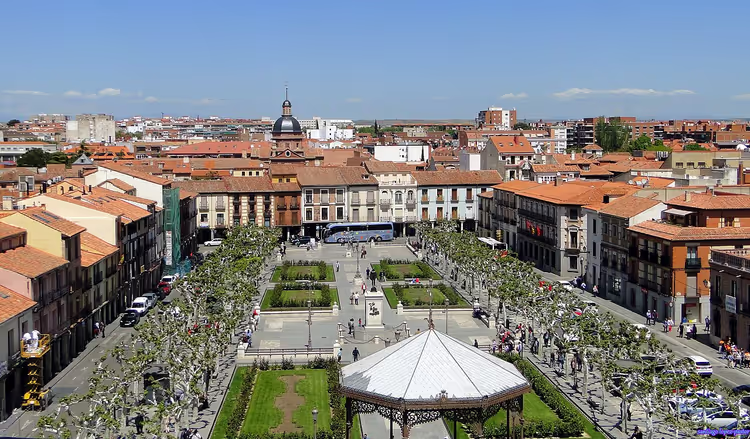
Alcalá de Henares lies 30 km northeast of Madrid (on the map). The city's name comes from the Arabic word "al-galat," meaning fortress, and the word Henares comes from the local river. The old town and university are a UNESCO site.
The university was founded by Cardinal Cisneros in the 16th century and is one of the oldest in Europe. On Cervantes Square stands the house where the author of "Don Quixote" was born; in front of the entrance you'll see sculptures of Don Quixote and Sancho Panza. Nearby is the Cathedral of the Holy Children (Catedral de los Santos Niños).
The city has preserved a 12th-century Gothic church with the Gate of Martyrs and the bishop's residence, where archival documents of the Inquisition are displayed. Storks circle above Cervantes Square, building nests on the rooftops, and the late 19th-century Laredo Palace hosts exhibitions. The Church of Santa María remembers the baptism of Cervantes.
- How to get there: the commuter train from Chamartín station takes about twenty-five minutes (according to the commuter train schedule).
- Who it's for: a short half-day trip without a car.
6. San Ildefonso
 © Marmontel · CC BYPhoto: Marmontel, CC BY (https://creativecommons.org/licenses/by/2.0), Wikimedia Commons
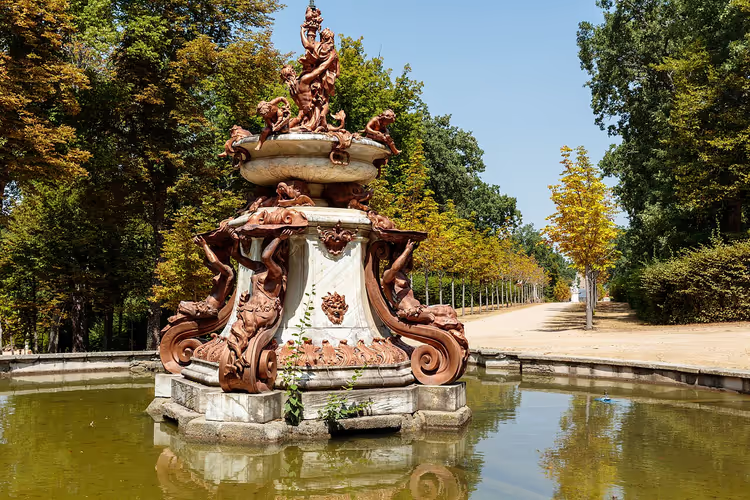
The royal residence La Granja de San Ildefonso sits 80 km from Madrid (on the map), at the foot of the Sierra de Guadarrama. The 18th-century palace was built on the model of French Versailles and now belongs to Patrimonio Nacional.
Inside you'll see halls with tapestries, frescoes, and furniture, and next to it the collegiate church of the Holy Trinity with an altar of white, red, and green marble. The park with fountains on mythological themes operates as a separate site; in summer the fountains run on a schedule.
- Getting there: the most convenient way is by car via the A-6 and AP-61 highways, about an hour and fifteen minutes. By public transport you'll have to make connections (on the map).
- Cost: the palace and park use combined Patrimonio Nacional tickets (as of 09/2026, La Granja palace).
- The catch: there's no direct train, so without a car the trip takes longer.
7. Manzanares el Real
 © Kent Wang · CC BY-SAPhoto: Kent Wang, CC BY-SA (https://creativecommons.org/licenses/by-sa/2.0), Wikimedia Commons
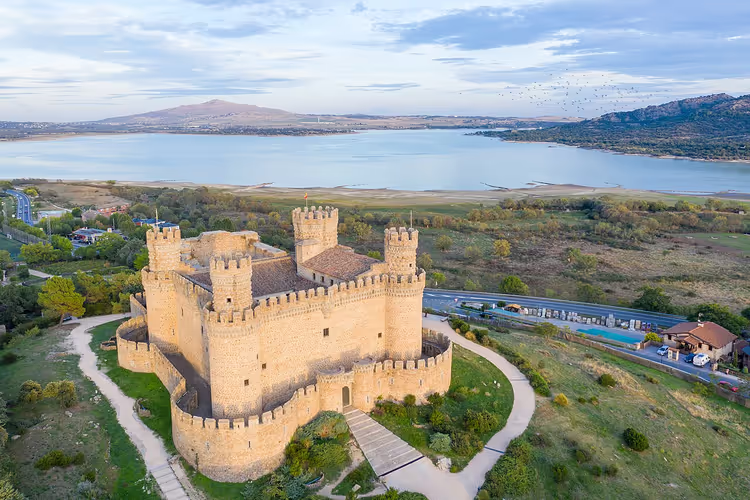
Manzanares el Real sits 50 km north of Madrid (on the map), at the southern foot of a mountain ridge. Castillo de los Mendoza was built in the 14th century as a fortress, and a hundred years later it was turned into a palace residence of the Mendoza family.
The square castle is surrounded by a crenellated wall with four towers: three round ones and one hexagonal "Tower of Honor". Inside, you'll walk through the arms courtyard with a two-tier gallery and see the main hall with weapons, armor, and 17th-century tapestries. The 2013 restoration returned the halls to their medieval appearance, and the 17th-century tapestries were woven with scenes from Rembrandt's paintings. The castle is among the best-preserved fortresses around Madrid, so people come here not only for the views but also for the interiors.
- How to get there: bus from the stop at Plaza de Castilla, about forty-five minutes (per the ALSA bus schedule).
- Who it's for: those who want to see a residential castle in half a day.
- The catch: there is no direct train, only a bus from the northern part of the city.
8. Valley of the Fallen
 © Catedrales e Iglesias/Cathedrals and Churches from Puebla de los Ángeles, Mexico · CC BYPhoto: Catedrales e Iglesias/Cathedrals and Churches from Puebla de los Ángeles, Mexico, CC BY (https://creativecommons.org/licenses/by/2.0), Wikimedia Commons
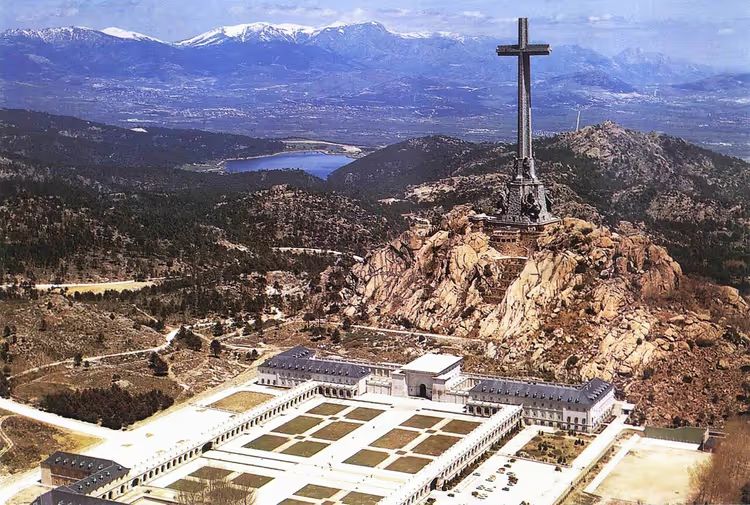
The Valley of the Fallen (now officially Valle de Cuelgamuros) is in the Guadarrama mountains, 15 km from El Escorial (on the map). The memorial to the victims of the civil war was built from 1940 to 1958 under Franco (per Patrimonio Nacional).
The complex includes an esplanade, a basilica carved into the rock, and a cross on a granite pedestal 150 meters high. The basilica's dome has a diameter of 42 meters, and chapels are built into the rock galleries (as of 09/2026, Valle de Cuelgamuros tickets). A mountain trail leads to the foot of the cross.
- How to get there: by car only, there is no direct public transport; the memorial is convenient to combine with El Escorial (on the map).
- Cost: admission by tickets on the official Patrimonio Nacional website (as of 09/2026).
- The catch: hard to reach without a car, the complex is not on any bus schedule.
9. Ávila
 © Anual · CC BYPhoto: Anual, CC BY (https://creativecommons.org/licenses/by/3.0), Wikimedia Commons
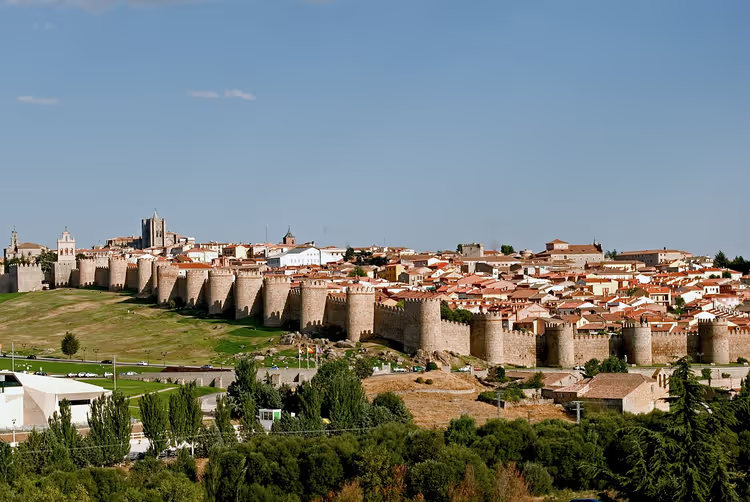
Ávila sits 110 km northwest of Madrid (on the map), on the banks of the Adaja River. The city rises to an elevation of one thousand one hundred thirty meters above sea level, and its 11th-century city wall has survived almost entirely. The old town is a UNESCO World Heritage Site.
The wall encircles the center for two and a half kilometers: eighty-seven towers, nine gates, and fortifications up to twelve meters high. Inside, you'll see the church and museum of Saint Teresa of Ávila on the site of her home, Romanesque churches, and monasteries. A circular tourist train runs through the city; you can get off at any stop and continue on the next one.
- How to get there: direct bus from the Moncloa stop, about seventy-five minutes.
- Cost: access to the wall is paid, tickets are sold at the entrance (as of 09/2026).
- The catch: because of the altitude, winters here are colder than in Madrid, so bring warm clothes.
10. Guadalajara
 © Pavlemadrid · CC BY-SAPhoto: Pavlemadrid, CC BY-SA (https://creativecommons.org/licenses/by-sa/2.5), Wikimedia Commons
Guadalajara sits 60 km northeast of Madrid (on the map). The city was founded by the Arabs in the 8th century, and the name translates as "river of stones".
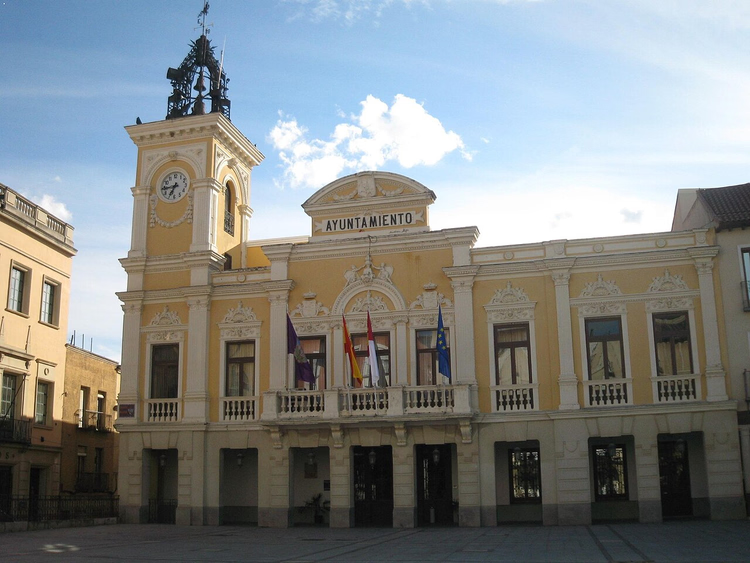
The cathedral on Plaza de los Caídos was converted from a mosque in the 14th century in the Mudéjar style; the tower with its spire remains from the mosque. Nearby stands the 15th-century palace of the Mendoza family with carved galleries and arcades. On Calle Mayor you'll see the 19th-century city hall, and in the square nearby stands a monument to Cardinal Mendoza. Inside the Mendoza palace, the gallery facades are covered with lace-like stone carving, and from the outside it looks like a huge carved box. Behind the church, on the site of an ancient spring, rises a column with a statue of the Virgin Mary.
- How to get there: direct commuter train from Madrid's station, about an hour (per the Cercanías schedule to Guadalajara).
- Who it's for: a relaxed trip without crowds and lines.
11. Salamanca
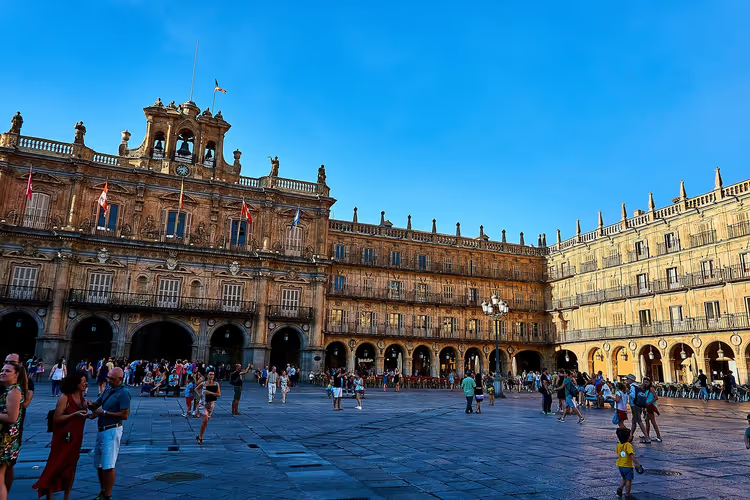
Salamanca sits 200 km northwest of Madrid (on the map). It is home to one of Europe's oldest universities, founded in the 13th century, and its historic center is a UNESCO World Heritage Site.
The old town is built from golden sandstone. The 18th-century Plaza Mayor is surrounded by buildings in the Spanish Renaissance style. Standing apart are the Casa de las Conchas with its facade of three hundred shells and the 16th-century university building in the Plateresque style.
- Getting there: train from Chamartín station, about an hour and a half. The bus from the south bus station takes longer, about two and a half hours (see the Salamanca train schedule).
- Cost: admission to the university's historic building is by ticket (as of 09/2026).
- The catch: the trip is long, so a day is only enough for the center.
12. Sigüenza
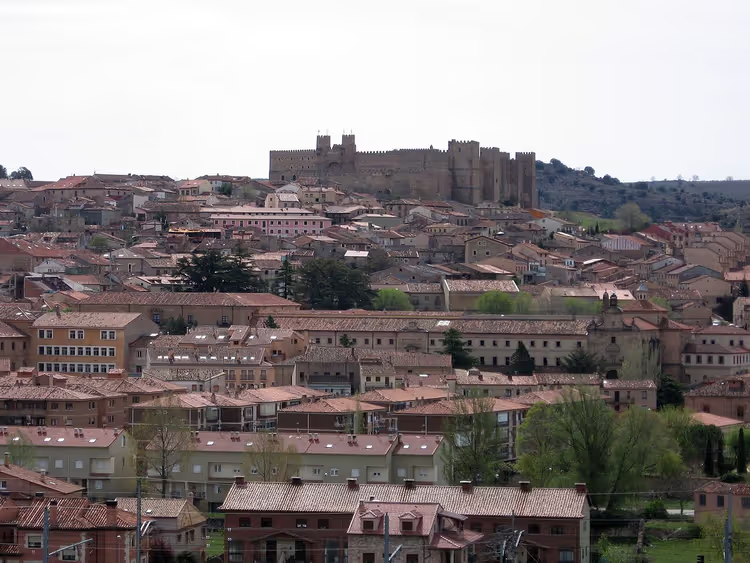 © Cillas · CC BY-SAPhoto: Cillas, CC BY-SA (https://creativecommons.org/licenses/by-sa/4.0), Wikimedia Commons
Sigüenza sits 130 km northeast of Madrid (on the map). The historic center is small and easy to cover in half a day.
On Plaza Mayor, laid out by Cardinal Mendoza in the 16th century, stands the cathedral. Construction began in the 12th century in Romanesque style and finished almost four centuries later in Gothic, so from the outside it looks like a fortress with two square towers. The monastery attached to the cathedral houses sixteen tapestries. Above the town stands a 12th-century castle, the former bishop's residence, now a hotel.
- Getting there: direct bus 034 from the station, about an hour and a half (see the bus schedule to Sigüenza). There is also a direct train from Madrid.
- The catch: departures are infrequent, so it's best not to linger on the way back.
13. Medinaceli
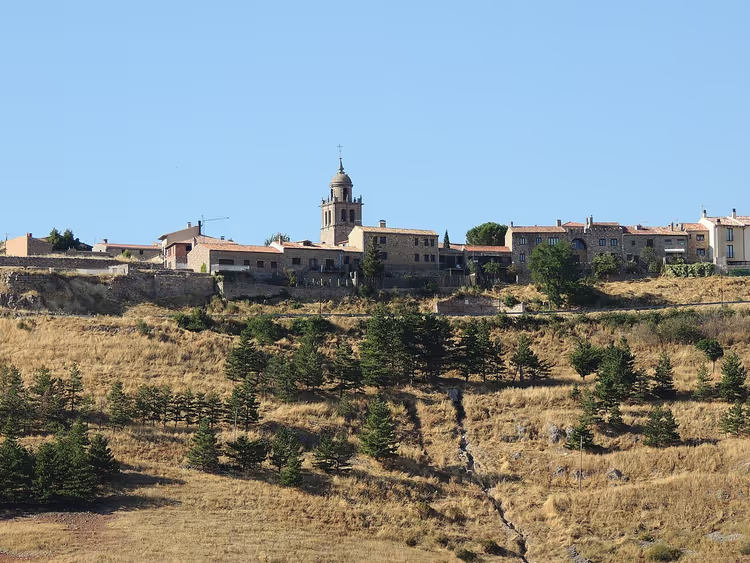 © Olga Gairin · CC BY-SAPhoto: Olga Gairin, CC BY-SA (https://creativecommons.org/licenses/by-sa/3.0), Wikimedia Commons
Medinaceli sits 155 km northeast of Madrid (on the map), in the Jalón river valley. In Roman times salt, iron, and silver were mined here, and today a three-span arch nine meters high on a hill recalls that past.
The main square with the palace of the Dukes of Medinaceli was built in the 16th century. Inside the palace you'll see Roman mosaics from the 2nd and 4th centuries on mythological themes, found during restoration of the squares. Nearby stand the Church of St. Martin, the Convent of St. Elizabeth, and the Collegiate Church of Our Lady.
- Getting there: the train from Madrid runs twice a day, about two hours (see the train schedule to Medinaceli).
- The catch: departures are infrequent, so you'll have to work around the schedule.
14. Colmenar de Oreja
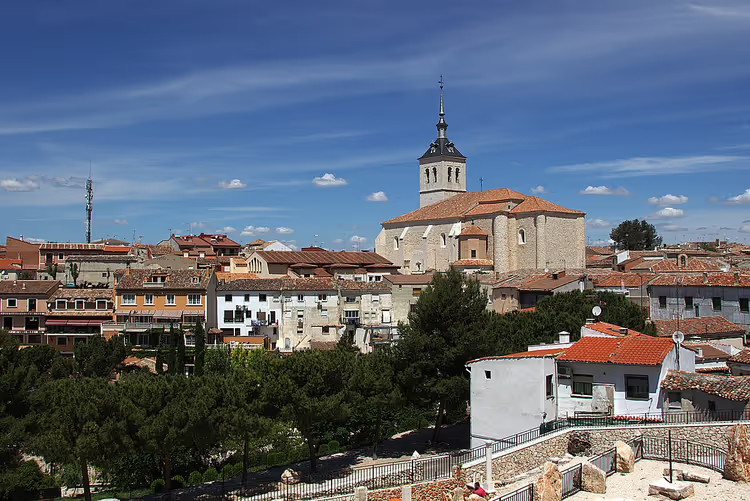 © manuel m. v. from Valdemoro, Spain · CC BYPhoto: manuel m. v. from Valdemoro, Spain, CC BY (https://creativecommons.org/licenses/by/2.0), Wikimedia Commons
Colmenar de Oreja sits 35 km southeast of Madrid (on the map). The town was founded by the Romans in the third century BC and later became a Moorish fortress.
A good place to start your visit is Plaza Mayor. The main church, Santa María la Mayor, after its 16th-century rebuilding looks like a fortress and is topped by a spire sixty-two meters high. Besides it, the stone chapel of Humilladero and the Baroque facade of the convent are worth seeing. The town has a museum dedicated to the painter Ulpiano Checa, with a garden and a bust.
- Getting there: bus 337 from Conde de Casal station, about an hour (see the bus schedule to Colmenar).
- Who it's for: a short trip if you've already seen the main cities.
15. Consuegra
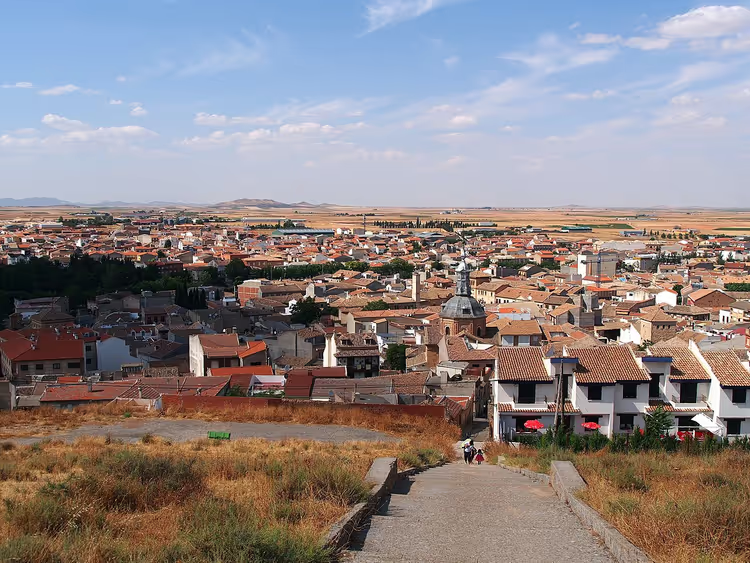 © rheins · CC BYPhoto: rheins, CC BY (https://creativecommons.org/licenses/by/3.0), Wikimedia Commons
Consuegra sits 160 km south of Madrid (on the map), in La Mancha. The town is part of the Don Quixote route, and on a nearby hill stand Consuegra Castle and twelve windmills.
On the historic Plaza España you'll see the 17th-century town hall and the "Los Corredores" house with carved balconies, which now hosts an archaeological museum. The 16th-century Church of San Juan Bautista holds paintings by Spanish artists on biblical themes. Nearby, a first-century Roman dam survives.
- Getting there: bus 012 from Madrid station, about two hours and forty-five minutes (see the bus schedule to Consuegra).
- Who it's for: those who want to see the Don Quixote windmills and the castle in one day.
- The catch: the trip takes almost three hours each way.
16. Pedraza
 © Richard Mortel from Riyadh, Saudi Arabia · CC BYPhoto: Richard Mortel from Riyadh, Saudi Arabia, CC BY (https://creativecommons.org/licenses/by/2.0), Wikimedia Commons
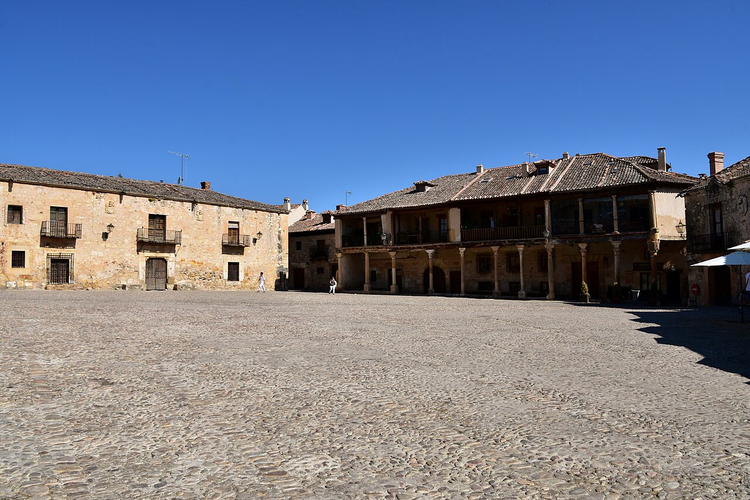
Pedraza sits 126 km north of Madrid (on the map). The settlement has remained entirely inside its fortress wall and has barely changed since the 13th century, which is why historical films are shot here.
You can only enter Pedraza through the fortress gate bearing the coat of arms of the local ruler; its appearance has not changed since the 16th century. Just past the gate stands the 16th-century town jail, now empty. Along Calle Real you will reach Plaza Mayor with its noble mansions, town hall, and restaurants. The preserved castle houses a museum of the artist Ignacio Zuloaga, and the main tower once held French princes captive.
Pedraza is small: you can walk its narrow cobbled streets in a couple of hours and still make it back to Madrid by evening. On Plaza Mayor you will find the town hall and several restaurants serving local cuisine.
- How to get there: easiest by car; there is no direct public transport (on the map).
- The catch: hard to reach without a car; buses require transfers.
17. Aranjuez
 © Unknown author · CC BY-SAPhoto: Unknown author, CC BY-SA (http://creativecommons.org/licenses/by-sa/3.0/), Wikimedia Commons
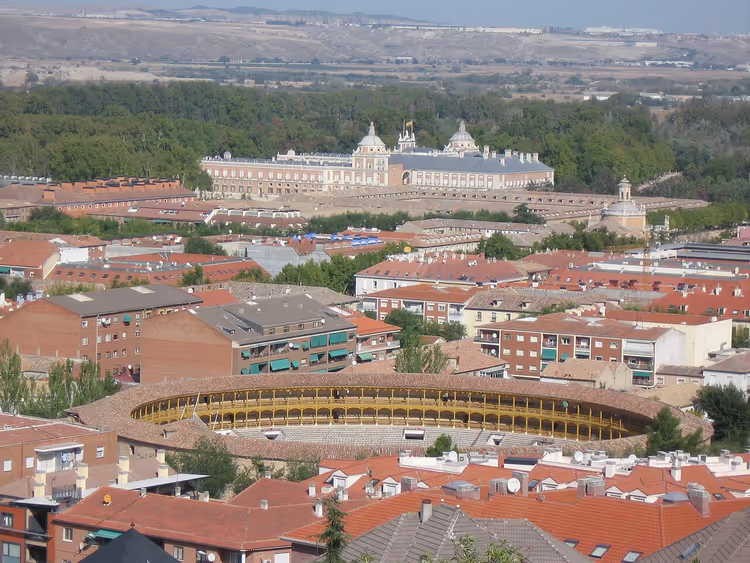
Aranjuez sits 48 km south of Madrid (on the map), between the Tagus and Jarama rivers. The summer Royal Palace is a UNESCO site and belongs to Patrimonio Nacional.
The palace is built in the Baroque style; inside you will see the porcelain room, the mirror salon, and the royal bedrooms. The ground-floor rooms house a museum of palace life. Around the palace are four parks: the Prince's Garden, the Island Garden, the Parterre Garden, and the Garden of Isabella II. The church of the San Pascual monastery holds an altarpiece painted by Raphael Mengs.
- How to get there: train from Atocha station, about an hour (per the Aranjuez train schedule). In summer, a historic "strawberry train" runs from Madrid.
- Cost: palace and parks by Patrimonio Nacional tickets (as of 09/2026, Aranjuez palace).
- The catch: the complex is large; the parks need separate time.
18. Chinchón
 © jacinta lluch valero from madrid * barcelona...., (España-Spain) · CC BY-SAPhoto: jacinta lluch valero from madrid * barcelona...., (España-Spain), CC BY-SA (https://creativecommons.org/licenses/by-sa/2.0), Wikimedia Commons
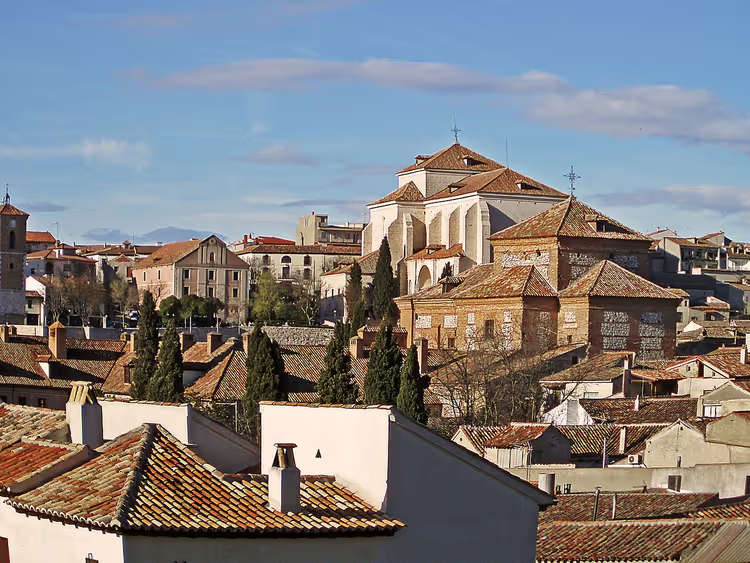
Chinchón sits 45 km southeast of Madrid (on the map). It is a small town with one main square; people come here for the atmosphere and lunch on the square.
Tours start at Plaza Mayor: the square is surrounded by three-story houses from the 15th to 17th centuries with wooden gallery balconies. Nearby stands the Clock Tower, a former bell tower. The 16th-century Church of the Assumption holds Francisco Goya's painting "The Assumption of the Virgin." On a hill above the town you can see the ruins of the counts' castle, Castillo de los Condes, reached by an old stone bridge.
Chinchón has two old monasteries: a 17th-century convent of the Poor Clares and a 15th-century Augustinian monastery, now converted into an authentic hotel. Nearby stands the late 17th-century Baroque House of Chains. Also worth seeing are the Baroque Church of Saint Roch and the Lope de Vega theater with its pink facade and the town's stone coat of arms.
- How to get there: bus 337 from Av. Mediterráneo-Conde de Casal station, about an hour (per the Chinchón bus schedule).
- Who it's for: a half-day trip with lunch.
19. Cuenca
 © Tomás Fano · CC BY-SAPhoto: Tomás Fano, CC BY-SA (https://creativecommons.org/licenses/by-sa/2.0), Wikimedia Commons
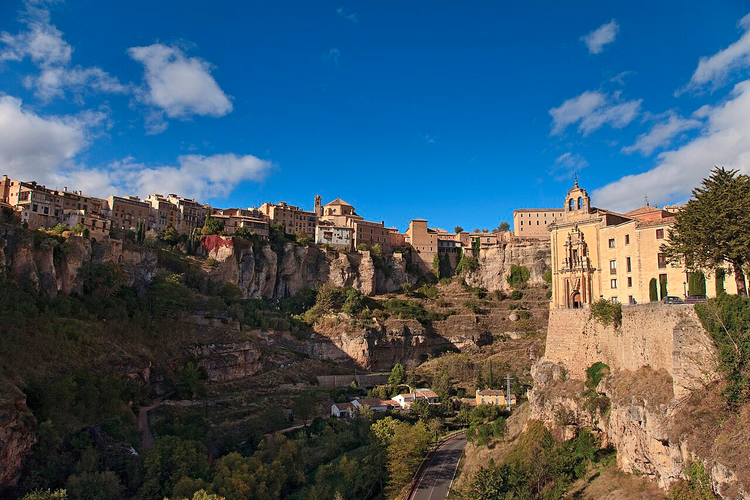
Cuenca sits 138 km southeast of Madrid (on the map), on a rocky ridge. The historic center is a UNESCO site, and its symbol is the Casas Colgadas, the hanging houses that overhang the gorge.
On Plaza Mayor stands the Cathedral of Santa María la Mayor, founded in the late 12th century. Nearby you will see the Mangana clock tower, the Cuenca archive in the former Inquisition building, and the Bishop's Palace with a museum. Among the churches, San Felipe de Neri with its Rococo interior is worth a visit. On a high hill above the city stands the monument to the Sacred Heart of Jesus, and near the city lies the park of whimsical rock formations, Ciudad Encantada.
- How to get there: easiest by car, about two hours. There is also an AVE train from Atocha station, about an hour (per the Cuenca train schedule).
- The catch: the center sits on slopes; you will do a lot of climbing up and down.
20. Buitrago del Lozoya
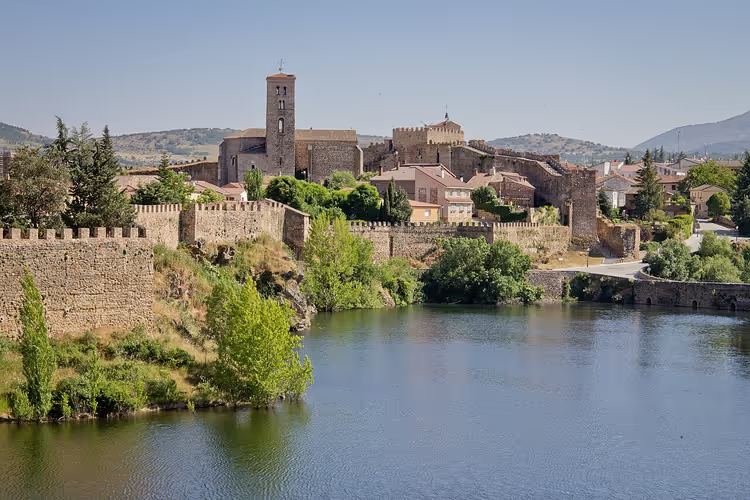 © Carlos Delgado · CC BY-SAPhoto: Carlos Delgado, CC BY-SA (https://creativecommons.org/licenses/by-sa/3.0), Wikimedia Commons
Buitrago del Lozoya sits 78 km north of Madrid (on the map). The old town occupies a promontory above the river, surrounded by water and 11th-century Moorish walls.
Start your visit at Plaza de la Constitución: here you will find an old fountain, the municipal building with a museum of Pablo Picasso's paintings, and the Clock Tower. Through the tower arch you will reach the Plaza de los Caídos and the castle church of Santa María with its Mudéjar facade. The square 15th-century Castillo de Buitrago del Lozoya with its seven towers stands by a wall eight hundred meters long. You can walk along the lower part of the wall by the river.
- How to get there: no direct connection; easiest by car, about an hour (on the map).
- The catch: hard to reach without a car; trains and buses require transfers.
⁉️🤔 Frequently asked questions
Where can you go from Madrid for a day without a car?
Direct trains and buses run to Toledo, Segovia, Aranjuez, Alcalá de Henares, and Valladolid; the trip takes from half an hour to an hour and a half. Guadalajara, Sigüenza, and Salamanca are also reachable by public transport, but take longer. Pedraza, Cuenca, Buitrago del Lozoya, and the Valley of the Fallen are easier to visit by car.
Which city should you choose for a first trip?
Start with Toledo or Segovia. Both are UNESCO sites, easy to reach, and you can see the main sights in a day. In Toledo that means the cathedral, the Alcázar, and the El Greco Museum; in Segovia, the Roman aqueduct and the Alcázar.
What is there to see in El Escorial?
In El Escorial you will see the Basilica of Saint Lawrence, the library, the Pantheon of Kings, and halls with paintings by Titian, Velázquez, and El Greco. The monastery is open Tuesday through Sunday, closed on Mondays, with admission by Patrimonio Nacional ticket.
How much time does one trip take?
Half a day is enough for Toledo, Segovia, Alcalá de Henares, and Chinchón. El Escorial, Aranjuez, and San Ildefonso take a full day; each has a large complex with a park. Salamanca and Medinaceli only work as a long full-day trip.
When is the best time to go?
In spring and autumn the weather in Castile is mild; in summer Toledo is hot during the day, while Ávila is cooler because of the altitude. Arrive when sites open, so you will beat the larger tour groups.
Map of day trips from Madrid
The map below shows all twenty destinations. Open it to gauge the distances between points and plan a multi-day trip.
The destinations are conveniently divided into south and east (Toledo, Aranjuez, Chinchón, Cuenca) and north (Segovia, El Escorial, San Ildefonso, Ávila). In one day, pick one or two places from the same group. That way you avoid wasting time on backtracking.
Route from Madrid for 1 day
Places on the map
- 1Toledo City of three cultures on the Tagus River, a UNESCO site
- 2Segovia Roman aqueduct of 167 arches and the Alcázar
- 3El Escorial 16th-century monastery, palace and royal mausoleum
- 4Valladolid Former capital of Spain, Cervantes's house-museum
- 5Alcalá de Henares Cervantes's birthplace, Europe's oldest university
- 6San Ildefonso La Granja residence modeled on Versailles
- 7Manzanares el Real Mendoza family castle with a tower of honor
- 8Valley of the Fallen Memorial with a basilica carved in rock and a 150-metre cross
- 9Ávila 11th-century city wall two and a half kilometres long
- 10Guadalajara Mendoza family palace with carved galleries
- 11Salamanca One of Europe's oldest universities
- 12Sigüenza Romanesque-Gothic cathedral and a castle-hotel on a hill
- 13Medinaceli Three-arch Roman bridge and a palace with mosaics
- 14Colmenar de Oreja Fortress-church with a 62-metre spire
- 15Consuegra Twelve windmills of the Don Quixote route
- 16Pedraza Medieval film-set town behind city walls
- 17Aranjuez Summer Royal Palace with four gardens
- 18Chinchón Plaza Mayor with a Goya painting in the local church
- 19Cuenca Casas Colgadas, houses hanging over the gorge
- 20Buitrago del Lozoya 11th-century Moorish walls and a Picasso museum
If you plan to visit several towns in one trip, it is convenient to book a car in advance: that way you are not dependent on infrequent buses and can return to your hotel whenever you like.
Find hotels
Compare prices across booking sites and filter for rooms with free cancellation.
Compare prices on Discover CarsThe widget loads once you give your consent.
In short: what's worth booking
All twenty destinations work as day trips, but in one day you can realistically cover only one or two places. If it's your first time in Madrid, choose Toledo or Segovia. For palaces and parks, head to El Escorial, Aranjuez, or San Ildefonso; for fortresses and quiet, go to Ávila, Manzanares el Real, or Buitrago del Lozoya.
Buy tickets to the royal residences and time slots in advance on the foundation's official website, and check train schedules on the carrier's website.

A small editorial team writing guides for independent travel. We travel ourselves, but we haven’t been everywhere, so we check prices, opening hours and how to get there against official sources.