









Červená Lhota Castle: opening hours, ticket prices and how to get there from Prague
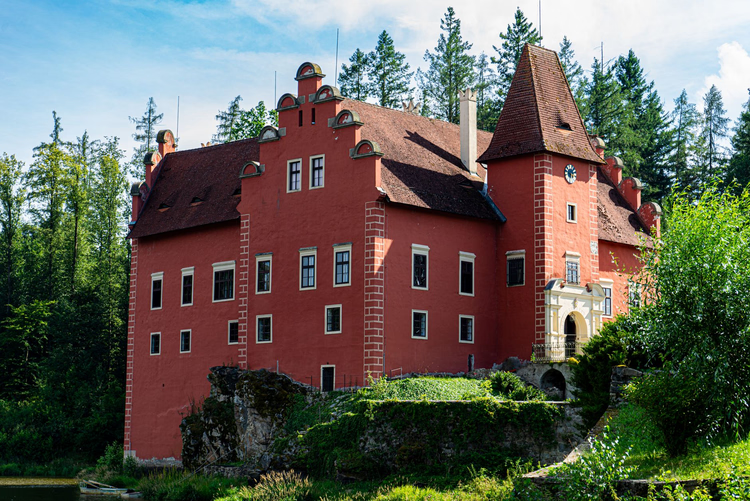
It's easy to make a wasted trip to the red castle on the lake. Červená Lhota stands on a granite island in South Bohemia and welcomes visitors only in the warm season. In April and October the gates are open only on Saturdays and Sundays, and from November 2 until the end of the year the castle is closed (as of 10/2026, official website).
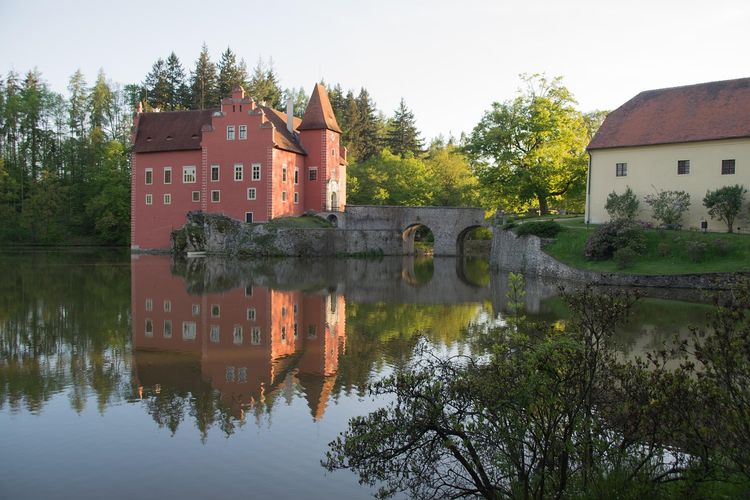
The second challenge involves the road and the language. No trains run to the castle, the bus requires a transfer, and the guide almost always speaks Czech. That's why below you'll find the schedule by month, prices for the three tours, and all the ways to get there from Prague. We retell the history of the red walls and both legends in detail: on the tour you'll hear them only in Czech.
Ad: this article contains affiliate links, we earn a commission if you book through them, at no extra cost to you.
What to know before you go
💡 In short:
- The interiors are accessible only with a guide; there are three tours: the ground floor, the attic, and the cellars.
- The season runs from April through October; from May through September, Monday is a day off.
- No trains run to the castle: take a bus with a transfer in Deštná, a car, or a bicycle.
- You can walk around the lake on a trail or row across it in a rental boat.
- Prices and opening hours: 10/2026, verified on the castle's official website
From a Gothic fortress to a Renaissance castle
No document gives the exact date of construction. Historians believe the fortress on the granite rock already stood in the mid-14th century. The first written mention dates to 1465: at that time the estate was divided among the sons of Ctibor of Zásmuky (according to Wikipedia).
Around 1530 the fortress was bought by the Káb family of Rybňany. From 1542 to 1555 the new owners rebuilt the Gothic structure in the Renaissance style (according to an article about the castle). In those same years, builders removed the isthmus between the rock and the shore and dammed the Deštná stream. The water rose. The castle ended up on an island in the middle of a lake.
At first a drawbridge led from the shore to the island. In 1622 it was replaced with a stone bridge (castle chronicle). That bridge still stands today, and you'll cross it to reach the entrance. There is no other way to the castle.
Where the red color of the walls came from
Until the end of the 16th century the castle was white and was called simply Lhota. In 1597 it was bought by Vilém Ruth of Dírná, who ordered the walls covered with red plaster (according to English Wikipedia). Since then the castle has been called Červená Lhota, meaning "red Lhota."
Old guidebooks date the repainting to the following century and attribute it to the Káb family of Rybňany. For your trip, this dispute changes nothing. What matters is this: a red castle looked unusual at the time, and the neighbors looked for an explanation. Over time, the rumors turned into legends. Two of them are worth knowing before the tour.
Two legends of the bloody cross
The first legend tells of a family of noble aristocrats. The father and daughter prayed diligently and sincerely believed in God. Then the mother died suddenly, and the girl could not accept her death. She blamed God for not healing her mother and stopped praying.
One day the girl tore a cross off the wall and threw it into the lake. At that very moment waves rose on the water, a sharp wind blew, and black clouds covered the sky. The girl turned around and saw the devil in the middle of the room. He grabbed her and carried her off to hell. Only the smell of burning and clouds of thick smoke remained in the room.
When the smoke cleared, the father and the servants saw a cross on the castle wall. According to the legend, the devil had drawn it in human blood. The servants painted over the mark several times, but the cross kept showing through again. So the master ordered all the walls repainted red. Storytellers add that a faint trace of the drawing is still visible. Take a close look at the wall as you cross the bridge.
The second legend repeats the plot of the first, but its characters bear historical names. They are the knight Gutrame Kaabe of Rybňany and his wife Jeanne of Dírná. The husband remains a faithful Catholic, while the wife supports the Protestants. During a quarrel, Jeanne throws a Catholic cross into the lake. After that everything happens the same way: a storm breaks out over the lake, the devil drags Jeanne to the bottom, and a bloody cross appears on the wall.
The second legend has a historical basis. Two branches of one family really did live in the castle, and faith divided them: some were Catholics, others Protestants. The dispute was not limited to family quarrels and more than once ended in bloodshed.
The family cross around which the strife revolved actually exists. It is kept in the Church of St. Otto in nearby Deštná. The bus route to the castle passes through Deštná, so you can stop by the church during your transfer. By car it's also on the way.
How the caretaker saved the castle from the bureaucrats
After World War II the castle passed to the state. In 1946 it was confiscated and a children's institution was placed in it, and in 1949 it was opened to visitors (according to a reference on the castle). Between those two dates the castle nearly became a government dacha.
One official decided to turn the castle into a vacation home for Ministry of Agriculture employees. The castle caretaker came up with a way to stop it. He raised the dam gate and drained the lake. The commission arrived to inspect the future dacha and saw the building in the middle of a muddy puddle. The idea was dropped. Soon after, the castle was declared a historic site.
What you'll see on the three tours
The main tour covers the ground floor. Here you'll see the living quarters of the last owners, the princes of Schönburg-Hartenstein, as they looked after the 1910 renovation (according to the castle administration). The second tour takes you to the attic, where antique children's toys are collected. The third goes down into the cellars, where the walls of the original fortress are visible.
Among the exhibits, guides single out an antique vase. According to descriptions, it is about two and a half thousand years old. The second famous exhibit raises more questions. It is a portrait of Margaret of Tyrol, whom rumor called the ugliest woman of her time.
The painting is an old copy of Quentin Matsys's "The Ugly Duchess." Margaret was nicknamed Maultasch. Maultaschen is a German dish similar to dumplings. In reality, the duchess looked different from this portrait.
The reason for her bad reputation lies in a divorce. Margaret was married off as a child to the son of the Czech king John of Luxembourg. In 1341 she expelled her husband without the church's permission and began living with Ludwig, son of Emperor Ludwig of Bavaria (biography of Margaret). The pope excommunicated both of them. After that, Margaret began to be described as an ugly and depraved woman.
The lake, the boats, and the trail along the shore
Set aside separate time for the lake. At the boat rental station by the castle you can rent a boat and circle the island by water (according to the South Bohemia tourist office). Check the rental price on site.
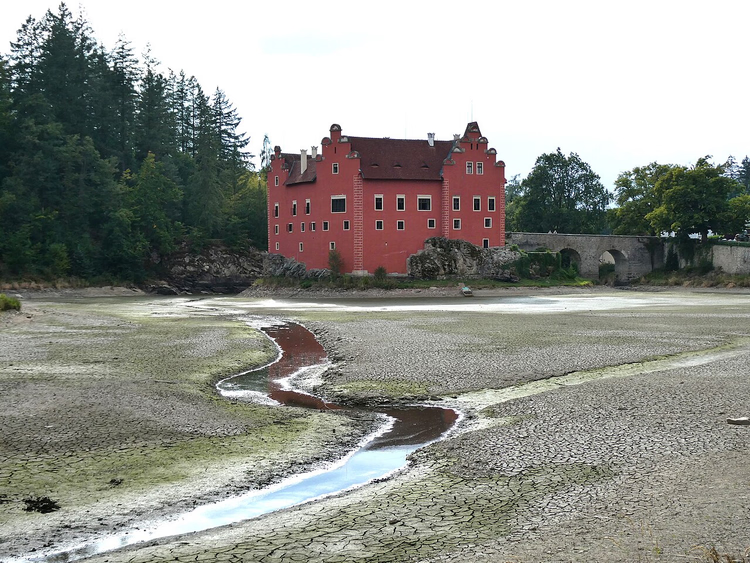 © Palickap · CC BY-SAPhoto: Palickap, CC BY-SA (https://creativecommons.org/licenses/by-sa/4.0), Wikimedia Commons
A path runs along the shore under dense tree canopies. From it, the castle is visible from different angles, and this is where you get the best photos. The same path was used to shoot the main scenes of the Czech fairy-tale films "Goldilocks" and "The Princess and the Pea."
Tickets and opening hours (as of 10/2026)
You cannot walk through the rooms on your own: a guide leads each group along every route. The main route through the ground floor costs 220 CZK for an adult, the attic 160 CZK, the cellars 100 CZK (as of 10/2026, castle price list). Children under 5 enter free. Prices are in Czech koruna, as shown on the castle website.
Route | Adult | 18-24 and 65+ | Children 6-17 | Guide language |
|---|---|---|---|---|
Ground floor | 220 CZK | 180 CZK | 70 CZK | Czech; English for pre-booked groups |
Attic | 160 CZK | 130 CZK | 50 CZK | Czech |
Cellars | 100 CZK | 80 CZK | 30 CZK | Czech |
Table source: pricing page on the castle website, checked on 10/03/2026 on the official site.
- The catch: older guidebooks promise tours in Czech, German, and English, but now an English guide is available only on the main route and only for groups booked in advance.
If you do not speak Czech, book a group tour ahead of time or come with an interpreter. The castle is open from mid-spring to mid-autumn:
Period | Days | Hours |
|---|---|---|
April | Saturday and Sunday | 9:30-12:00 and 13:00-16:00 |
May and September | Tuesday-Sunday | 9:30-12:00 and 13:00-16:00 |
June, July, August | Tuesday-Sunday | 9:30-12:00 and 12:30-17:00 |
September 29 to November 1 | Saturday and Sunday | 9:30-16:00 |
October 28-30 | Wednesday-Friday | 9:30-16:00 |
November 2 to December 31 | closed | closed |
In winter the castle is closed because of the weather and difficult transport connections. The schedule changes from year to year, so check the opening hours on the castle website before you set off. We verified the table on 10/03/2026. In autumn the attic is open on Saturdays and Sundays with a shorter schedule; check the times there as well.
If you are staying in Prague and do not want to plan connections, look at day trips around the Czech Republic on GetYourGuide. The guide on such a tour usually speaks English or German.
Tours and tickets in Prague
Guided tours, skip-the-line tickets and activities — most offers can be cancelled free of charge.
See offers on GetYourGuideThe widget loads once you give your consent.
How to get to the castle from Prague
Trains do not run to the castle. The nearest stations are called Kardašova Řečice, Jindřichův Hradec, and Soběslav; the first lies on the Brno-Plzeň line (according to the "How to get there" page). From Kardašova Řečice a blue hiking trail leads to the castle. On foot it is a long walk, and it is not suitable with luggage.
The bus is more convenient. Regular services run from Soběslav and Jindřichův Hradec with a change in Deštná. In the timetable look for the stop "Červená Lhota/Pluhův Žďár". There is no direct service from Prague: first travel to Soběslav, then change. Watch the stops and get off on time.
By car you do not depend on the timetable. Three paid parking lots operate near the castle, and from there you can walk to the bridge. Keep one thing in mind: the last stretch runs along narrow rural roads with frequent turns, and without a satnav it is easy to take a wrong turn. If you do not want to drive, compare prices for a transfer from Prague via Kiwitaxi.
A bicycle is also a workable option. An international cycle route from Prague to Vienna passes near Červená Lhota. Such a ride requires preparation and plenty of time. In return, you will see the castle surroundings without rushing and ride right up to the lake.
⁉️🤔 Frequently asked questions
When is Červená Lhota Castle open to visitors?
The season runs from April to October. In April and October the castle is open on Saturdays and Sundays, and from May to September from Tuesday to Sunday. From November 2 to the end of the year the castle is closed. For exact hours on your day, see the schedule on the official website: it changes from season to season.
How much does a castle ticket cost?
The main route through the ground floor costs 220 CZK for an adult and 70 CZK for a child aged 6 to 17. The attic costs 160 CZK, the cellars 100 CZK. Children under 5 enter free. Prices are valid as of 10/2026; current figures are in the official price list.
Can you see the castle without a guide?
No, the interiors are accessible only with a tour. A guide leads the group in Czech, and the English version of the main route must be booked in advance for a group. Without a ticket you can walk across the stone bridge, circle the lake on the path, and rent a boat. From outside, the castle is visible from all sides.
How do you get to the castle from Prague without a car?
There is no direct service from Prague. Travel to Soběslav, then change there to a bus toward Deštná and continue to the stop "Červená Lhota/Pluhův Žďár". Trains do not run to the castle, and the nearest station, Kardašova Řečice, is too far for a walk. Check the bus timetable the day before your trip.
Why are the castle walls red?
The historical answer is simple: at the end of the 16th century the new owner ordered the walls covered with red plaster, and the castle received the name Červená Lhota. Legends explain the color differently. According to them, the devil painted a bloody cross on the wall, the mark could not be painted over, and so the owner repainted the entire castle red.
In short: what is worth booking
Červená Lhota takes about half a day including the journey from the nearest towns. The castle itself sells tickets for the routes, so in advance you only need to sort out travel and accommodation. Before you set off, check the opening hours: in April and October the castle is open only on weekends, and in winter it is closed entirely.
- If you are traveling without a car: take the bus via Soběslav or a transfer from Prague.
- If you are cycling: plan your route along the trail from Prague to Vienna.
- If you want to stay overnight: choose Jindřichův Hradec; from there a bus runs to the castle with a change in Deštná.
For an overnight stay near the castle, compare South Bohemia hotels on Trip.com.

A small editorial team writing guides for independent travel. We travel ourselves, but we haven’t been everywhere, so we check prices, opening hours and how to get there against official sources.