















Municipal house in Prague: tour of the halls, tickets and metro route
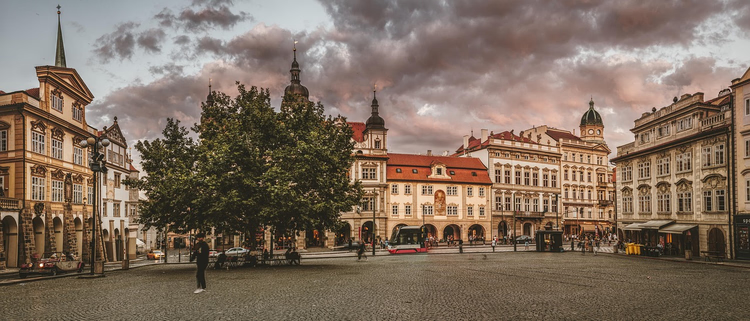
The Municipal House stands on náměstí Republiky in the very center of Prague. You can view the facade with its mosaic for free right from the square. The ceremonial halls are open differently: you can get in with a guided tour or with a concert ticket.
The tour lasts about an hour and costs 320 Czech koruna for an adult (as of 10/2026, Municipal House website). Below you'll find what they show inside, what to look at outside, and how to get there by metro. We've also put together ticket prices and box office hours separately.
Ad: this article contains affiliate links: we earn a commission if you book through them, at no extra cost to you.
What the Municipal House is and why you should go
💡 In short:
- The Municipal House (Obecní dům) is an Art Nouveau concert and exhibition building on náměstí Republiky.
- You can get into the ceremonial halls with a guided tour: about an hour, adult ticket 320 Czech koruna.
- Book your ticket in advance online or at the building's historic box office, open daily from 10:00 to 19:00.
- The nearest metro station is called Náměstí Republiky, line B.
- Prices and hours: 10/2026, verified on the official website
Prague lived at the crossroads of several cultures for centuries. The Czech lands were part of Austria-Hungary, later Czechoslovakia appeared, and each era left its mark on the city. The Municipal House captures this layer of history well. It was built as a place for all citizens, not as a palace for the nobility.
The building's name honestly describes its purpose. Its doors were open to any resident: balls, receptions, exhibitions, and meetings of various societies and clubs were held here. Over time, the building also became one of Prague's main gastronomic destinations.
Today the building works primarily as a cultural venue. Concerts are held here regularly, and tours run every day. An hour and a half is enough for a visit: an hour for the halls and a little more for the facade.
From a royal court to an Art Nouveau building
A royal palace once stood on this site. Czech kings lived in it and ruled the country for several centuries. Later the building's purpose changed several times. First a seminary opened in it, then the archbishop settled here with his court, and later future military officers were trained within these walls.
The old buildings were barely maintained, so the palace gradually deteriorated and eventually fell into ruin. The site didn't stay empty for long. The foundation stone of the new building was laid in 1905; the construction timeline is published on the official website of the building.
Construction on this scale didn't start right away. The city held several competitions, and they produced no result. In the end, the project was entrusted to two architects: Osvald Polívka and Antonín Balšánek. The work took seven years and was completed in 1912, as confirmed by the building's history on the house's website.
Czech artists were invited to work on the project. Among them was Karel Špillar, who was commissioned to create the mosaic panel on the facade. The theme of national revival is visible in almost every detail of the building. Interested in early 20th-century history? Then you'll notice it already from the square.
What happened within these walls after the opening
The most important date in the building's history came in the fall of 1918. On October 28, the independence of the republic was proclaimed here. Two weeks later, the constitution of the new state was presented within these same walls. For Czechia, this place means more than an ordinary concert hall; details are available on the building's website.
Over its more than century-long history, the building has witnessed major events many times. The structure was modified, and new details were added to its appearance. That's why today you see the work of artists and architects from several generations.
The influence of Austria-Hungary is also visible: the Czech lands were part of that empire for a long time, and the building's architecture shows features of Austrian Art Nouveau. But the decorative themes are distinctly Czech.
It's hard to fully unpack this history on your own. Take a guided tour: the guide will show you the halls and explain what event is connected to each of them. We cover the tours below.
The facade: Špillar's mosaic and Šaloun's sculptures
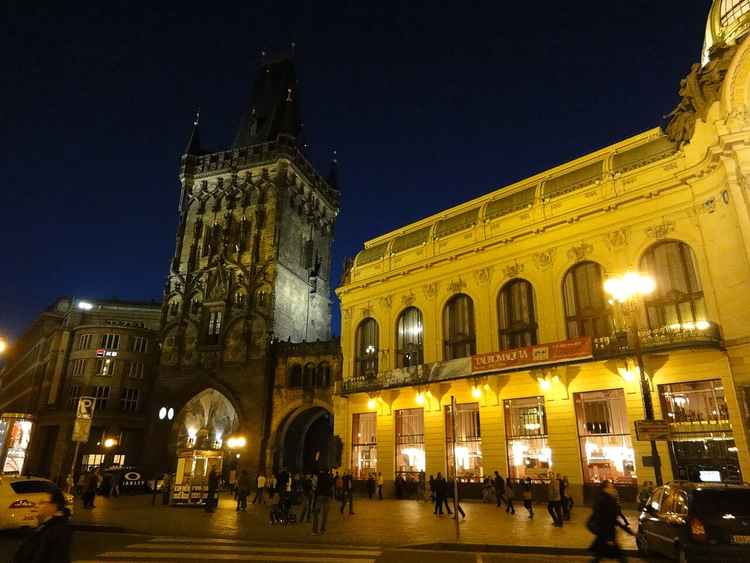
The building combines styles that were widespread in Czechia in the 19th and 20th centuries: Neo-Baroque, Art Nouveau, and Neo-Renaissance. They're usually considered poorly compatible, but here they look cohesive.
 © ktanaka · CC BYPhoto: ktanaka, CC BY (https://creativecommons.org/licenses/by/3.0), Wikimedia Commons
About 30 Czech artists and sculptors worked on the decoration, according to the construction chronicle. The result is noticeable not only to tourists: Prague residents also stop on the square and study the facade.
The first thing you'll see when approaching the building is the facade's sculptural work. Its main theme comes from the history of the Czech people, with Secession-style ornamentation alongside it. Don't rush inside; first walk around the entrance.
The main entrance is framed by Karel Špillar's mosaic. It's dedicated to Prague, and its title translates as "Glory to Prague." Sculptures stand at the base of the building, divided into two groups: "The Humiliation of the Nation" and "The Resurrection of the Nation." Their author is Ladislav Šaloun, who also created the Jan Hus monument on Old Town Square.
Two atlantes stand on the columns of the main entrance. Relief figures in national costumes recall different regions of Czechia: each is dedicated to a separate province. Raise your eyes to the second-floor windows: there you'll see stucco heads with allegorical meaning.
Interiors: the Smetana Hall, cafe, and restaurant
The building's technical equipment was cutting-edge for the early 20th century. Air conditioning and heating systems were installed from the start. Twenty-eight hydraulic and electric elevators operated between floors, a figure cited in the building fact sheet. For a public building of that era, this was a rare level of sophistication.
 © Ben Skála, Benfoto · CC BY-SAPhoto: Ben Skála, Benfoto, CC BY-SA (https://creativecommons.org/licenses/by-sa/4.0), Wikimedia Commons
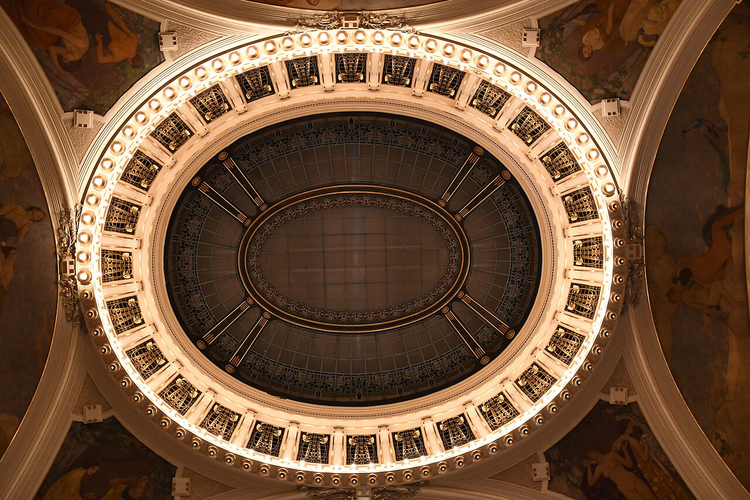
Each hall is decorated in its own way. The ornaments and sculptures here have remained examples of applied art, painting, and architecture for over a century. You don't need to be a specialist to appreciate it: just follow the tour route and study the walls and ceilings.
The cafe in the building is also done in Art Nouveau style, with walls paneled in mahogany. The French restaurant has barely changed since it opened. Its paintings are built on allegories, and in richness of painting it rivals an art gallery.
The Smetana Hall is at the center of the building. It's the building's main concert hall, and listeners come here from many countries. Its walls are decorated with portraits of Czech composers. Allegorical statues of Dance, Music, Poetry, and Drama stand in the balcony niches. Since 1942, the hall has served as the home stage of the Prague Symphony Orchestra, according to the building's history.
Tours, tickets, and box office hours
The house tour lasts about an hour. The guide leads it in English or Czech. For other languages, including German, French, Italian, and Spanish, you will be given a printed text (as of 10/2026, tours section on the house website).
Ticket | Price | Who it suits |
|---|---|---|
Adult | 320 Czech korunas | visitors over 26 |
Reduced | 270 Czech korunas | children under 15, students under 26, visitors over 60 |
Family | 660 Czech korunas | 1-2 adults and 1-3 children under 18 |
Child | free | children under 10 |
Private group tour | from 2,800 Czech korunas | groups, by prior reservation only |
Prices in the table were checked on 10/03/2026 on the Obecní dům website. Tickets are sold at the house's historic ticket office, which is open daily from 10:00 to 19:00. You can also buy a ticket online on the same website.
The route starts in the Smetana Hall. Then you pass through the confectionery and several salons, and finish in the ceremonial halls: the Grégr Hall, the Palacký Hall, and the Mayor's Hall. The full list of halls is provided in the route description.
- Important: the schedule changes by day. In October 2026, tours start after noon, for example at 12:00, 13:00, 14:30, and 16:00, according to the schedule on the website. Check the time the day before.
- The catch: the guide does not lead the tour in Russian, and on concert and event days some halls may be closed.
If you want to combine the house with a walk through the Old Town, check out Prague sightseeing tours on GetYourGuide. Below we have put together several options with prices.
Tours and tickets in Prague
Guided tours, skip-the-line tickets and activities — most offers can be cancelled free of charge.
See offers on GetYourGuideThe widget loads once you give your consent.
How to get to the Municipal House
The building stands in the city center at náměstí Republiky 5, Praha 1. The easiest way to get there is by metro. Náměstí Republiky station is on line B, and the exit leads directly onto the square (as of 10/2026, house contacts).
Transport | Stop | Lines |
|---|---|---|
Metro B | Náměstí Republiky | exit to the square |
Metro A | Můstek | about a 4-minute walk |
Tram | Náměstí Republiky | 6, 8, 15, 26 |
Tram | Jindřišská | 3, 6, 9, 14, 24 |
We checked the lines and stops against the house website on 03.10.2026. Tram numbers sometimes change due to track repairs. Before your trip, check the route in the transit operator's app.
From the airport, you can get there by public transport with a transfer to the metro. It is the cheapest option, but it is inconvenient with luggage. We do not recommend street taxis in Prague: drivers often overcharge foreigners. If you are traveling with suitcases or late in the evening, a fixed-price transfer on Kiwitaxi will be more convenient.
The house's location on a map of Prague is shown below. Open the map on your phone in advance: the square is large, and the entrance to the building is on the mosaic side.
⁉️🤔 Frequently asked questions
Can you visit the Municipal House without a tour?
You can see the facade, Karel Špillar's mosaic, and Ladislav Šaloun's sculptures from the square for free at any time. The cafe and restaurant operate as regular establishments. The ceremonial halls, including Smetana Hall and the Mayor's Hall, are open only to tour participants or concert attendees. So you need a ticket to see the interiors.
How much does a Municipal House tour cost?
An adult ticket costs 320 Czech koruna, a reduced ticket 270 Czech koruna, and a family ticket 660 Czech koruna. Children under 10 enter free. The reduced rate applies to children under 15, students under 26, and visitors over 60. Prices were checked on 03.10.2026 on the house's official website; please confirm them again before your visit.
How much time do you need for a visit?
The tour itself lasts about an hour. Add another 20-30 minutes for the facade: the mosaic above the entrance, the two sculptural groups at the base of the building, and the atlantes on the columns. If you want to stop by the Art Nouveau cafe, allow about two hours for the visit. A concert in Smetana Hall requires a separate evening.
What language are the tours in?
The guide leads the tour in English or Czech. Printed texts are available for visitors who speak other languages, including German, French, Italian, and Spanish. The language schedule changes by day, so choose a specific time slot on the official website or at the house's historic ticket office.
How do you get to the Municipal House by metro?
Take line B to Náměstí Republiky station: the exit leads to the square, and you will see the building right away. If line A is more convenient for you, get off at Můstek station and walk for about 4 minutes. Trams 6, 8, 15, and 26 also stop at Náměstí Republiky, right next to the entrance.
In short: who should book a tour in advance
The Municipal House is one of the key buildings of Prague Art Nouveau and the place where the republic's independence was proclaimed in 1918. You can see it from the outside for free. Inside, you will need a tour or concert ticket; prices are on the tickets page.
- If you have one hour: see the facade and stop by the Art Nouveau cafe.
- If you have two hours: take the tour of the halls and arrive at the ticket office 15 minutes before it starts.
- If you love music: choose a concert in Smetana Hall instead of a tour.
- If you are traveling with children: a family ticket is a better deal than two adult tickets.
The house is right in the center, so staying nearby saves you travel time. Compare hotels in central Prague on Trip.com and book the tour for a day that works for you.

A small editorial team writing guides for independent travel. We travel ourselves, but we haven’t been everywhere, so we check prices, opening hours and how to get there against official sources.