
















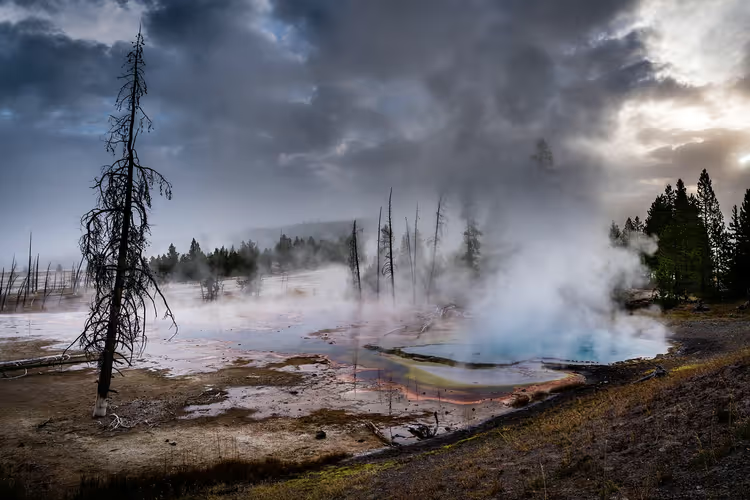
Fly Geyser in Nevada: a rainbow geyser from an accidental well
Water in the Fly Geyser reaches the surface at 93 °C, and the rainbow-colored mound around the jets grew out of an ordinary borehole (as of 09/2026, Wikipedia). In 1964, prospectors were looking for geothermal energy here and did not find water hot enough. The well was plugged, but the seal failed. That is how a geyser appeared on a ranch in Nevada, and its photographs made their way into every state guidebook. There is no free public access to the site, so below we break down how Fly works, where its colors come from, and how to book a walk to see it.
💡 In short:
- The geyser is man-made: the first well was drilled here in 1916, the second in 1964.
- The rainbow-colored mound was built by minerals from the hot water, and the jets themselves erupt without stopping.
- There is no free access to the ranch: visitors are only allowed in as part of a guided tour.
History of the geyser
The first well on this site appeared in 1916. The ranch owners were looking for irrigation water and hit a geothermal layer. The water in the well turned out to be nearly boiling, unsuitable for farming, and the well was abandoned. Over the years, a cone of calcium carbonate 3.0-3.7 m high grew around the mouth (as of 09/2026, Wikipedia article on the geyser). This formation later became known as The Thumb.
In 1964, a second well was drilled nearby. A geothermal company hoped to get hot water for a power plant, but the water turned out not to be hot enough. The well was plugged. The seal failed, and the water found its way to the surface. Pressure in the first well dropped after that, and the old geyser dried up.
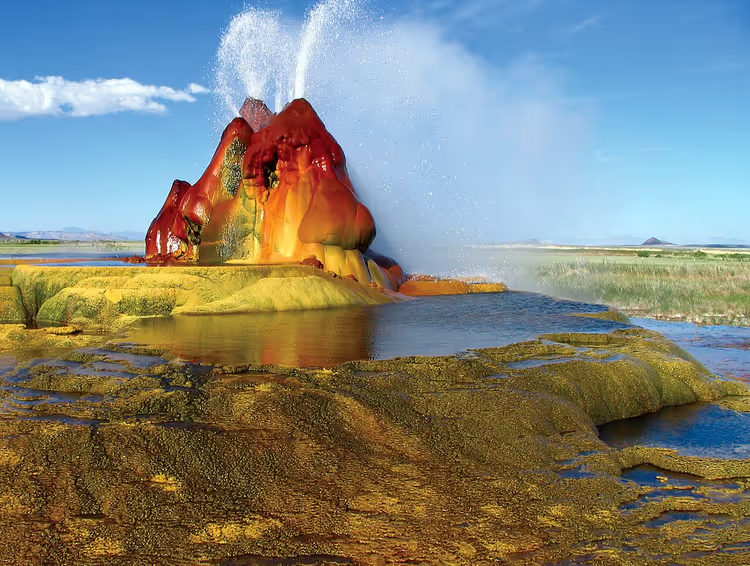
Fly Geyser is the result of that very mistake from 1964. Hot water rises through the wellbore constantly, with no pauses or seasonal interruptions. Each jet carries dissolved minerals and deposits them on the rock. Layer by layer, they built three cones on a shared travertine base. The cones themselves are about 1.8 m high, while the entire mound beneath them has grown to 7.6-9.1 m (as of 09/2026, Wikipedia data).
For a long time, access to the site was impossible. The ranch remained private property, the area was fenced off, and visitors were only allowed with the owners' permission. The geyser became famous after photographs circulated in newspapers and guidebooks. Tourists started showing up at the fence, and some climbed over it to get closer.
Chemical and biological processes
The geyser's water is rich in dissolved minerals. Calcium carbonate settles on the surface in a thick layer and gives the deposits the strength of stone. Silica precipitates along with it, so the cone walls grow thicker year after year (as of 09/2026, Wikipedia on water composition). You will find the jets in place at any time of day: they rise to about 1.5 m and never stop, day or night.
The colors come from living organisms. Thermophilic bacteria, archaea, and algae live in the hot water. Colonies of these microbes tint the deposits in green, rusty, and coral-red shades (as of 09/2026, Wikipedia on microbes). The water itself remains clear, and the rock is light-colored: the microbes give it its tone.
The silica content in Fly's water is unusually high. Geologist Carolina Muñoz Saez studied the geyser on behalf of the owners and noted that quartz inside it grows at a record pace. Normally, such a layer of quartz and opal takes up to 10,000 years to grow (as of 09/2026, Wikipedia on quartz). Because of this, Fly is unlike any geyser she had seen before.
The landscape around the geyser
The geyser has built an entire system of terraces around itself. Calcium carbonate deposits form rims and pools that hold hot water. Today there are 30 to 40 such travertine pools, covering 74 acres, or about 30 hectares (as of 09/2026, Wikipedia on travertine pools).
Around the terraces lies a lake of cooled water. It grows along with the discharge: the longer the geyser works, the more land goes underwater. In the morning, the low sun lights the steam from the side, and it appears pink. During the day, you see the contrast between the blue water, green algae, and rusty rock.
From a distance, the whole structure looks like a pedestal. Three cones stand on a shared rock base that rises above the flat desert. The height of this platform together with the cones reaches 7.6-9.1 m (as of 09/2026, Wikipedia on cone height). In the evening, as it gets dark, the jets and steam stand out most strongly against the sky.
A rare species lives next to the geyser. The spring snail Pyrgulopsis bruesi is found only in one of the ranch's ponds: you won't find it anywhere else (as of 09/2026, Fly Ranch on the rare snail). In total, 144 plant species, 15 mammal species, 138 bird species, and 12 reptile species have been documented on the property (as of 09/2026, Fly Ranch on fauna and flora).
How to visit the geyser: tours and rules
Fly Geyser sits on private land, so there is no free access to the ranch. In May 2018, the owner, the nonprofit Burning Man Project, opened limited access to the geyser for the first time (as of 09/2026, Wikipedia on access since 2018). You can only see the cones with a guide.
Tours run every Saturday from April through October. The tour takes about three hours, and the geyser is part of the route. The walks are led by Friends of Black Rock-High Rock, and the fee for a spot is considered a donation to the ranch and the organization itself (as of 09/2026, Wikipedia on ranch tours).
Spots are limited and get booked up in advance. Since 2021, the ranch has welcomed between 50 and 400 people per week, and it is open for 32 weeks a year (as of 09/2026, Fly Ranch on visitation). Sign up for a specific Saturday ahead of time, or the spot will go to someone else. Read the ranch's visitor guide in advance: the desert is hot, and there is almost no shade.
You cannot leave the trail on the property. The ground around the geyser is muddy, loose, and waterlogged, so you won't get across it in sneakers. The rare snail lives in exactly one of the ponds here. Do not go past the fence even for a photo: this is private land, and you won't have access without a guide.
How to get there and where it is
The geyser is located on Fly Ranch in Washoe County, Nevada. It sits 40 km north of the town of Gerlach and just 0.5 km from State Route 34, west of the Black Rock Desert (as of 09/2026, Wikipedia on the location).
The ranch covers about 15 km² at an elevation of 1,223 m above sea level (as of 09/2026, Wikipedia on the ranch's elevation). Navigator coordinates: 40.85944° N, 119.33194° W. Enter them into your phone ahead of time, because cell service drops out in the desert. The road goes through the desert, so plan for extra fuel and water. The nearest gas stations and stores are in Gerlach, 40 km from the ranch.
Fly Geyser
Places on the map
- Fly Geyser Rainbow-colored man-made geyser on Fly Ranch, access only with a guide on Saturdays
⁉️🤔 Frequently asked questions
How do you get to Fly Geyser?
The geyser sits on private land at Fly Ranch, so there is no free public access. The only way to see it up close is on a guided walk. Spots are booked in advance on the official website, and the fee is considered a donation (as of 09/2026, Fly Ranch on booking).
Does the geyser work in winter?
The water flows nonstop, so the cones do not freeze in winter or summer. What changes is access: walks run only from April through October, and the rest of the year the site is closed (as of 09/2026, Fly Ranch on the walk season). The water temperature stays around 93 °C year-round (as of 09/2026, Wikipedia on temperature).
Is Fly Geyser natural or man-made?
Man-made. The first well was drilled here in 1916 for irrigation, and the second in 1964 for a geothermal plant. The second well was poorly sealed, water burst to the surface, and it dried up the first geyser. All the rainbow-colored cones you see in photos were built by minerals from that well (as of 09/2026, Wikipedia on the history of the wells).
Why is the geyser multicolored?
The color comes from thermophilic bacteria, archaea, and algae that live in the hot water (as of 09/2026, Wikipedia on bacteria). They colonize the wet formations and tint them green and red. The rock itself is light-colored, and the tone comes from the microbes together with deposited minerals: calcium carbonate and silica.
Where exactly is Fly Geyser?
Fly Ranch lies in Washoe County, Nevada, north of Gerlach (as of 09/2026, Wikipedia on coordinates). The geyser stands at the edge of Fly Reservoir, west of the Black Rock Desert.
In short: what to book
Fly Geyser does not sell tickets in the usual sense. Access to the ranch is closed, and the only legal way to see the cones up close is a guided walk (as of 09/2026, official ranch website).
If you have one free day in Nevada: take the Saturday walk and arrive by its start time.
If you are traveling with children: choose the morning, the desert gets very hot in the afternoon.
If you only need photos: shoot from permitted spots and do not go past the fence.
There are not many spots on the walk. Book Saturday on the official website in advance and read the ranch's visitor guide before your trip.

A small editorial team writing guides for independent travel. We travel ourselves, but we haven’t been everywhere, so we check prices, opening hours and how to get there against official sources.