
















Yellowstone: what to see and how to get to the geyser park
A column of boiling water taller than a ten-story building. A minute later it collapses, and the smell of sulfur lingers over the valley. This is what Yellowstone looks like on almost any day of the season.
Yellowstone was established in 1872, and it is the first national park in the world. It covers nearly 9,000 km² where Wyoming, Montana, and Idaho meet (as of 09/2026, NPS).
If you are planning a trip, start with the park's main geyser. Old Faithful erupts roughly every hour and a half to two hours (as of 09/2026, NPS eruption forecast).
Ad: this article contains affiliate links, we earn a commission if you book through them, at no extra cost to you.
The world's oldest national park
💡 In short:
- Go from late May through September, when most roads are open.
- Do not approach wild animals and do not step off the wooden boardwalks near geysers.
- Prices and hours: 09/2026, verified on the official NPS website.
The park got its name from the Yellowstone River. It carved a canyon through yellow rocks, hence the English "yellow stone." The park sits on a volcanic plateau, which is why there is so much steam and hot water here.
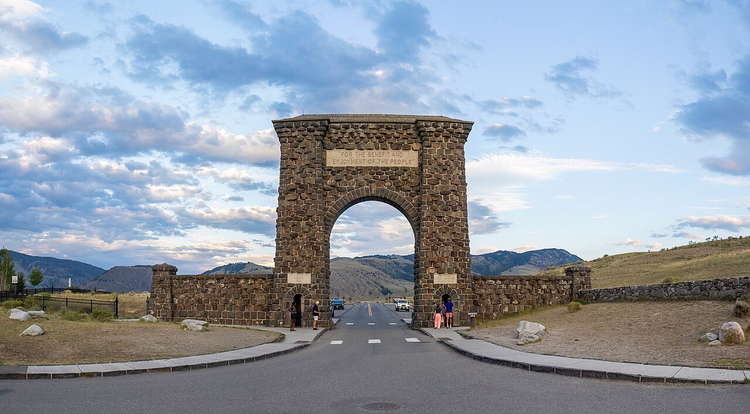
See the main sights by cluster. Mammoth Hot Springs stand in the north, the caldera lies in the center, and geyser basins and the lake spread across the south. You will drive dozens of kilometers between clusters.
 © Rhododendrites · CC BY-SAPhoto: Rhododendrites, CC BY-SA (https://creativecommons.org/licenses/by-sa/4.0), Wikimedia Commons
In one day you can cover one cluster and no more. For the whole park, allow at least a week.
History of Yellowstone
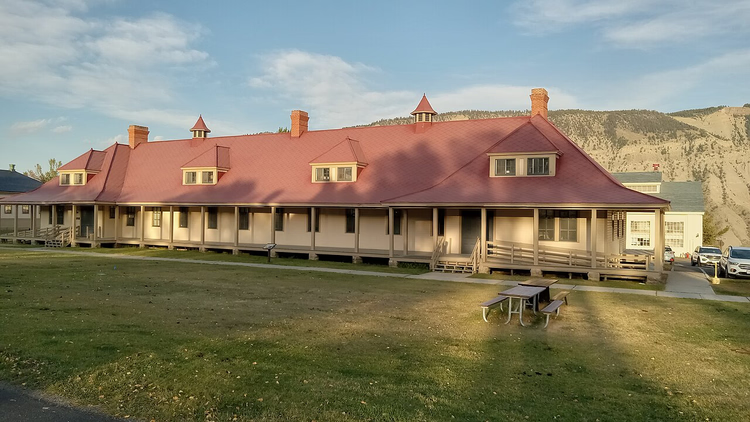
In the early 19th century, hunter John Colter described boiling springs in the upper reaches of the river. Nobody believed him, and the area was dubbed "Colter's Hell." That was how the first Yellowstone story began.
 © Garth Newton · CC BY-SAPhoto: Garth Newton, CC BY-SA (https://creativecommons.org/licenses/by-sa/4.0), Wikimedia Commons
Later, mountain man Jim Bridger traveled through the area. He repeated Colter's accounts, but he was not believed either. Talk of the hot land kept growing, yet there was no proof.
The turning point came in the 1870s. Geologist Ferdinand Hayden organized an expedition and backed up his report with photographs and sketches. The convincing images worked: in 1872, the US Congress created the world's first national park (as of 09/2026, official park website).
In its early years, the park had no money and no protection. A flood of tourists arrived after the Northern Pacific Railroad was completed. Only then did the authorities allocate funds to protect the area.
The Yellowstone supervolcano
A giant caldera lies beneath the park. That is the name for a depression left after a massive eruption. The last such eruption happened about 640,000 years ago, creating a depression 45 by 85 km in size (as of 09/2026, USGS).
 © Dietmar Rabich · CC BY-SAPhoto: Dietmar Rabich, CC BY-SA (https://creativecommons.org/licenses/by-sa/4.0), Wikimedia Commons
Magma still pulses beneath the crust, and scientists monitor it around the clock. There is no reason to panic: a major eruption is unlikely in the foreseeable future (as of 09/2026, US Geological Survey).
The caldera is what feeds all of the park's geysers and hot springs. The closer you get to the center of the depression, the more steam you see rising from the ground.
Many people know Yellowstone from the disaster movie "2012." In reality, the supervolcano brings the park not destruction, but heat for thousands of thermal features.
Yellowstone lake and waterfall
The park's largest body of water sits at an elevation of 2,357 m. This is Yellowstone Lake, covering 342 km² (as of 09/2026, NPS). North America has no other high-altitude lake like it.
In summer the water stays icy cold, even when it is hot on shore. Few people swim here, and you will need a warm jacket even in July. Anglers head out on the lake early in the morning, when there is almost no wind.
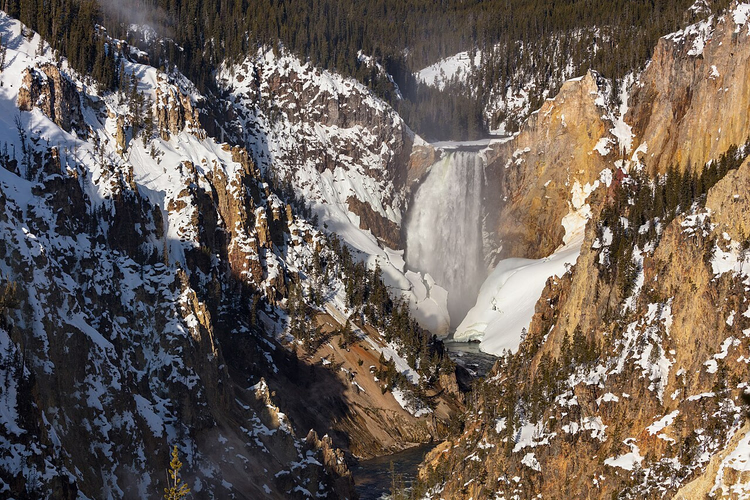
In the canyon of the Yellowstone River, Lower Falls roars. It is nearly twice as high as Niagara Falls, and the best place to photograph it is from Artist Point overlook.
Hot springs and geysers
The park has more than 10,000 thermal features (as of 09/2026, USGS). About half of all geysers on the planet are located right here (as of 09/2026, NPS).
 © Dietmar Rabich · CC BY-SAPhoto: Dietmar Rabich, CC BY-SA (https://creativecommons.org/licenses/by-sa/4.0), Wikimedia Commons
Every notable geyser has been given a name. The most famous one, Old Faithful, shoots water 30-55 m into the air roughly every 102 minutes (as of 09/2026, NPS on Old Faithful). The interval varies from 54 to 118 minutes, so check the forecast in the NPS app.
Before an eruption, a crowd gathers around Old Faithful. Arrive early and stand upwind, otherwise you will get covered in hot mist.
The second record holder, Steamboat Geyser, is considered the tallest active geyser in the world. It erupts irregularly, but its water column rises tens of meters.
The colorful morning glory pool
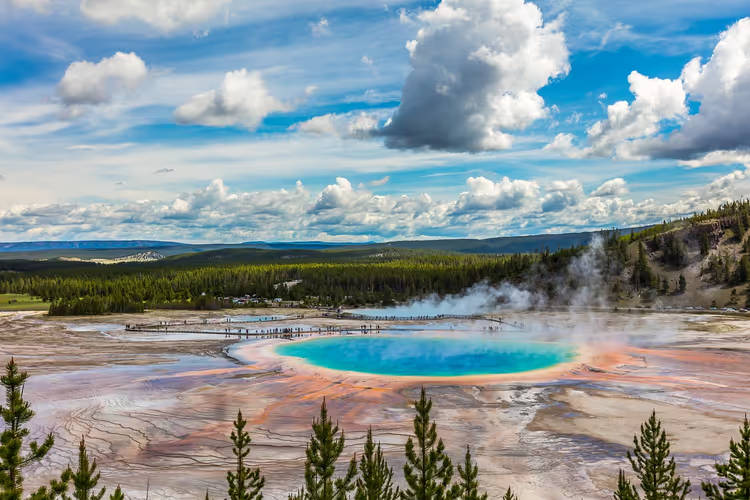
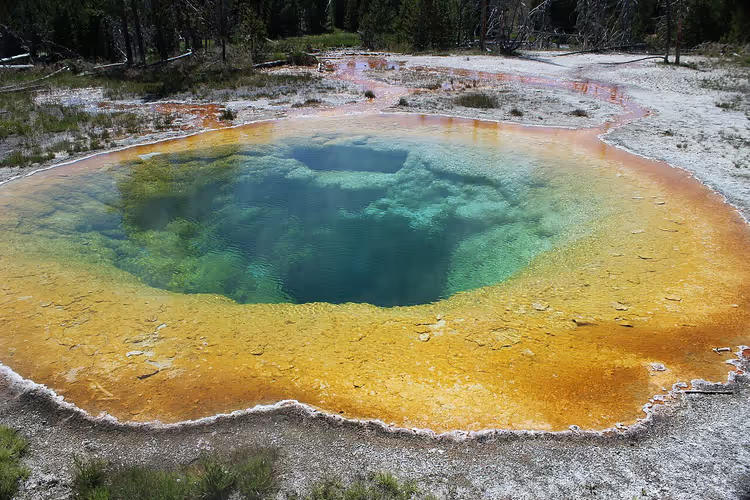
This spring has an unusual palette: a turquoise center and an orange-yellow rim. The color comes from bacteria that live in the hot water. The hotter the water, the purer the turquoise in the center.
 © Miguel Hermoso Cuesta · CC BY-SAPhoto: Miguel Hermoso Cuesta, CC BY-SA (https://creativecommons.org/licenses/by-sa/4.0), Wikimedia Commons
Morning Glory Pool got its name from its resemblance to the morning glory flower. Over time, the name became official.
The pool's colors have faded over the decades. Tourists threw coins and trash into the water, the water cooled, and the bacteria changed. Now you cannot get close to the water: the spring can only be viewed from the boardwalk.
Coins are sometimes cleaned out of the spring, but the cooling process can no longer be stopped. The turquoise center has noticeably dulled, and restoring its former appearance is unlikely.
Tickets and hours
Park entry is paid. A passenger car pays one fee, which is valid for 7 days. For the exact amount and the list of free days, see the official NPS fees page (as of 09/2026).
No separate vehicle entry reservation is needed. You just need to buy a pass on site or online in advance (as of 09/2026, NPS). Hotels and campgrounds inside the park, however, should be booked six months ahead.
The park is open 24 hours a day. In winter, some roads are closed to cars and converted for snowmobiles, so check the map of open roads on the NPS website before your trip.
Guided tours and one-day park trips are booked in advance; in summer, spots sell out quickly. You can browse options on GetYourGuide.
Tours and tickets in Yellowstone
Guided tours, skip-the-line tickets and activities — most offers can be cancelled free of charge.
See offers on GetYourGuideThe widget loads once you give your consent.
When to go and how to get there
The best months for a trip are late May through September. All major roads are open then, and the trails around the geysers are dry. July and August are the busiest, so book lodging near the entrances in advance.
The nearest major airports, Bozeman (BZN) in Montana and Jackson Hole (JAC) in Wyoming, receive connecting flights. From Bozeman to the park's north entrance is about 140 km (on the map), roughly a two-hour drive.
You need your own car here. Without one, you are tied to infrequent shuttles and group tours. Book a car in advance: in high season, prices climb and availability shrinks.
Wildlife and other routes
Yellowstone is home to bison, moose, elk, and bald eagles. The animals are used to cars and stay near the roads. You will see bison right from your window, so do not approach the animals.
In the Mud Volcano area, the ground churns and bubbles. It smells stronger than at any geyser, but here you can see how the underground boiler works.
If you have an extra day, save it for the Grand Canyon of the Yellowstone. The overlooks above the canyon are connected by short trails, and the distances between them are small.
We have also written separately about US national parks: Everglades and Glacier.
⁉️🤔 Frequently asked questions
How much does it cost to enter Yellowstone?
Entry is paid: one fee per passenger car is valid for 7 days. Check the exact amount and free days on the official NPS fees page. The America the Beautiful annual pass covers both Yellowstone and other national parks.
Do I need to reserve entry in advance?
No separate reservation for a car is required to enter. You can buy the pass on site or online.
How often does Old Faithful erupt?
The average interval is about 102 minutes, but it varies from 54 to 118 minutes (as of 09/2026, NPS). The eruption lasts 1.5-5 minutes and shoots water 30-55 m high. Check the forecast in the NPS app.
When is the best time to visit?
The optimal months are from late May through September, when the roads are open. In the off-season, some roads close, but there are fewer tourists and lodging is cheaper.
Is it dangerous to walk near the geysers?
Stay only on the wooden boardwalks and do not step off them. The water temperature in the springs is close to boiling, and the thin crust around them often collapses. Keep your distance from wild animals and do not feed them.
In short: what to book
If you have two days, take a one-day tour of the geyser basins and stay overnight near the west entrance.
If you have a week and your own car, add the canyon, the lake, and the mud volcano valley.
Compare hotel prices near the park entrances on Trip.com.
Check transfers and car rentals on Discover Cars, and guided tours on GetYourGuide.
Yellowstone National Park on the map
Below is an interactive map of the park. Use it to estimate distances between clusters: from the geyser basins to the canyon is over 30 km.

A small editorial team writing guides for independent travel. We travel ourselves, but we haven’t been everywhere, so we check prices, opening hours and how to get there against official sources.