
















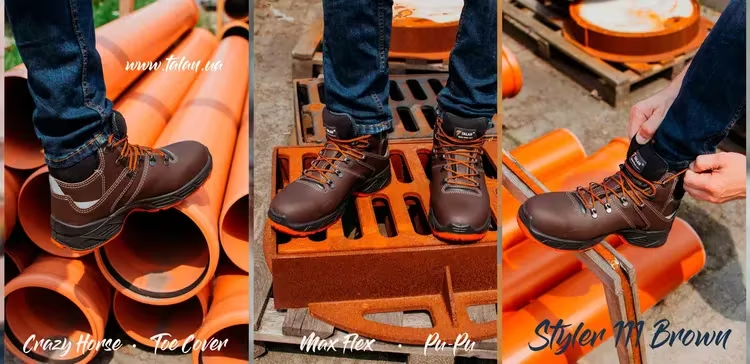
How to choose safety footwear: classes S1, S2 and S3
Safety footwear protects your feet and reduces fatigue over a shift. Getting the protection class wrong is costly. Regular sneakers will not survive either a heavy object falling on them or a nail puncture.
The protection class is selected based on the risks of a specific workplace. The protective toe cap is tested with an impact energy of 200 J and a pressure of 15 kN (according to DGUV, 10/2026). Water resistance of the upper, puncture protection, and sole profile are added in steps: S1, S2, S3.
Below you will find a breakdown of the classes, employer obligations, and sizing. Each point is based on European Union and German regulations, not on advertising claims.
What counts as safety footwear
💡 In short:
- Safety footwear is marked with the letter S (toe cap rated at 200 J), protective footwear with the letter P (toe cap rated at 100 J).
- Classes S2 and S3 add a water-repellent upper, puncture protection, and a sole profile.
- Employer obligation to provide protective equipment: 10/2026, according to BAuA.
Safety footwear is part of personal protective equipment. Under the German classification, it is divided into safety footwear, protective footwear, and occupational footwear (according to DGUV rules). Safety footwear carries the S marking, protective footwear the P marking. Occupational footwear has no toe cap.
Safety footwear may only be sold with the CE marking. It confirms that the product has been tested according to EN ISO 20345. Without CE, footwear cannot be considered protective, even if the seller calls it work footwear. If you have doubts, ask the seller for the certificate in advance.
Protection classes: from SB to S5
The protection class shows which risks the footwear handles in the workplace. The simplest class is designated SB, and it provides only a protective toe cap. Each subsequent class adds its own properties to the basic set according to a standard list.
Class | What it adds | Where it fits |
|---|---|---|
SB | basic protective toe cap | dry workshops without water and punctures |
S1 | closed heel, antistatic, shock absorption, oil resistance | dry indoor areas, warehouses |
S2 | S1 properties plus water-repellent upper | work with moisture, wet floors |
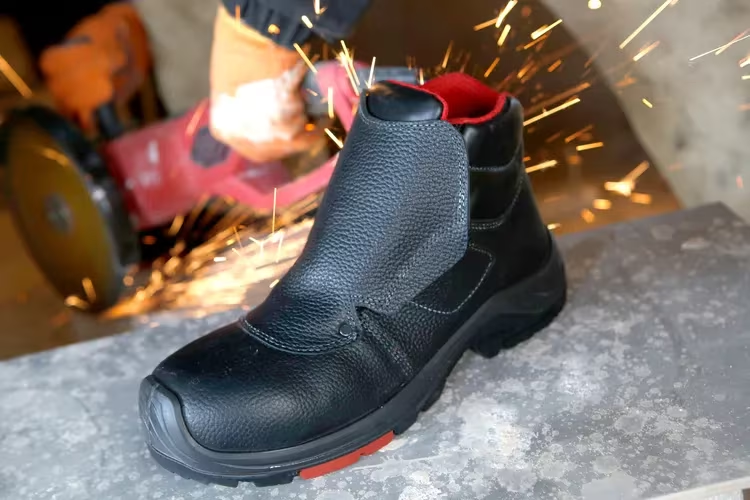
S3 | S2 properties plus puncture protection and sole profile | construction, installation, outdoor work |
S4 | molded polymer footwear, antistatic | food production, wet workshops |
S5 | S4 properties plus puncture protection and sole profile | meat processing, heavy wet areas |
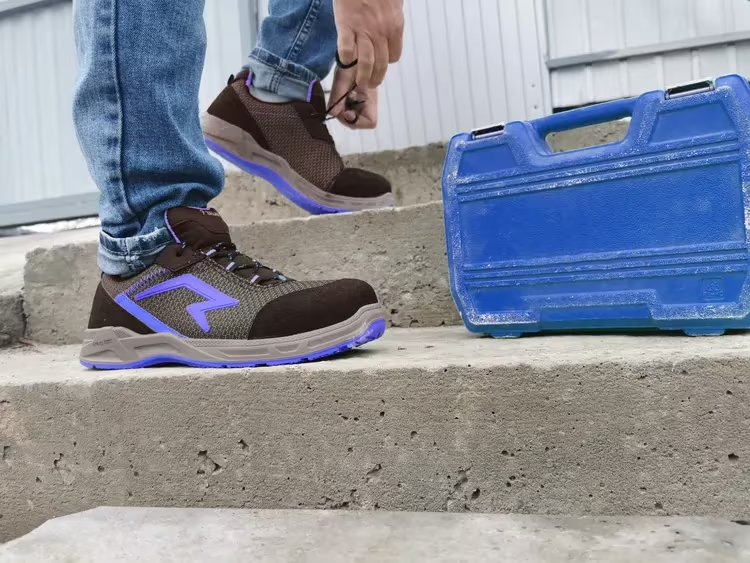
The letter P in the name, for example S1P, means puncture protection. A water-repellent upper is added by class S2. A sole profile with high lugs comes with S3. Understanding these steps matters more than chasing a brand: one model is often produced in three versions.
Where to look for the range
Models are easy to compare in a catalog with a protection class filter. One such catalog has been put together by the store talan-s.com. There, footwear is grouped by purpose and protection level, so selection takes less time.
Before ordering, check three things with the seller: protection class, CE marking, and return policy. Sizes differ across systems, so rely on the seller's size chart rather than blindly choosing your usual number.
If you are buying footwear at the employer's expense, agree on the model first. Many companies purchase a batch centrally and ask you to specify your size in advance. That way you get the right pair without unnecessary exchanges.
Who pays for safety footwear
If risks cannot be eliminated by engineering measures, the company must pay for the footwear. The employer provides protective equipment free of charge (according to BAuA, 10/2026). The costs cannot be passed on to the employee.
The rules are set out in the PSA-Benutzungsverordnung. This document transposes the general EU directive on protective equipment into German law. The employer not only buys the footwear but also monitors its condition.
You are issued footwear for the task, not one pair for everyone. An installer and a warehouse worker need different protection classes. If your pair is uncomfortable and pinches, it is replaced, not worn out to the end.
How to choose size and width
Size is determined by foot length, not by your usual number. Measure your foot in the evening, when it is slightly larger. Leave a small gap in front of your toes so they do not press against the front when walking.
Safety footwear fits more snugly than regular footwear, but it should not pinch. Check the width and instep: if the arch of your foot is under pressure, a larger size will not help. Try on footwear with the same socks you work in. A thick sock requires a slightly larger pair.
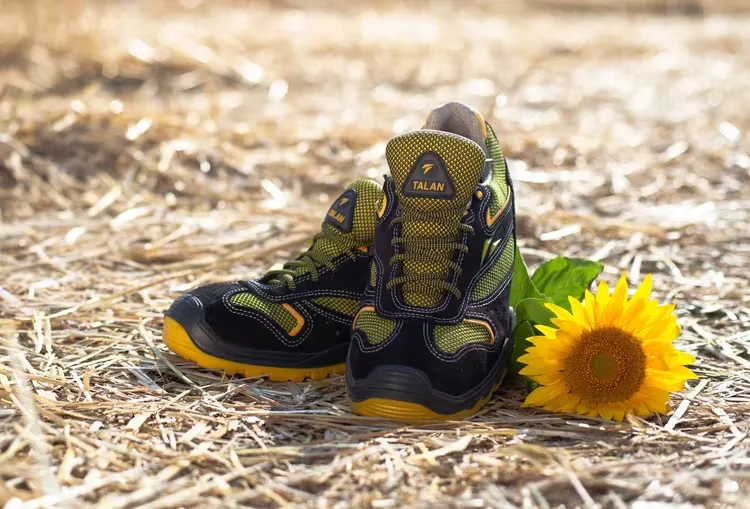
For flat feet, there are two options: footwear with adjustable width or models designed for custom insoles. Standard orthotic insoles often do not fit into safety footwear. Discuss this with your doctor and the seller in advance.
Care and service life
The protective properties last as long as the toe cap and sole are intact. Dry wet footwear at room temperature, away from radiators. Strong heat causes leather to crack and adhesive to lose strength.
Clean the upper with a soft brush and treat it according to the material: leather with wax, textiles with a water-repellent spray. Remove the insoles and dry them separately. This way the pair lasts longer and does not smell.
Footwear is replaced when the toe cap is dented, the sole is worn smooth, or the upper is torn. A damaged pair cannot be stretched to the end of the season, because it no longer protects. The employer replaces such footwear with a new pair at no extra cost to you.
Common selection mistakes
- Buying your usual size. Size systems differ, so measure your foot.
- Wearing one pair for all shifts. Wet footwear does not have time to dry, so you need two pairs.
- Trusting "safety" labels without marking. Only footwear with CE and a specified class counts as protective.
- Wearing footwear until it falls apart. A worn sole loses grip, and a dented toe cap does not absorb impact.
These mistakes cost more than just money. A slippery sole and a dented toe cap lead to injuries that could have been avoided.
⁉️🤔 Frequently asked questions
How does S3 differ from S1P?
Class S1P includes antistatic properties, a closed heel, and puncture protection. S3 adds a water-repellent upper and a sole profile on top of that. For construction and outdoor work, choose S3; for a dry warehouse, S1P is sufficient.
Is the employer required to buy the footwear?
Yes, if risks cannot be eliminated by engineering and organizational measures. Protective equipment is provided free of charge, and this rule is established in German law. The employee does not pay for such footwear out of their wages.
How do you know when to replace the footwear?
Look at the condition: a dented toe cap, a smooth worn sole, a split upper. Such a pair no longer protects. The employer replaces damaged footwear, so you should report the problem early.
Can you insert orthotic insoles?
Standard insoles often do not fit under the toe cap. Many manufacturers make removable insoles and models with adjustable width. It is best to resolve this with a doctor before buying a pair.
What should you do if the footwear pinches at the instep?
A larger size will not solve the problem. Try a different width or a model with soft lacing. If it still presses after that, the pair is replaced before work begins.
In short: what to check before buying
First identify the risks: water, puncture, heavy objects. Then choose the class that covers them: S1P for dry workshops, S3 for outdoor work, S5 for wet production environments.
Check the CE marking and the EN ISO 20345 standard. If the company issues the footwear, agree on the model with your employer in advance. And try on the pair with your work socks. Footwear is chosen for the shift, not for the price on display.

A small editorial team writing guides for independent travel. We travel ourselves, but we haven’t been everywhere, so we check prices, opening hours and how to get there against official sources.