
















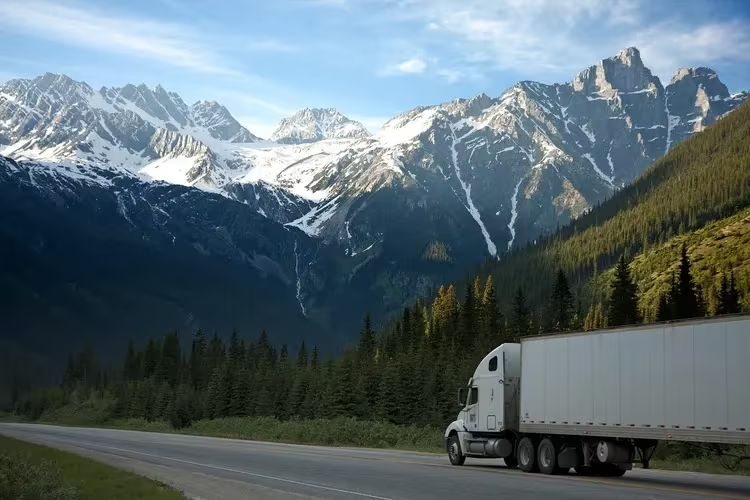
How to organize freight transportation between Ukraine and Germany
Sending a pallet from Dortmund to Lviv is not difficult. The challenges begin at the border and in customs. Ukraine and Germany do not share a border, so cargo always travels in transit through neighboring EU countries. On entry, it is processed by customs.
We broke down the practical side: what types of shipping exist, what German customs requires, and what delivery times depend on. We also focused separately on documents and typical contract mistakes.
One change is worth knowing in advance. Starting October 29, 2025, an updated EU-Ukraine free trade agreement is in effect (GTAI, 2025). For an importer, this means clear rules for access to the European Union market.
How logistics between Ukraine and Germany works
💡 In short:
- Ukraine is not in the EU, so cargo goes through customs clearance at the external border.
- The main shipping method: road transport. Small shipments are cheaper to send as consolidated cargo.
- No permits are needed for road freight trips: the EU-Ukraine agreement eliminated them.
- Import declaration in Germany: 10/2026, according to IHK Köln.
Below we explain in more detail. Germany does not border Ukraine directly, so the truck travels through Poland, Slovakia, Hungary, or Romania. Transit segments add a day or two to the timeline, and there can be queues at the border.
The choice of shipping method depends on your cargo. Road transport covers most needs: from a single pallet to a full truckload. Sea and rail are used for large shipments. Air freight is chosen for urgent and high-value goods.
Types of shipping: what to choose
Shipping type | When it fits | What to consider |
|---|---|---|
Full truckload road transport | cargo fills an entire trailer | pricing is per truck, not per weight |
Consolidated cargo | from one pallet to several | takes longer due to reloading at an intermediate warehouse |
Sea freight in a container | heavy and bulky shipments | requires port handling, longer timeline |
Air freight | urgent and high-value goods | high price per kilogram |
Rail | regular large-volume shipments | depends on schedules and stations |
Choose based on weight, volume, and urgency. If the cargo is compact and not time-sensitive, consolidated shipping will save your budget. If timing matters more, consider air freight: it pays off for high-value goods. For furniture, equipment, and household appliances, a container or full truckload makes more sense.
Hazardous goods are a separate matter. They require a carrier with an ADR dangerous goods permit and proper labeling. Otherwise the shipment will not be processed, and you will lose time on repacking.
Road freight to Germany: how it works
Road transport remains the main channel. No permits are needed for trips: the EU-Ukraine freight transport agreement of June 2022 removed them for bilateral trips and transit. The European Commission extended this agreement several times (European Commission, 2025).
The carrier Ally Logistic operates on this route. Its page freight shipping between Ukraine and Germany describes the full shipping cycle. According to the company's website (checked 10/2026), it has more than 8,000 partner trucks, over 15 years of experience, and 900 types of cargo, including hazardous and oversized. The company identifies its specialties as road, sea, air, and rail shipping, warehousing services, and customs clearance.
What happens in practice. The truck picks up the cargo at the sender's warehouse and heads to the border. There the cargo is presented to customs, and after clearance it continues to Germany. Clarify in advance with the carrier who files the declaration: this determines your responsibility at the border.
Documents and customs clearance
The declaration in Germany is filed electronically through the ATLAS system, and each shipment requires a declaration and a commercial invoice from the sender (according to IHK Köln).
Check your EORI number separately. As an importer, you definitely need it: without it, the cargo will not be released for free circulation. Prepare the document package in advance, including the packing list, description, and commodity code. For transit through EU countries, a T1 procedure is set up: the cargo travels under customs control to the point of clearance.
Regarding duties. Preferential import treatment for Ukrainian goods remains in place, but origin must be confirmed with documents. The specific tariff depends on the commodity code.
What affects delivery times
The carrier's quote consists of several parts. These are the route, mode of transport, weight and volume of your cargo, number of pallets, urgency, and season. In winter and during peak months, fewer trucks are available, so the price is higher.
Route: part of the journey goes in transit through third countries.
Loading: full truckload, consolidated cargo, or container.
Nature of cargo: standard, temperature-controlled, hazardous, or oversized.
Additional services: insurance, warehousing, customs clearance, border downtime.
Timelines depend not only on kilometers. The main risks: border queues and processing time. Build in a buffer. If you need same-day delivery, choose air freight, not road transport.
What to look for in the contract
Review the contract before paying, not after. Four points cover most disputes you may encounter.
Delivery terms (Incoterms): they determine who is responsible for the cargo at each stage and who files the declaration.
Cargo insurance: clarify the liability limit and what exactly is covered.
Liability for delays: timelines in days and the procedure for downtime.
Hazardous goods: confirmation of ADR permit and labeling requirements.
One more point. Ask for a written quote before starting. It should separately list freight, fuel surcharge, and clearance. Then the final invoice will not surprise you.
⁉️🤔 Frequently asked questions
How long does cargo take from Ukraine to Germany?
By road, usually several days including border clearance. The exact time depends on queues, weather, and route congestion. Air delivery takes less time, while sea freight takes weeks. Ask the carrier for a delivery time for your specific route, not the market average.
Are permits needed for road freight between the EU and Ukraine?
No. The EU-Ukraine agreement removed permits for bilateral trips and transit, so no separate trip permit is required. This simplifies planning and reduces downtime. Customs clearance of cargo at the border has not been canceled, however: documents are still checked.
Who handles customs, the sender or the recipient?
It depends on the delivery terms in the contract. If clearance is on the recipient's side, they file the declaration. If it is on the sender's side, the sender handles it. Check this point before shipping so you do not pay for border downtime or argue with the counterparty.
Can I send a single pallet?
Yes. For small shipments, consolidated cargo is used: your pallet is combined with other cargo in one truck. You pay only for your space, but timelines are slightly longer due to reloading at an intermediate warehouse. There is usually no minimum shipment weight.
What should I do if cargo is held at the border?
Stay in touch with the carrier and find out the reason for the delay. Most often it is a queue or an incomplete document package. Agree in advance in the contract who pays for downtime and how the delivery timeline is recalculated. That way you will have written confirmation of the agreements.
In short: how to choose a carrier
Choose a carrier for your cargo, not the other way around.
One pallet: use consolidated cargo.
Full load: request a quote for a full truckload.
Urgent and high-value cargo: consider air freight.
Hazardous or temperature-controlled cargo: check permits and equipment.
Before paying, verify the quote and contract terms. Then downtime and extra charges at the border will not come as a surprise.

A small editorial team writing guides for independent travel. We travel ourselves, but we haven’t been everywhere, so we check prices, opening hours and how to get there against official sources.