
















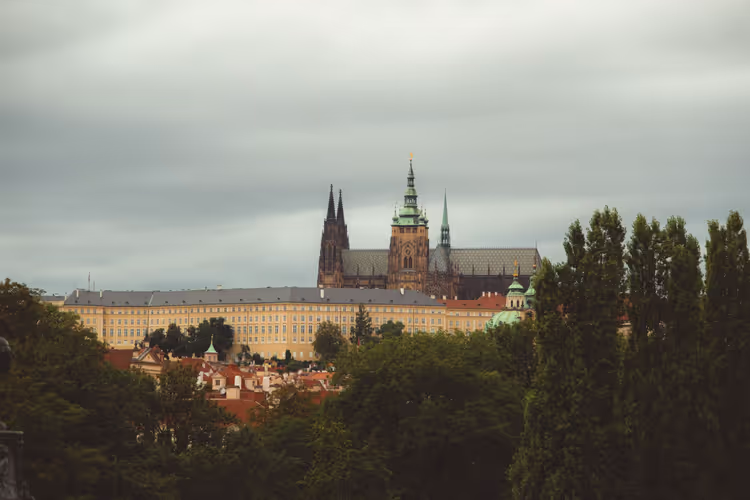
Hradcany Square: three palaces and a gate at the entrance to Prague Castle
Hradčany Square (Hradčanské náměstí) serves as the ceremonial entrance to Prague Castle. Through the Giants' Gate you enter the first courtyard, where almost any route through Hradčany begins. The entrance itself is free; you only pay for tickets inside the castle complex. We've put together the four main landmarks of the square, opening hours, directions, and a map.
Ad: this article contains affiliate links, we earn a commission if you book through them, at no extra cost to you.
What to see on Hradčany Square
The square is densely lined with palaces, and you'll recognize each one by its facade. The western side is closed off by the Tuscan Palace, with the Archbishop's and Martinic Palaces standing nearby. There's no single ticket here, because this is a working administrative district, not an open-air museum.
💡 In short:
- Entry to the square and through the Matthias Gate is free; you only pay for tickets inside Prague Castle.
- Walk around the three palaces from the outside; only individual halls are open to the public, and only on special occasions.
- Opening hours and the changing of the guard: 09/2026, verified on the official Prague Castle website.
Landmark | What to see | Entry |
|---|---|---|
Matthias Gate | Baroque arch, changing of the guard | free |
Tuscan Palace | balustrade with allegories of the arts | closed |
Archbishop's Palace | Rococo facade, Chapel of John the Baptist | closed |
Martinic Palace | facade paintings, museum of mechanical musical instruments | ticketed |
Matthias gate of Prague castle
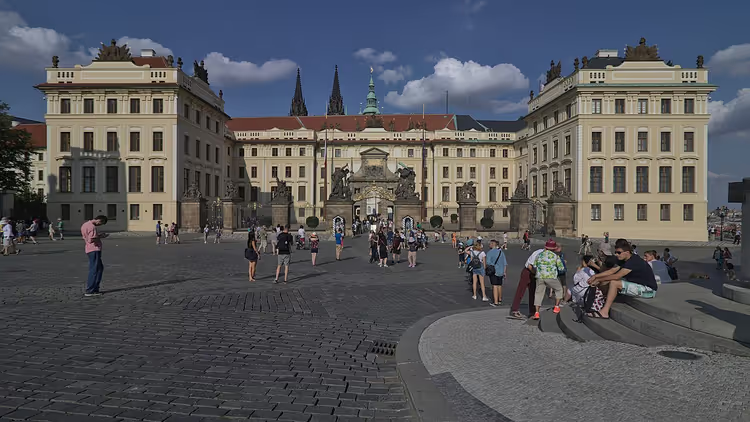
The Matthias Gate (Matyášova brána) leads from the first courtyard of Prague Castle into the second. The arch was built in 1614 and is considered the first Baroque structure in Prague (official Prague Castle website). The gate is named after Emperor Matthias, not after its creator, as older guidebooks sometimes claim.
 © Paul Korecky · CC BY-SAPhoto: Paul Korecky, CC BY-SA (https://creativecommons.org/licenses/by-sa/2.0), Wikimedia Commons
The arch's shield is decorated with the coats of arms of Matthias and the lands under his rule, and two staircases lead from the gate to the western wing of the palace. On both sides stand the striped guard booths. The guard changes here every hour, and at noon a ceremonial changing takes place with fanfares and the flag. A crowd gathers at the gate well in advance for this, so arrive 15 minutes early and stand to the left of the arch. Passage through the gate is free and requires no ticket.
Tuscan Palace on the western side
 © VitVit · CC BY-SAPhoto: VitVit, CC BY-SA (https://creativecommons.org/licenses/by-sa/4.0), Wikimedia Commons
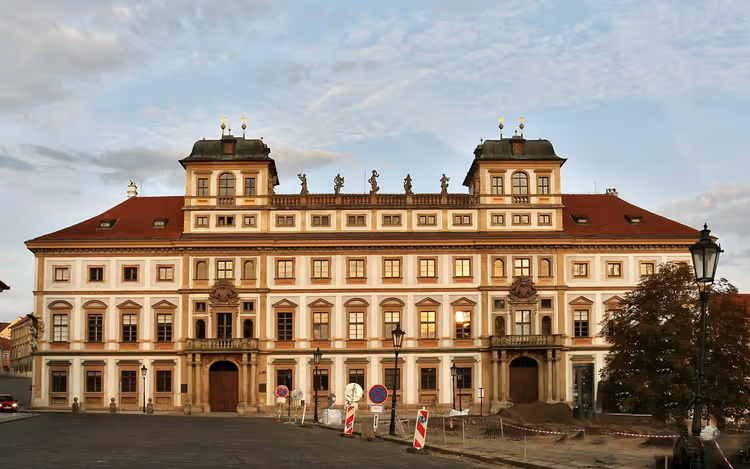
The Tuscan Palace (Toskánský palác) occupies the western side of the square. Construction began in the late 17th century to a design by the French architect Jean Baptiste Mathey, and it was completed by the Grand Duchess of Tuscany, Anna Maria Franziska, whose name the building still bears (Wikipedia). The palace belongs to the Czech state and currently houses the Ministry of Foreign Affairs.
The building is easy to recognize by its red roof and the colored window surrounds of its numerous windows. On the roof balustrade you'll see seven allegories of the liberal arts by the sculptor Jan Brokoff, and on the corner facing Loretánská Street stands the Archangel Michael with a flaming sword by Ottavio Mosto (data from the Czech Ministry of Foreign Affairs). Tourists are not allowed inside; only two halls in the western wing are occasionally opened to the public.
Archbishop's Palace on the square
 © Gampe · CC BY-SAPhoto: Gampe, CC BY-SA (https://creativecommons.org/licenses/by-sa/4.0), Wikimedia Commons
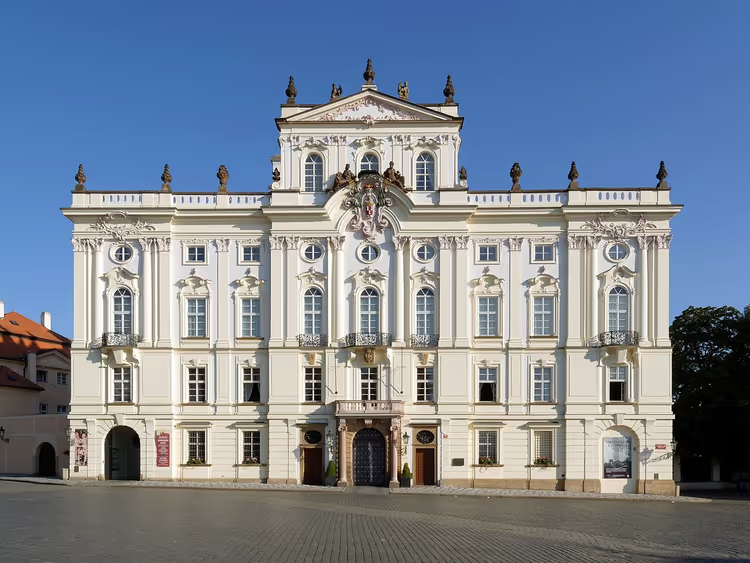
The Archbishop's Palace (Arcibiskupský palác) stands right at the main entrance to Prague Castle. It has served as the residence of Prague's archbishops since the 1660s and grew up on the site of eight old houses (Prague tourist office). The building got its current appearance in the second half of the 18th century, when it was rebuilt in late Baroque style: side wings, a third floor, and a rocaille facade were added.
The heart of the palace is the 16th-century Chapel of John the Baptist with wall paintings and stucco decoration. The state rooms house a collection of Parisian tapestries, and the entrance is crowned with the coat of arms of Prague's archbishops (as of: Prague City Tourism). You won't get inside: it is a working residence, open only for official receptions. It's worth viewing from the outside, together with the neighboring Tuscan Palace.
Martinic Palace and its murals
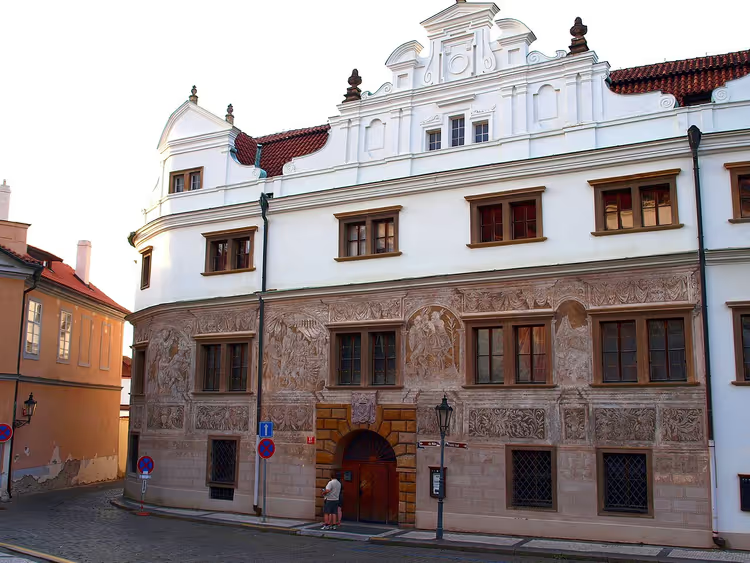 © VitVit · CC BY-SAPhoto: VitVit, CC BY-SA (https://creativecommons.org/licenses/by-sa/3.0), Wikimedia Commons
Martinic Palace (Martinický palác) is a Renaissance landmark on the north side of the square. It was built in the 16th century on the site of houses that burned down in the great fire of Hradčany, as historical documents attest (official palace website). Construction was started by the nobleman Teyfl and continued by the imperial governor Jiří Martinic. His nephews expanded the eastern part and added the north wing, and above the entrance you'll find the Martinic family coat of arms, a water lily leaf with a star.
The central facade is covered with murals depicting biblical and classical subjects: scenes from the life of Joseph, Samson, and Hercules. In the early 19th century, another floor and a classical-style pediment were added to the palace (official website). After a long period of neglect, the building was brought back to life by a restoration that took 14 years and was completed by the late 1960s, and the most recent renovation finished in 2011.
Today the palace's former stables house a private museum of historical mechanical music machines. It displays mechanical gramophones and phonographs from 1870-1940 made in Czech workshops (kultura.cz). Check tickets and opening hours on site, as the schedule changes by season. If mechanical music doesn't interest you, walk around the palace for the facade alone, it stands out against the neighboring buildings.
When to come and how to get there
The first courtyard of Prague Castle is open daily, from early morning to late evening. Exact hours change by season, so check the official website on the day of your visit. The best time for the square is morning before 10 a.m.: the tour groups haven't arrived yet, and the light on the facades is soft.
The easiest way to get there is by tram to the Pražský hrad stop or by metro to Malostranská station, then up Nerudova Street. On foot from Charles Bridge, it's about a 20-minute uphill walk, so wear comfortable shoes (route on the map).
Tours and tickets in Prague
Guided tours, skip-the-line tickets and activities — most offers can be cancelled free of charge.
See offers on GetYourGuideThe widget loads once you give your consent.
Hradčany Square on the map
Below is a map of Hradčany Square with the palaces and gates marked. Save it so you don't lose your bearings between Prague Castle and Loretánská Street.
Sights of Hradčany Square
Places on the map
- Matthias Gate Baroque arch from 1614, entrance to the first courtyard, guard change at noon
- Tuscan Palace Western side of the square, seven allegories of the arts on the balustrade
- Archbishop's Palace Residence of the archbishops, rocaille facade and Chapel of St. John the Baptist
- Martinic Palace Renaissance building with painted facade, a museum of musical automatons in the stables
⁉️🤔 Frequently asked questions
Where is Hradčany Square?
The square lies in the Hradčany district, right in front of the main entrance to Prague Castle. Address: Hradčanské náměstí, Praha 1.
Do I need a ticket to see the palaces?
No, the square and Matthias Gate are open to everyone. The Tuscan and Archbishop's Palaces are occupied by government offices, so you can't go inside. Tickets are only needed inside Prague Castle, where the cathedral and permanent exhibitions are located.
How much time should I allow for the square?
Half an hour is enough to see the three palaces and the gate from the outside. If you add Prague Castle with the cathedral and Golden Lane, allow half a day so you don't rush through the route and miss the details of the facades.
In short: what's worth booking
If you came for the architecture, start with Matthias Gate at noon, then walk around the palaces in a circle. If you have one day in Prague, get a ticket inside Prague Castle and save the square for dessert. For families with children, morning is more convenient, while the square is still uncrowded. Ready-made guided tours of Prague can be found at Prague tours on GetYourGuide.

A small editorial team writing guides for independent travel. We travel ourselves, but we haven’t been everywhere, so we check prices, opening hours and how to get there against official sources.