






Izmailovo and Kolomenskoye: why we removed these guides
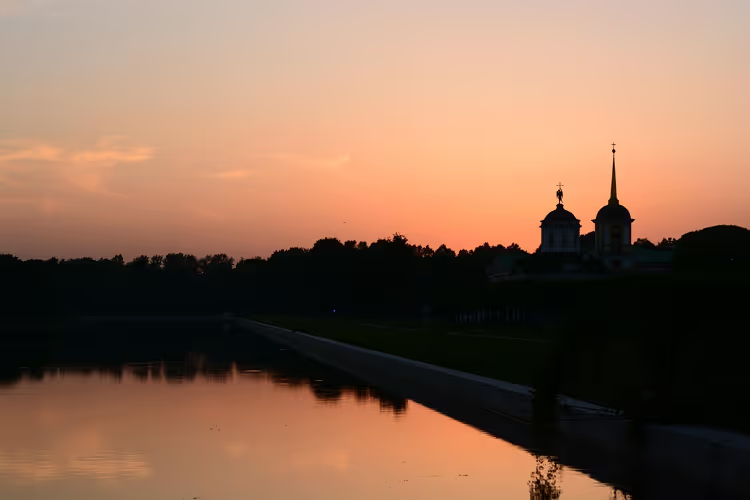
Here lay three guides: to the island in Izmailovo in eastern Moscow, to the Izmailovo Kremlin, and to the palace in Kolomenskoye. All three have been removed in every language version of the site.
They were united by one promise, carried in their subtitles and opening paragraphs: here you can see the real old Russia. In place of that promise stands a reproduction made for visitors, and our texts said almost nothing about this. We took them down not because we dislike reconstructions, but because substituting history with a stage set has stopped being a harmless storyline.
💡 At a glance:
- which three guides were removed and what they promised the reader
- why we give neither construction dates nor assessments of these sites
- what is happening in Russia to organizations that worked on historical memory
- which Central European cities remain in our live sections
- Last updated: 09/2026
Why we deleted these guides
All three pieces worked as ordinary tourist references: how to get there, what to see, how much admission costs. Our readers came to them through searches for a terem, a wooden palace, and a souvenir fair, and got exactly what they were looking for.
Russia's full-scale invasion of Ukraine began on February 24, 2022, and after that date we continued to publish an invitation to spend a weekend in a stage set of old Russia. All three texts have been removed, and the old URLs now redirect here.
It is worth explaining why we did not leave these pieces in the archive with a note at the top. An archived page stays in the index and keeps answering the same search query, which means it works exactly as it did before, only with a disclaimer in fine print. A reader who arrived through a search for a wooden palace would have gotten a reference about a wooden palace. So instead of an archive, there is a redirect to an explanation, and the same rule applies to every text in this section without exception.
Let us also say up front what this text deliberately does not contain. We give neither the year these sites were built, nor assessments of their architectural quality, nor arguments about how accurately they reproduce the lost originals. We have no verified primary source for such claims, and without a source we do not publish figures or assessments: this rule applies to every text in the section, and here it is especially fitting, because the subject is precisely the accuracy of historical claims.
The financial framing is the same as in the rest of the section, and it is more modest than people tend to assume. The share of oil and gas revenue in the Russian budget has fallen to roughly 22 percent, while the share of non-oil-and-gas revenue, which includes taxes from the service sector, has risen to roughly 78 percent (OSW Centre for Eastern Studies, 09.12.2025). That means a visitor's spending ends up in the part of the budget that now weighs more heavily for the state than it did before the war.
The memory our texts did not write about
The main story here is not architectural. While the tourist complex was selling visitors an image of the old country, the organizations that worked on its real history were being liquidated.
Memorial was founded in 1987, and among its initiators was Andrei Sakharov, winner of the 1975 Nobel Peace Prize. In 2016 the authorities designated the organization a foreign agent, in 2021 the Supreme Court of Russia ordered its liquidation, and in 2022, after the start of the full-scale invasion, the authorities declared it illegal and occupied the premises of the forcibly dissolved organization (Nobel Committee, background on the 2022 peace prize laureate). Memorial itself received the prize in 2022, together with the Ukrainian Center for Civil Liberties and the Belarusian human rights defender Ales Bialiatski (Nobel Committee). In 2026 a Russian court designated Memorial as extremist, effectively criminalizing its work; the Nobel Committee condemned the ruling (Al Jazeera, 08.04.2026).
This is not an isolated case but an operating system. The law on undesirable organizations has been in force since 2015 and allows foreign organizations and their materials to be banned (EUAA). As of April 2026, more than 340 organizations have been designated undesirable, and the foreign agents register lists more than 1,173 entities and individuals (Human Rights Watch, World Report 2026). At least 37 guilty verdicts have been handed down under Article 284.1 of the Russian Criminal Code (EUAA).
In April 2026, UN experts stated that the strategy of openly abusing anti-terrorism and anti-extremism legislation to destroy Russian civil society must stop (UN OHCHR, 09.04.2026).
There is a direct connection between these two sets of facts, and we state it as an assessment, not as a proven claim. A state that encourages a convenient stage set of the past while simultaneously destroying the organizations that worked on its inconvenient parts is managing history selectively. A tourist text is silent about this by the very nature of the genre, and that is why we no longer publish such texts.
What this means for you
Item | Status 09/2026 | Source |
|---|---|---|
Services related to tourism in Russia | Prohibited by Article 5n(2) of Regulation 833/2014 as amended by Regulation 2025/2033 | |
Transition period | Ended 01/01/2026 | |
German Foreign Office advisory | "Vor Reisen in die Russische Föderation wird gewarnt" | |
Registries of "undesirable" organizations and "foreign agents" | More than 340 organizations and more than 1,173 entities and individuals as of 04/2026 | |
Position of UN experts | The abuse of anti-extremism legislation to destroy civil society must stop |
Council Regulation (EU) 2025/2033 of 23 October 2025 replaced paragraph 2 of Article 5n of Regulation 833/2014 with a direct prohibition on providing services directly related to tourism activities in Russia, including advertising such services (EUR-Lex; Skadden, 11.2025). For us, this means the question of "publish or not" is not even legally open.
Where to go instead
The query was about wooden architecture, a craft fair, and an old town you can walk around all day. The live sections of the site answer that: Poland with Krakow, Czechia, Hungary, and Germany. For a reader specifically looking for wooden architecture and open-air ethnographic museums, the closest matches are the Polish and Czech skansens, and for souvenir stalls and craft markets, the old towns of Krakow and Prague.
The general explanation of the editorial decision for the whole section is collected in the section hub. Adjacent text: our position on the Kremlin and the ensemble inside the walls.
Where we stand
We believe that tourist reconstruction is not in itself a moral question: rebuilt quarters and palaces exist all over Europe, and we write about them. In our assessment, the difference is what the state is doing nearby. When organizations that worked with documentary memory have been liquidated and labeled extremist, an invitation to look at a convenient version of the past stops being a neutral invitation.
We write about the state and its policies, not about people based on their passport. There are people in Russia who came out against the war and received prison sentences for it. Our decision not to publish guides to Russia is about money, sanctions, and reader safety, not about nationality.
Published: September 3, 2026. Last updated: September 3, 2026.
⁉️🤔 Frequently asked questions
Why don't you write when these structures were built?
Because we don't have a verified primary source for those dates. The rule for this section is simple: every figure must be backed by a document or a source in the same paragraph, and without a source we don't publish figures. In a text that is precisely about the accuracy of historical claims, breaking this rule would be strange.
Is reconstruction a bad thing?
We don't claim that, and we explicitly state the opposite. The issue isn't the type of construction, but what's happening around it: organizations that worked on documentary history have been shut down, and one of them has been designated extremist. Our previous texts were silent about this.
What does Memorial have to do with a souvenir complex?
Both stories are about the same thing: who controls the past and how. We don't equate them with each other, and we present the facts about the shutdown and the extremist designation strictly according to sources, while the connection between them is stated as our assessment.
Did you also delete the text about the island with the pond?
Yes, all three pieces. They were structured the same way, as visitor guides, and the decision applies specifically to that function.
Will you bring these guides back?
We don't make promises with dates. The decision will be revisited when the grounds for it, listed in the sources block, change.
In short
Three guides to Izmailovo and Kolomenskoye have been removed in full. The main takeaway is different: visitors are being sold a convenient version of the past, while organizations that worked with real history have been shut down and banned. Central European cities with old quarters and open-air museums that we continue to write about are listed above.
How you can help
We don't collect money and we don't receive anything from the links below. These are official websites of organizations working with the consequences of the war:
- UNHCR, the UN Refugee Agency, unhcr.org
- UNICEF, unicef.org
- Ukrainian Red Cross, redcross.org.ua
Sources
- Nobel Committee, background on the 2022 Nobel Peace Prize laureate. https://www.nobelprize.org/prizes/peace/2022/memorial/facts/
- Al Jazeera, on Memorial being designated extremist and the Nobel Committee's reaction, 04/08/2026. https://www.aljazeera.com/news/2026/4/8/nobel-prize-committee-condemns-russian-move-to-criminalise-rights-group
- EUAA, on legislation on "undesirable organizations" and "foreign agents". https://www.euaa.europa.eu/russian-federation-country-focus/22-legislation-undesirable-organisations-and-foreign-agents
- EUAA, on cases and sentences under Article 284.1 of the Russian Criminal Code. https://www.euaa.europa.eu/russian-federation-country-focus/22-legislation-undesirable-organisations-and-foreign-agents#221_undesirable_organisations
- Human Rights Watch, World Report 2026, "Russia" chapter. https://www.hrw.org/world-report/2026/country-chapters/russia
- UN OHCHR, expert statement, 04/09/2026. https://www.globalsecurity.org/wmd/library/news/russia/2026/04/russia-260409-ohchr01.htm
- Council Regulation (EU) 2025/2033 of 10/23/2025 amending Regulation 833/2014, EUR-Lex. https://eur-lex.europa.eu/legal-content/EN/TXT/?uri=OJ:L_202502033
- Skadden, analysis of the EU's 19th sanctions package, 11/2025. https://www.skadden.com/insights/publications/2025/11/eu-adopts-19th-sanctions-package
- Auswärtiges Amt, Russische Föderation: Reise- und Sicherheitshinweise, as of 09/02/2026. https://www.auswaertiges-amt.de/de/service/laender/russischefoederation-node/russischefoederationsicherheit-201536?isLocal=false&isPreview=false
- Centre for Eastern Studies OSW, Russia's 2026 budget, 12/09/2025. https://www.osw.waw.pl/en/publikacje/osw-commentary/2025-12-09/russias-2026-budget-mounting-financial-challenges-and-economic
Link check date: 09/03/2026.

A small editorial team writing guides for independent travel. We travel ourselves, but we haven’t been everywhere, so we check prices, opening hours and how to get there against official sources.