













 AIIllustrative image: AI-generated
Japan for the first time: visa, transport and budget without mistakes
Japan is intimidating in the scale of its preparation. Tickets, rail passes, visas, and unfamiliar rules: it feels like planning the trip takes months. In reality, it is one of the most convenient countries for independent travel.
The tourism.com.de editorial team has put together a practical guide for your first trip. A direct flight from Vienna or Frankfurt takes about eleven hours, and after that you arrive in a country where everything runs on schedule. Below we break down what to do before departure, how much you will spend on transport and accommodation, what you eat, how you communicate with locals, and what to avoid.
Ad: this article contains affiliate links, we earn a commission if you book through them, at no extra cost to you.
What awaits you in Japan
💡 In short:
- A two-week Japan Rail Pass costs 80,000 yen (as of 09/2026, official Japan Rail Pass website).
- Prices: 09/2026, verified on the official Japan Rail Pass website.
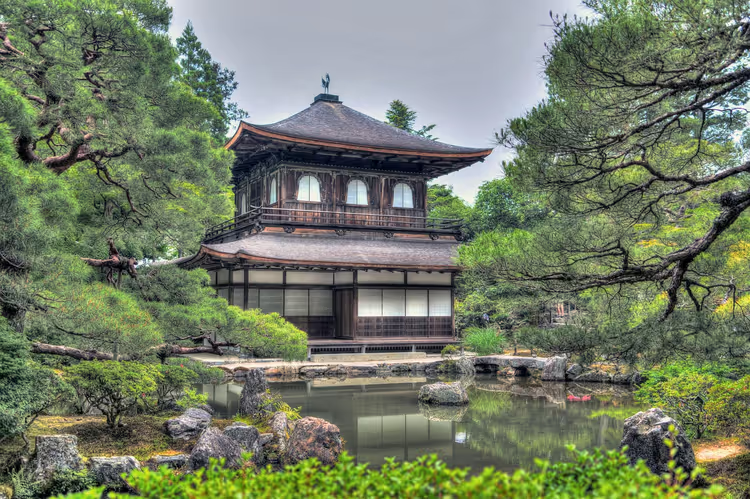
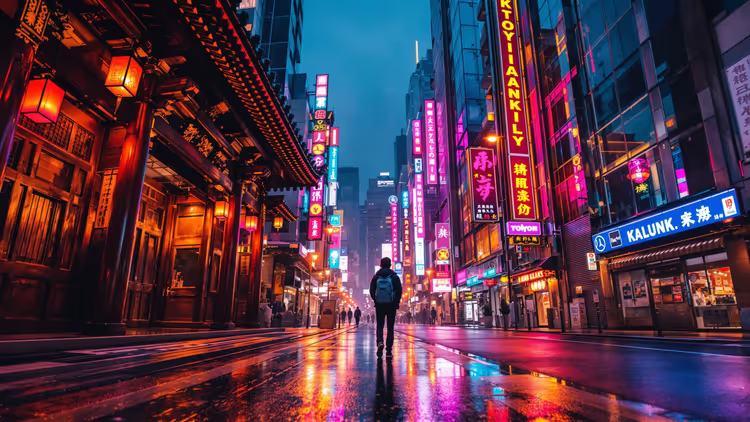
Hills, volcanoes, and tropical islands in the south of the country. Cities of temples and neon skyscrapers. Japan combines the incompatible, and that is exactly why you will not get bored. In one trip you can see beaches, mountains, and hundreds of shrines.
There are three things that make this country special. Culture: manga, anime, cosplay, tea ceremonies, strict etiquette, and automatic toilets. Temples and shrines: Buddhist temples and Shinto shrines stand all over the country, and the cultural center of the country is in Kyoto. Modern Japan: almost everything here is automated, from ticket machines to capsule hotels.
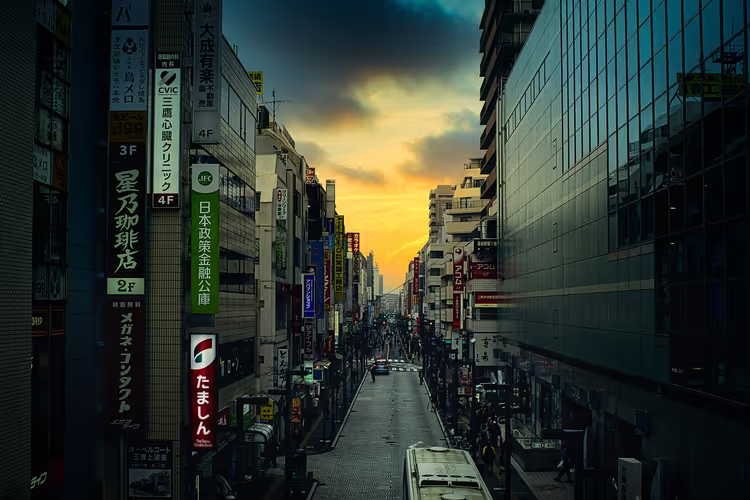
All of this coexists side by side. In the morning you stand in a quiet rock garden, and in the evening you find yourself in the neon center of a metropolis. This density of impressions is disorienting at first, but it is exactly what makes the trip so rich.
A first trip almost always follows the main island of Honshu: Tokyo, then Kyoto, then Osaka. That is the route we cover below.
When to go to Japan: cherry blossoms and Golden Week
Japan stretches across several climate zones, so you can come here year-round. In winter people come for the ski resorts, in summer for the beaches. Below we talk about the classic Honshu route: Tokyo, Kyoto, and Osaka.
Cherry blossom season is peak demand. The blossoms make the country more photogenic, but accommodation prices rise and temple lines get longer. If you are on a limited budget, choose a different time.
The worst time to arrive is Golden Week, a week of national holidays in late April and early May. Japanese people travel domestically in large numbers, trains and hotels get booked in advance, and tickets become more expensive.
After Golden Week, the situation quickly returns to normal. May offers comfortable temperatures for walking and few rainy days. Autumn is also a good time: the leaves change color, and it is a favorable period for photography.
Practical takeaway: plan for May or October if you want mild weather and reasonable prices. Separately, check the national holidays for the year of your trip, because on those days museums and trains are packed.
How many days to spend in Japan
There is no exact answer; the length depends on your budget and pace. The general principle is simple: the longer, the better. But trying to see the whole country in one trip is doomed, so choose your priorities.
 © Sitao Xiang · CC BY-SAPhoto: Sitao Xiang, CC BY-SA (https://creativecommons.org/licenses/by-sa/4.0), Wikimedia Commons
For the classic highlights of Tokyo, Kyoto, and Osaka, allow at least two weeks. That pace will be intense: you change cities or districts almost every day.
Three weeks is more comfortable. Then you will have time for day trips, for example from Tokyo to Mount Fuji or from Kyoto and Osaka to Nara. This noticeably reduces fatigue by the end of the trip.
Practical advice: first choose three or four base cities, and tie the transfers between them to specific dates. The first and last night in Tokyo simplify airport logistics.
If you only have a week, do not try to cover three cities. Take one city with its surroundings, for example Tokyo with a trip to Mount Fuji. That way you will not spend half your vacation on trains.
Plan your days with a buffer for transfers and rest. The transfer between Tokyo and Kyoto takes half a day including packing, so do not schedule another excursion on that day. We recommend leaving one free day for every five or six active days.
Separately, check the dates of Japanese holidays and school vacations. During those periods hotels get more expensive and train tickets sell out faster than usual.
Flying to Japan: flights and airlines
Direct flights to Tokyo operate from Germany, Austria, and Switzerland. The flight time is about eleven hours, but you arrive without a layover. Some flights land at Narita, some at Haneda.
 © shikabane taro · CC BYPhoto: shikabane taro, CC BY (https://creativecommons.org/licenses/by/3.0), Wikimedia Commons
Pay attention to Japanese airlines. Japan Airlines and All Nippon Airways (ANA) are known for their service, and a Japanese crew will greet you on board. In ANA economy class, legroom is greater than on most European carriers.
Also think about arrival time. A morning flight lets you check into your hotel before evening and not lose the first day. Evening arrival is convenient if you want to sleep right after the journey.
Look for tickets in advance: in summer and during cherry blossom season, direct flight prices are higher. You can compare options and buy flights to Tokyo on Kiwi.com.
Next, decide where it is more convenient to land. The airport determines the route into the city and its cost.
Visa and entry to Japan
With a German or Austrian passport, no visa is needed for a short trip. You can enter for ninety days without a visa (as of 09/2026, Japan immigration rules). That is more than enough for the classic route.
During the flight you will be given two forms: an entry card and a customs declaration. Both are short, but prepare your hotel address in Japan in advance. A pen will come in handy, because filling out the documents is easier before landing.
At the border, your fingerprints will be taken and a photo will be taken. This is a standard procedure and takes a minute. Separately, check your passport validity before departure.
If you are traveling with children, check the documents for each child separately. Rules for minors differ from those for adults, and it is worth finding out before departure.
Take medications with you in their original packaging. Some drugs that are common in Europe are restricted in Japan, so check your list in advance.
From Tokyo airport to the city
Tokyo has two international airports. Haneda is located closer to the center, while Narita lies far outside the city. Most European flights land at Narita, so the trip to your hotel takes longer.
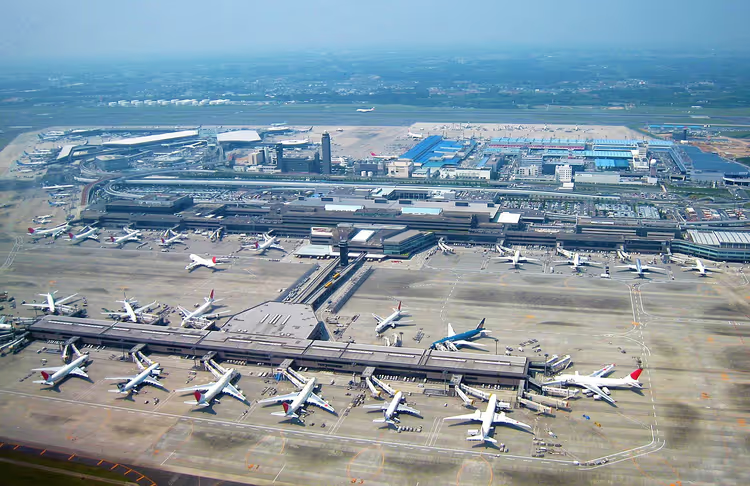 © PSnyan · CC BY-SAPhoto: PSnyan, CC BY-SA (https://creativecommons.org/licenses/by-sa/3.0), Wikimedia Commons
From Narita, the train is the most convenient option. The Narita Express takes you to Tokyo Station without transfers, and the ride is included in the Japan Rail Pass. Without a pass, choose the Keisei lines: if you want to save money, skip the fastest and most expensive train, the Skyliner.
From Haneda, the Monorail takes you to Hamamatsuchō Station. There you transfer to the Yamanote Line and continue to your destination. The trip is short, so Haneda is more convenient for your first night in the city.
If you are arriving with suitcases and want to avoid transfers, an airport transfer is a good option.
Tours and tickets in Tokyo
Guided tours, skip-the-line tickets and activities — most offers can be cancelled free of charge.
See offers on KiwitaxiThe widget loads once you give your consent.
Plan around your arrival time. Late in the evening, trains run less frequently, and a transfer becomes more convenient.
Decide in advance which ticket works for you. A single ticket costs more but does not require a card. Suica or a similar card is more convenient if you plan to take many rides. A Rail Pass only makes sense if you are traveling between cities.
With luggage, choose the train rather than the bus: train cars have luggage racks, while a taxi sits in traffic during rush hour. Large suitcases are easy to leave in a station luggage locker if your hotel is not ready to receive you yet.
Trains and shinkansen: do you need a Japan rail pass
The train is the most convenient way to travel between cities in Japan. High-speed Shinkansen connect Tokyo, Kyoto, Osaka, and dozens of other cities. You travel fast and on a schedule that almost never breaks down.
The Japan Rail Pass covers Japan Railways trains, including most Shinkansen and the Yamanote line in Tokyo. The price depends on the duration: seven days cost 50,000 yen, fourteen days 80,000 yen, twenty-one days 100,000 yen; prices will increase from October 1, 2026 (as of 09/2026, Japan Rail Pass fares).
Whether the pass pays off depends on your route. If you are only going to Tokyo, Kyoto, and Osaka, price out individual tickets: sometimes they work out cheaper. The pass is worth it for long journeys and frequent trips between cities.
You can buy the pass online in advance and exchange the voucher once in Japan, for example at the station in the airport. For Nozomi and Mizuho trains you need a separate supplementary ticket, which is worth checking before boarding.
You can check schedules and buy train tickets conveniently through Trip.com.
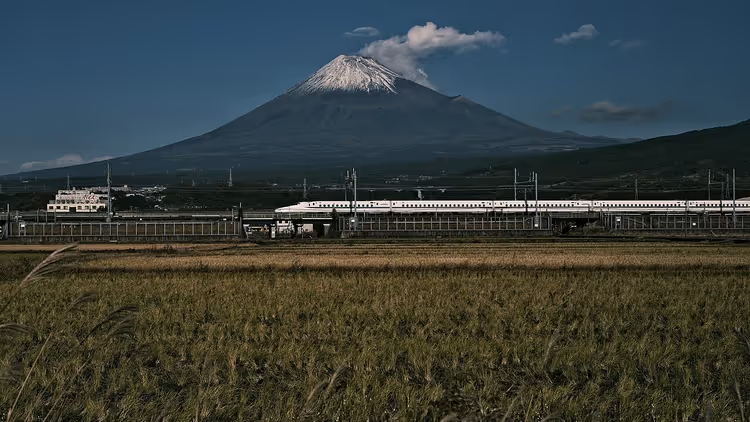 © Charlie fong · CC BY-SAPhoto: Charlie fong, CC BY-SA (https://creativecommons.org/licenses/by-sa/4.0), Wikimedia Commons
Buses are cheaper than trains, so for budget travel between cities they are a sensible alternative. Renting a car works for rural regions, but in cities parking is expensive and traffic drives on the left.
Subway, buses, and the Suica card
Within cities you use the subway, buses, and commuter trains. With the Japan Rail Pass some of these lines are free, but the city subway requires separate payment.
For the subway, get a Suica card. It is a rechargeable card that you tap at the ticket gate: the system automatically deducts the fare. The price depends on distance, but with the card each trip is slightly cheaper than a single ticket. You can top up the card at machines in stations.
You can buy a Suica at the airport right after arrival, next to the same counters where you exchange your Rail Pass. The card itself is free; you leave a small deposit and get it back when you return the card. Do not throw it away before the end of your trip, otherwise you lose the deposit.
In major cities the subway runs from early morning until midnight. Plan nighttime trips by taxi or bus, because some lines close.
The subway schedule in Tokyo is dense: trains run every few minutes. You do not check a timetable, you just go down to the platform.
At rush hour the cars are packed, so with suitcases it is better to travel after ten in the morning or before five in the evening. At other times you ride comfortably.
Taxis in Japan
Taxis in Japan are convenient but expensive. For a short stretch, for example from a station to a remote temple, it is a good solution. For long distances the subway or train is cheaper.
Hailing a car on the street is easy, and you can also order one through an app. If the red sign 空車 is lit, the taxi is available. The doors here open automatically: do not pull the handle, the driver controls them, and that is the custom in every car.
Payment is accepted in cash and by card almost everywhere, but it is better to have small bills on hand. You will get your change back without asking.
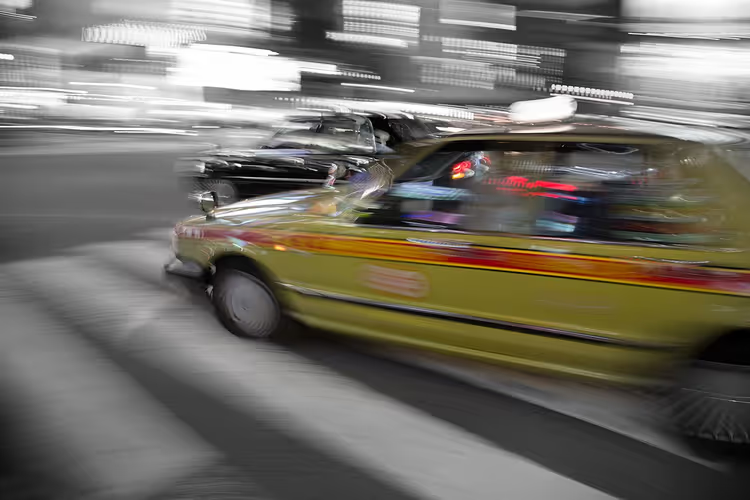
For a group of four, a taxi sometimes works out cheaper than the subway for the whole party. Alone and for long distances, the train is always the better deal.
At rush hour a taxi sits in traffic along with the rest of the city. For an airport trip, allow extra time in advance and prefer the train.
The meter in the car is visible on the dashboard. If you need to pay in cash, let the driver know in advance.
Money in Japan: yen, ATMs, and payment
The Japanese currency is the yen. The exchange rate against the euro changes noticeably from year to year, so calculate your budget using the current ECB rate, not from memory.
Cash is still important. Cards are accepted in hotels and large stores, but small cafes, shops, and temples often work only with cash. Keep a reserve for a day or two in your wallet.
Finding ATMs is easier than old guidebooks say. At stations and post offices there are machines marked "International ATM" that accept foreign cards. The bank may charge a small fee for withdrawal.
Payment looks unusual: you do not hand money from hand to hand, you place it on a small tray at the register. This is the custom in both shops and restaurants.
Tipping is not done in Japan. Good service here is considered the norm, and extra money can embarrass the staff. This rule applies in taxis, cafes, and hotels.
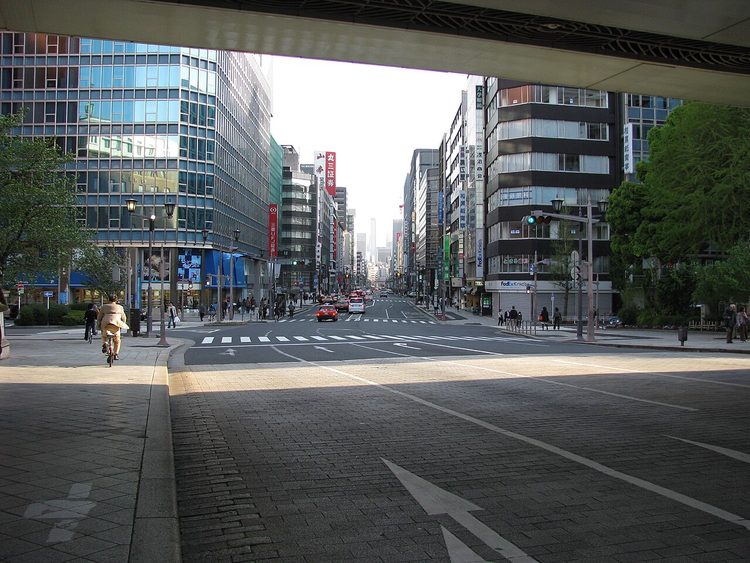 © Aimaimyi · CC BY-SAPhoto: Aimaimyi, CC BY-SA (https://creativecommons.org/licenses/by-sa/3.0), Wikimedia Commons
You do not need to exchange the entire amount in advance. Take a little cash for the first day and withdraw the rest once you are there.
A separate topic is small change. Japan has a lot of coins, and after your first purchase you will have a handful of change. Often there is a machine near the register that accepts coins and gives out larger bills.
If you pay by card, choose to be charged in the local currency, not in euros. Otherwise the bank will convert the purchase at its own rate and you will lose on the difference.
Some terminals in small towns do not accept foreign cards at all. So cash remains your safety net, especially outside Tokyo, Kyoto, and Osaka.
How much a trip to Japan costs
Japan is not cheaper than Europe, but it is not several times more expensive either. A lot depends on your habits: accommodation, food, and transport eat up the main part of the budget. You can save on almost every category.
Accommodation is the main variable. A night in a decent city hotel costs about the same as in a major German city, while a hostel or capsule hotel is noticeably cheaper. Book in advance: in high season there are fewer available rooms.
Food is flexible. A mug of beer and a portion of ramen in a simple eatery cost about the same as European prices, while lunch in a well-known restaurant will cost more. If you eat at inexpensive places and drink little, food expenses drop quickly.
Transport depends on the pass and the number of trips. Tickets for observation decks and museums add a separate budget category, so plan them in advance. Check current prices on the official Tokyo Skytree website.
The main expenses look like this:
Category | What affects the price |
|---|---|
Accommodation | Type (hostel, capsule, hotel, ryokan) and city |
Food | Inexpensive eateries versus well-known restaurants |
Transport | Japan Rail Pass versus individual tickets and buses |
Tickets | Observation decks, museums, digital exhibitions |
The bottom line is simple: you control your budget through accommodation and food. Expensive trips are primarily the fault of the hotel and restaurants, not the country itself. You can compare hotel prices and book a room on Trip.com.
What to see in Japan
A first trip almost always runs through the island of Honshu, and that makes sense. The country's main attractions are concentrated here, and travel between cities is short.
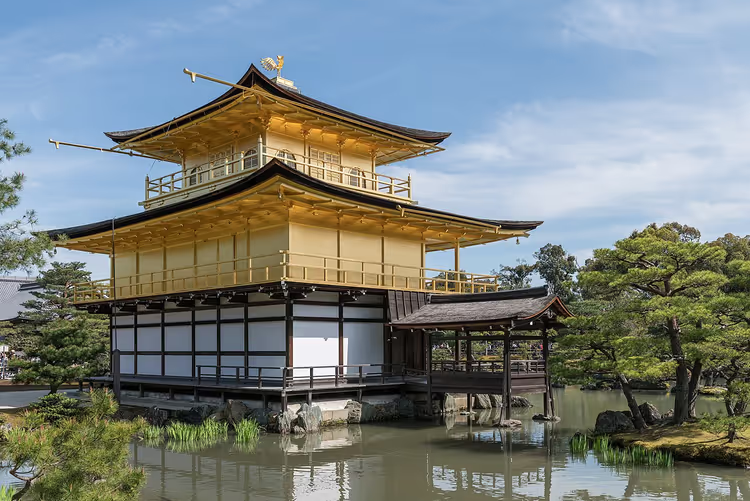
Tokyo is a huge capital with neighborhoods for every taste. You will find skyscrapers, old quarters, museums, and the best observation decks here. Kyoto is considered the cultural center: hundreds of temples and shrines stand in and around the city. Osaka is known for food and nightlife, and Mount Fuji rises between Tokyo and Kyoto.
We break down the Tokyo, Kyoto, and Osaka route in a separate guide, and here we give practical tips for each stop. Tours and tickets with a guide can be booked in advance on GetYourGuide.
 © DXR · CC BY-SAPhoto: DXR, CC BY-SA (https://creativecommons.org/licenses/by-sa/4.0), Wikimedia Commons
Visit observation decks and popular temples in the morning. By midday the lines grow, especially during cherry blossom season and on weekends.
Plan cities by days, not by a list. You can easily spend a week in Tokyo and not see everything, so choose neighborhoods in advance: one day for the historic center, one for modern districts, one for observation decks.
In Kyoto, temples stand in clusters, and on foot you will cover more than by bus. Start with the eastern part of the city early in the morning, before the tour groups arrive.
Tickets for popular attractions are better bought online with a time slot. That way you do not stand in line at the ticket office and you are guaranteed to get in at your chosen time.
Japanese cuisine: what to try
Food in Japan is an experience in itself. Dishes are prepared carefully and quickly, and quality is maintained even in cheap eateries. Here are the dishes worth trying on your first trip.
Sushi is everywhere, from expensive restaurants to conveyor belt spots with plates. Vegetarian options in such places are usually limited. Next comes ramen: a rich noodle soup served in small eateries with just a few seats.
In Osaka, be sure to order okonomiyaki and takoyaki. Okonomiyaki is a dense pancake made from egg and cabbage, fried on an iron griddle right in front of you. Takoyaki are batter balls with a piece of octopus inside, topped with sauce and sprinkled with bonito flakes.
For dessert, try mochi, sticky rice cakes with filling. In Nara, they are made at Nakatanidou, where mochi is prepared faster than anywhere else in Japan. The local cuisine is built on simple ingredients, but they are served fresh.
 © gorian21 · CC BYPhoto: gorian21, CC BY (https://creativecommons.org/licenses/by/3.0), Wikimedia Commons
Try new things at lunch rather than in the evening: at midday, the same dishes cost less. A set of several dishes at an inexpensive place lets you sample a lot at once.
Vegetarian food in Japan
Japanese cuisine relies heavily on fish and meat. Many soups are made with fish broth, so strict vegetarians can have a hard time in regular eateries. This is the main challenge of the local food scene.
The Happy Cow app makes things easier: it shows vegetarian options nearby. At a ramen shop, you can ask for a meat-free version, and it is often prepared without any problem.
In Tokyo, look for T's Tantan, Afuri, Ain Soph, and 8ablish. In Kyoto, check out Engine Ramen and Ain Soph; in Osaka, Mizuno. Save these addresses in your maps ahead of time so you do not have to search on the spot.
A dictionary will help you more than a phrasebook. Learn the phrase about broth: many Japanese people do not consider fish broth to be meat, so when asked about meat, they will answer "no."
If you eat fish, your options expand immediately. Sushi, onigiri, and seafood dishes are available in any supermarket, and ready-made sets are inexpensive.
In small towns, vegetarian places are almost nonexistent, so rely on major cities and the Happy Cow app.
Restaurant etiquette in Japan
The first thing you will notice is the displays with wax food models. They make it easy to choose food even without knowing the language. At inexpensive places, orders are often placed through a vending machine: it issues a ticket that you hand to the waiter or directly to the cook.
The second rule concerns seating. Do not rush to take a table: wait for a staff member to seat you. At popular restaurants, you will stand in line, but it moves quickly.
Water or tea is brought to you free of charge almost always. The packaged wet towel is for wiping your hands. At a ramen shop, you can ask for a paper apron to avoid staining your clothes.
Slurping while eating is not rude here; it is the norm and a sign that you are enjoying the food. Payment is usually made at the register on the way out, not at the table.
If you do not know what to order, look at neighboring tables. This makes it easier to choose a dish to your taste without explaining yourself through gestures. Staff are happy to point out the right line on the menu if you are struggling.
At expensive restaurants and ryokans, a service charge is sometimes added to the bill. Clarify this at the entrance so you are not surprised at the end of dinner.
Takeout does not work everywhere. At small cafes, food is prepared only for dining in, while ready-made meals for the road can be found in supermarkets.
Where to stay in Japan: hotels, capsules, ryokans
Accommodation in Japan is more expensive than it seems, but the choice is wide. There is a format for every budget, which makes planning noticeably easier.
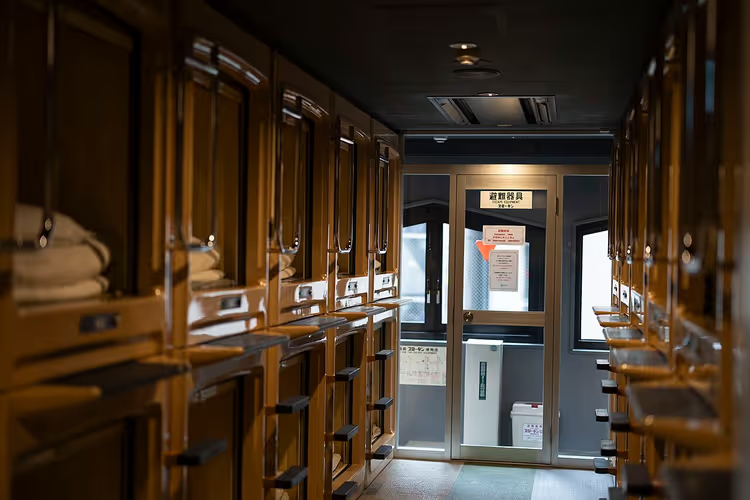
City hotels can be old or modern, but rooms are usually small. Capsule hotels give you not a room but a compact cabin: inexpensive, safe, and often centrally located. Hostels offer a bed in a shared room or a private room for two. A ryokan is a traditional option with tatami on the floor and a futon instead of a bed.
Breakfast is rarely included, with ryokans being the exception. Breakfast is more often Japanese, and the "Western" section is limited to porridge, yogurt, and bread. Keep this in mind if you are used to a hearty morning meal.
Comparing options and booking a hotel in Japan is convenient on Trip.com.
 © GoToVan · CC BYPhoto: GoToVan, CC BY (https://creativecommons.org/licenses/by/2.0), Wikimedia Commons
For your first trip, choose a hotel near a subway station. This way you spend less time commuting and have an easier time getting back late in the evening.
Internet in Japan: SIM or pocket Wi-Fi
Free Wi-Fi is available in hotels, airports, and major train stations. If you only need to check email, that is enough. For navigation and a translator, it is better to have your own internet at all times.
You have two options: a local SIM card for your phone or renting a Pocket Wi-Fi router.
A Pocket Wi-Fi router shares internet with all your devices, usually with capacity for several connections at once. The router is small, fits in your pocket, and the battery lasts about a day of use. Bring a power bank, and you will not be left without a connection.
The router is always rented, never bought. The price depends on the rental period and the provider. For two people, a router is almost always cheaper than two SIM cards: one device serves both phones.
Order the router in advance from home; it is cheaper. At the airport, you simply pick it up at the provider's counter and get online right away.
If you only need a SIM card, compare eSIM options for Japan in advance: eSIM options for Japan. Once installed, you activate the eSIM right at the airport and do not have to look for a mobile carrier store.
Will English be enough in Japan?
Not everyone understands English. Many Japanese people speak it poorly or not at all, but for simple situations it is often enough. At hotels, problems rarely arise: the front desk staff know English.
At train stations and in the subway, you will not get lost either. Signs and announcements are duplicated in English, at least in Tokyo, Kyoto, and Osaka. Station names are written in Latin letters, so navigating is convenient.
Restaurants are trickier. English menus are not available everywhere, so you choose based on photos or the wax models in the display. This method works if you eat everything and have no allergies.
Download Google Translate with the Japanese pack in advance. The app translates text from a photo and helps where you do not understand a word. Make sure the pack is downloaded for offline use.
Adapters and voltage in Japan
Outlets in Japan are type A/B and differ from European ones, so you will need an adapter. Bring several: one for charging your phone, a second for your laptop, and a third will get lost along the way.
Voltage in Japan is 100 V, which is lower than in Europe. As a result, some appliances work less powerfully. A hair dryer or iron may heat noticeably worse, and this is not a malfunction but a difference in the power grid.
A voltage converter is usually not necessary. Most modern chargers and gadgets support both ranges, which is indicated on the power adapter or cable itself. Check the label before your trip so you do not bring an unnecessary device.
Sometimes hotel rooms have USB ports, but you should not rely on them alone. A simple adapter without a transformer solves almost all problems.
Check the label on your appliance before the trip. If it lists a wide voltage range, an adapter is all you need. If it is European-only, it is better to leave the appliance at home.
Many hotels provide an adapter at the front desk, but you should not count on this during high season. Your own set of two or three is always more reliable.
Useful apps for Japan
Without a few apps, the trip gets harder. Here is a set to start your preparation with.
Google Translate with the offline Japanese pack helps you read signs and menus. maps.me or CityMaps2Go give you an offline map of the country, where you save the places and restaurants you need in advance. Apple Maps or Google Maps plan routes on the subway and trains, and in Japan they work especially accurately.
For vegetarians, there is Happy Cow, which we wrote about above. Ramen lovers will appreciate Ramen Beast: the app finds noodle shops near you.
A printed guidebook also helps. It is more convenient to take separate books for each city rather than one thick volume for the whole country: you carry less weight and take only what you need.
Check all apps and offline maps before your flight. Once you are there, you will not want to spend time downloading packages.
Etiquette in Japan
Japan runs on politeness and order, and a few simple rules will make your trip much easier.
There are almost no trash cans on the streets. The reason is historical: after the gas attack in the Tokyo subway in the nineties, the bins were removed. You are expected to carry your trash with you and throw it away at the hotel or at home.
Eating and drinking while walking is not the custom here. It is better to have a snack in a cafe or next to it, not while walking down the street.
Smoking is allowed only in designated areas. Since 2020, smoking is banned in most restaurants. Some hotels still have smoking rooms, so check this when booking.
Blowing your nose in public is not the custom: instead of a tissue, people here are more likely to sniff quietly. This is one of the habits a tourist needs to get used to.
In lines, the Japanese stand neatly, and markings on the floor show exactly where. Do not cut in line or stand off to the side; you will be politely corrected.
When meeting and saying goodbye, people bow. This is an expression of respect that you will see in shops and hotels. The depth of the bow depends on the situation, but nobody expects a tourist to follow the ritual strictly.
⁉️🤔 Frequently asked questions
Do I need a visa for a trip to Japan?
Citizens of Germany, Austria and Switzerland do not need a visa for a tourist trip. With a passport you can enter for ninety days (as of 09/2026, visa rules for tourists). That is enough for any classic itinerary. Your passport must be valid for the entire trip, and at the border they will take your fingerprints.
When is the best time to go to Japan?
The best time for a first trip is May and October. In May the temperature is comfortable and there are few rainy days; in autumn the foliage changes beautifully. Cherry blossom season looks more spectacular, but costs more and draws more people. A separate week in late April and early May is taken up by the Golden Week holidays, when Japanese people travel within the country.
How much money do I need for a trip to Japan?
The budget depends on accommodation and food. A night in a city hotel costs about the same as in a major German city, while a hostel or capsule is cheaper. A mug of beer and a bowl of ramen in a simple eatery are at European levels. The main large expenses are accommodation, travel between cities and tickets to observation decks.
Do I need a Japan Rail Pass?
It pays off on long journeys and frequent trips between cities. For two weeks, the pass costs 80,000 yen (as of 09/2026, Japan Rail Pass prices). If you are only going to Tokyo, Kyoto and Osaka, price out individual tickets: sometimes they come out cheaper than the pass. For Nozomi and Mizuho trains you need a supplementary ticket.
Is English enough in Japan?
In hotels and at train stations, English is enough. Signs in Tokyo, Kyoto and Osaka are duplicated in English, and station names are written in Latin letters. Restaurants are trickier: English menus are not available everywhere, so you choose by photos and wax models. Google Translate with the offline Japanese pack solves almost all other situations.
In short: what to book
If you have two weeks and a classic itinerary, get the Japan Rail Pass in advance and a hotel near the station in Tokyo. If you are traveling as a couple, renting a Pocket Wi-Fi router will be cheaper than two SIM cards. If you are a vegetarian, mark suitable restaurants in Happy Cow before your flight.
The matrix is simple. A couple or family on a first trip: hotel near the station, rail pass and airport transfer. Solo travel on a limited budget: capsule hotel, buses and city subway. A short trip of a few days: one city, observation decks in the morning and booking a transfer in advance.
What to book first: a hotel near the station on Trip.com. Buy flights and the rail pass right after that.

A small editorial team writing guides for independent travel. We travel ourselves, but we haven’t been everywhere, so we check prices, opening hours and how to get there against official sources.