


Kazan landmarks: why we removed these guides
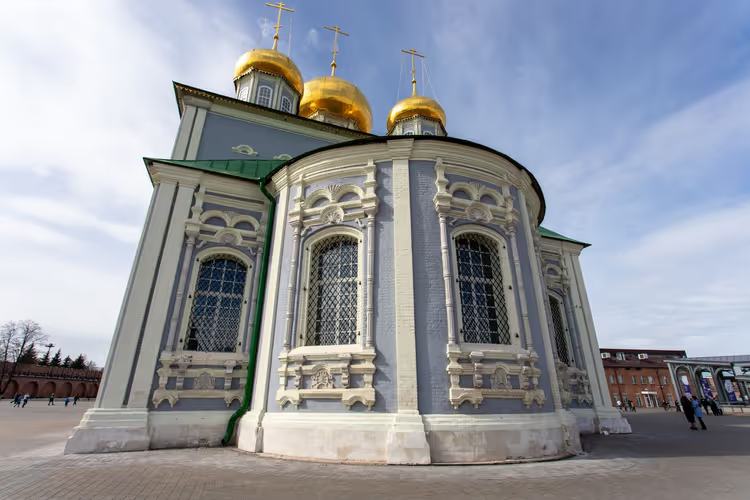
Here lay four travel guides: the Kazan Kremlin as a whole, the Kul Sharif Mosque, the Söyembikä Tower, and the Palace of Agriculturalists. All four have been removed in every language version, and the old URLs now redirect permanently to this page.
A short answer for the reader who came here looking for a list of sights. We no longer describe these sites as a travel destination. The reason is not the architecture, nor that the ensemble has become less interesting: as of January 1, 2026, an EU-based publisher is prohibited from providing services directly related to tourism activities in Russia, including advertising them, and in recent years this ensemble itself has been used as a stage for showing the world the normality of what is happening.
💡 At a glance:
- which four pieces were removed and why they could not be updated
- how the city's historic center works as a diplomatic showcase
- what we deliberately do not write about when discussing the republic and its people
- which cities with a similar architectural history remain in our live sections
- Last updated: 09/2026
Why we deleted these guides
All four texts were standard site cards: when it was built, who the architect was, the legend, what to see inside, 2021 prices, how to get there. This is not a description of history but an instruction for visiting, and there was nothing to update in it: without the practical part, such a text does not exist.
Russia's full-scale invasion of Ukraine began on February 24, 2022 (UN press release GA/12407, 03/02/2022). We believe that after this date, an editorial team based in the European Union cannot publish materials that organize travel to this country, and we make no exception for cities that are commonly called calm.
We state the financial argument precisely. The share of oil and gas revenues in Russia's federal budget fell to roughly 22 percent in 2025 and 2026, while the share of non-oil-and-gas revenues rose to roughly 78 percent (OSW Centre for Eastern Studies, 12/09/2025). Entrance tickets, a hotel, and a visitor's meals fall into the second category, which is why the phrase "a tourist pays for oil rent" is incorrect, while the phrase "a guest's spending ends up in the budget of a state waging war" is correct.
A showcase, not just a panorama
Now, how this ensemble differs from other places in our texts about Russian cities.
From October 22 to 24, 2024, Kazan hosted the BRICS summit, the largest international event held in Russia since the start of the full-scale invasion (Al Jazeera, 10/22/2024). This took place roughly a year and a half after the International Criminal Court issued arrest warrants on March 17, 2023 for Russian President Vladimir Putin and Presidential Commissioner for Children's Rights Maria Lvova-Belova on suspicion of the war crime of unlawful deportation of population (children) and unlawful transfer of population (children) from occupied territories of Ukraine to the Russian Federation, Articles 8(2)(a)(vii) and 8(2)(b)(viii) of the Rome Statute (UN News, 03/17/2023). A warrant is a procedural decision, not a verdict: Article 66 of the Rome Statute establishes the presumption of innocence, and we adhere to exactly that wording.
The participation of the UN Secretary-General in the summit drew criticism from Ukraine's Ministry of Foreign Affairs, which pointed out that in June of the same year the invitation to the peace summit in Switzerland had not been accepted (Al Jazeera, 10/22/2024). We cite this as a fact of public diplomatic controversy, not as our own assessment of anyone's decisions.
The legal background of the event is recorded in UN documents. On October 12, 2022, the UN General Assembly adopted resolution ES-11/4 by 143 votes: the attempted annexation of Ukraine's Donetsk, Luhansk, Zaporizhzhia, and Kherson regions was declared to have no legal validity (UN press release GA/12458, 10/12/2022).
From this follows our conclusion about the genre. The panorama of the Kremlin, the mosque, and the tower during the summit days worked as a backdrop for protocol footage, that is, as an argument for normality. A travel guide to the same sites, published by an EU-based outlet, adds another voice to that argument, even if it contains not a word about politics.
What we do not write about here
Separately and deliberately. This text contains no statements, and will contain none, about the residents of the republic, about the Tatars as a people, or about anyone else on ethnic or religious grounds. This is not caution but principle: our subject is the decisions of a state and our own editorial genre.
We also do not present ourselves as experts on local life and do not speculate about what people in the city think. We have no sources to cite, and we will not invent any.
And we do not transfer responsibility for politics onto historical monuments. The mosque, the tower, and the Kremlin walls do not become worse because of what is happening in the country. What changes is not the monument but what our text about it is.
What this means for you
Item | Status 09/2026 | Source |
|---|---|---|
Services related to tourism in Russia | Prohibited by Article 5n(2) of Regulation 833/2014 as amended by Regulation 2025/2033 of 23.10.2025 | |
Transition period | For contracts concluded before 24.10.2025, ended on 01.01.2026 | |
Tour guide services | Explicitly named among the services covered by the ban | |
Online booking and ticket sales | Covered by the ban on the same basis as agency services | |
German Foreign Office advisory | "Vor Reisen in die Russische Föderation wird gewarnt" |
Where to go instead
The question readers brought to these four texts was about eastern architecture next to European architecture, about minarets and fortress walls in a single skyline, and about a city where two traditions have coexisted for centuries. The live sections of the site answer that: Turkey with Istanbul and Edirne, Azerbaijan with Baku and its old city, Armenia with Yerevan and its monasteries, Georgia with Tbilisi and Mtskheta. We name countries and cities, not individual sites with schedules: this section deliberately has no practical part.
The overall explanation for the entire section is collected in the section hub. Related topics: our position on Kazan hotels and our position on museums and tours in Kazan.
Where we stand
We believe that a guide to the ceremonial center of a city used as a venue for international summits cannot be neutral. In our assessment, by publishing such a text, an EU-based outlet inserts itself into the same performance of normalcy for which this place is shown in the first place, and no disclaimer at the bottom of the page cancels that. That is why we decided to remove all four pieces and explain the reason at the same address.
We also think it is important to say what we are not doing. We are not calling on anyone to sever personal ties, we are not judging other people's trips, and we are not making lists of what should be closed. Our decision concerns exactly one thing: our own publications.
We write about the state and its policies, not about people based on their passport. There are people in Russia who spoke out against the war and received prison sentences for it. Our decision not to publish guides to Russia concerns money, sanctions, and the reader's safety, not nationality.
Publication date: September 3, 2026. Last updated: September 3, 2026.
⁉️🤔 Frequently asked questions
What does the summit have to do with it if I just wanted to see a mosque?
The summit matters not in itself, but as an indicator of the place's function. This ensemble is used as a ceremonial backdrop for international meetings, and tourist writing about it works in the same direction. Plus, the general EU ban on tourism services described above applies.
Are you calling the president of Russia a war criminal?
No. We are citing a fact from a procedural document: the International Criminal Court issued arrest warrants on suspicion of specific crimes, citing articles of the Rome Statute. A warrant is not a verdict and does not override the presumption of innocence.
Do you have something against Tatarstan?
No, and the text has a separate section about this. We write about state decisions and about our own editorial genre, not about the residents of the republic, their language, or their faith.
Isn't cultural exchange better than isolation?
We are not engaged in cultural exchange. We publish travel materials, meaning we suggest going somewhere and spending money. That is a different activity, and it is precisely what is prohibited with respect to Russia for a person from the EU.
Where do the old links to these four texts lead?
Here. We decided that a reader arriving from search deserves an explanation and a list of destinations we continue to write about, not an empty page with an error message.
In short
Four guides to the Kazan Kremlin and its monuments have been removed in full, and the old addresses redirect here. From October 22 to 24, 2024, the city hosted the BRICS summit, the largest international event in Russia since the start of the invasion, roughly a year and a half after the International Criminal Court issued its warrants. Regardless of the city, the EU ban on tourism services applies, and the German Foreign Office warns against travel. The text contains no claims about the residents of the republic, and there will be none. Cities with a similar architectural history that we continue to write about are listed above.
How you can help
We do not collect money and receive nothing from the links below. These are official websites of organizations working with the consequences of the war:
- UNHCR, the UN Refugee Agency, unhcr.org
- UNICEF, unicef.org
- Ukrainian Red Cross, redcross.org.ua
Sources
- UN General Assembly, resolution ES-11/1 "Aggression against Ukraine", 02.03.2022. https://press.un.org/en/2022/ga12407.doc.htm
- UN General Assembly, resolution ES-11/4 "Territorial integrity of Ukraine", 12.10.2022. https://press.un.org/en/2022/ga12458.doc.htm
- International Criminal Court, arrest warrants in the situation in Ukraine, 17.03.2023, as reported by UN News. https://news.un.org/en/story/2023/03/1134732
- Al Jazeera, on the BRICS summit in Kazan and criticism from Ukraine's Foreign Ministry, 22.10.2024. https://www.aljazeera.com/news/2024/10/22/russias-brics-summit-whats-on-the-agenda-and-why-does-it-matter
- Council Regulation (EU) 2025/2033 of 23.10.2025 amending Regulation 833/2014, EUR-Lex. https://eur-lex.europa.eu/legal-content/EN/TXT/?uri=OJ:L_202502033
- Skadden, analysis of the EU's 19th sanctions package, 11.2025. https://www.skadden.com/insights/publications/2025/11/eu-adopts-19th-sanctions-package
- Fieldfisher, analysis of the EU's 19th sanctions package, 2025. https://www.fieldfisher.com/en/insights/the-eu-s-19th-sanctions-package-against-russia
- Auswärtiges Amt, Russische Föderation: Reise- und Sicherheitshinweise, as of 02.09.2026. https://www.auswaertiges-amt.de/de/service/laender/russischefoederation-node/russischefoederationsicherheit-201536?isLocal=false&isPreview=false
- Centre for Eastern Studies OSW, Russia's 2026 budget, 09.12.2025. https://www.osw.waw.pl/en/publikacje/osw-commentary/2025-12-09/russias-2026-budget-mounting-financial-challenges-and-economic
Link check date: 03.09.2026.

A small editorial team writing guides for independent travel. We travel ourselves, but we haven’t been everywhere, so we check prices, opening hours and how to get there against official sources.