
















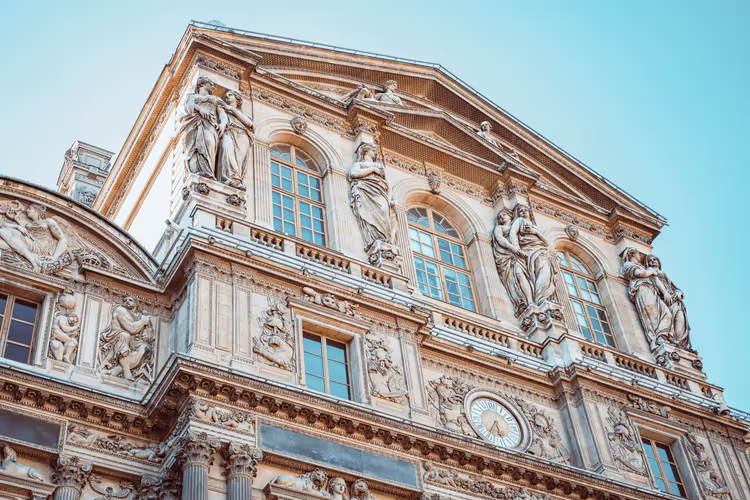
Louvre in Paris: 2026 tickets and skip-the-line entry
The Louvre welcomes nearly nine million visitors a year. According to the museum, 8.7 million people visited in 2024 (Louvre press office, 01/2025). It is the most visited museum in the world, and getting in without a plan is not easy.
A ticket from January 14, 2026 costs €22 for EEA residents and €32 for everyone else (prices and hours on the museum website, 09/2026). The galleries are spread across three wings with underground passages, and the line at the pyramid stretches for hundreds of meters.
We put together a practical guide: how much admission costs, when the museum is closed, how to get in without waiting in line, and what to see on your first visit.
Ad: this text contains affiliate links, we earn a commission from them, the price for you does not change.
History: from fortress to museum
💡 In short:
- Come on Wednesday or Friday: the museum is open until 9:00 PM, and it is closed on Tuesday.
- Get a timed-entry ticket in advance, otherwise you will lose an hour at the ticket office.
- Prices and opening hours: 09/2026, verified on the official Louvre website
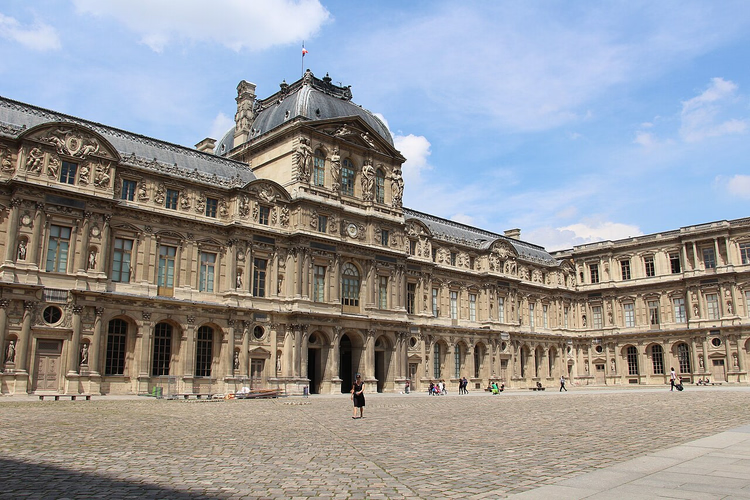
The Louvre began as a military fortress, not as a museum. In the late 12th century, King Philip II Augustus built it to defend Paris from the Normans and the English. A tall cylindrical tower and thick walls with massive gates protected the royal treasury, archives, and a prison. According to one theory, the name itself comes from a Frankish word meaning "to stand guard."
 © Fred Romero from Paris, France · CC BYPhoto: Fred Romero from Paris, France, CC BY (https://creativecommons.org/licenses/by/2.0), Wikimedia Commons
Over time, the city grew around the fortress, and it lost its defensive purpose. In the 14th century, Charles V turned the grim citadel into a royal residence. New towers, a lavish garden, and pompous ceremonial apartments appeared. But harsh winters, famine, a plague epidemic, and wars with England left the residence in a sorry state. Throughout the 15th century, the Louvre stood almost abandoned, and the monarchs lived far from Paris.
The turning point came in the 16th century. Francis I brought the court back to Paris and began rebuilding in the Renaissance style. The medieval towers gave way to a palace with new wings, an inner courtyard, an arcaded gallery, ceremonial halls, and decorated facades. Construction dragged on for decades, and you can still see its traces in the Louvre's appearance today.
In 1682, Louis XIV moved the court to Versailles, and construction stopped. The unfinished building was occupied by French painters, sculptors, scholars, and itinerant merchants. From 1699, art exhibitions for the privileged nobility began to be held in the palace, and the residence gradually turned into a public museum.
After the French Revolution, the Louvre became the property of the people: the first art museum in France opened here. Parisians gained access to the royal collection. Under Napoleon I, the collection grew through works confiscated from the nobility and clergy, and through war trophies from conquered countries.
The royal palace and its facades
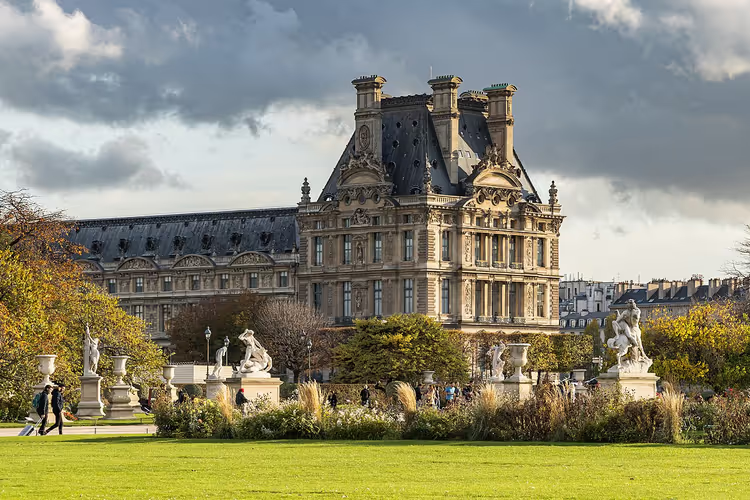
The appearance of today's Louvre took shape over centuries. Each monarch added to and remodeled the complex, which is why it resembles a layer cake of architectural eras. The palace largely acquired its modern look by the end of the 19th century. The perimeter of the complex exceeds one and a half kilometers.
The ensemble consists of three main buildings. One wing runs along the Seine embankment, another runs parallel to Rue de Rivoli, and in the center stands a square building with an inner courtyard. The facades are decorated with arcades, colonnades with ornate capitals, pilasters, balustrades, pediments, and numerous sculptures. If you approach the museum from the Seine side, you will see the most ceremonial side of the ensemble.
Building the collection
The foundation of the collection was laid by Francis I. After returning from Italy, the king was captivated by Renaissance art and brought many paintings and sculptures to France. He invited Leonardo da Vinci to court and appointed him court painter. After the master's death, his works remained in France, including the "Mona Lisa."
The collection kept growing. The most avid collectors were Cardinal Richelieu, Mazarin, and Colbert: they bought paintings across Europe, sparing no expense to glorify the monarchy. From the 19th century, archaeologists working in Egypt and the Middle East made their contribution. That is how ancient statues, manuscripts, and unique artifacts ended up in Paris.
Today this collection spans almost the entire history of art, from antiquity to the mid-19th century. It is the breadth of the selection that explains why the Louvre is considered the world's greatest museum, not just a palace with paintings.
The Louvre today: numbers and place in the world
Today the Louvre ranks among the most visited museums on the planet. According to the museum, 8.7 million people visited in 2024, and 28% of guests entered for free (Louvre statistics, 01/2025). The collection numbers about 370,000 exhibits and occupies tens of thousands of square meters of galleries.
The Louvre ensemble and the banks of the Seine are on the UNESCO World Heritage list. So it is worth planning a full day here: otherwise you will spend half the day in lines and miss the highlights.
The theft of the "Mona Lisa" in 1911
In 1911, one of the museum's longtime employees walked out of the painting pavilion with the "Mona Lisa" without any obstruction. The loss was noticed only a day later. The police searched for the painting for more than two years, from 1911 to 1913. All that time it lay in the thief's modest apartment.

A loud scandal erupted. It became clear that the museum could not protect its collection, so the director was replaced by a commissioner with broad powers. He increased the number of guards, introduced strict visiting rules, renovated the galleries, installed an elevator, and brought in electricity. It was after this incident that the "Mona Lisa" became the most recognizable painting in the world, and today you see it behind bulletproof glass.
Why the glass pyramid was needed
 © Benh LIEU SONG ( Flickr ) · CC BY-SAPhoto: Benh LIEU SONG ( Flickr ), CC BY-SA (https://creativecommons.org/licenses/by-sa/3.0), Wikimedia Commons
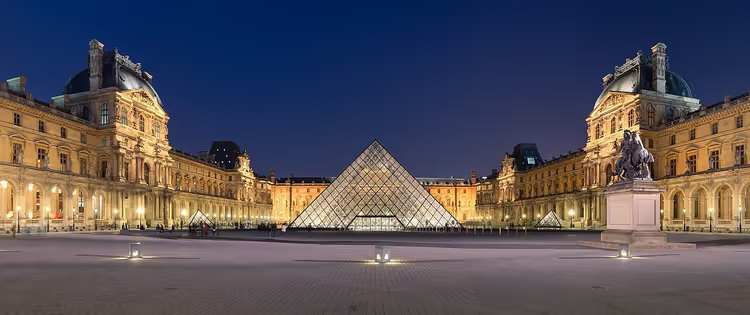
The glass pyramid serves as the main entrance to the Louvre. It was built in 1989, designed by the American architect I. M. Pei as part of a major museum renovation program. Its transparent faces contrast with the classical palace and have long since become a new symbol of Paris.
The pyramid had a practical purpose. The historic entrances could not handle the flow of visitors, so the main entrance was moved underground, into a spacious hall. From there you go directly to the museum's three wings.
How the museum is organized inside
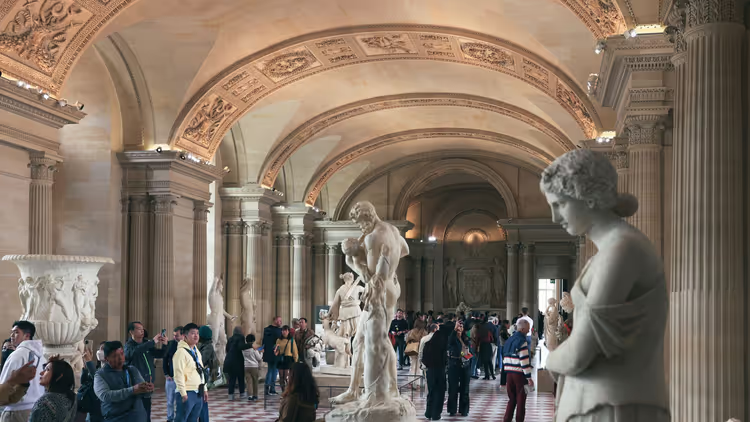
The complex consists of three wings: Richelieu, Denon, and Sully. They are connected by underground passages, so you can easily move from one gallery to another without going outside. The spacious rooms display paintings, sculptures, royal furniture, porcelain, tapestries, jewelry, and ancient statues.
The galleries are decorated with arched ceilings, columns, frescoes, and bas-reliefs. The ancient collections of Greece, Egypt, and the Near East occupy the first floors, while fine and decorative art rises to the second and third. It is easier to navigate from bottom to top: you start with antiquity and finish with painting.
The collection: main galleries and masterpieces
The collection is divided into thematic zones. It brings together Egyptian and Near Eastern antiquities, Greek and Roman sculpture, objects from the French kings, and paintings by artists from around the world. The large gallery with an arched ceiling, where Greek statues stand among slender columns, deserves special attention.
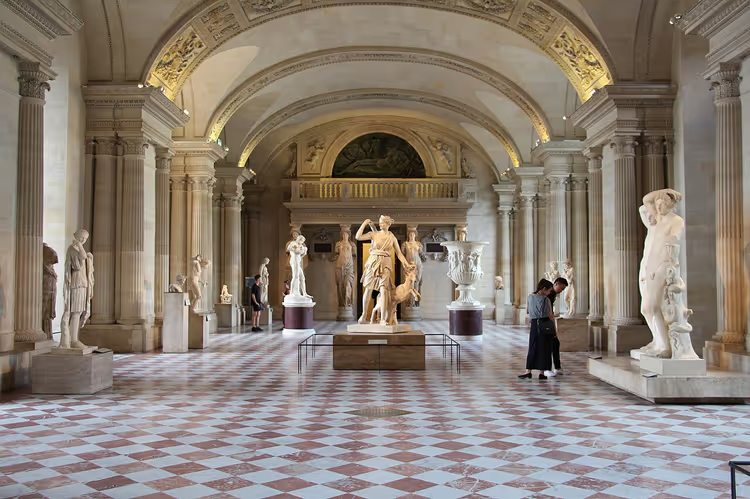 © Fred Romero from Paris, France · CC BYPhoto: Fred Romero from Paris, France, CC BY (https://creativecommons.org/licenses/by/2.0), Wikimedia Commons
The marble Venus de Milo holds an important place in the collection. This armless statue of the ancient goddess of love and beauty draws crowds: visitors head to it right after the Mona Lisa. Look for it in the Greek sculpture gallery, where other marble figures also stand.
The painting gallery attracts the largest crowds. Its walls are adorned with canvases by Italian masters: Raphael, Domenico Ghirlandaio, Caravaggio, and Leonardo da Vinci. The Louvre holds thousands of paintings, from the Renaissance to the mid-19th century.
The museum's most ornate room is called the Galerie d'Apollon. The ceiling is painted with frescoes on themes from Greek mythology, paintings hang in gilded frames with stucco work, and jewelry from the French kings is displayed nearby. The room is worth seeing for the interior alone.
The most famous paintings
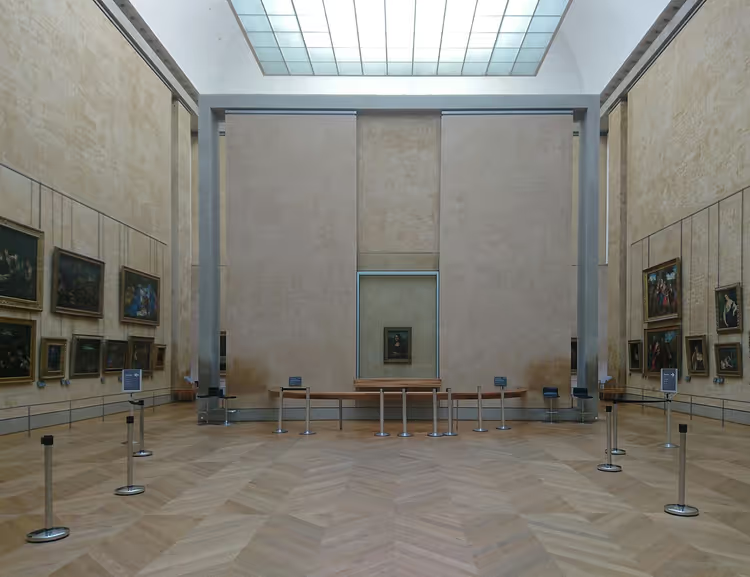
Leonardo da Vinci's Mona Lisa was painted more than 500 years ago. The small portrait of a woman is protected by bulletproof glass, and its enigmatic smile has held visitors spellbound for centuries. This is where most guests head first, and it is crowded any day of the week.
The Wedding at Cana by Paolo Veronese takes up an entire wall opposite the Mona Lisa and is considered the largest painting in the collection. The subject comes from the Gospel: Jesus Christ turns water into wine at a wedding. The best way to view the canvas is from the far end of the room, otherwise you cannot take it all in at once.
How to get in without waiting in line
The line at the Louvre is shortest early in the morning. At 9:00 there are still few groups at the entrance, and you can walk calmly to the main halls. A ticket bought in advance with a timed entry slot saves you from standing at the ticket office. Buy it online on the official website, because paying in cash and queuing at the ticket office eats up more than an hour.
If your dates are flexible, choose Wednesday or Friday: the museum is open until 9:00 PM, and after 6:00 PM the halls are noticeably less crowded. On the first Friday of the month, admission is free after 6:00 PM for everyone, except in July and August (as of 09/2026, Louvre website).
Opening hours and ticket prices
The Louvre is closed on Tuesdays and on three holidays: January 1, May 1, and December 25. On other days, the schedule depends on the day of the week.
Day of the week | Opening hours |
|---|---|
Monday, Thursday, Saturday, Sunday | 9:00 AM to 6:00 PM |
Wednesday, Friday | 9:00 AM to 9:00 PM |
Tuesday | closed |
Last entry is one hour before closing, and visitors are asked to leave the halls 30 minutes before closing time (Louvre website, as of 09/2026).
Ticket | Price from 01/14/2026 |
|---|---|
EEA residents and citizens | €22 |
Other visitors | €32 |
Children under 18 and EEA residents under 26 | free |
An audio guide costs €6. The ticket covers both the permanent collection and temporary exhibitions. If you need timed entry, check Louvre tickets and tours.
Tours and tickets in Louvre
Guided tours, skip-the-line tickets and activities — most offers can be cancelled free of charge.
See offers on TiqetsThe widget loads once you give your consent.
Where the Louvre is located and how to get there
The Louvre stands in the very center of Paris, on the right bank of the Seine, at Rue de Rivoli, 75001. The nearest metro exits lead directly to the glass pyramid.
The most convenient option is to get off at Palais Royal - Musée du Louvre station (lines 1 and 7) or at Louvre - Rivoli station (line 1). Buses 21, 27, 39, 68, 72, and 95 also go to the museum. In summer, a sightseeing riverboat is added: the dock is a few minutes' walk away.
The Louvre on the map
Below is a map with the museum marked. Check in advance which direction you will approach from: the square with the pyramid has several entrances, and at peak times they fill up unevenly.
⁉️🤔 Frequently asked questions
How much does a Louvre ticket cost in 2026?
From January 14, 2026, a ticket costs €22 for EEA residents and €32 for other visitors (Louvre website, as of 09/2026). Children under 18 and EEA residents under 26 enter free. On the first Friday of the month after 6:00 PM, admission is open to everyone, except in July and August.
When should I go to the Louvre to avoid the crowds?
Come at opening time, at 9:00 AM, or plan your visit for Wednesday or Friday after 6:00 PM. The museum is closed on Tuesdays, and on weekends the halls fill up from the morning. Early in the morning there are almost no groups at the pyramid, and you get to the Mona Lisa faster.
How much time do you need to see the Louvre?
Three to four hours is enough for the highlights: the halls with the Mona Lisa, the Greek sculpture with the Venus de Milo, and the Apollo Gallery. A full tour of the entire collection takes days, so choose two or three wings in advance and do not try to see everything at once.
How do I get to the Louvre by metro?
The most convenient option is to get off at Palais Royal - Musée du Louvre station, lines 1 and 7, or at Louvre - Rivoli station, line 1. The exits lead directly to the glass pyramid. Buses 21, 27, 39, 68, 72, and 95 also go there.
What should I see at the Louvre on a first visit?
Start with the Mona Lisa, then spend some time at The Wedding at Cana on the opposite wall. After the paintings, go down to the Venus de Milo and finish with the Apollo Gallery. That way, one route covers painting, ancient sculpture, and the most ornate hall in the museum.
In short: what is worth booking
Plan the Louvre as a full day, not a stop along the way. Morning gives you open galleries, a timed ticket saves an hour in line, and Wednesday or Friday evening works well for those visiting Paris for the weekend.
- If this is your first time in Paris: book a 9:00 slot and start with the paintings in the Denon wing.
- If you love art: split the visit into two days, one for paintings and one for antiquities.
- If you're on a budget: choose the first Friday of the month after 6:00 PM and take your time.
Compare tickets, tours, and audio guides on GetYourGuide, and check accommodation near the museum on Trip.com.

A small editorial team writing guides for independent travel. We travel ourselves, but we haven’t been everywhere, so we check prices, opening hours and how to get there against official sources.