
















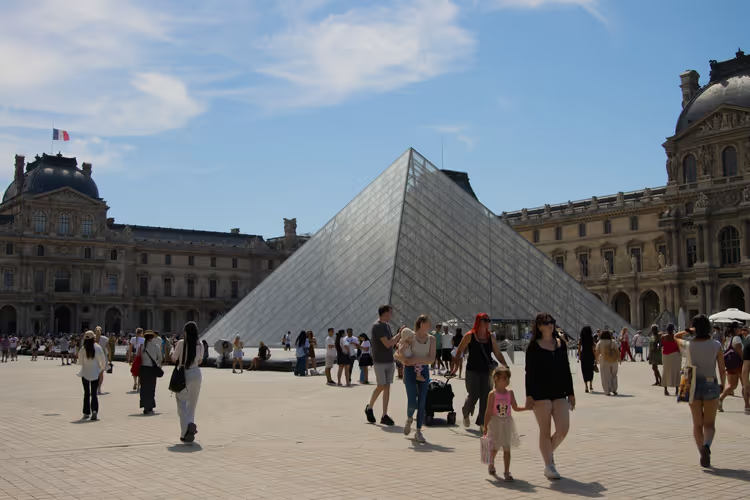
Paris City Pass: who saves money with it and who doesn't in 2026
Paris hits your wallet even at the planning stage. A Louvre ticket, climbing the Arc de Triomphe, the Musée d'Orsay, a Seine cruise: the costs add up fast. A city pass promises all of this for one price. The only question is: does it actually save you money, or does it just look convenient?
The Paris City Pass from the Hamburg-based company Turbopass gives you entry to dozens of museums and attractions plus a public transport pass. The idea is simple. You pay once and go through the list without buying separate tickets. But the value depends on your age, citizenship, and how many sights you can fit into your trip.
Let's break it down by the numbers. If you're over 25 and pay full price for museums, the pass can pay for itself.
We recalculated the costs using current 2026 prices and compared the Paris City Pass with the cheaper Paris Museum Pass. Everything below is tied to specific rates and opening hours, not to promises.
The pass includes three types of items: museums and monuments, activities like observation decks and a Seine cruise, and a public transport pass. Below you'll see which scenarios make it worthwhile and which don't. And what to buy separately if the pass isn't right for you.
Ad: this article contains affiliate links, we earn a commission if you book through them, at no extra cost to you.
Is the Paris City Pass worth buying in 2026
💡 In short:
- The pass pays off for adults 26 and older if you visit many paid museums during your trip.
- EU citizens and residents under 26 don't need it: national museums are free for you with a passport.
- On the first Sunday of the month, many museums are free for everyone, but booking is required.
- The Centre Pompidou is closed until 2030, so don't count on it in your itinerary.
- If you're mostly going to museums, the Paris Museum Pass is cheaper.
- Prices and opening hours: 09/2026, verified on official websites (Louvre, Musée d'Orsay).
The Paris City Pass isn't a ticket, it's a bundle of entries. You get access to museums, observation decks, a Seine cruise, and city transport for one price. The pass is issued online and arrives in the app, so you don't need to go pick up a plastic card.
The logic is simple. The more paid attractions you visit during the allotted days, the more value you get from the pass. If you only manage two museums and one viewpoint in two days, individual tickets will be cheaper. So what matters isn't the purchase itself, but your plan for each day.
In terms of content, the two-day pass offers a choice of about 39 museums and 27 activities, tours, and viewpoints, plus free public transport. Seeing everything in two days is unrealistic, and you don't need to. You pick what you can fit in from the list and simply skip the rest. That's why the same pass pays off differently for two travelers. One has a packed itinerary of five entries and subway rides, the other has two museums and a walk. Calculate for your own plans, not for the marketing list.
The Turbopass price in 2026 stays around €130 per adult for the basic pass, but the seller's rates and validity periods have changed, so check the current price on the Turbopass website before paying. We don't link to it and calculate the value from the opposite direction: how much the same attractions cost individually.
Calculating the value for two days
Let's take a typical set for a first visit: the Louvre, the Musée d'Orsay with the Musée de l'Orangerie, the Arc de Triomphe terrace, a one-hour Seine cruise, and a transport pass. This is exactly the set where the pass starts to pay off for an adult 26 and older.
Below are current prices for individual tickets. For an EU citizen or resident under 26, almost all museums are free, so the pass makes no sense for them.
Item | Individual ticket, adult 26+ | With EU passport under 26 |
|---|---|---|
Louvre | €22 for EEA, €32 for others | free |
Musée d'Orsay | about €16 | free |
Musée de l'Orangerie | about €13 | free |
Arc de Triomphe terrace | about €16 | free |
Seine cruise, 1 hour | about €18 | about €18 |
FlyView VR flight over Paris | about €15 | about €15 |
Transport pass, day | rates changed in 2025, check | same |
Prices: 09/2026, verified on the official websites of the Louvre, Musée d'Orsay and other attractions; check VR flight and tours with the operator. Starting January 14, 2026, the Louvre introduced a two-tier pricing system: €22 for residents of the European Economic Area and €32 for everyone else, which noticeably changes the calculation for non-EU visitors. Even without transport, the set of museums and activities for an adult 26 and older adds up to roughly €100-110. The basic Turbopass at around €130 starts to win when you add a couple more paid items on top and actively use the metro.
When is the pass definitely a win for an adult 26 and older? The benchmark is simple. If you fit in the Louvre, the Musée d'Orsay with the Orangerie, one viewpoint, a Seine cruise, and several metro rides over two days, individual tickets approach the pass price, and some activities come on top. If your program is more modest, the gap quickly turns against the City Pass. A separate trap is free admission days and age discounts: they wipe out the pass's main selling point, paid museums. On those dates, it's better to build your program around activities and get museums for free. For a family, calculate the scenario for each person separately: children's rates are lower, and some museums are free for kids anyway, so the group average is misleading.
An important point about savings: they're only real if you actually visit all these attractions. Buying a pass and seeing three places in two days is a way to overpay. So first make your list, then do the math. If your list is mostly museums, check the section on the Paris Museum Pass below: it's cheaper.
A separate note on transport. Since 2025, Paris has switched to a single metro ticket without zone divisions, and day and multi-day passes are calculated differently than before. For getting around the center, regular metro tickets are enough, but the trip to Versailles on the RER has a separate fare. The free transport in the City Pass saves money if you ride a lot. If you mostly walk, this part of the pass barely works, and the value drops. So evaluate not just the museums, but also how you get around.
For museum and activity tickets, it's convenient to check prices and time slots on GetYourGuide: you can see available entry times in advance.
When the two-day pass doesn't pay off
There are two cases where buying the Paris City Pass isn't worth it. In both, you get in free anyway, and the pass just takes your money.
The first case is age and citizenship. All EU citizens and residents under 26 get free entry to the permanent collections of national museums. This includes the Louvre, the Musée d'Orsay, the Musée de l'Orangerie, the Arc de Triomphe terraces and Notre-Dame Cathedral, Versailles, and Sainte-Chapelle. Just show your passport or ID. If you're under 26 and from an EU country, you don't need the pass for museums.
The second case is the first Sunday of the month. On this day, the permanent collections of many national museums are open free for everyone, regardless of age and citizenship. This applies to the Musée d'Orsay, the Musée de l'Orangerie, and several other venues. There's a catch: almost everywhere you need to book a free time slot online, otherwise you won't get in. Versailles joins the free Sundays only from November to March.
The catch: free days are also the busiest days. Get there at opening time and book your slot in advance, otherwise you will waste time in line. The Louvre also offers free admission on the first Friday of the month from 6:00 PM to 9:45 PM, except in July and August (as of 09/2026, official Louvre website).
If you fall into one of these categories, build your itinerary around paid activities that free admission does not cover. A Seine cruise, a Montmartre walking tour, a VR flight, and transportation are paid separately even on free days.
One more detail about documents. For free admission based on age, always bring your original passport or ID. Screenshots and printouts are not accepted at the ticket office. Without the document, you will not get the discount and will have to pay full price on the spot.
Eiffel Tower: buy your ticket separately
The Eiffel Tower is not included in the Paris City Pass, and that is fine. From below, from the Champ de Mars, you can look at it for free. You only pay to go up. It is convenient to combine the tower with a Seine cruise: the boat route starts right beneath it.
 © Yann Caradec from Paris, France · CC BY-SAPhoto: Yann Caradec from Paris, France, CC BY-SA (https://creativecommons.org/licenses/by-sa/2.0), Wikimedia Commons
There are two ways up. The elevator takes you to the top; on foot, via 704 steps, you can only reach the second floor. Only the elevator goes all the way to the summit at about 276 meters. A ticket with the elevator to the second floor costs €23.50, to the summit €36.70 (as of 09/2026, Eiffel Tower rates), but fares change, so check the website before buying.
The catch: the tower is almost always overcrowded. In season, getting up to the observation deck takes 1 to 2 hours in the regular line, and standing outside in rain or cold months is unpleasant. A ticket with a fixed entry time, bought in advance, solves this.
A couple more practical details. The second floor already gives you a full view of the entire center, and many people find it enough, while the summit adds height and cost. If you want to save energy and money, get a ticket to the second floor and spend the difference on a boat cruise. Schedule the Seine cruise right after the tower: it departs from the same bank, so you do not waste time getting there. In the evening the tower is illuminated, and the views from the water are at their most spectacular then.
A timed-entry ticket has a rule. You choose the exact time of your ascent, and it cannot be changed on site. Arrive on time; the slot is reserved specifically for you. You can book a fixed-entry ascent on GetYourGuide: this way you skip the general line.
Two-day itinerary: what you can fit in
For the pass to pay off, your plan needs to be packed. Below is a workable two-day layout where sights follow geography rather than random order. Between stops it is convenient to walk or take the metro.
Day 1: museums of the Left and Right Banks
- Morning: Musée d'Orsay and Musée de l'Orangerie (about a 10-minute walk between them).
- After lunch: the Louvre (about a 15-minute walk from Musée de l'Orangerie).
- Toward evening: Notre-Dame Cathedral and its observation deck.
- At sunset: a walk along the Seine and the square by the cathedral.
Instead of walking, you can take the metro at any point; it all depends on the weather and your energy. Keep in mind that museums close earlier than the streets, so put the heavy galleries in the first half of the day. The locations for day one are easy to see on the map below.
Day 2: the tower, Montmartre, and the Arc de Triomphe
- Morning: Eiffel Tower (not included in the pass) and a one-hour Seine cruise; the boat starts beneath the tower.
- Before lunch: FlyView VR flight over Paris (minimum participant height 1.20 meters).
- After lunch: a tour of Montmartre and the Sacré-Cœur Basilica (available in the pass on specific days of the week; check the schedule).
- Toward evening: Arc de Triomphe with its terrace and a walk along the Champs-Élysées.
Day two is built around activities rather than museums, so free admission days do not affect it. Take the Montmartre tour in the afternoon: in the morning the area by the funicular is crowded. The day two route is shown on the map below.
Paris City Pass for three days
If you have three days, the pass pays off more noticeably. The third day adds major sights outside the city, where individual tickets are expensive. It is on the longer program that the difference versus buying separate tickets grows the most, especially for adults aged 26 and over.
 © Andrew H · CC BYPhoto: Andrew H, CC BY (https://creativecommons.org/licenses/by/2.0), Wikimedia Commons
First, the math. The three-day pass costs more than the two-day one, but the list of included sights is broader, and the major out-of-town attractions provide the main savings. Versailles alone, with a tour and a couple of museums bought separately, easily covers the extra cost of the third day. For adults aged 26 and over, the third day is most often what puts the pass in the black. For EU visitors under 26, the calculation does not change: museums are free, and an extra pass day brings no benefit.
The main addition on day three is Versailles. The palace with its museum and gardens is a UNESCO site and lies outside Paris. A ticket to the palace alone costs about €21; full access with the gardens and estate (the Passport ticket) reaches up to €32 in high season (as of 09/2026, check the official website). For EU citizens under 26, palace entry is free, as with Paris museums.
On day three, it makes sense to add a couple more items from the pass to Versailles. Below are the current individual ticket prices for an adult aged 26 and over, so you can see where the savings come from.
Day three item | Individual ticket, adult 26+ | With EU passport under 26 |
|---|---|---|
Versailles, palace | about €21 | free |
Sainte-Chapelle | about €13 | free |
Palais Garnier opera tour | check with the operator | same |
Luxembourg Gardens | free | free |
Prices: 09/2026, verified on official attraction websites; check opera tours with the operator. For an EU citizen or resident under 26, the situation is the same as with two days: museums are free, and the pass makes no sense for them. Do not forget your document; without it, the discount will not be granted on site.
Versailles tickets with an entry slot are easy to find on GetYourGuide: the palace sells out morning windows quickly.
Day three plan: Versailles and the center
Keep the first two days as in the itinerary above. Build day three around Versailles, and spend the evening in the center. The trip to Versailles takes about 30 minutes on the RER C train, so leave in the morning.
- Morning: Versailles, palace, museum, and gardens (RER C, about 30 minutes each way).
- After lunch: a tour of the Palais Garnier opera house (in English, about 1.5 hours).
- Afternoon: Sainte-Chapelle with its stained glass, entry by timed ticket.
- Evening: a relaxed walk through the Luxembourg Gardens (free, about a 15-minute walk from Sainte-Chapelle).

A few words about the day three sights themselves. Palais Garnier means the grand staircase, gilded foyers, and the auditorium with Chagall's ceiling; the tour runs about an hour and a half in English. Sainte-Chapelle is a former palace chapel where stained glass rises the full height of the walls. On a sunny day, light through the glass is the main impression, so book a daytime slot. The Luxembourg Gardens at the end of the day work as an honest wind-down: free entry, shade, benches, and a view of the Senate palace.
A logistics tip. After Versailles, choose the opera tour in the center. That way you will have time for Sainte-Chapelle and the evening gardens without rushing. The locations for day three are shown on the map below.
Alternative: Paris museum pass
If you are going to Paris primarily for museums, take a look at the Paris Museum Pass. It costs less than the City Pass and is designed specifically for museums and monuments. It does not include transport or activities like a river cruise, but it saves you more on admission tickets.
The pass is valid for 2, 4, or 6 consecutive days and gives access to the permanent collections of more than fifty museums and monuments. The price in 2026 is roughly as follows: 2 days around 85-90 €, 4 days around 105-110 €, 6 days around 125-140 € (as of 09/2026, prices vary noticeably between sellers, check the seller's website). You can buy it online, including on GetYourGuide, where you can immediately see the pickup terms.
It is useful to know in advance exactly what is included. It covers the permanent collections of more than fifty museums and monuments in Paris and the surrounding area: the Louvre, Musée d'Orsay, Musée de l'Orangerie, Versailles, Sainte-Chapelle, the Arc de Triomphe terraces, and others. Temporary exhibitions are usually paid separately, even if the museum itself is included in the pass. The pass is activated on the first day of use and runs for the selected number of consecutive days. So do not buy it in advance for scattered dates: missed days simply expire.
There is the same age caveat. For EU citizens and residents under 26, the Museum Pass is unnecessary: permanent collections are already free for them. The same applies to children and teenagers under 18. It benefits adults aged 26 and over and travelers from outside the EU. For a short trip, the two-day option is enough; for a packed week, get the four- or six-day pass.
Paris city pass or museum pass: which to choose
The difference between the passes is simple. The Museum Pass is cheaper and covers only museums and monuments. The City Pass costs more but adds transport, a Seine cruise, a VR flight, and guided tours. The choice depends on what you will actually do on your trip.
If you only want museums over two days, the Museum Pass is the better value. It is cheaper, and the included attractions largely overlap: the Louvre, Musée d'Orsay, Musée de l'Orangerie, the terraces, Versailles, Sainte-Chapelle. Below is a comparison for museums only, for an adult aged 26 and over.
Item (adult 26+) | Separately | Paris City Pass, 2 days | Paris Museum Pass, 2 days |
|---|---|---|---|
Louvre | 22 € for EEA, 32 € for others | included | included |
Musée d'Orsay and Orangerie | around 29 € | included | included |
Arc de Triomphe terrace | around 16 € | included | included |
Sainte-Chapelle | around 13 € | included | included |
Versailles, palace | around 21 € | included | included |
Pass price | around 100 € in tickets | around 130 € | around 85-90 € |
Prices: 09/2026, verified on official attraction websites; confirm final totals with the seller before purchasing. The takeaway from the table: for museums only, the Museum Pass saves more because it costs less. The City Pass makes up the difference only through what the Museum Pass does not have: free transport, a river cruise, and activities. Do the math for your own itinerary.
You can conveniently find specific tickets and time slots for either pass through the cards below.
Tours and tickets in Paris
Guided tours, skip-the-line tickets and activities — most offers can be cancelled free of charge.
See offers on TiqetsThe widget loads once you give your consent.
One more practical tip. Even with a pass, book your Louvre and Versailles entry in advance: they use timed entry, and without a slot you cannot get in even with a valid pass.
Bottom line: who the Paris City Pass actually saves money for
Overall, the Paris City Pass can pay off, but not for everyone and not always. It is worth it if you are an adult aged 26 or over or a traveler from outside the EU and you will visit many paid attractions during your trip. For an adult with a packed two-day itinerary, the savings are noticeable, and for three days with Versailles they are significantly greater. The key factor is a packed itinerary: the pass only works when you use it actively.
Let's talk money again in plain terms. The pass's savings are not fixed; they depend on the number of paid entries. Two or three museums per trip is not the case where you should pay for a pass. Five or six paid attractions plus transport and activities is where it starts working in your favor. And keep the Museum Pass difference in mind: if you are going almost exclusively to museums, that one is cheaper.
If you are traveling mainly for museums, the Paris Museum Pass will cost you less than the City Pass. Check current prices and hours before buying: Paris rates have risen noticeably in recent years.
⁉️🤔 Frequently asked questions
Who is the Paris City Pass actually worth it for?
Adults aged 26 and over and travelers from outside the EU who will visit many paid museums and activities during their trip. With a packed two- or three-day itinerary, the savings are noticeable. If you only visit one or two museums, individual tickets will be cheaper than the pass.
Do I need the pass if I am under 26?
No, if you are an EU citizen or resident. The permanent collections of the Louvre, Musée d'Orsay, Versailles, and other national museums are free for you with an ID. In that case, the City Pass and Museum Pass are a waste of money; you will only pay for the river cruise and activities.
Is it true that the Centre Pompidou is closed?
Yes. The Centre Pompidou closed on September 22, 2025 for a major renovation and will reopen only in 2030. Part of the collection is being shown at temporary venues. You cannot include it in a Paris itinerary right now; focus on the Louvre and Musée d'Orsay.
Which is cheaper: City Pass or Museum Pass?
For museums only, the Paris Museum Pass is cheaper: it costs around 85-90 € for two days versus roughly 130 € for the City Pass. The City Pass costs more but adds transport, a Seine cruise, and guided tours. Choose based on your trip itinerary.
How does free entry on the first Sunday of the month work?
On the first Sunday of the month, the permanent collections of many national museums are free for everyone. Almost everywhere you need to book a free time slot online. Versailles only joins this offer from November to March, and lines on those days are the longest.
In short: what to book
A short summary. The pass is a tool for a packed itinerary, not a universal discount. Do the math for your own list of attractions and your age, and the choice becomes obvious.
- If you are 26 or over and visiting many museums and activities: get the Paris City Pass.
- If you are only visiting museums: get the Paris Museum Pass, it is cheaper.
Whatever you choose, individual tickets with entry slots for the Louvre, Versailles, and the Eiffel Tower are easy to find on GetYourGuide and book in advance. This saves time in line and protects you from the situation where popular morning windows are already sold out while you are standing at the door with a valid pass.

A small editorial team writing guides for independent travel. We travel ourselves, but we haven’t been everywhere, so we check prices, opening hours and how to get there against official sources.