

















Luxury and ultra luxury: hotel selection criteria and real prices per night
You're choosing a hotel and see two prices for similar rooms. The difference is several times over, and the pool looks almost identical in the photos. That's what the line between luxury and ultra-luxury looks like. It doesn't run through the marble in the lobby.
Below, we'll break down what makes up both segments and what criteria to use when comparing hotels. The benchmark is simple: the nightly rate. In Paris, the ten most expensive hotels hold an average rate of $2,600 per night, while the city's average luxury hotel asks $922 (as of 09/2026, CoStar on prices).
Ad: this article contains affiliate links, we earn a commission if you book through them, at no extra cost to you.
How to understand luxury?
💡 In short:
- Luxury delivers predictably high service, not a couple of expensive details.
- Ultra-luxury adds personalized service and privacy.
- The nightly rate at the most expensive hotels is several times higher than the average luxury rate (as of 09/2026, CoStar data).
Luxury means a high standard in every area, not a couple of expensive details in the lobby. You don't deal with everyday logistics: the transfer arrives on time, the room is ready for check-in, the concierge knows the city. You pay for quality of service and peace of mind, not for logos.
The category isn't mandatory for a basic trip. It's a deliberate choice in favor of experiences: a spacious room, attentive staff, dinner by a head chef. On a business trip, luxury solves a second problem: it helps you negotiate in a calm setting, without hustle and extra connections.
There is no official unified "ultra" scale. People rely on independent ratings and national classifications. Forbes Travel Guide evaluates hotels against 900 standards, and its inspectors stay in the room for at least two nights (as of 09/2026, verified on the official website).

What criteria should you use to choose a luxury hotel?
When booking, compare not the brand but five points: location, service, attention to detail, staff training, and uniqueness. Let's go through each in order.
Location and design
Location matters more than room finishes. Luxury hotels choose prestigious neighborhoods: from there it's easy to reach the main attractions and get back without long connections. Transit is nearby, but the tourist flow doesn't pass under your windows.
Check three things on the map: distance to the metro or tram, which side the windows face, and what's a short walk away. A hotel near the train station is convenient for a short trip, but it's crowded in the evening. A quiet neighborhood wins if you want to sleep and stroll rather than rush between connections.
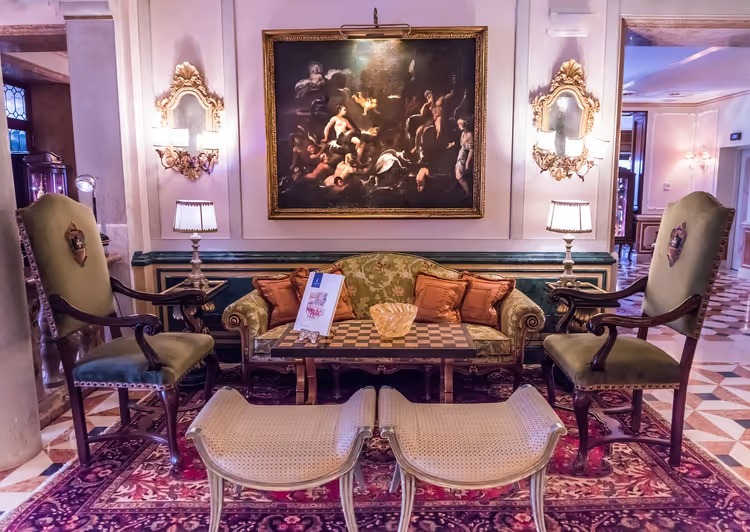
Design creates the first impression. Strong hotels combine modernity with local traditions and put meaning into small interior details. That's where a recognizable atmosphere comes from, one you want to return to.
 © Basile Morin · CC BY-SAPhoto: Basile Morin, CC BY-SA (https://creativecommons.org/licenses/by-sa/4.0), Wikimedia Commons
Service and amenities
The luxury segment holds its standard not only through renovations. You get more than a spacious room and a breakfast buffet: a concierge, 24-hour front desk, spa, gym, and restaurants with their own head chef. On top of that come local events, entertainment, and educational activities.
The concierge handles tasks that would take you an evening at a regular hotel: a restaurant table, transfer, tickets, an early breakfast before departure. Ask about these in advance, by email before arrival.
For a business trip, such a hotel handles logistics at a high level: business travel services on Trip.com. Negotiations in a quiet lobby go more smoothly than in a crowded cafe.
Attention to detail
The difference between luxury and mass market shows in the small things. Staff take note of the guest's personal preferences. You can influence the room choice and get a menu tailored to your taste habits. The hotel will take care of organizing an excursion or a trip in any direction.
Attention goes beyond requests. Guests can expect spacious rooms, natural bed linen, air conditioning, and thoughtful in-room relaxation options. Strong hotels work with atmosphere through scent and lighting.
What should you check yourself? A 24-hour front desk, spa hours, what the breakfast includes, and the early check-in policy. These points are usually listed on the hotel's website, and it's worth confirming them before booking.
Continuous training
Luxury hotels outperform competitors and still don't stop developing. They could lock in what they've achieved, but they keep raising their own bar.
Every employee goes through professional training and studies dozens of service protocols and rules. That's where the difference in small things comes from: you're greeted by name, your previous order is remembered, a solution is offered before you even ask.
The measure of mastery is simple. Reality doesn't just match expectations, it exceeds them. Check this through reviews: look not at the score, but at recurring details in recent reviews.
Uniqueness in everything
In luxury, a hotel isn't reduced to a place to sleep with a shower and breakfast. Every detail makes the stay special: round-the-clock care, opulence, and hospitality regardless of where you come from.
That exclusivity is what creates the VIP-guest feeling. You're not a number on a list, but a guest with a name and habits.
Practical takeaway: compare hotels not by the number of stars, but by the set of services you actually need. Spa, kids' area, transfer, and late checkout should be chosen based on your trip, not on a brochure.
What to expect from ultra-luxury?
Ultra-luxury sits above luxury, even when it seems there's nothing left to add. An important caveat: these hotels are not all the same, and the service offering depends on the destination. The same chain holds a different standard in different countries.
The ultra level is easy to find in Europe too. In Paris, London, and Rome, the most expensive hotels are set apart in a separate segment with their own rates.
Outside Europe, ultra-luxury is most often sought in the UAE, Qatar, and the Maldives.
The difference between segments is also visible in price. In London, New York, and Rome, ultra-luxury asks more than $1,500, while the regular luxury segment stays in the $500-800 range (as of 09/2026, CoStar market overview).
See hotels in the Maldives on Trip.com
 © Grand Hotel Djibloho · CC BY-SAPhoto: Grand Hotel Djibloho, CC BY-SA (https://creativecommons.org/licenses/by-sa/4.0), Wikimedia Commons
What's included in ultra-luxury?
You already know what luxury consists of. The category with the "ultra" prefix adds a different level of adaptation to the guest.
Ultra-hotels easily adjust to different types of travelers. The requests of a crown prince, a honeymoon couple, a programmer, and a billionaire are hard to bring to a common denominator. The service accounts for the aspects that make wealthy guests' stays comfortable and flawless.
As a rule, such hotels maintain several service levels. The base level targets affluent clients, the extended level targets the wealthiest. Each category gets its own experience, and the guest isn't disappointed with the trip.
The segmentation looks justified for another reason too. Not all guests like crossing paths with each other within the same hotel, so privacy is part of the base package.
Excursion options on GetYourGuide
What features does ultra-luxury have?
The specifics of ultra-luxury are visible in the degree of personalization. Menus and drinks here are selected for the tastes of a specific guest.
The same logic applies to leisure. In luxury, you choose from the hotel's program. In ultra-luxury, the program is built around your request.
Additional services also differ. In ultra-luxury, spa, transfer, and dinner are adjusted to your schedule.
Practical takeaway: before booking, clarify what's included in the rate. Spa, airport transfer, breakfast, late checkout, and minibar are often charged separately even at expensive hotels.
Luxury and ultra-luxury: comparison by criteria
Criterion | Luxury | Ultra-luxury |
|---|---|---|
Service level | High and predictable | Personalized, for a specific guest |
Service levels | One | Several, including for the wealthiest |
Menu and drinks | Hotel restaurant menu | Selected for the guest's tastes |
Leisure | Hotel program | Program built around the guest's request |
Spa | Booking on a shared schedule | Adjusted to the guest's schedule |
Privacy | Standard | Enhanced, guests are separated |
Nightly rate | Average luxury level | Several times above average luxury |
The table shows the difference in logic, not in finishes. Both segments can stand in the same city and on the same street.
⁉️🤔 Frequently asked questions
How does ultra-luxury differ from luxury?
Luxury maintains a high but uniform service level. Ultra-luxury adds personalized service and divides guests into categories. In practice, the difference is visible in personalization: spa, transfer, and dinner are adjusted to your schedule.
How much does a night at an ultra-luxury hotel cost?
There is no single price; it all depends on the city and season. In Paris during high season, rooms at the most expensive hotels reach $3,000-4,000 per night (as of 09/2026, CoStar on seasonal prices). Suites at these hotels sell for more.
Which countries should you look for ultra-luxury in?
In Europe, that's primarily Paris, London, and Rome, where ultra-luxury is set apart as a separate price segment. Outside Europe, people most often look at the UAE, Qatar, and the Maldives.
How do you check a hotel's level before booking?
Look at the official website, not just an aggregator. Clarify front desk hours, what the breakfast includes, what's covered by the rate, and the checkout policy. Lists from independent ratings, such as Forbes Travel Guide, help filter out weak options.
Are stars mandatory for the ultra level?
No. Stars and luxury are not the same thing. In Germany, the category is assigned by Deutsche Hotelklassifizierung according to a unified catalog of criteria (klassifizierung.de), not by the hotel itself. So look not only at stars, but also at the set of services.
In short: what's worth booking
The choice depends on the trip, not on the size of the budget. Here are simple rules.
If you need predictable comfort with your family: take a luxury hotel in a quiet area near transit.
If the trip is a celebration and you need maximum attention: look at ultra-luxury with several service levels.
If you're on a business trip: choose a hotel with a 24-hour front desk and concierge, and confirm the transfer in advance.
For a beach vacation with maximum privacy, destinations like the Maldives work well.
Compare options by price and included services, not just by photos: find a hotel on Trip.com.

A small editorial team writing guides for independent travel. We travel ourselves, but we haven’t been everywhere, so we check prices, opening hours and how to get there against official sources.