
















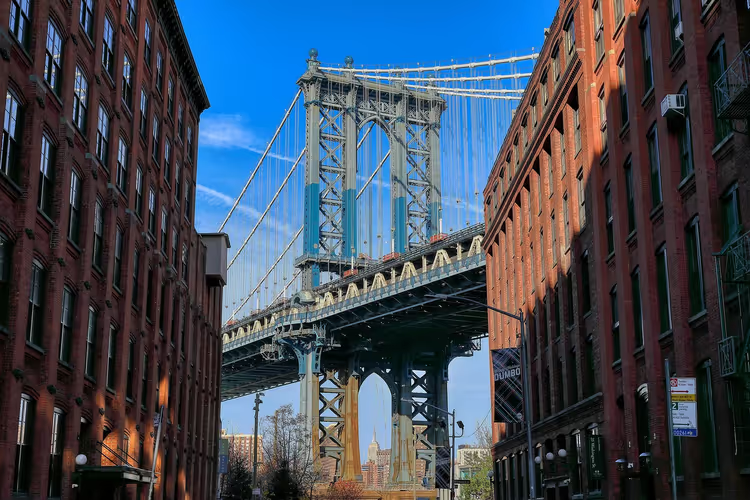
Manhattan Bridge in New York: walking tour and best views
The Manhattan Bridge is most often seen only from a taxi window or a subway car. You can walk across it for free, and it is a completely different New York.
The bridge connects Manhattan and Brooklyn. Its length is 2,089 meters, and four subway lines run on the lower level (as of 09/2026, Wikipedia, Manhattan Bridge).
Ad: this article contains affiliate links, we earn a commission if you book through them, at no extra cost to you.
We marked where the pedestrian walkway is, which side offers the best view of the city, and how to get to the bridge from JFK Airport.
Manhattan Bridge: facts and figures
💡 In short:
- The 2,089-meter crossing has connected Manhattan and Brooklyn since December 31, 1909 (as of 09/2026, the bridge's Wikipedia page).
- The pedestrian walkway is free and open 24/7. Cyclists have a separate path on the north side.
At the time of its opening, the bridge was the most functional of the three crossings over the East River. It has two levels. Cars drive on top, while pedestrians, cyclists, and four subway lines use the lower level. The towers reach 102 meters, and the main span stretches 451 meters (as of 09/2026, Wikipedia). For the city, this is a rare case where an engineering structure also became an observation deck.
 © Tdorante10 · CC BY-SAPhoto: Tdorante10, CC BY-SA (https://creativecommons.org/licenses/by-sa/4.0), Wikimedia Commons
History of the bridge
New York sits on the Atlantic coast, and the East River divides the city into Manhattan and Brooklyn. By the early 20th century, the two existing crossings could no longer handle the traffic flow. Construction of the third bridge began on October 1, 1901, and it opened to traffic on December 31, 1909 (as of 09/2026, Wikipedia). The project was designed by engineer Leon Moisseiff, and his solution became a model for bridge building of that era.
The new crossing had two levels. The neighboring Williamsburg Bridge turned out to be longer. Cars were first put on the upper level, while the lower level was given to pedestrians, cyclists, and trains. In 1910, the city began designing the approaches, and the architectural look was created by the firm Carrère and Hastings. The work was completed by 1915 (as of 09/2026, New York Landmarks Conservancy).
 © jqpubliq from Brooklyn, NY, United States · CC BY-SAPhoto: jqpubliq from Brooklyn, NY, United States, CC BY-SA (https://creativecommons.org/licenses/by-sa/2.0), Wikimedia Commons
On the Manhattan side, an arch and colonnade were built, fanning out in a semicircle from the road. This ensemble has long become a separate landmark of the neighborhood and is protected as a monument. The base is decorated with sculptures of the Spirit of Industry and the Spirit of Commerce, and above sits Charles Rumsey's frieze "Buffalo Hunt." Cars drive under the arch and onto the upper level of the bridge.
On the Brooklyn side stood figures representing Manhattan and Brooklyn. In the mid-20th century, they were moved to the Brooklyn Museum, and some local residents still consider this unfair. For the city, the bridge was primarily a transportation artery, not an ornament. The flow of people and goods across the East River grew every year.
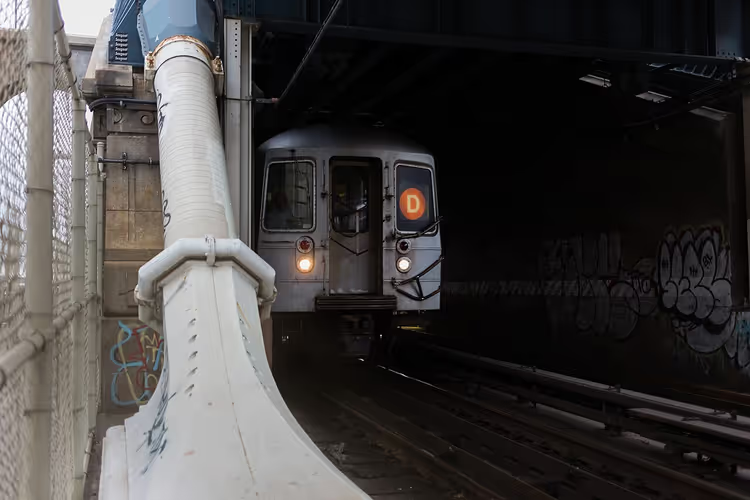
At first, the crossing served cars and pedestrians. Later, subway lines were added to the bridge (as of 09/2026, Wikipedia). The tracks ran along the outer side of the bridge, and constant vibrations eventually damaged the structure. In 1986, several lines were closed for repairs, and in 2004, four subway lines returned to the bridge.
Engineers built bridges to connect neighborhoods with convenient roads, so from the outside it is more engineering than architecture. But the openwork trusses withstand enormous loads and still do not look bulky. The bridge fits organically into the cityscape.
Manhattan Bridge today
The pedestrian walkway runs along the lower level, and from it you get a panorama of Manhattan and the Brooklyn Bridge. Among the skyscrapers you cannot fit the whole city into one frame. Only from the side does it become clear how buildings, streets, and bridges come together into a whole city.
 © Error46146 at English Wikipedia · CC BYPhoto: Error46146 at English Wikipedia, CC BY (https://creativecommons.org/licenses/by/3.0), Wikimedia Commons
If you walk from Manhattan toward Brooklyn on the right side, the view is better. From here it is convenient to shoot the panorama and the Brooklyn Bridge. The walkway is protected by a mesh fence, but it does not block the view. The skyline shots are worth putting up with the subway noise behind you.
The bridge is assembled with rivets, and they make it easy to imagine early 20th-century technology. In the era of welded seams, this looks especially unusual.
Manhattan Bridge in film
Directors often chose this crossing as a set. In "Independence Day," aliens first appear above the bridge. In "Deep Impact," a tsunami destroys the Brooklyn and Manhattan Bridges.
How to get there on your own
The easiest way is to fly into JFK Airport. From there, two routes lead to Manhattan. The AirTrain runs from JFK to Jamaica Station, and then you transfer to the subway toward the center. The AirTrain costs $8.75, the subway ride costs $3, and the trip takes about an hour (as of 09/2026, MTA).
A yellow taxi from JFK to Manhattan is faster, but the fare is flat, and fees and bridge tolls are added on top. Check the exact amount with the carrier before getting in.
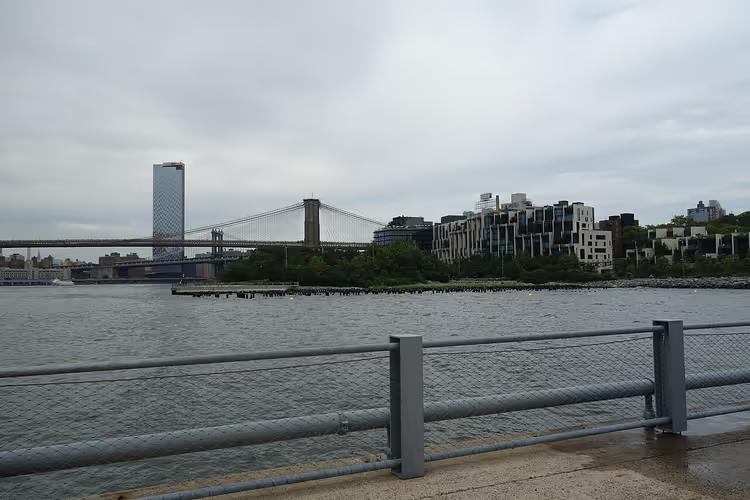 © Tdorante10 · CC BY-SAPhoto: Tdorante10, CC BY-SA (https://creativecommons.org/licenses/by-sa/4.0), Wikimedia Commons
You can reach the bridge on foot from either side. On the Brooklyn side, the nearby stations are High Street (A and C lines) and York Street (F line). On the Manhattan side, the closest are Grand Street (B and D lines) and East Broadway (F line).
Tours and tickets in New York
Guided tours, skip-the-line tickets and activities — most offers can be cancelled free of charge.
See offers on GetYourGuideThe widget loads once you give your consent.
⁉️🤔 Frequently asked questions
How much does it cost to walk across the Manhattan Bridge?
Walking across the bridge is free; you only pay for the subway. The walkway is open 24/7, so you can come at any time. In the morning and after sunset there are noticeably fewer people than during the day on weekends. Bring water with you, since there are no shops on the bridge.
Which side is better for photos?
The classic shot is taken not from the bridge, but from the Brooklyn side. From Washington Street in DUMBO, the span of the Manhattan Bridge is visible framed by buildings. From the walkway itself, shoot toward Brooklyn in the morning, when the light falls on Manhattan, and in the evening bring a tripod for shooting the lights.
How do I get from JFK Airport?
From JFK, take the AirTrain to Jamaica Station, then transfer to the subway toward Manhattan. The trip takes about an hour; a taxi is faster but more expensive.
Does the subway run on the bridge?
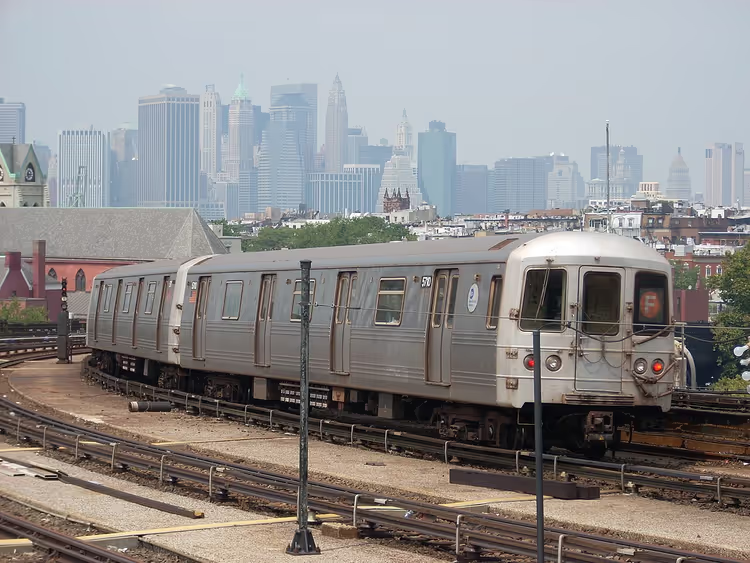
Yes, four subway lines run on the lower level: B, D, N, and Q (as of 09/2026, Wikipedia). They will take you from Manhattan to Brooklyn in a few minutes. The cars run along the outer side, so the window offers a view of the bay and the Brooklyn Bridge.
How many movies were filmed on this bridge?
Shots with the crossing appear in dozens of Hollywood films. Directors value the bridge as a ready-made set with a view of the East River and the city. Many visitors recognize the bridge precisely from movie scenes.
In short: what to book
The Manhattan Bridge does not require a ticket: the walkway is free, and you only pay for the subway. If you have half a day, walk it from Canal Street to Brooklyn and return by subway. If you want to see the crossing from the water and add other neighborhoods to your route, take a sightseeing tour: New York tours on GetYourGuide.

A small editorial team writing guides for independent travel. We travel ourselves, but we haven’t been everywhere, so we check prices, opening hours and how to get there against official sources.