
















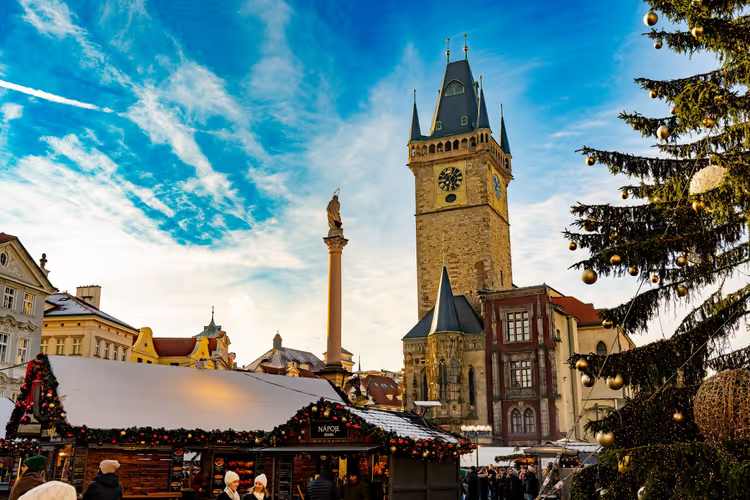
Old town hall: what is included in the ticket and when to watch the apostles
The Old Town Hall has stood on the main square of Prague for almost seven centuries. Its Gothic tower and the Orloj astronomical clock draw a crowd every hour, from nine in the morning to eleven at night. One ticket covers the whole route: the tower, the historic halls, the Chapel of the Virgin Mary, and the underground spaces.
Many tourists settle for a photo from the square and leave without knowing what the ticket actually includes. Others arrive at the most popular time and spend an extra hour in line. So let's look at how the town hall is organized, how the astronomical clock works, and when it makes the most sense to go up the tower.
Below you'll find the opening hours by season, what the ticket includes, directions from the metro, and the exact point on the map.
Ad: this article contains affiliate links, we earn a commission if you book through them, at no extra cost to you.
What to see at the old town hall
💡 In short:
- The town hall was founded in 1338 and is made up of five buildings around the Gothic tower.
- The Orloj astronomical clock shows the procession of the 12 apostles every hour from 9:00 to 23:00.
- One ticket includes the tower, the historic halls, the Chapel of the Virgin Mary, and the underground spaces.
- Prices and opening hours: 09/2026, verified on the official Prague City Tourism website.
The visitor route starts at the ticket office on the ground floor and leads through the historic halls to the tower (as of 09/2026, prague.eu). From the viewing gallery you'll see Old Town Square, the Church of Our Lady before Týn, and the tiled roofs of the quarter. The underground section preserves Romanesque vaults that are older than most of the buildings above ground. You can climb on foot via the spiral staircase or take the elevator.
History of the old town hall
The town hall came into being in 1338 as the meeting place of the Old Town council (as of 09/2026, Prague City Tourism page). It wasn't built from scratch: the city bought up neighboring houses and gradually attached them to the complex.

In the mid-15th century, Mikš's house was added to the western side. Two more houses, "At the Golden Moon" and "At the Rooster," were added in the late 17th century, and the city bought the house "At the Minute" in the late 19th century. Mikš's house was rebuilt in the Neo-Renaissance style to a design by Antonín Baum.
The eastern Neo-Gothic wing was badly damaged on May 8, 1945, during the Prague Uprising and was never restored (as of 09/2026, chronicle on prague.eu). As in other medieval town halls, there was a prison here: prisoners were lowered into the basement and buried under stones. In the 20th century, architects repeatedly proposed expansion projects, but no competition ever reached the construction stage.
Description and appearance of the town hall
Today the town hall remains both a tourist attraction and a working municipal administration building. The ground floor houses the chapel and ceremonial halls, while meetings and ceremonies take place upstairs. The original appearance of the eastern wing has not survived: some of the buildings were destroyed at the end of World War II.
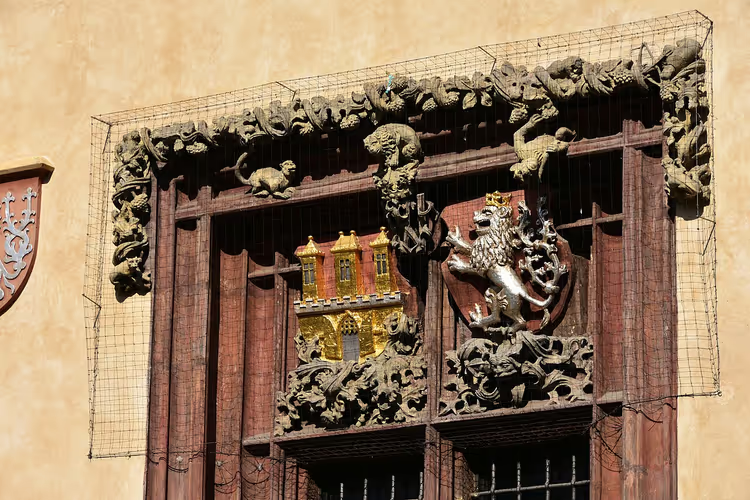 © Richard Mortel from Riyadh, Saudi Arabia · CC BYPhoto: Richard Mortel from Riyadh, Saudi Arabia, CC BY (https://creativecommons.org/licenses/by/2.0), Wikimedia Commons
For a separate fee, anyone can go inside, and couples hold weddings here. Allow extra time for your visit so you can both go up the tower and see the halls. During ceremonies, some rooms are closed to tourists.
Architecture of the complex
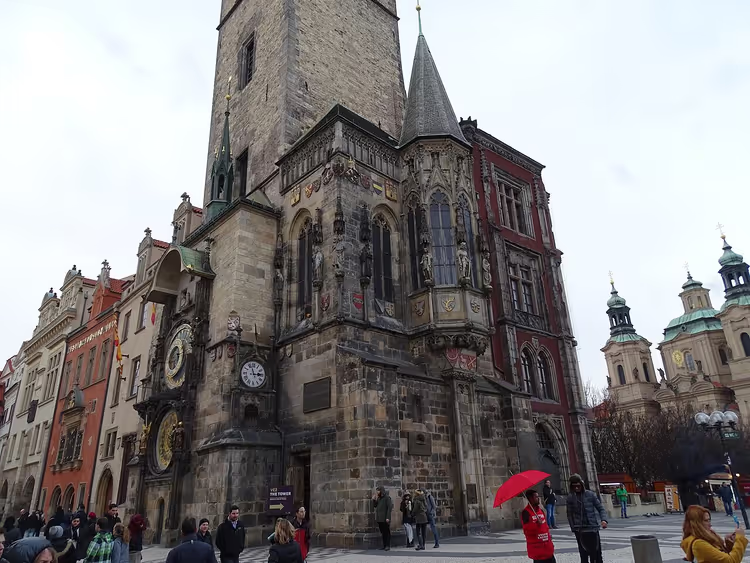
The town hall consists of five buildings in different styles that were combined into one complex. They are former townspeople's houses that the city council gradually bought up. The facades are designed in the Italian Neo-Gothic style, and the tower, about seventy meters high, was built in the late 14th century.
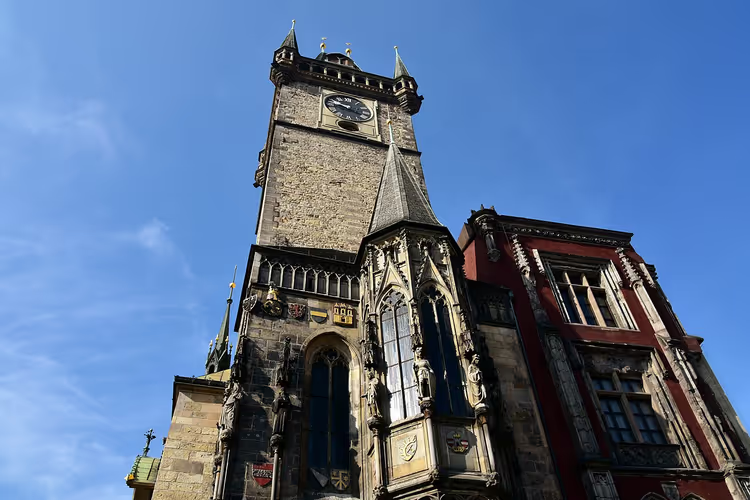 © Richard Mortel from Riyadh, Saudi Arabia · CC BYPhoto: Richard Mortel from Riyadh, Saudi Arabia, CC BY (https://creativecommons.org/licenses/by/2.0), Wikimedia Commons
The tower features a richly decorated window and a chapel with an oriel on the eastern side. The grand vestibule was designed during the reconstruction of the late 15th century. Two large mosaics were created by the Czech architect Vojtěch Ignác Ullmann based on a design by Mikoláš Aleš.
On the western wall is a depiction of Princess Libuše, who foretells the greatness of Prague. Opposite it is the composition "Homage of the Slavs to Prague". There is also a bronze statue from the late 19th century by Josef Václav Myslbek: the legendary singer Lumír accompanied by the figure of Song.
A staircase designed by Jan Bělský leads to the first floor. Wedding ceremonies are held here, and the assembly hall and Council Chamber are on the second floor. The Council Chamber has preserved its appearance from the second half of the 15th century: Gothic wall paneling, emblems, and coats of arms of the Old Town. The most valuable item is considered to be a wooden figure of Christ from the early 15th century.
Chapel of the Virgin Mary
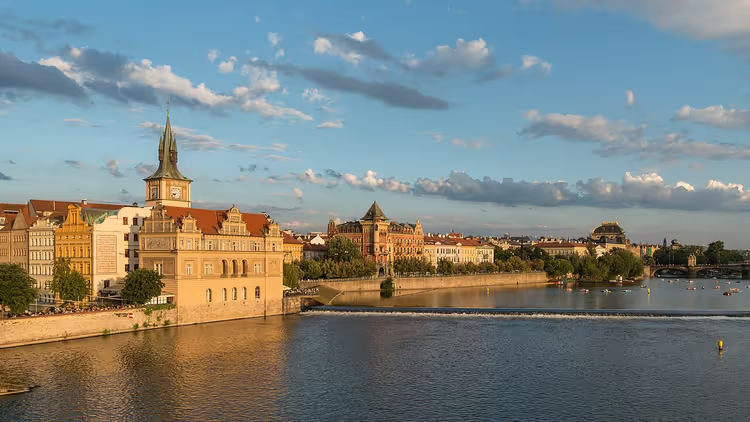 © DXR · CC BY-SAPhoto: DXR, CC BY-SA (https://creativecommons.org/licenses/by-sa/4.0), Wikimedia Commons
The chapel is located on the first floor and is included in the ticket. Its stained glass windows show the figures of the apostles and the mechanism of the astronomical clock. From the outside, the chapel is recognizable by its five-sided oriel with the coats of arms of the Czech lands.
The Gothic portal on the right side has not survived: it was destroyed during World War II. Mass used to be celebrated here before council meetings, and festive liturgies were held. Today the chapel hosts only state events and weddings, so you may find it closed.
The Orloj astronomical clock
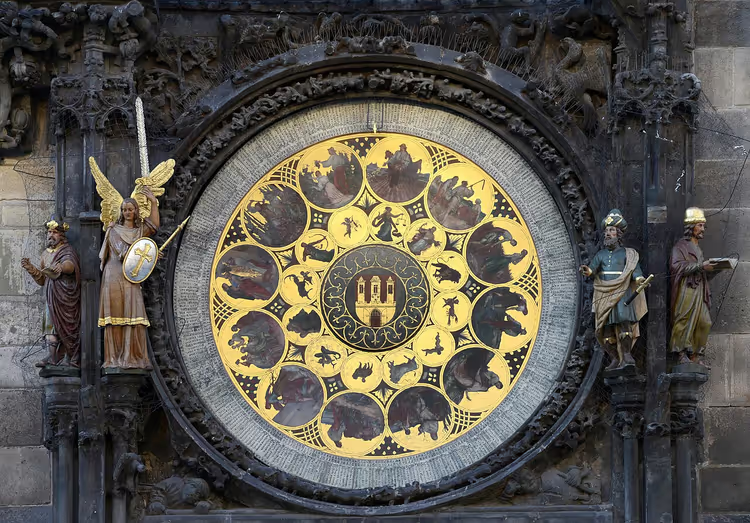
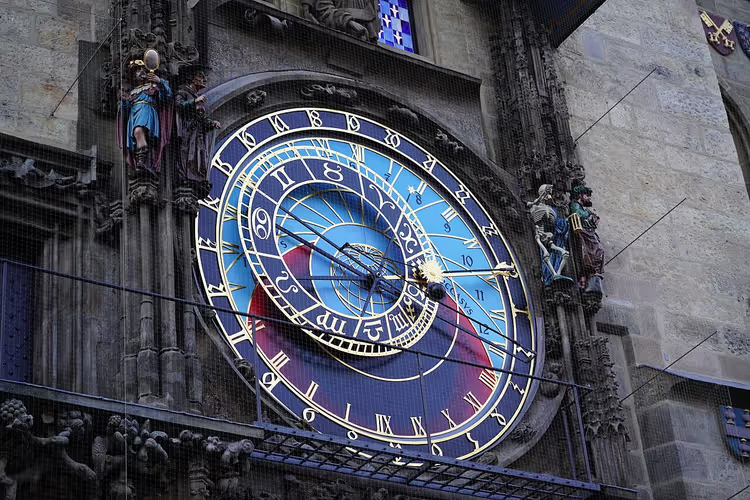
The crowd gathers at the tower because of the Orloj, one of the oldest astronomical clocks in the world. The mechanism is divided into three parts: the windows with the apostles, the astrolabe, and the calendar dial.
 © Alvesgaspar · CC BY-SAPhoto: Alvesgaspar, CC BY-SA (https://creativecommons.org/licenses/by-sa/4.0), Wikimedia Commons
The apostles and moving figures
Every hour from 9:00 to 23:00, the 12 apostles appear in the upper windows and bow to the crowd (as of 09/2026, the procession of the apostles on prague.eu). Each has their own symbol: Saint Peter has a key, Saint Matthew an axe, Saint John a chalice. Four figures below the windows join the performance together with the apostles.
The skeleton turns over an hourglass and rings a bell, reminding us of the end of life. The Turk shakes his head, refusing to surrender to death. The figure of Vanity looks in a mirror, and the Miser shakes a purse of money. The show ends with the crow of a rooster, and you will hear it even from deep within the square.
 © Ray Swi-hymn from Sijhih-Taipei, Taiwan · CC BY-SAPhoto: Ray Swi-hymn from Sijhih-Taipei, Taiwan, CC BY-SA (https://creativecommons.org/licenses/by-sa/2.0), Wikimedia Commons
The astrolabe and the calendar
The upper dial shows the movement of the planets as it was imagined in the Middle Ages: the Sun revolves around a stationary Earth. Below is a calendar wheel with the coat of arms of the Old Town, the signs of the zodiac, and the months. Along the edge of the wheel are 365 notches, and each day it moves by one (according to the article about the Orloj, 09/2026).
The clock shows four times at once: Central European time in Roman numerals, Old Czech time in Gothic numerals, Babylonian time, and sidereal time. The Old Czech reckoning begins at sunset. Some researchers see the four elements in the design: earth, water, air, and fire.
History of the astronomical clock
The first clock on the tower was installed around 1402, and the oldest record of the astronomical clock is dated October 14, 1410 (according to the chronology of the Orloj, 09/2026). It was built by the clockmaker Mikuláš of Kadaň based on calculations by the mathematician Jan Šindel.
For a long time it was believed that the clock was created by Jan Růže, known as Master Hanuš, in 1490. In fact, he only repaired it between 1475 and 1497 and modernized the mechanism. After him, the clock was worked on by the clockmakers Jakub, Václav Zvonek, and Jan Táborský.
 © Bradley Weber · CC BYPhoto: Bradley Weber, CC BY (https://creativecommons.org/licenses/by/2.0), Wikimedia Commons
In the 18th century, the mechanism was nearly forgotten, but Professor Antonín Strnad convinced the city to restore it. The restoration took place in 1787-1791, the apostle figurines were added later, and the rooster was installed after the reconstruction of 1865-1866 (according to the history of restorations, 09/2026).
During the Prague Uprising of 1945, the town hall burned, and the flames damaged the clock mechanism along with the statues. The clock was restored in 1948 by the Vesecký brothers, and the mechanism has been working ever since.
South facade of the town hall
 © ŠJů · CC BYPhoto: ŠJů, CC BY (https://creativecommons.org/licenses/by/4.0), Wikimedia Commons
When another house was purchased in the mid-15th century, work on the interior was completed with a new portal in the late Gothic style. The double wooden door was installed in the mid-17th century.
The windows of the south facade date to the early 16th century and are done in the Renaissance style. The central window is original, while the two side windows were added in the first half of the 18th century. The canopies above the pilasters are made in the Gothic style, which makes the facade look older than the dates suggest. This is the side that tourists coming from Wenceslas Square see first.
Opening hours, tickets and tips
The Old Town Hall is open daily, but hours depend on the season (as of 09/2026, official Prague City Tourism schedule). From January through March the tower and halls are open from 10:00 to 19:00, from April through December from 9:00 to 20:00. Go up the tower in the morning or closer to closing time to avoid crowding on the gallery.
In the first hour after opening there is a 50% early bird discount (as of 09/2026, early bird discount terms); it does not apply on December 25 and January 1. The price depends on the season and ticket type, and the family rate works out cheaper than buying tickets separately. Check the exact price for your date at the Prague City Tourism ticket office, the only official ticket seller.
Book timed-entry tickets in advance through Tiqets or choose guided tours of Prague.
Tours and tickets in Old Town Hall Prague
Guided tours, skip-the-line tickets and activities — most offers can be cancelled free of charge.
See offers on TiqetsThe widget loads once you give your consent.
Location and how to get there
The Old Town Hall stands on Old Town Square in the center of Prague, next to the Church of Our Lady before Týn. The closest option is metro line A, Staromestska station, and trams to the same stop. From Wenceslas Square you can walk there in about 10 minutes.
Come at opening time or after 18:00, when the crowd around the astronomical clock thins out. The procession of the apostles is easier to watch from the side of the tower: that way you see the windows rather than the backs of tourists.
Old Town Hall on the map
The map pin and the square's location are below.
⁉️🤔 Frequently asked questions
How much does it cost to enter the Old Town Hall?
The price depends on the season and ticket type, and the 50% early bird discount applies only in the first hour after opening (according to prague.eu, 09/2026). Check the exact price for your date at the official Prague City Tourism ticket office. The family rate is a better deal than buying tickets separately, so take it if you are visiting with children.
When does the clock show the procession of the apostles?
The apostles appear every hour from 9:00 to 23:00, so there is no need to wait specifically for noon (according to prague.eu, 09/2026). Arrive 10 minutes early to get a spot to the side of the tower. The show itself lasts less than a minute, but the crowd gathers in advance.
What is included in one ticket?
The ticket includes the tower with its viewing gallery, the historic halls, the Chapel of the Virgin Mary and the underground areas (according to prague.eu, 09/2026). You can go up on foot or by elevator. The visit takes about an hour if you do not linger at every display case.
How do I get to the Old Town Hall?
The fastest way is metro line A to Staromestska station or trams 2 and 18 (according to prague.eu, 09/2026). From the stop to the entrance is less than five minutes on foot. From Wenceslas Square it is about a 10-minute walk.
When is the best time to come to avoid standing in line?
The fewest people are there in the first hour after opening and after 18:00. In the first hour the early bird discount applies, so the morning is also better for the price. In summer the ticket office line stretches across the square by midday; in winter it is noticeably shorter.
In short: what to book
The Old Town Hall covers three interests at once: a Gothic tower with a view over the square, the Orloj astronomical clock and the underground areas with Romanesque vaults. If you have one day in Prague, get a ticket with a morning time slot and go up the tower before the crowds. If you are visiting with children, plan your visit for the start of the hour to see the procession of the apostles.
The choice is simple. If you want the view from the tower, get a ticket in the first hour. If you only want the astronomical clock, come at the start of the hour and watch from the square for free. Check the opening hours before your trip: the schedule changes on holidays (as of 09/2026, current schedule on prague.eu).
Start with timed-entry tickets through Tiqets.

A small editorial team writing guides for independent travel. We travel ourselves, but we haven’t been everywhere, so we check prices, opening hours and how to get there against official sources.