
















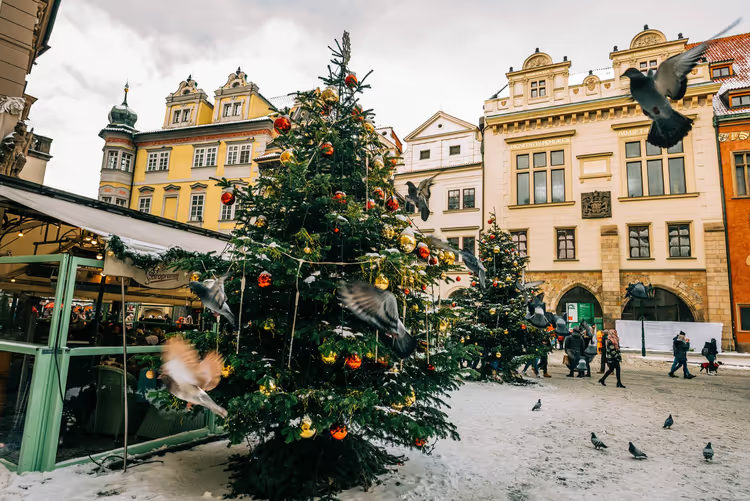
Old Town Square: what to see and when to go to the astronomical clock
Old Town Square is the main square of the Old Town in Prague. People come here for the Prague Astronomical Clock, the Church of Our Lady before Týn and the town hall, but often run into crowds and confusing prices.
Below: the history of the place, a description of all key sights, opening hours and ticket prices, plus metro and tram routes. The square covers almost 15,000 sq m.
Prices and opening hours were checked on 14.09.2026 on the official website prague.eu.
Ad: the text contains affiliate links: we earn a commission from them, the price for you does not change.
What to see on Old Town Square
💡 In short:
- The square in the Prague 1 district is open around the clock, admission is free.
- In one visit you can see the town hall with the astronomical clock, the Church of Our Lady before Týn, the Church of St. Nicholas and the Jan Hus Memorial.
An hour is enough for a quick look. If you want to go inside the town hall and climb the tower, plan half a day.
It is crowded here during the day, calmer in the evening. The astronomical clock draws a crowd every hour, so watch the show from the side rather than from the center.
History of the square
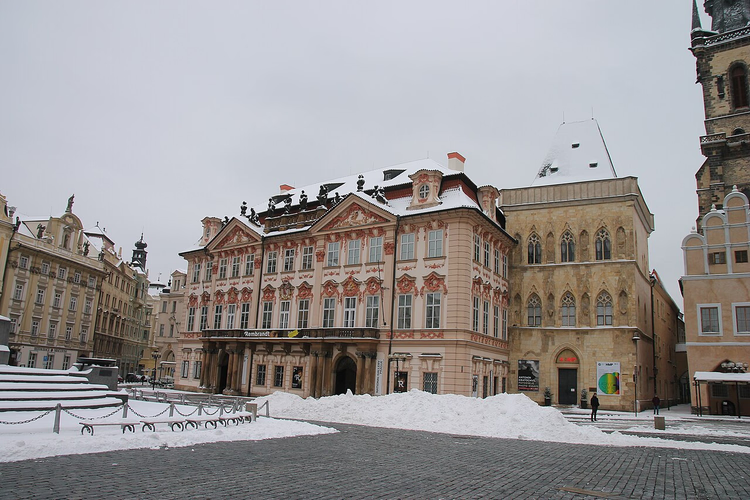 © Draceane · CC BY-SAPhoto: Draceane, CC BY-SA (https://creativecommons.org/licenses/by-sa/4.0), Wikimedia Commons
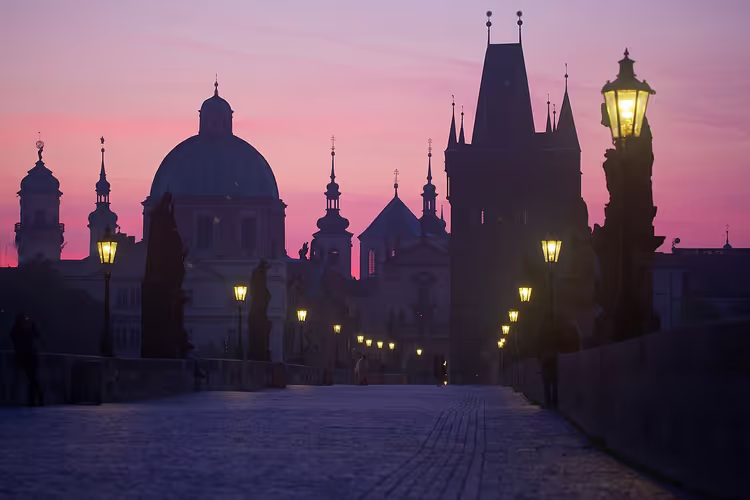
The Old Town and the Lesser Town are connected by Charles Bridge, the symbol of Prague. Old Town Square lies in the very heart of the historic part of the city.
The first mentions of this place date back to the early 10th century. At the intersection of trade routes, the largest market in Europe grew up here. In the 13th century it was named the Old Market, later it came to be called Old Town Square.
Merchants from other countries came here. They traded fabrics, clothing, items made of wood, clay and leather. Fish was brought from the north of the country.
The name changed over the centuries: Old Town Platz, Great Square. The square received its current name in 1895. Locals call it Staromák.
People strolled at fairs here and people were executed here. In 1422 Jan Želivský, who led the poor against the nobility, was executed. In 1437 the Hussite leader Jan Roháč was killed. In the early 17th century 27 people were executed for attempting to overthrow the Habsburgs.
Over time the square became a cultural center. In the 14th century construction began on the Church of Our Lady before Týn, then the town hall and the tower with the astronomical clock were built. In the second half of the 20th century vehicle access was banned. Now it is a pedestrian zone, and horse-drawn carriages ride around the square.
What the square looks like today
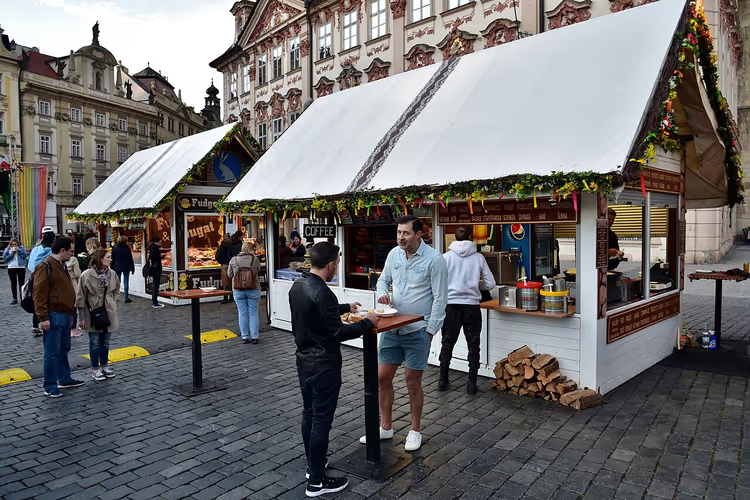 © Bahnfrend · CC BY-SAPhoto: Bahnfrend, CC BY-SA (https://creativecommons.org/licenses/by-sa/4.0), Wikimedia Commons
Along the perimeter stand buildings in several styles: rococo, renaissance, baroque. They complement each other and create a recognizable look.
During the day it is crowded here. Tourists study the facades, listen to street musicians and illusionists. Performances go on until late evening.
It is easy to spend the whole day on the square. You can visit an art gallery, go down into the Romanesque underground or have lunch in an old beer restaurant. In the evening add an organ music concert.
Czech beer is brewed here in hundreds of varieties, including in home breweries using old recipes. At the "Old Town Restaurant" you will be offered dozens of varieties of this drink.
In summer tables are set out right by the entrance. You watch city life without getting up. Inside there is wooden furniture, houseplants and paintings with views of medieval Prague.
In the center of the square there is a tourist center. There you can learn about the city's sights, buy booklets and get a map of Prague for free.
Sights of the square
In the center stands the Jan Hus Memorial. To the west is the town hall with the tower and the Orloj astronomical clock, where the self-government bodies worked. In the northern part is the Church of St. Nicholas, in the eastern part the Kinský Palace.
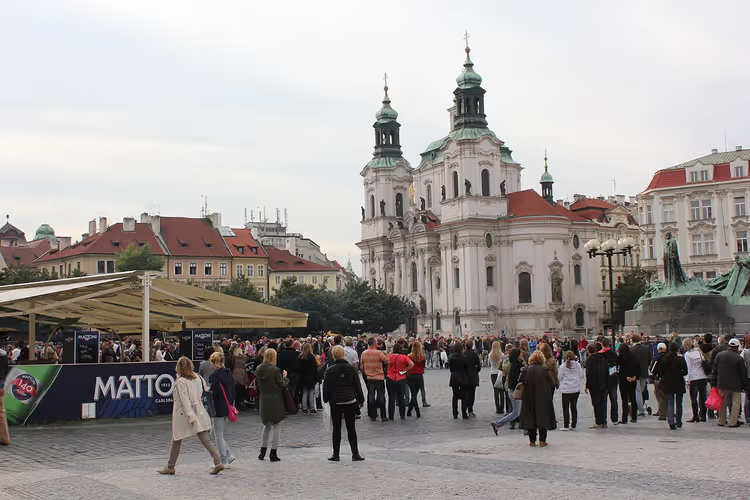
The Kinský family produced Bertha von Suttner, a Nobel Peace Prize laureate. Nearby stands the medieval house Dům U Kamenného zvonu with a Gothic facade. Its stone house sign is shaped like a bell. The building now hosts exhibitions of contemporary artists.
Týnská škola in the eastern part is one of the oldest schools in the city. It was founded in the last quarter of the 13th century, and students learned in Latin. The school operated until the mid-19th century. On the main facade there is a fresco of the "Assumption of the Virgin Mary".
Old Town Hall and the Prague Astronomical Clock
The town hall was founded in 1338 as the administrative center of the Old Town. The oldest part is the Gothic tower with a chapel and the astronomical clock. The town hall consists of several buildings connected by underground passages.
Visitors enter a lobby with murals. Beyond that are the halls: the Brožík Hall is decorated with canvases by Václav Brožík on historical subjects. Here stands the mayor's chair, which visitors are allowed to sit in.
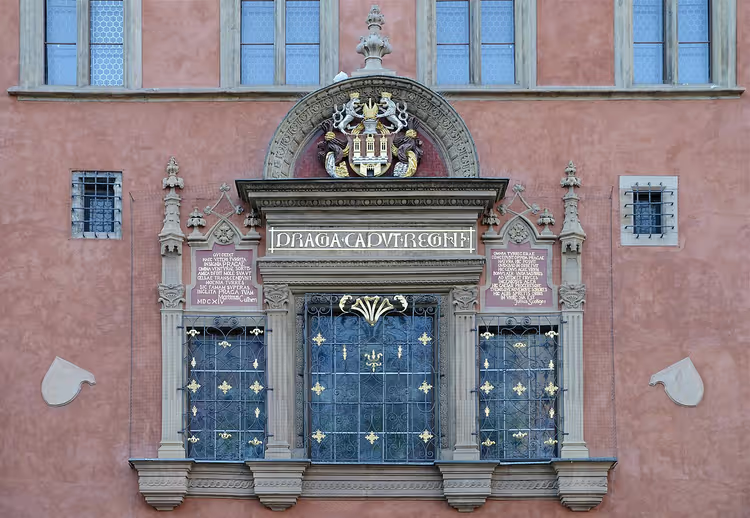 © Alvesgaspar · CC BY-SAPhoto: Alvesgaspar, CC BY-SA (https://creativecommons.org/licenses/by-sa/4.0), Wikimedia Commons
In the Assembly Hall there are sculptures of Themis and Christ. On the walls are the coats of arms of craftsmen: coopers, shipbuilders, shoemakers. The shoemakers have boots on their coat of arms, the potters have Adam and Eve.
The Romanesque underground holds sculptures of saints, prison and storage rooms. The square used to serve as an execution site. Wells are also located here.
The Jiřík Hall is decorated with chandeliers and brown-toned finishes. Marriages are registered in the town hall: the ceremony takes place in medieval interiors.
Prague Astronomical Clock
 © Ray Swi-hymn from Sijhih-Taipei, Taiwan · CC BY-SAPhoto: Ray Swi-hymn from Sijhih-Taipei, Taiwan, CC BY-SA (https://creativecommons.org/licenses/by-sa/2.0), Wikimedia Commons
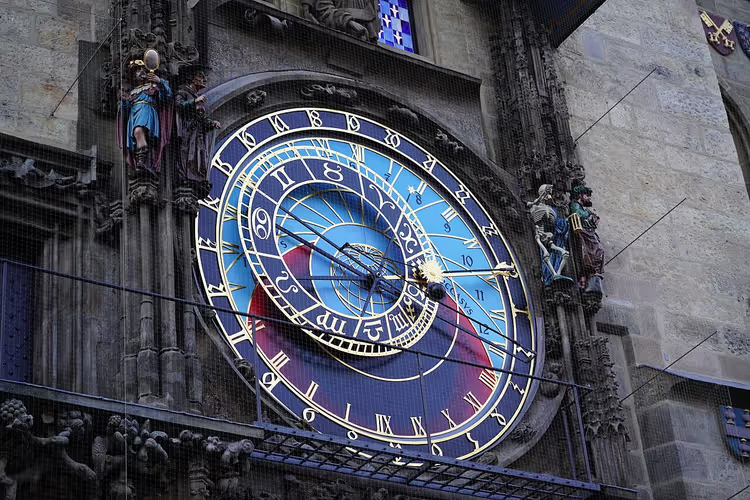
The main decoration of the town hall is the Orloj clock. Work on it began in 1410. The task was entrusted to master Mikuláš of Kadaň and mathematician Jan Šindel. The clock was needed so that townspeople would not be late for services and trade deals.
In the 15th century the calendar dial was made and Gothic sculptures were installed. The figures of the apostles appeared in the 19th century. The astronomical clock shows current and old Czech time. The dials consist of four parts and move against the background of the sky and the Earth, and a golden star marks the vernal equinox point.
Every hour from 8:00 to 23:00 there is a show (as of 09/2026, prague.eu). The figure of Death sets the mechanism in motion, and 12 apostles appear in the upper openings. Each holds their own object: Matthew has an axe, Peter has a key. Below, the figures of Greed, Death, the Turk and the Archangel Michael move.
During World War II the astronomical clock was damaged, but it was restored. Watching the show from the square is free, but entering the tower costs extra.
Observation deck on the tower
At the top of the tower, an observation deck is open above the astronomical clock. The tower is open from 9:00 to 20:00 from April through December and from 10:00 to 19:00 from January through March (as of 09/2026, Prague City Tourism).
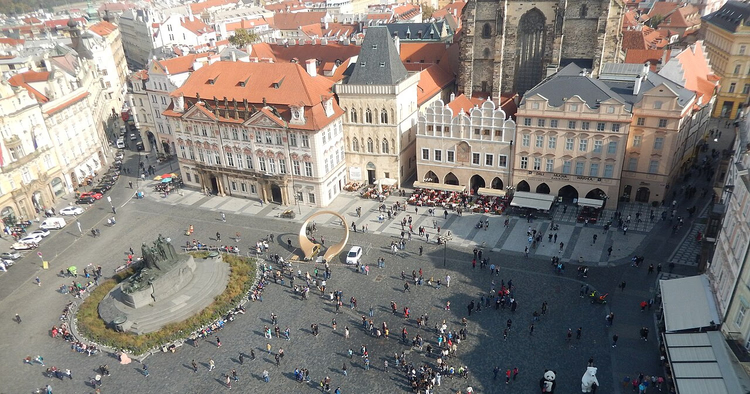 © Prabhachatterji · CC BY-SAPhoto: Prabhachatterji, CC BY-SA (https://creativecommons.org/licenses/by-sa/4.0), Wikimedia Commons
You can go up by the new elevator or take the stairs. From the top you will see the Old Town, the Church of Our Lady before Týn, and Prague Castle. Come at opening time: the deck is less crowded in the morning.
Church of Our Lady before Týn
 © Bradley Weber · CC BYPhoto: Bradley Weber, CC BY (https://creativecommons.org/licenses/by/2.0), Wikimedia Commons
The Church of Our Lady before Týn is visible from anywhere on the square; its two towers with sharp spires can be seen from afar. It is an active Catholic church with Gothic and Baroque elements. Construction ran from the mid-14th century to the early 16th century.
In 1679 the church was badly damaged by fire. The nave was then lowered, and during reconstruction the old Gothic towers were replaced with small Baroque-style towers. The interior is considered one of the finest collections of Gothic, Renaissance, and early Baroque art (according to the church's official page).
Inside there are 19 altars, an old baptismal font, and a stone pulpit from the 15th century. To the right of the nave stands a statue of the Madonna and Child. The walls are decorated with paintings by Karel Škréta. The organ from 1673 is considered the oldest in Prague.
More than 60 people are buried here, including the astronomer Tycho Brahe and Bishop Lucian. There is also a tragic story: a boy named Šimon Abeles secretly attended the church and converted to Catholicism, for which his father ordered him killed. The child was buried in the church as a martyr.
Entry to the church is free, with a recommended voluntary donation of 50 crowns (as of 09/2026, visiting the church). Viewing is not possible during Mass. The catch: on Mondays and Sundays the church is closed to tourists.
Church of St. Nicholas
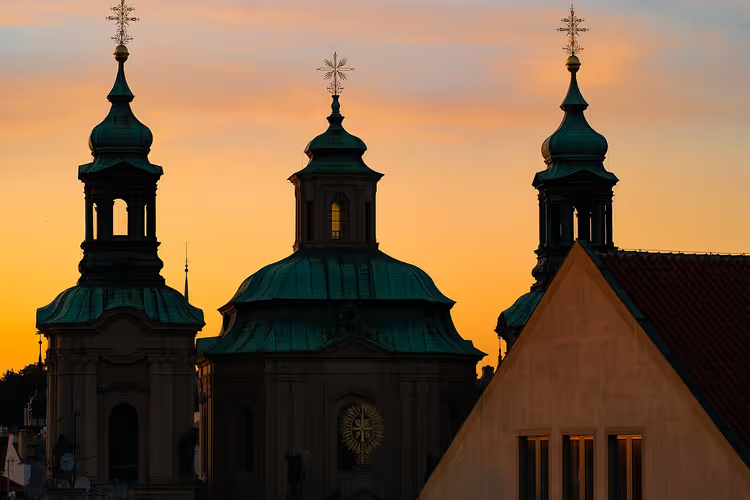 © Nan Palmero from San Antonio, TX, USA · CC BYPhoto: Nan Palmero from San Antonio, TX, USA, CC BY (https://creativecommons.org/licenses/by/2.0), Wikimedia Commons
The Church of St. Nicholas stands in the northern part of the square. The first structure on this site has been known since the 13th century. The last reconstruction took place in 1732-1737, when the city gained a Baroque building.
The church belongs to the Czechoslovak Hussite Church, not the Catholic one. Inside you will see an organ and stained glass windows with Saints Wenceslas and Nicholas.
From 1787, by order of King Joseph II, the country's religious buildings were closed. The church was taken over by the city magistrate: grain, furniture, documents and books were stored here. The building fell into disrepair and was slated for demolition, but in 1870 it was leased to the Russian Orthodox Church. This saved the church, and restoration began.
Russian Emperor Alexander II gifted the church a choros chandelier in the shape of an imperial crown. The consecration took place in August 1874. Today classical music concerts are held here regularly; tickets are sold at the box office and online.
Jan Hus Monument
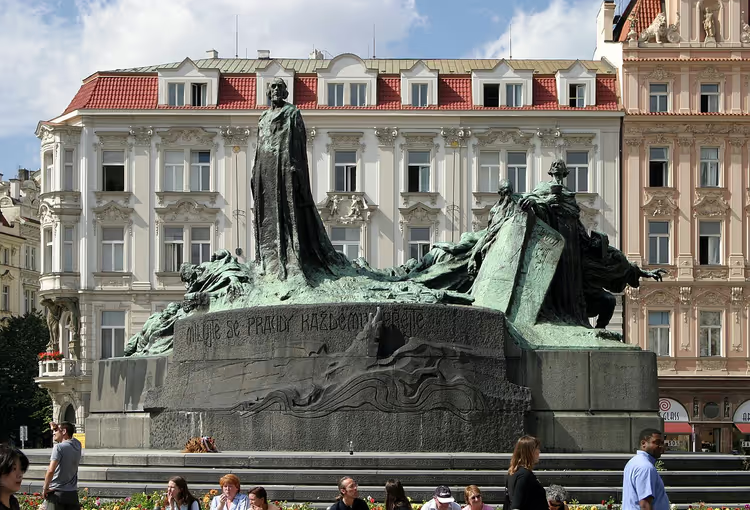 © Petr Vilgus · CC BYPhoto: Petr Vilgus, CC BY (https://creativecommons.org/licenses/by/2.5), Wikimedia Commons
The Jan Hus Monument was erected in 1915 to mark the 500th anniversary of the execution of the Czech national hero. Hus was accused of heresy and burned at the stake. The monument was created by sculptor Ladislav Šaloun.
At the center of the composition is the figure of Jan Hus, facing the Church of Our Lady before Týn. Along the perimeter is an inscription: "Love one another, wish truth for everyone." Nearby are two groups of people: victorious warriors, Hus's supporters, and emigrants exiled two hundred years after the execution. Between them is the figure of a Mother, a symbol of the nation's rebirth.
Houses and mansions around the square
Dům U Minuty is part of the town hall complex. The house was built in the Gothic style in the 15th century; after renovation it acquired Renaissance features. In the early 17th century the facade was decorated with black-and-white sgraffito paintings depicting historical and biblical scenes. Today it houses a cafe offering dozens of varieties of tea, coffee and desserts.
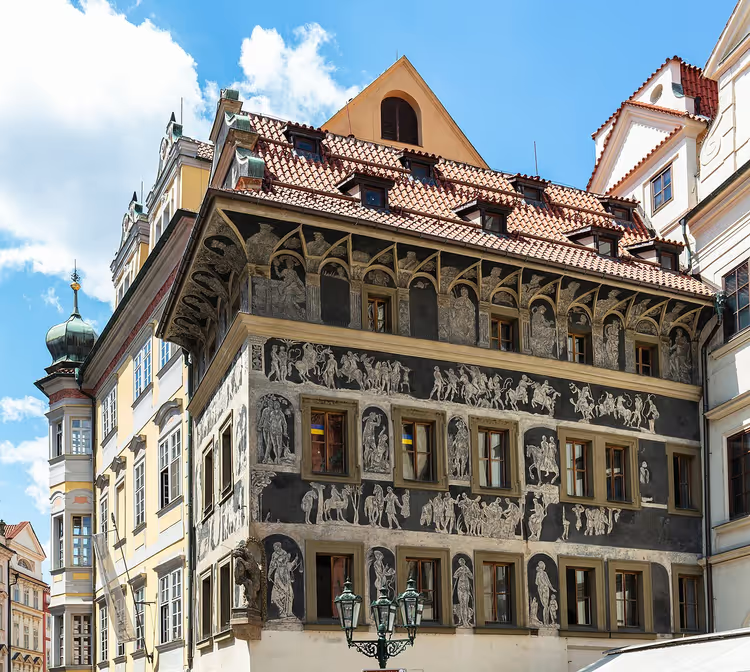 © Diego Delso · CC BY-SAPhoto: Diego Delso, CC BY-SA (https://creativecommons.org/licenses/by-sa/4.0), Wikimedia Commons
Štorchův dům stands nearby. Its front wall is covered with Renaissance-style frescoes. One depicts Saint Wenceslas on horseback, and a statue of the Madonna is installed above the entrance. The facade is adorned with a neo-Gothic balcony.
Dům U Bílého jednorožce was built in the 15th century as the residence of the Trčkovský family. The Church of Our Lady before Týn rises nearby. Another house, Dům U Kamenného beránka, got its name from its house sign. The stone depicts a lamb with a horn, which is why some historians consider it a unicorn.
From 1907 to 1914, Dům U Bílého jednorožce housed the fashion salon of Fantová-Wertheim. Albert Einstein and Franz Kafka visited it. On the house facade there is a fresco "Consolation of the Suffering."
All these houses are well preserved. Each has its own name and adds to the square's character.
Tickets and opening hours
Tickets are needed only for the town hall tower and its interiors. The square, the Hus Monument and the Church of Our Lady before Týn are free to visit. Here is the key information in one table.
Site | Admission | Hours | Closed |
|---|---|---|---|
Old Town Hall Tower | 350 CZK, adult (as of 09/2026, tickets and rates) | Apr-Dec 9:00-20:00, Jan-Mar 10:00-19:00 | none |
Church of Our Lady before Týn | free, 50 CZK donation (as of 09/2026, visiting hours) | Tue-Sat 10:00-13:00 and 15:00-17:00 | Monday, Sunday |
Church of St. Nicholas | concert ticket | per evening program | none |
Jan Hus Monument, square | free | 24/7 | none |
Child and student tickets for the tower are cheaper. You can buy tickets at the town hall box office or online in advance, so you don't have to wait in line.
tickets to the Old Town Hall and tower
Tours and tickets in Old Town Hall Prague
Guided tours, skip-the-line tickets and activities — most offers can be cancelled free of charge.
See offers on TiqetsThe widget loads once you give your consent.
How to get to the square
The square is located in the Prague 1 district, in the very center of the city. The easiest way to get there is by metro or tram.
- Green line A: Staroměstská or Můstek station.
- Yellow line B: Náměstí Republiky (Republic Square) station.
- Trams No. 1, 2, 6, 14, 17, 23, 41, 57, 59: stops Náměstí Republiky, Právnická fakulta, Staroměstská.
From Staroměstská metro station it's about a 5-minute walk (per the map). From Náměstí Republiky it's about 7 minutes via Celetná Street. Check schedules and routes with the carrier DPP.
The square on the map
The square runs north to south and is bounded by Celetná, Dlouhá and Pařížská streets. Coordinates for navigation: 50.0844, 14.4199.
open Old Town Square on the map
⁉️🤔 Frequently asked questions
How much does it cost to enter Old Town Square?
Old Town Square is an open public space, and entry is free at any time of day. You only pay to go up the Old Town Hall tower. Evening concerts at the Church of St. Nicholas are also ticketed, and tickets are sold on site.
When is the best time to watch the astronomical clock show?
The show with the apostles runs every hour from 8:00 AM to 11:00 PM, and access to the square is free (as of 09/2026, City of Prague data). Arrive 10 minutes before it starts and stand off to the side rather than in the middle of the crowd. In the morning and late evening there are noticeably fewer people than at midday.
Can you go inside the Church of Our Lady before Týn?
Yes, entry is free, but the church is closed during masses. You can visit Tuesday through Saturday from 10:00 AM to 1:00 PM and from 3:00 PM to 5:00 PM (as of 09/2026, tours and hours). It is closed on Mondays and Sundays. The recommended voluntary donation is 50 crowns (as of 09/2026, visiting the church). It is best not to take photos during services.
How do you get to Old Town Square?
The easiest way is by metro: green line A, Staroměstská or Můstek station, or yellow line B, Náměstí Republiky station. From the metro it is a 5-7 minute walk using a map. Trams 1, 2, 6, 14, 17, 23, 41, 57 and 59 stop near the square.
What to see near Old Town Square?
It is roughly 600-700 m to Charles Bridge and about 600 m to Wenceslas Square (on the map). A little farther away are Prague Castle and St. Vitus Cathedral. Near the square stand the Powder Tower and the Municipal House. You can easily put together a full-day route without using transport.
In short: what to book
Old Town Square itself is free. Plan your visit for the morning: fewer tourists, softer light for photos, and a shorter line for the tower.
- If you have one day in Prague: get a ticket for the Old Town Hall tower and viewing platform.
- If you are with kids: come for the astronomical clock show and watch the street performers.
- If you want music: get a ticket for an evening concert at the Church of St. Nicholas.
Main booking: Old Town Hall tickets. For a guided walk: tours of Prague's Old Town.

A small editorial team writing guides for independent travel. We travel ourselves, but we haven’t been everywhere, so we check prices, opening hours and how to get there against official sources.