
















Pest: what to see, when it is open and how much entry costs
Most of Budapest lies on the east bank of the Danube. This is Pest: two thirds of the city's area, the parliament, the main squares, and the Széchenyi Baths. In one day you can see the synagogue, the basilica, and the Széchenyi Baths if you sort out tickets and opening hours in advance.
We walked the route on the map and put together the places in Pest that are truly worth your time. For each spot below you'll find opening hours, admission prices, and how to get there. You'll know in advance where to buy tickets online and where entry is already inexpensive.
Ad: this article contains affiliate links, we earn a commission if you book through them, at no extra cost to you.
How Pest is laid out
Pest occupies the east bank of the Danube, and most of the city's sights are concentrated here. Buda on the west bank is known for Buda Castle and the Fisherman's Bastion, while Pest answers with the parliament, the basilica, and the Széchenyi Baths. The river and dozens of bridges separate them.
💡 In short:
- The Dohány Street Synagogue, St. Stephen's Basilica, and the parliament are in the center, close to each other.
- Heroes' Square, Vajdahunyad Castle, and the Széchenyi Baths form one cluster in City Park.
- The whole route takes one full day without rushing.
- Prices and opening hours: 09/2026, verified on the official websites of the sights.
 © Shane Lin http://photo.shanelin.com · CC BY-SAPhoto: Shane Lin http://photo.shanelin.com, CC BY-SA (https://creativecommons.org/licenses/by-sa/3.0), Wikimedia Commons
Let's start with the religious sites. Hungary doesn't come across as a very religious country, and there aren't many places of worship here. Some temples charge for entry, and it's better to be prepared for that in advance.
Great Synagogue of Budapest
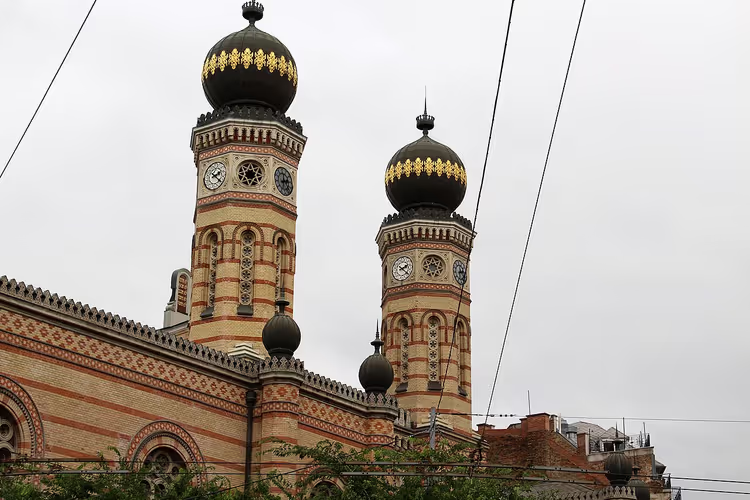
The Great Synagogue on Dohány Street is considered the largest functioning synagogue in Europe and the second largest in the world (as of 09/2026, official synagogue website). For a city with a Christian majority, this is an unusual scale, but Budapest's Jewish community has always been part of its history.
The building was constructed from 1854 to 1859 in the Moorish Revival style, the hall seats 3,000 worshippers, and the towers reach 44 meters in height (as of 09/2026, Wikipedia data). The towers reference the Middle Eastern roots of Judaism. Hungarian fascists bombed the synagogue in 1939, damaging the building, and it was fully restored only by 1998 (as of 09/2026, Wikipedia data).
Entry is by ticket with a guided tour or audio guide; admission is paid and costs about €30 per adult (as of 09/2026, official website). The Jewish museum and memorial are nearby.
- Who it's for: if you're interested in the community's history and can spare an hour.
- How to get there: metro M2 to Astoria station, then a couple of minutes on foot (see map).
- The catch: you won't be allowed in wearing shorts or with bare shoulders; men are given a paper kippah at the entrance.
 © Fred Romero from Paris, France · CC BYPhoto: Fred Romero from Paris, France, CC BY (https://creativecommons.org/licenses/by/2.0), Wikimedia Commons
St. Stephen's Basilica
St. Stephen's Basilica is a few minutes' walk from the Great Synagogue. St. Stephen, also known as King Stephen I, is revered in Hungary as the patron of the state: he united the Hungarian lands and brought Christianity to the country.
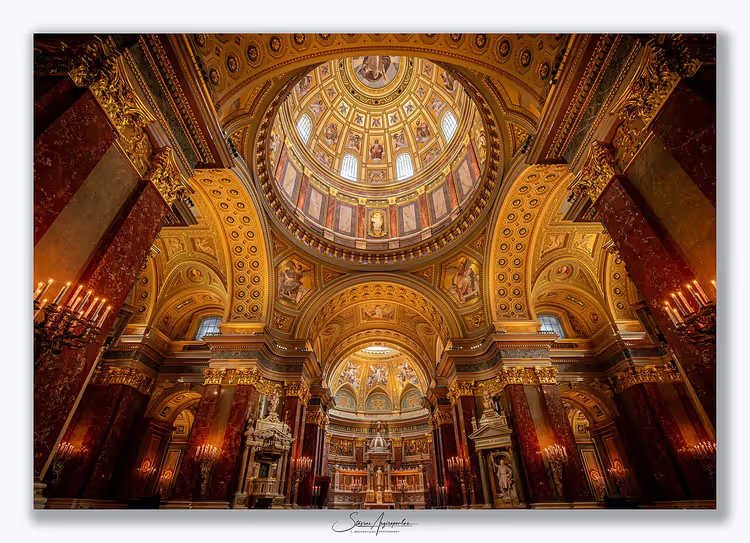
The cathedral took 54 years to build, from 1851 to 1905, and its height including the dome reaches 96 meters (as of 09/2026, Wikipedia data). The parliament building has the same height. Inside, a gilded reliquary holds the Holy Right, the right hand of the first king.
 © Stavros Argyropoulos · CC BY-SAPhoto: Stavros Argyropoulos, CC BY-SA (https://creativecommons.org/licenses/by-sa/2.0), Wikimedia Commons
Another reason to go inside: the observation deck just under the dome. From up there you can see all of Pest with St. Stephen's Square below. A ticket to go up costs a few euros, and the elevator saves your energy. Come at opening time; by midday a line forms at the lift.
Entry to the basilica itself is sometimes charged, sometimes left as a donation (according to the cathedral). The observation deck is usually paid for separately at the ticket office.
Visitors in reviews mention the panorama from the dome more often than the interior itself (Google Reviews, 09/2026). That makes sense: the climb gives you a view of the entire center, not just one hall.
- Who it's for: those who want a panorama of the center and are willing to go up to the dome.
- How to get there: metro M1 to Bajcsy-Zsilinszky út station, then three minutes on foot (see map).
- The catch: you may not be allowed in wearing shorts or with bare shoulders; the dress code is stricter than at tourist churches.
Hungarian Parliament Building
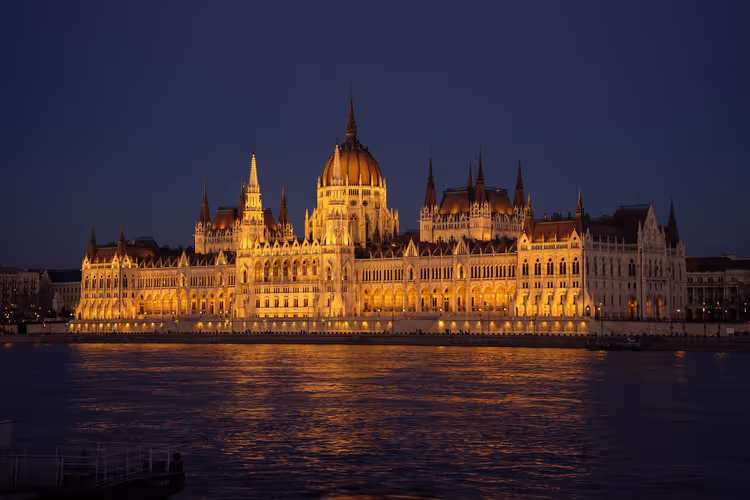
The Parliament occupies Hungary's largest building on the Danube embankment. Inside there are about 691 rooms, and only a small part is open to visitors (as of 09/2026, official parliament website). Hungarians built it using only local workers and Hungarian materials, and the architects took Westminster as their model.
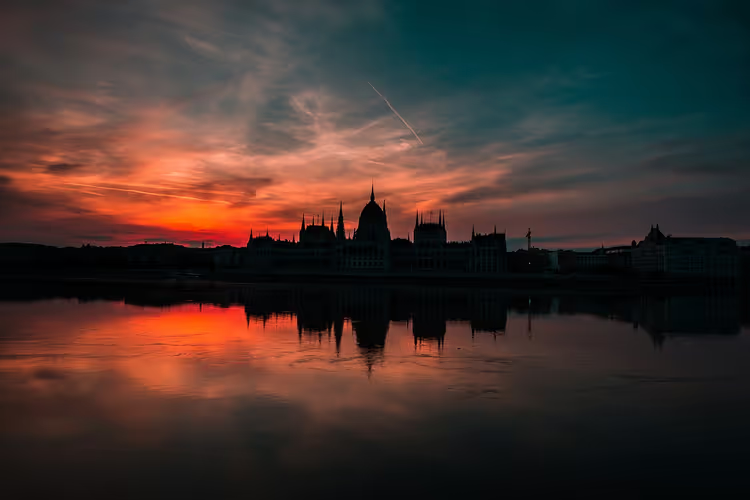
You can only get inside as part of a short guided tour or with an audio guide. A ticket costs about 7,000 forints for EU citizens and twice as much for visitors from other countries (as of 09/2026, official website). Inside, it's worth seeing the dome hall and that famous long red carpet. If you want a guide and no waiting, a parliament tour on GetYourGuide takes care of the time slot.
Also check the day of your visit: on session days some halls are closed. The catch: you can't get inside without a tour, and for non-EU visitors the ticket is almost twice as expensive.
Liberty Square
Liberty Square lies southeast of the Parliament. It is surrounded by the mansions of the Hungarian public broadcaster, the National Bank, and the US Embassy.
In the center, an eternal flame burns in memory of the mid-19th-century revolution. Nearby there is a monument to Soviet soldiers, and later a statue of US President Ronald Reagan was added. The catch: the square is small; half an hour is enough to see it.
 © Dennis G. Jarvis · CC BY-SAPhoto: Dennis G. Jarvis, CC BY-SA (https://creativecommons.org/licenses/by-sa/2.0), Wikimedia Commons
If you want more than just the square and would like a guided walk through the center, city tours on GetYourGuide start right here.
Vajdahunyad Castle
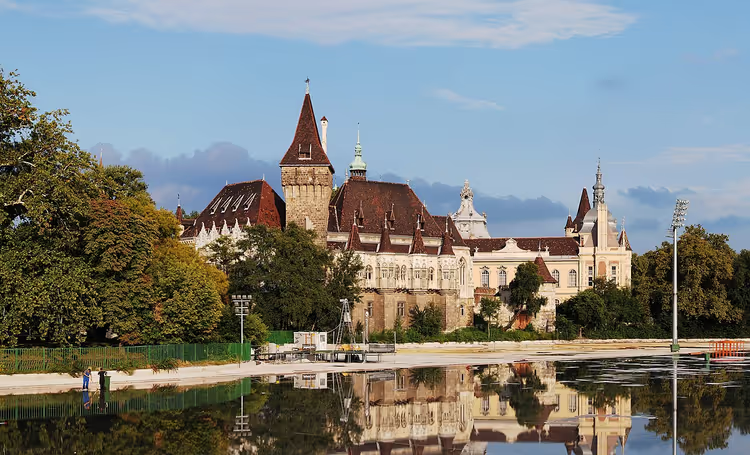
Vajdahunyad Castle stands in Városliget Park, in the eastern part of the city. Originally, only a pavilion was built on this site to celebrate the 1000th anniversary of the Hungarians finding their homeland. The pavilion was so popular with residents that in 1904-1907 a full castle complex was built in its place and a pond was dug (As of 09/2026, Wikipedia data).
Architect Ignác Alpár assembled Vajdahunyad from elements of 21 famous structures from Hungarian lands. Gothic, Romanticism, Baroque and Renaissance styles are mixed in one building. Nearby stands a statue of the monk Anonymus, a chronicler who, according to local belief, brings good luck to anyone who rubs his pen.
- Who it's for: those who want a romantic view without a trip to the countryside.
- The catch: it's an early 20th-century building, not a real medieval fortress.
 © Felix König · CC BYPhoto: Felix König, CC BY (https://creativecommons.org/licenses/by/3.0), Wikimedia Commons
Heroes' Square and the Millennium Monument
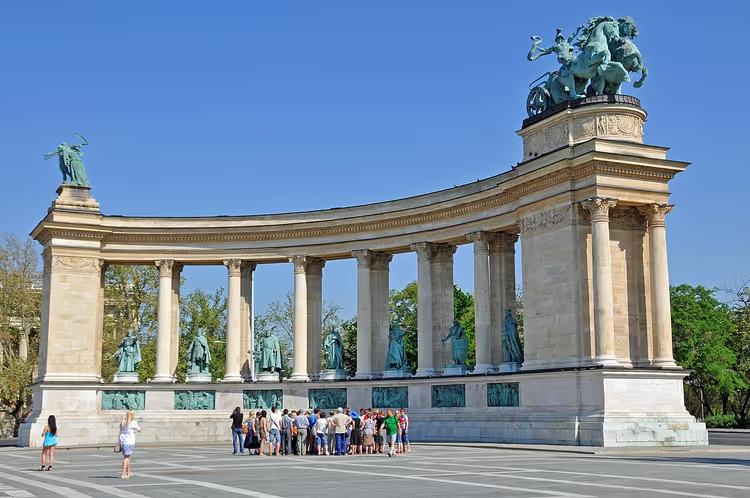
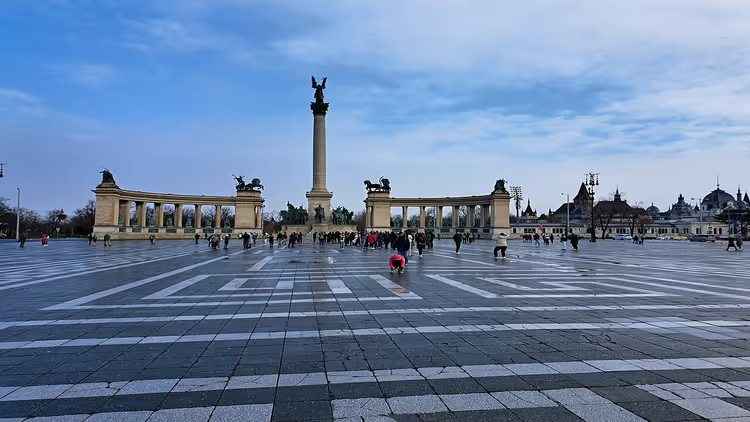
Heroes' Square appeared in the late 19th century for the same 1000th anniversary as Vajdahunyad, and is a UNESCO World Heritage site (As of 09/2026, Wikipedia data). For the anniversary celebration, monarchs, military leaders and educators were immortalized in stone.
In the center stands a 36-meter column with a statue of the Archangel Gabriel. At the base of the column are mounted leaders of the seven Hungarian tribes headed by Prince Árpád (As of 09/2026, Wikipedia data).
- How to get there: metro M1 to Hősök tere station, the exit leads directly to the square (see map).
- The catch: there's nowhere to climb, the monument can only be viewed from the square.
 © Bybbisch94 · CC BYPhoto: Bybbisch94, CC BY (https://creativecommons.org/licenses/by/4.0), Wikimedia Commons
Széchenyi Thermal Bath
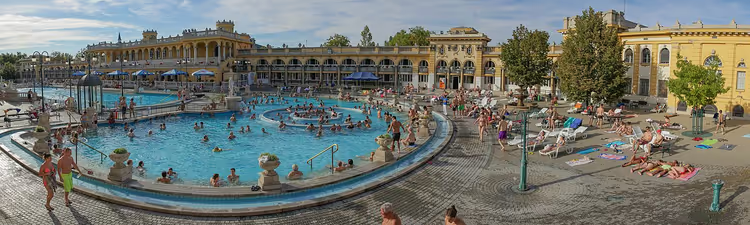
Széchenyi Thermal Bath is open year-round. On weekdays it's open from 07:00 to 20:00, on Fridays until 22:00, and on weekends from 08:00 to 20:00. The schedule was verified on 13.09.2026 on the bath's official website.
Ticket offices close one hour before closing time, and guests are asked to leave the pool areas slightly before closing. The water in Széchenyi's springs is similar in composition to the water of the Nile, which is why it's used to water the hippopotamus at the Budapest Zoo.
- Who it's for: those who want to swim in outdoor thermal pools.
- How to get there: metro M1 to Széchenyi fürdő station (see map).
- The catch: it's the most popular bath in the city, with a line at the entrance in summer.
It's more convenient to buy tickets in advance, Széchenyi bath tickets open bookings several months ahead.
 © Grand Parc - Bordeaux, France from France · CC BYPhoto: Grand Parc - Bordeaux, France from France, CC BY (https://creativecommons.org/licenses/by/2.0), Wikimedia Commons
Margaret Island and the bridges over the Danube
Two Budapest landmarks stand apart from the Buda and Pest rivalry because they sit on the river itself. Margaret Island in the middle of the Danube is named after Princess Margaret, daughter of King Béla IV. Her father sent her to a Dominican convent in gratitude for saving the country from the Mongol invasion. Today it is an open-air botanical garden with the convent ruins and a fountain.
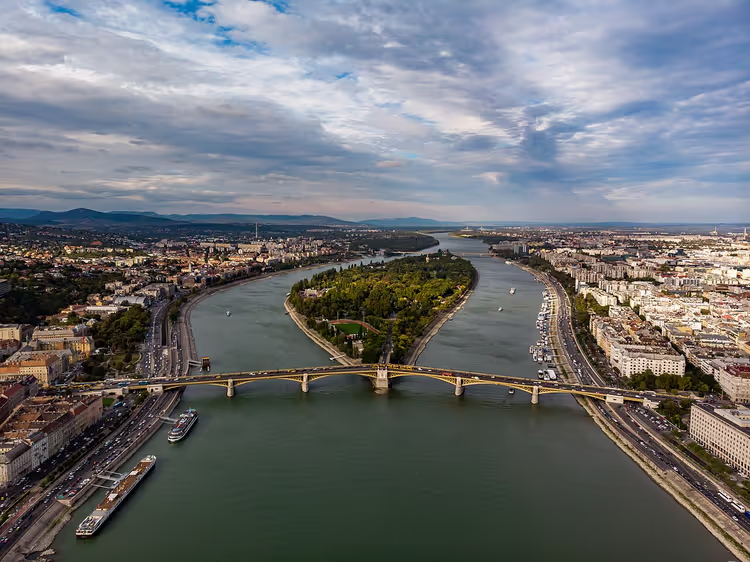 © Ralf Roletschek · CC BY-SAPhoto: Ralf Roletschek, CC BY-SA (https://creativecommons.org/licenses/by-sa/1.0/fi/deed.en), Wikimedia Commons
The Chain Bridge opened in 1849, becoming the first permanent bridge across the Danube in Hungary and a true engineering marvel of its time (as of 09/2026, Wikipedia data). It is worth walking across just for the view of the Parliament from the water.
The Elisabeth Bridge opened in 1903, and at the time of its opening it was the largest suspension bridge in the world (as of 09/2026, Wikipedia data). The city has dozens of bridges, but these two are instantly recognizable. For the western half of the city, see the Buda guide: it covers the castle, Fisherman's Bastion, and the baths.
Tours and tickets in Budapest
Guided tours, skip-the-line tickets and activities — most offers can be cancelled free of charge.
See offers on GetYourGuideThe widget loads once you give your consent.
⁉️🤔 Frequently asked questions
How much time do you need to see Pest?
The center with the synagogue, basilica, and Parliament takes half a day. If you add Heroes' Square, Vajdahunyad, and Széchenyi Bath, plan a full day. Walking between the center and Városliget takes about forty minutes, but it is easier to ride 6-7 stops on metro line M1.
What can you see in Pest for free?
Heroes' Square, Városliget Park, Vajdahunyad Castle, and Margaret Island are free. The Parliament and the basilica can also be viewed from the outside at no cost. You pay for entry at the synagogue, the basilica, and Széchenyi Bath, where tickets are purchased separately.
Where do you buy tickets for Széchenyi Bath?
Tickets are sold on the bath's official website and at the ticket office on site. In high season, book a time slot in advance: by midday there may be no same-day slots left.
Can you visit the Parliament without a tour?
No, you can only go inside as part of a short guided tour or with an audio guide. Tickets for EU citizens are cheaper than for other visitors. The exterior and the embankment are freely accessible at any time, including the evening illumination.
When is the best time to visit the Great Synagogue?
The synagogue is closed on Saturdays for Shabbat. On other days, come at opening time: there are fewer groups and no line at the entrance.
In short: what to book
If you have just one day, start with the synagogue on Dohány Street, walk to the basilica and Parliament, and spend the evening at Széchenyi Bath. If you are traveling with children, choose Városliget: Heroes' Square, Vajdahunyad, and the zoo are all nearby. If you want a panorama, go up to the observation deck under the basilica's dome.
Book a hotel in central Pest in advance: prices rise quickly in high season. check Budapest hotel prices on Trip.com

A small editorial team writing guides for independent travel. We travel ourselves, but we haven’t been everywhere, so we check prices, opening hours and how to get there against official sources.