
















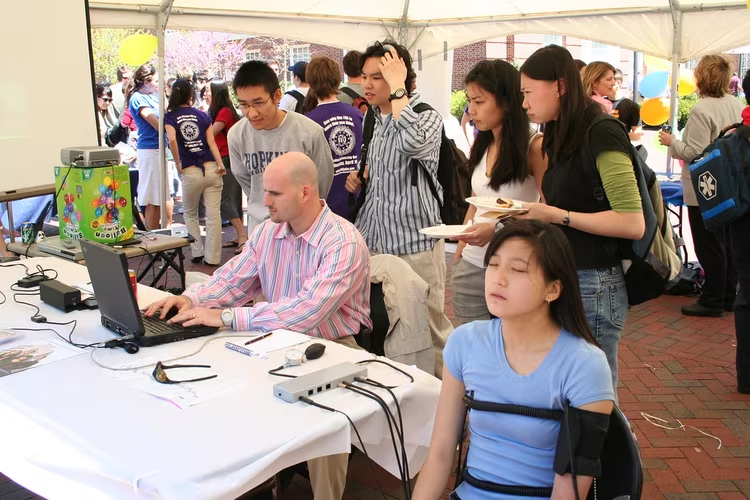
Polygraph test in Hamburg: how the examination works and why the court does not consider it
In Germany, a polygraph is not considered evidence in court. That does not mean a lie detector test is useless: it provides a reference point when accounts diverge. We looked into how the test works in Hamburg, what determines the price, and where the method's limits lie.
What a polygraph is and what it measures
💡 In short:
- A polygraph records pulse, blood pressure, breathing, and sweating simultaneously.
- It is not a "truth machine": the device only records the stress response, and a specialist evaluates it.
- Legal status of the test in Germany: Federal Court of Justice (BGH) ruling of 17.12.1998.
A polygraph, commonly called a lie detector, measures several channels at once: pulse rate, blood pressure, breathing, and skin conductance. All of them respond to nervousness. The device only records these signals; a person draws the conclusion.
The specialist compares responses to neutral and relevant questions and looks at the dynamics. So this is not about "mind reading" but about a psychophysiological examination. If you are considering such a test, keep that in mind.
What a polygraph shows and what it does not
How accurate a polygraph is remains a matter of debate. According to data from the American Psychological Association, an industry meta-analysis from 2011 reported accuracy of about 89%. Critics point out that the study did not undergo independent review.
The U.S. National Research Council, in a 2003 report, assessed the method more strictly: accuracy is acceptable under laboratory conditions, but in real cases it remains uncertain (National Academies).
The Federal Court of Justice of Germany, in its ruling of December 17, 1998, called polygraph testing a completely unsuitable form of evidence (BGH ruling of 17.12.1998). As evidence, the test does not work: it provides a probabilistic reference point, not a fact.
In practice, a polygraph is useful as a conversation tool. It suggests which topics are worth clarifying. The decision still remains yours, not the device's.
How a test works in Hamburg
The test is scheduled in advance, usually by phone or through a website. First the situation is discussed, then the list of questions is drawn up together. Before the test, the person signs written consent.
The procedure itself takes place in a quiet room without other people. Sensors are attached to the chest, fingers, and arm, then neutral and relevant questions are asked. The specialist adjusts the order of questions and the pauses to separate ordinary nervousness from a reaction to meaning.
After the recording, the data is processed and compared with control questions. A written report is usually delivered the same day. A simple test takes a few hours, while a complex case can take longer.
What determines the price of a test
There is no single rate for the test. The price depends on several factors: duration, number of questions, format (in the office or on site), and the specialist's qualifications. On-site testing adds travel costs.
A reference point for Hamburg is provided by the service Polygraph Top: on its page polygraph test in Hamburg, it states that an on-site test costs from €550, and an online test from €299 (as of 10/2026). The final amount depends on the scope: a detailed analysis costs more than a short test.
When comparing offers, do not look only at the price. A cheap test without a certified specialist does not produce a reliable result. Ask in advance who will conduct the test, by what method, and what will be included in the report.
What the test is used for in personal cases
Private clients come with different situations. Typical reasons: suspicion of infidelity, disputed promises, family conflicts, a desire to clear oneself of a false accusation.
The test is conducted only voluntarily and with the consent of the person being tested. The result does not replace a conversation and does not prove guilt. It helps the parties see where their accounts diverge.
If you take the test to confirm you are right, be prepared for any outcome. A polygraph records nervousness, and an innocent person can also be nervous.
Polygraph for companies: what matters
Companies use the test when there is suspicion of theft, data leakage, or internal collusion. In Germany, an employer must respect employee rights: the test is possible only voluntarily and with written consent.
For a disciplinary decision, such a result is not evidence. It is used as a reason for further review, not as a verdict. Otherwise the decision is easy to challenge.
When ordering a test for business, check whether the written report is included in the price. For internal investigations, it is more useful than an oral conclusion.
Testing at home and in the office
Some specialists travel to the location: to a home, an office, or another city. This is more convenient if the person does not want to go to a laboratory or if maximum discretion is needed.
The on-site format is usually more expensive: travel is added to the rate. Quality does not suffer if the specialist brings calibrated equipment.
For a home test, you need a quiet room and time without interruptions. Light and outside noise should not distract the person being tested.
How to choose a specialist
Look at qualifications and method, not advertising. A good sign: the specialist openly describes the procedure, shows certificates, and explains the method's limitations.
Ask which channels are measured, how long the test lasts, and what will be included in the report. Find out who exactly conducts the test and what experience they have with your type of case.
One example of such a service in Hamburg: Polygraph Top, office at Hammer Landstraße 204, on-site testing on request, and a written report. The terms are described on the service page: lie detector test in Hamburg.
Be wary of promises of one hundred percent accuracy. No method offers a full guarantee, and an honest specialist will tell you that.
⁉️🤔 Frequently asked questions
How much does a polygraph test cost in Hamburg?
According to Polygraph Top (10/2026), an on-site test costs from €550, an online test from €299; the amount increases with the number of questions and the format. The online option is usually cheaper than an in-person meeting, and on-site testing at home is more expensive. The exact amount is given after a conversation about your case. Compare several offers and clarify what is included in the price.
How long does the test take?
A standard test takes a few hours, most often one to two. The time depends on the number of questions, the complexity of the case, and preparation. With the on-site format, travel time is added. A written report is usually prepared the same day. Clarify the timeline in advance if you have time constraints.
How accurate is a polygraph?
Industry studies report accuracy of about 89% (according to the APA), while independent experts treat those figures more cautiously. The method provides probabilistic indications, not fact. That is why definitive conclusions are not drawn from it. Make your decision taking other facts into account.
Is a polygraph test legal?
The test itself is not prohibited if the person participates voluntarily and gives written consent. Without consent, the test is not conducted. It is not accepted as evidence in court: the Federal Court of Justice of Germany called such a result unsuitable (case 1 StR 156/98). For internal investigations, the result remains a reference point, not a verdict.
Can you beat a lie detector?
Attempts to distort the result exist, but an experienced specialist notices them through reactions and behavior during the test. However, the test itself is not perfect either. Neither side offers guarantees. That is why the result is always evaluated together with other facts.
In short: how to choose a polygraph specialist
A polygraph does not prove guilt and does not replace a conversation. It shows where accounts diverge and helps continue the investigation in a focused way. Choose a specialist based on qualifications, method, and openness, not on promises.
If you have a private matter, start with a conversation about the case and clarify the test format. If the matter concerns business, agree in advance on a written report and the voluntary consent of participants.
Before paying, check what is included in the price: duration, number of questions, on-site travel, and the report. That will eliminate most surprises.

A small editorial team writing guides for independent travel. We travel ourselves, but we haven’t been everywhere, so we check prices, opening hours and how to get there against official sources.