
















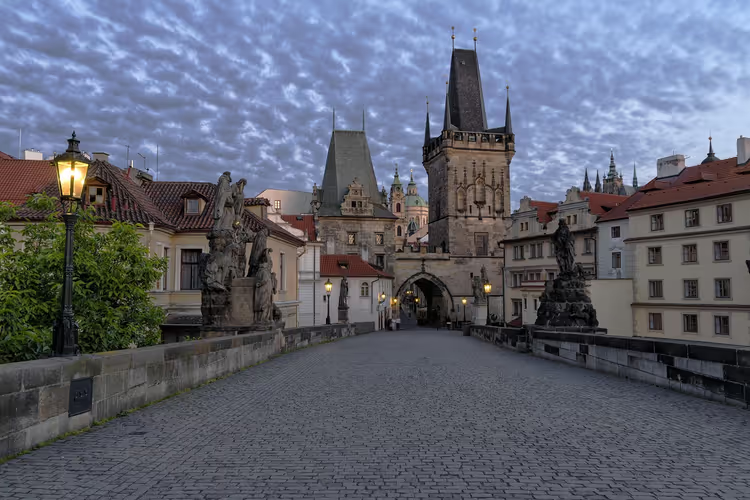
Prague in half a day on foot: Charles Bridge, Loreta and Strahov Library
Malá Strana and Hradčany fit into a single half-day walking tour. The density of sights here is high: on a small patch by the Vltava stand Charles Bridge, baroque palaces, and the Strahov Library. There is just one problem. Without a plan, you circle through the same lanes and climb the hill twice.
On foot from Charles Bridge to Strahov Monastery is about 1.5 km on the map. We put together an order where the sights follow one after another, from bottom to top, with no backtracking. Below you will find the time for each section and current entrance prices.
Ad: this article contains affiliate links, we earn a commission if you book through them, at no extra cost to you.
Malá Strana and Hradčany route
💡 In short:
- Start at Charles Bridge, walk up Mostecká and Nerudova toward Hradčany.
- Set aside half a day: under an hour on foot and about two hours for the Strahov Library and Loreta.
- Buy tickets for Loreta and Strahov Monastery online in advance.
- Prices and opening hours: as of 09/2026, verified on the official Strahov Monastery website.
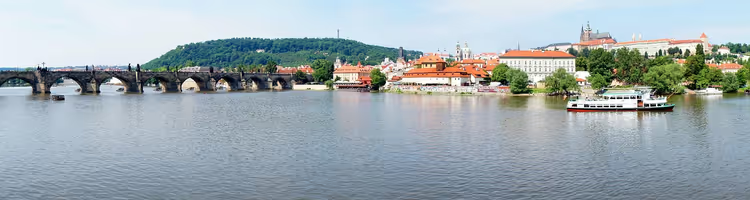
The route is linear. You start on the right bank of the Vltava, cross the river on Charles Bridge, and climb the hill to Prague Castle. Going back is easier by the same path or by tram from the Pohořelec stop. Below is the order of sights and approximate walking time.
Section | What to see | Walking time (on the map) |
|---|---|---|
Charles Bridge and Mostecká | bridge towers, souvenirs, marionettes | about 30 minutes |
Nerudova and Úvoz | houses with signs, the climb to Hradčany | 15-20 minutes |
Hradčany | town hall, Loreta, Strahov Monastery | 1.5-2 hours |
Below we go through each sight in order. You will see what sets it apart from its neighbors on the route and how much entry costs.
Charles Bridge
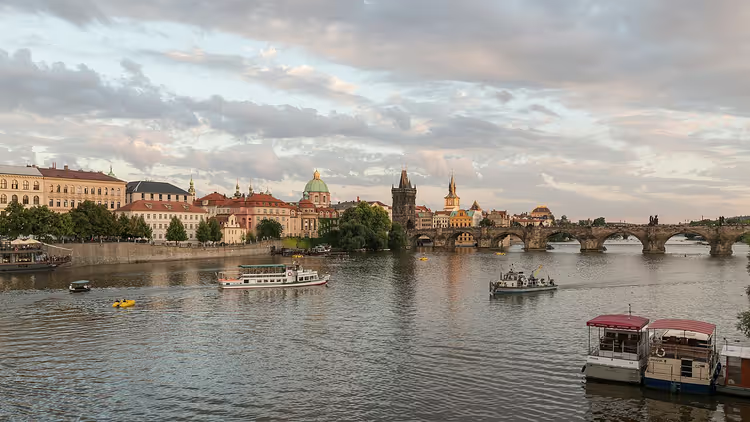 © DXR · CC BY-SAPhoto: DXR, CC BY-SA (https://creativecommons.org/licenses/by-sa/4.0), Wikimedia Commons
Charles Bridge leads from Staré Město to Malá Strana. At the Malá Strana end of the bridge, two old towers connected by a stone arch greet you. The smaller one was built in the 12th century as a defensive structure. Later it served as a prison, and for two centuries a customs office operated there. The larger and taller tower appeared in the 15th century: it was a signal tower and also a warehouse. Both are now restored and operate as small museums.
Walking across the bridge itself is free and open around the clock. In the morning it is noticeably quieter; during the day it gets crowded. If you want a shot without people, come early in the morning.
Church of St. Nicholas
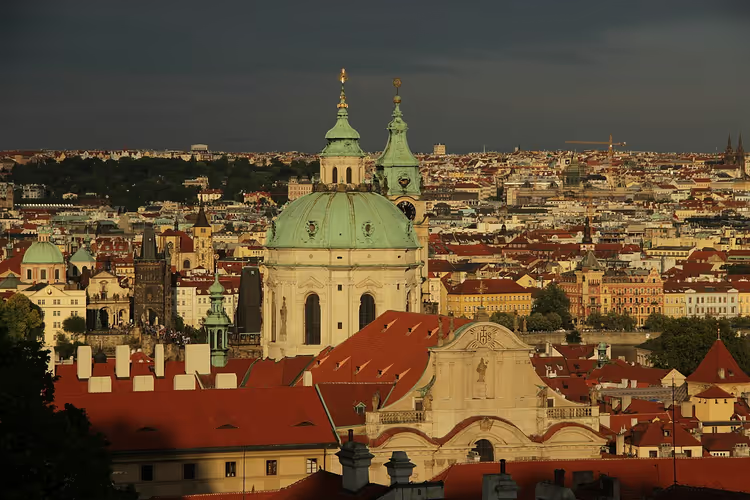 © Björn S... · CC BY-SAPhoto: Björn S..., CC BY-SA (https://creativecommons.org/licenses/by-sa/2.0), Wikimedia Commons
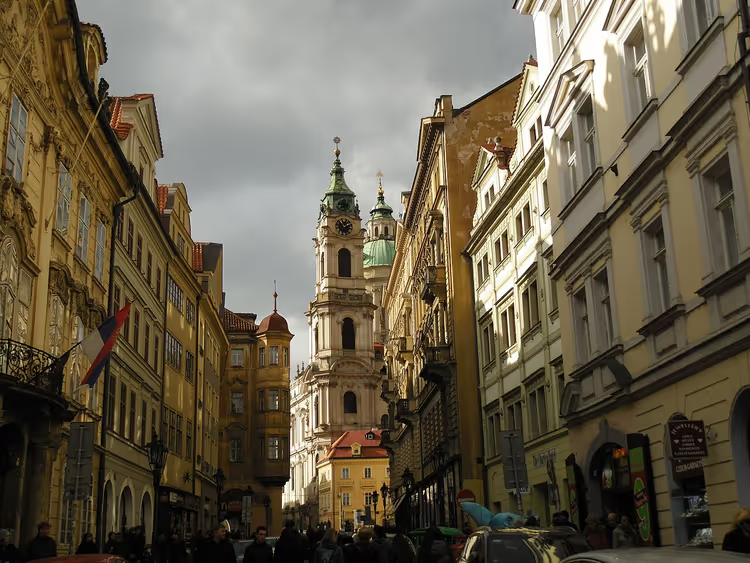
Right behind the bridge Malá Strana begins, and its main baroque church stands by Mostecká. The Church of St. Nicholas took 52 years to build, by father and son Dientzenhofer, local Germans. The building is considered a model of Prague baroque: stucco, rich decoration outside and inside. The 79 m bell tower with its dome was designed by Lurago. Its style differs from the church itself and it belongs to the city, as shown by the stone coat of arms of Prague on the facade.
Inside, the frescoes make the strongest impression. The ceiling fresco "Apotheosis of St. Nicholas" is considered the largest in Europe. The dome fresco "Apotheosis of the Holy Trinity" ranks among the masterpieces of church painting. The organ here is the one Mozart played in 1787. If church painting speaks to you, set aside an extra half hour for the church.
Mostecká Street
 © Stary1995 · CC BY-SAPhoto: Stary1995, CC BY-SA (https://creativecommons.org/licenses/by-sa/3.0), Wikimedia Commons
Mostecká Street leads from the bridge to the church and further into the district. It is lined entirely with mansions, with small shops and stores on the ground floors. They sell souvenirs, gifts, and Prague marionettes. These toys depict famous people and are controlled by thin strings. Every house has its own character and fits into the overall row of buildings. A walk along Mostecká introduces you to the medieval architecture of the district.
Nerudova Street
 © Wolfgang Sauber · CC BY-SAPhoto: Wolfgang Sauber, CC BY-SA (https://creativecommons.org/licenses/by-sa/3.0), Wikimedia Commons
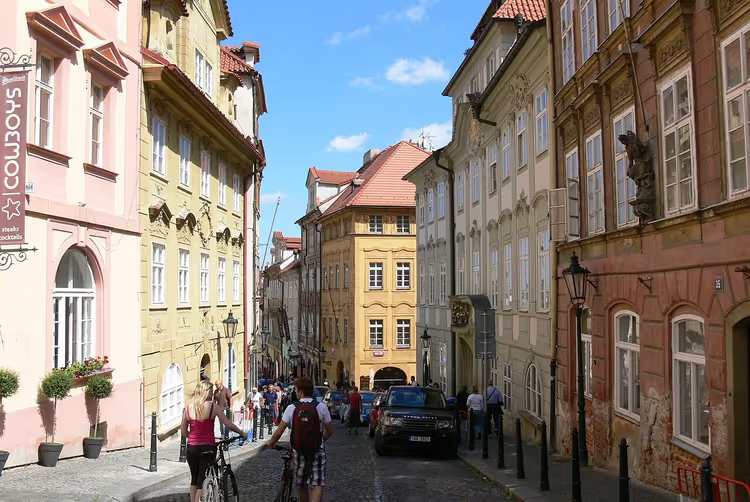
Nerudova Street was named after Jan Neruda, a public figure, journalist, and writer. Two old houses are connected with his name. He was born in the house "At the Two Suns," and its facade bears an emblem with a young man and a Masonic triangle. Neruda spent his final years in the house "At the Three Black Eagles." Almost every building on the street is a historic site with its own character. If you are heading to Hradčany, this street is on your way: at the end it quietly turns into Úvoz.
Hradčany Town Hall
 © DXR · CC BY-SAPhoto: DXR, CC BY-SA (https://creativecommons.org/licenses/by-sa/4.0), Wikimedia Commons
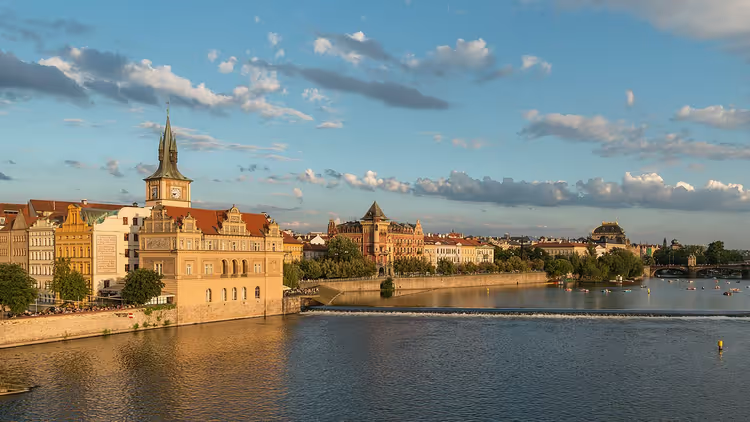
Hradčany begins right behind Úvoz. It is a former fortress town, one of Prague's old districts, on a rocky hill on the left bank of the Vltava. In the old days, the settlement was protected by fortress walls. One of them is still called the "Hungry Wall."
The town was repeatedly destroyed by the Hussite wars, and in 1541 it burned to the ground. Peacetime gave Hradčany a new life: wealthy people and clergy filled the area with palaces and cathedrals. After it was granted the status of a "Royal Town," the Hradčany Town Hall became the architectural symbol of the district. Its doors still bear a metal image of the "Prague ell," the official measure of length in the state. You can see this sign from the sidewalk right at the door.
Strahov Monastery
 © Matěj Baťha · CC BY-SAPhoto: Matěj Baťha, CC BY-SA (https://creativecommons.org/licenses/by-sa/2.0), Wikimedia Commons
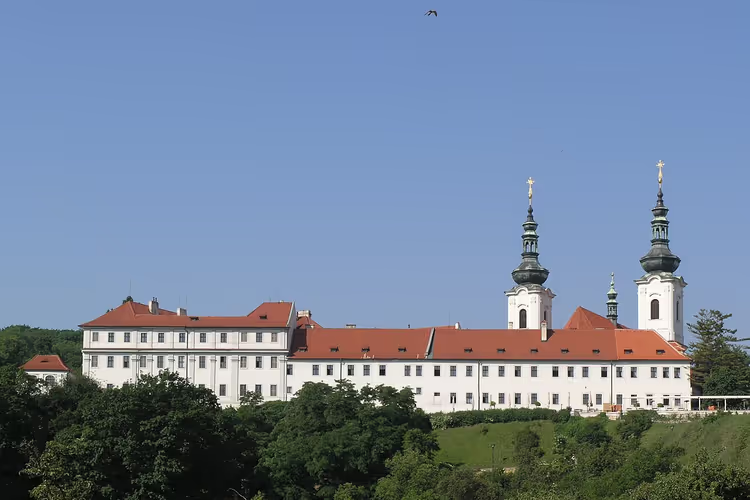
Strahov Monastery is considered one of the oldest monasteries in Czechia. It was founded in the 12th century by monks of the Premonstratensian order, known for its strict vows. The monastery survived fires and wars, and each time it was rebuilt. In the 18th century, a public library with ancient books and manuscripts opened here. Today the collection holds about 200,000 volumes (as of 09/2026, Prague tourism portal).
From the outside, the complex looks majestic: white walls contrast with red roof tiles and green domes. Inside, you will find frescoes, stucco work, and sculptures. Regular painting exhibitions are also held here.
Independent entry to the library costs 220 CZK for adults (as of 09/2026, visitor page). Important: the regular tour does not include entering the reading rooms; they can only be seen through the doorway. To get inside, take the combined tour for 390 CZK: it adds the gallery and the historic parts of the abbey. The monastery is open daily from 9:00 to 17:00.
- The catch: the standard ticket does not let you into the library halls themselves.
Černín Palace
Not far from the monastery stands Černín Palace, where the Ministry of Foreign Affairs of Czechia now operates. The palace took two decades to build and became the largest in Prague. Its 150 m facade occupied the entire Loretánské Square. In 1918, a major restoration returned the building to its Baroque appearance. In the 1940s, Foreign Minister Jan Masaryk worked here, whose death in 1948 remains a mystery to this day. You can only admire the palace from the outside.
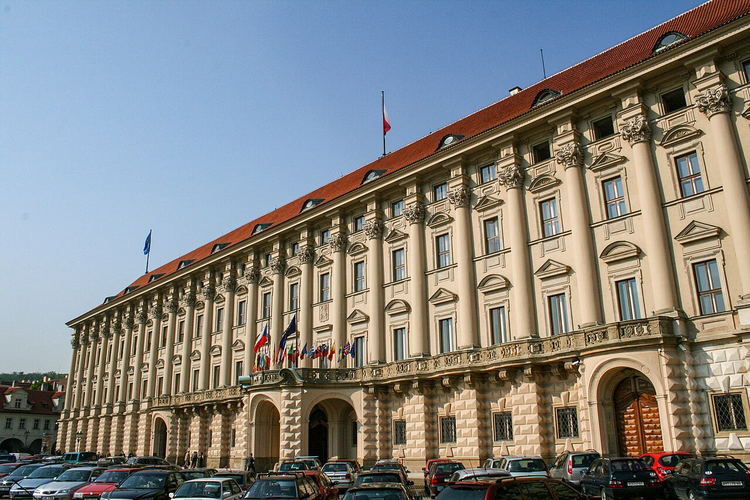 © Szilas · CC BYPhoto: Szilas, CC BY (https://creativecommons.org/licenses/by/4.0), Wikimedia Commons
- The catch: there is no free access inside; the building is closed to tourists.
Prague Loreta
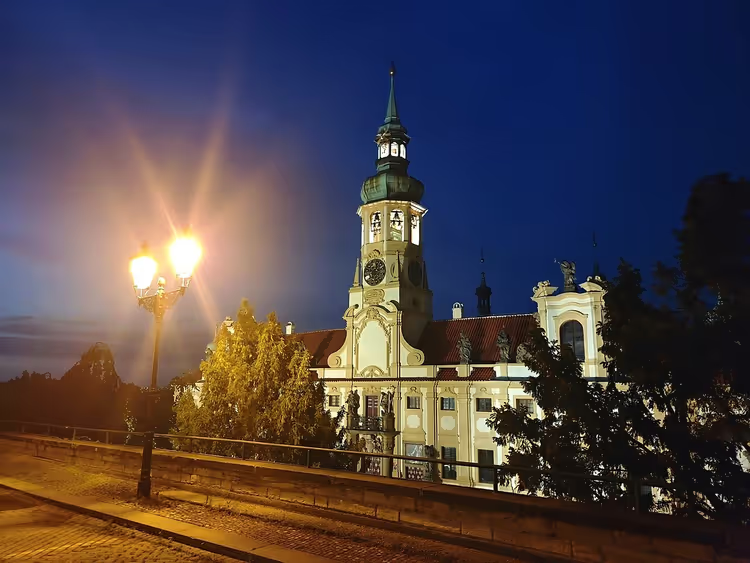 © Ladislav Boháč · CC BY-SAPhoto: Ladislav Boháč, CC BY-SA (https://creativecommons.org/licenses/by-sa/4.0), Wikimedia Commons
Prague Loreta was built on the model of the Italian shrine and dedicated to the Virgin Mary. The "hut" was built on the initiative of Baroness Katharina. In 1626, she invited the architect Orsi, who designed the replica. Legend has it that bricks and beams from the Italian house were set into the walls. After construction, the site became a place of pilgrimage, and in 1631 a church appeared next to it.
The complex is known for its sculptures of Old Testament prophets, stucco work, and ornate spires. The clock tower with its belfry deserves special attention. The bells were brought from Amsterdam, and the sound composition was arranged in 1694 by the clockmaker Peter Neumann. The carillon first sounded on August 15, 1695. Since then it has announced every hour, and it still does today.
The carillon now plays every hour from 10:00 to 17:00 (as of 09/2026, official Loreta website). Entry to the entire complex, including the treasury and seasonal exhibitions, costs 280 CZK for adults. Students and seniors pay 180 CZK (as of 09/2026, Loreta prices). The museum is open daily from 10:00 to 17:00, and a visit takes about an hour. If you are lucky with timing, you will hear a full carillon cycle.
- The catch: you can no longer get inside in the evening.
Tickets and opening hours
We have gathered the paid stops on the route into one table. Prices are for an adult ticket, checked 09/2026.
Attraction | Admission | Hours | Source |
|---|---|---|---|
Prague Loreto | 280 CZK | 10:00-17:00 | |
Strahov Monastery, library | 220 CZK | 9:00-17:00 | |
Strahov Monastery, combined tour | 390 CZK | 9:00-17:00 | |
Charles Bridge, Mostecká, Nerudova | free entry | 24 hours |
|
Children under 6 enter the Loreto and Strahov Monastery for free. Strahov also offers a family ticket: 460 CZK for self-guided entry (as of 09/2026, monastery website). Ticket offices at both stops close at 16:15. Plan the last paid tour no later than early afternoon.
If you would rather not sort out schedules on the spot, check out ready-made guided tours of Prague: tours and tickets on GetYourGuide.
Tours and tickets in Prague
Guided tours, skip-the-line tickets and activities — most offers can be cancelled free of charge.
See offers on GetYourGuideThe widget loads once you give your consent.
Malá Strana and Hradčany sights on the map
All route stops are collected on one map. Open it on your phone and follow the order, from Charles Bridge to Strahov Monastery.
Malá Strana and Hradčany on foot
Places on the map
- 1Charles Bridge Two towers at the entrance, free access around the clock, quieter in the morning
- 2St. Nicholas Church A masterpiece of Prague Baroque, the largest ceiling fresco in Europe and Mozart's organ
- 3Mostecká Street Mansions with souvenir shops and Prague puppets on the way to the cathedral
- 4Nerudova Street Houses with house signs, the climb to Hradčany, continues as Úvoz
- 5Hradčany Town Hall Symbol of the royal town, the Prague ell mark is on the door
- 6Strahov Monastery Library with 200,000 volumes, entry 220 CZK, combined tour 390 CZK
- 7Černín Palace The city's largest palace, 150-metre facade, closed to visitors
- 8Prague Loreta Carillon of 30 bells every hour, entry 280 CZK, ticket office until 16:15
⁉️🤔 Frequently asked questions
How long does the walk through Malá Strana and Hradčany take?
Allow half a day. The walk itself from Charles Bridge to Hradčany takes less than an hour on foot. You will need about two more hours for the library and the Loreto. If you are going with children or stop often for photos, allow more time. You can return the same way, without a loop.
Do I need to buy tickets in advance?
Yes, for paid stops it is better to buy tickets online. In summer, the lines at the Strahov Monastery and Loreto ticket offices are longer. Charles Bridge and the streets are free, so no ticket is needed there. Online tickets save you time at the ticket office and stress in line.
What should I see first if I am short on time?
The priority is this: Charles Bridge, St. Nicholas Church, and the Strahov Library. These stops give you the most impressions for the fewest steps. The Loreto and Černín Palace can wait for a second visit. The route stays linear, so you do not miss anything.
Where can I take a break and eat?
There are many cafés along Mostecká and Nerudova. Near Strahov Monastery, the Na Pekle restaurant operates at the monastery itself. At lunchtime, book a table in advance, as there are many tourists. Check the exact menu and opening hours on site, as they change by season.
Can I do the route with a stroller or by bike?
Charles Bridge and Mostecká are flat, but the climb up Nerudova and Úvoz goes uphill over cobblestones. With a stroller it will be hard, especially in the rain. It is better to leave the bike at the bottom: the narrow streets near the Loreto are awkward with one. For families, it is more convenient to plan the route for the morning.
In short: what is worth booking
The route is linear, so walk from bottom to top and do not double back. Buy tickets for paid stops online in advance, so you do not lose time at ticket offices.
- If you are short on time: take Charles Bridge, St. Nicholas Church, and the Strahov Library.
- If you have half a day: add the Loreto with its carillon and the monastery gallery.
- If you are traveling with children: plan the walk for the morning and save energy for the climb.
For ready-made group tours along this route, see GetYourGuide. And to stay nearby, compare Prague hotels on Trip.com.

A small editorial team writing guides for independent travel. We travel ourselves, but we haven’t been everywhere, so we check prices, opening hours and how to get there against official sources.