
















Red Sea corals: are Egypt's reefs alive in 2026 after the 2024 heat
The Red Sea was long considered a refuge for corals. Its reefs tolerate heat better than most in the world. But the summer of 2024 changed that picture. That year, the strongest bleaching in years of observation occurred off the coast of Egypt, and for the first time the north near Hurghada was noticeably affected (according to the BleachWatch Egypt report by HEPCA, 09/2026).
Let's break this down calmly, without panic and without glossing over anything. Here's what matters for you: where reefs suffered the most, what NOAA data showed for 2024 and 2025, whether corals can recover, and why the Red Sea still has hope. If you're planning a snorkeling or diving trip, this picture will be useful.
Why corals in the Red Sea are dying
💡 In short:
- The main reason is simple: water that's too warm. In the summer of 2024, an early and prolonged heat wave arrived.
- Southern Egypt near Wadi El Gemal suffered the most, the north near Hurghada noticeably less.
- In 2025 the water was cooler than in 2024, but the pressure on reefs hasn't gone away.
- Corals do recover, but slowly, and ocean acidification hinders their growth.
- Data on reef condition and bleaching: verified 09/2026 via HEPCA monitoring and NOAA Coral Reef Watch.
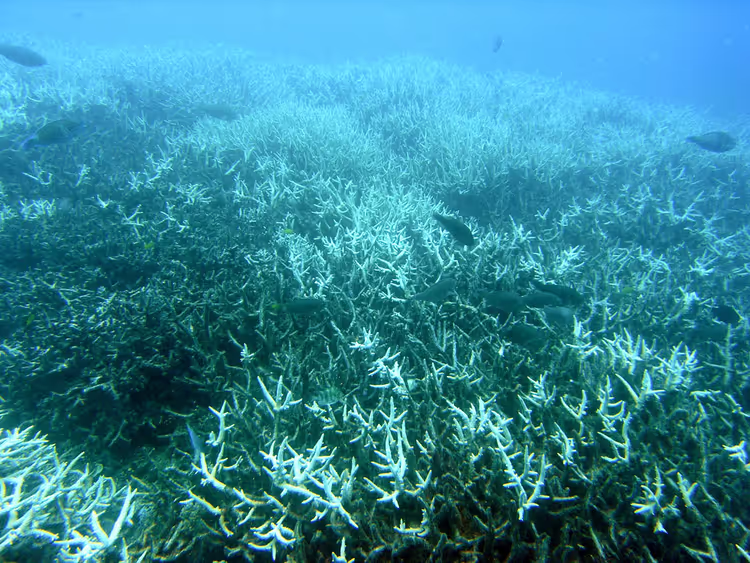
The main cause of coral death in Egypt is the same as everywhere in the world. It's excessively high water temperature. When the sea overheats, the coral loses the algae that give it color and nutrition. It turns white. If the heat persists, the coral dies.
It's worth explaining in a bit more detail. The coral's color and most of its nutrition come from tiny algae that live right inside its tissues. In heat, this partnership breaks down, and the coral expels the algae. It becomes transparent, and the white limestone skeleton shows through. That's where the word "bleaching" comes from. Without algae, the coral starves, and if the heat doesn't subside, its chances are slim.
Previously, severe bleaching in Egypt was rare and mostly in the south. Such episodes were recorded in 2012, 2020, and 2023. In the summer of 2024, everything went differently. The heat wave arrived unusually early and lasted a long time.
Other factors added to the heat. They weakened the sea's natural cooling and water exchange at the reefs. According to HEPCA, several conditions came together at once:
- very low water levels during low tides;
- unusually weak wind;
- altered currents.
All of this was layered on top of the early and prolonged heat. The result was bleaching on a scale never before seen on Egyptian reefs. Remember this combination. It wasn't heat alone, but specifically its combination with stagnant water that made 2024 an exception.
Where Egypt's reefs suffered the most
If you've dived here before, you'll notice the difference right away. Past bleaching waves mostly affected southern areas. In 2024, for the first time, the north near Hurghada was also noticeably hit. The south near Marsa Alam suffered even more than in previous years. In the far south, reefs sustained serious damage in places.

The numbers show the gap between north and south. According to the 2024 HEPCA report (09/2026), the highest figures were recorded in the south, in the Wadi El Gemal area: about half of the surveyed colonies bleached there. Near Hurghada, the share of affected colonies was the lowest, about 9%. On average along the coast, bleaching affected roughly a quarter of colonies. Other areas fell between these extremes.
Coastal and semi-protected reefs suffered especially. Note an important detail. Corals at medium depths of 5 to 10 m were hit hardest, not those in shallow water. This is unusual and doesn't match the typical pattern. Heat-sensitive species suffered the most: Porites, Millepora, and Montipora. These were the dominant species at the hardest-hit sites in the south.
Why this matters so much. Usually the shallow water heats up the most, while deeper down the water stays cooler. In 2024, the entire water column warmed, and even relatively deep corals took a hit. That is the anomaly. Another alarming detail is that the north fell into the zone of significant losses for the first time. Previously, Hurghada weathered such waves without much trouble. In 2024, that calm came to an end here.
Coral bleaching: how 2024 and 2025 differed
Did 2024 repeat itself? Was there another mass bleaching wave? Full scientific studies for 2025 are not available yet. But recorded water temperature data exists, and it already tells us something.
 © Acropora at English Wikipedia · CC BY-SAPhoto: Acropora at English Wikipedia, CC BY-SA (https://creativecommons.org/licenses/by-sa/3.0), Wikimedia Commons
Looking at the NOAA temperature curve, 2025 turned out to be noticeably cooler than 2024. Conditions were closer to 2023. Still, there were losses. In the southern areas, corals were damaged again, though not as severely.
This is an important caveat. A cooler year does not mean a year without losses. Even in a relatively calm summer, some southern reefs lose part of their colonies. The scale is just different. The difference between 2024 and 2025 is the difference between a mass catastrophe and localized damage.
The maximum temperature in 2025 was lower, and the period of excess heat was shorter than in 2023. From this, one can cautiously assume that mass damage from overheating most likely did not occur in 2025. At least not on the scale of 2024.
To understand the picture, it helps to understand the heat stress scale. NOAA measures it using the DHW indicator. This is "degree heating weeks": the sum of time and excess heat. The higher the value, the longer and more intensely corals sit in water that is too warm.
An important nuance. DHW accounts not only for the temperature peak, but also for time. Even moderate overheating, if it drags on for weeks, accumulates and hits the reef. That is why a short but intense heat wave is sometimes less dangerous than a long and moderate one. Corals suffer from the sum, not from a single hot day.
What NOAA alert levels mean
The thresholds are simple. Bleaching risk appears at DHW around 4. At DHW around 8, mass bleaching and death of the most sensitive species are likely. Above 12, the risk of mortality for several species at once increases, according to the NOAA Coral Reef Watch program. Alert levels AL3-AL5 were introduced in December 2023, when the previous scale was no longer sufficient. Below you will see how these levels mapped onto actual years.
Level | Description | DHW | Consequences |
|---|---|---|---|
Watch | temperature 0-1 °C above normal | 0 | no damage, but attention needed |
Warning | temperature threshold exceeded | 0-4 | corals begin to experience stress, bleaching possible |
AL1 | noticeably too warm | 4-8 | widespread bleaching possible |
AL2 | stress persists longer | 8-12 | first heat-sensitive species may die |
AL3 | severe heat stress | 12-16 | several species affected, higher likely mortality |
AL4 | extreme and prolonged stress | 16-20 | possible death of more than 50% of colonies |
AL5 | maximum heat stress | above 20 | 80% of corals or more may die |
Source: NOAA level scale.
Here is what heat stress periods looked like off the Egyptian coast by year. The count runs from the first to the last appearance of each level in Egyptian waters.
Level | 2023 | 2024 | 2025 |
|---|---|---|---|
Watch | 08.06-19.10 | 14.06-25.10 | 01.07-12.10 |
Warning | 11.07-06.10 | 23.06-06.10 | 11.07-22.09 |
AL1 | 26.07-06.10 | 13.07-06.10 | 28.07-22.09 |
AL2 | 10.08-02.10 | 23.07-06.10 | 08.08-22.09 |
AL3 | 22.08-02.10 | 02.08-06.10 | 24.08-22.09 |
AL4 | none | 11.08-06.10 | none |
AL5 | none | 20.08-06.10 | none |
The difference is immediately visible. 2024 became a true catastrophe for Egypt's reefs. The heat arrived early, already in June. The level quickly reached AL1, then stayed at AL5 for a long time. Corals can barely withstand that kind of pressure.
Last year turned out to be far milder. In 2025, the summer heat arrived late, and the maximum stopped at AL3. Also not ideal, but noticeably easier than 2024. On the NOAA scale, this is the difference between a catastrophe and a difficult but survivable season. The exact cost of these conditions will only be shown by new HEPCA reports. What 2026 will bring cannot yet be predicted. We can only hope there will be no severe marine heat waves.
To give you a sense of how severe 2024 was, let us return to the scale. Level AL5 means DHW above 20 and, according to the NOAA classification, possible death of 80% of corals or more. In Egypt, this maximum level persisted for weeks, roughly from late August to early October. For a reef, that is almost a death sentence. That is exactly why the south suffered so badly, and why recovery there is the hardest.
The history of the scale itself is telling. Levels AL4 and AL5 simply did not exist before December 2023. They were introduced when the previous steps were no longer sufficient. The fact that Egypt's waters triggered these new upper levels in 2024 says more than any words about the scale of the event.
Can Egypt's reefs recover
After every bleaching event, some colonies in Egypt come back to life. This happens regularly, and it is good news for those who love these reefs. Moreover, the recovery rate of Egyptian reefs is considered one of the highest in the world: according to HEPCA's estimate, it reaches 70-85%.
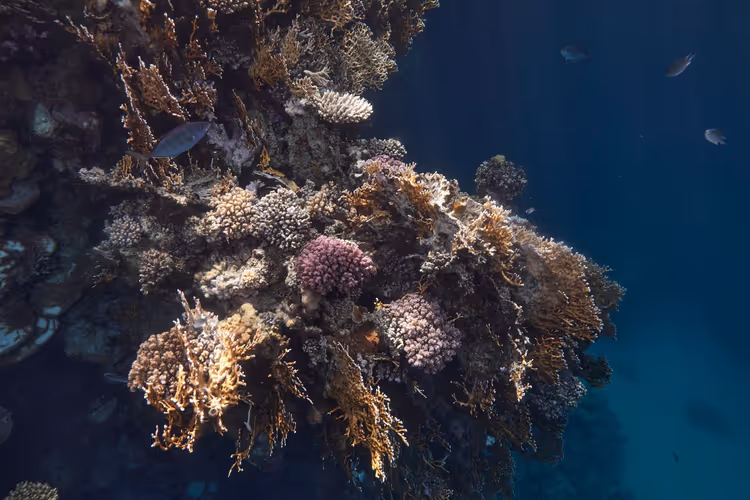
But there is a flip side. Some corals still die after severe heat. In their place, a dead limestone skeleton remains on the bottom. And the stronger the heat wave, the greater such losses.
How recovery actually works. When the water cools, the same algae recolonize the coral, and the color gradually returns. Whether it manages to do so depends on three things: how long the heat lasted, the coral species, and local conditions. Quickly cooled water gives it a chance. Prolonged overheating takes that chance away.
It is important to distinguish between an individual colony and the reef as a whole. A single coral can survive and turn green again within a season. But restoring the reef structure itself, all the forms and shelters built up over centuries, is far more difficult. That takes decades. That is exactly why Egypt's high recovery rate is so valued: it gives the reefs a head start that many other regions of the world do not have.
There is also the problem of growth speed. Corals grow slowly. If you remember how many years they need to reach a noticeable size, the hope for full recovery dims. In the southern Red Sea, growth has slowed sharply in recent decades. Previously, the same amount of growth took just a few years. Now it may take decades.
Ocean acidification: why corals grow more slowly
Why has growth slowed so much? There is no complete clarity. But the main cause is considered to be climate and excessive CO₂ emissions. Behind this lies ocean acidification.
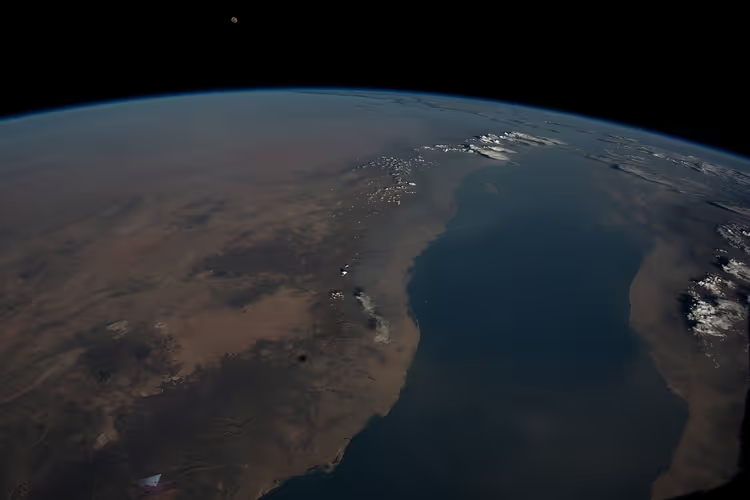
What this means. The seas absorb more and more carbon dioxide from the air. In water, it turns into carbonic acid. The acid lowers the ocean's pH and makes it harder for corals and mollusks to build limestone structures.
If pH drops too much, calcium not only forms with more difficulty. Something worse happens. Already-formed limestone skeletons become brittle and theoretically can even break down. Imagine a descaling agent in a home kettle. It dissolves deposits. Here, carbonic acid acts similarly, except the blow lands on living reefs.
The numbers confirm this. According to research in Nature Communications, the net contribution of corals to the carbonate balance of the southern and central Red Sea nearly dropped to zero between 1998 and 2015. For a reef that already grows slowly, this is an alarming signal.
There is a second problem with acidification. It hits not only corals, but the entire carbonate chain of the sea: mollusks, part of the plankton, shells. And that is the foundation of the reef's food webs. The result is a double blow. Heat presses from above, while water chemistry undermines from below. Coping with both at once is far harder for the reef.
Is there hope: the Gulf of Aqaba as a refuge
There is hope, though it is not an easy one. Climate warming, ocean acidification, and pollution are putting increasing pressure on reefs. Rapid improvement in the coming years is not something to expect. And yet one piece of news is encouraging.

Many corals in the northern Red Sea, in the Gulf of Aqaba, survived the 2024 bleaching almost without losses. The effects there were also noticeable. But most of the affected colonies recovered almost completely. And this despite the long and intense heat.
Illustration from the study by Na'ama-Rose Kochman and Maoz Fine, CC BY 4.0 license.
Why did this happen? The Gulf of Aqaba is considered a climate refuge of global importance. Over thousands of years of evolution, local corals adapted to heat. The reason lies in the narrow southern passage of the Red Sea, through which they once dispersed: only the hardiest species made it north.
The result is impressive. Even prolonged exceedance of the average temperature by 5 °C is tolerated by the gulf's corals almost without harm, according to research in Frontiers in Marine Science. Such resilience is almost nonexistent in the world, which is why the region is a focus of scientific attention.
Fresh data confirms this. The gulf's corals survived four consecutive summers with marine heatwaves. Among them was the record summer of 2024: the heat lasted 113 days, and water temperatures reached 32.6 °C, according to research by the Kochman and Fine group. If you are planning to dive in the north, this is good news for you. Still, scientists honestly warn: even this refuge is not fully protected. Local pollution and increasingly long heatwaves threaten it too.
Why this matters beyond Egypt. If scientists understand exactly how the gulf's corals withstand the pressure, this knowledge will help save reefs around the world. Perhaps this will become a source of material for restoring damaged reefs in other regions. That is why the gulf is studied so closely. It is not just a beautiful diving destination, but a living laboratory of hope.
What Egypt's reefs look like now
Assessing the current state of the reefs is not so simple. Scientists note a clear gradient from north to south.
Let's break it down by area to make it clearer. The north near Hurghada and further toward El Gouna is holding up best, with effects there mostly mild. The middle section from El Quseir to Marsa Alam is a transition zone, where the signs are increasingly visible. The far south near Wadi El Gemal took the main hit. And the Gulf of Aqaba and Dahab in the far north remain the most resilient, although in 2024 they too showed that there is no absolute protection.
There is also human-caused pressure. According to observations by dive guides working in the region, the most popular sites suffer the most. The reason is clear. Intensive tourism, careless behavior in the water, and rising temperatures hit reefs together. In some places corals no longer look as alive as they did a few years ago. Take care of the places you visit.
The Red Sea and Saudi Arabia: where reefs are still alive
The good news is that healthy reefs have not disappeared. Egypt still has vibrant and living corals, fish-rich sites, and beautiful walls. They are worth seeing with your own eyes.
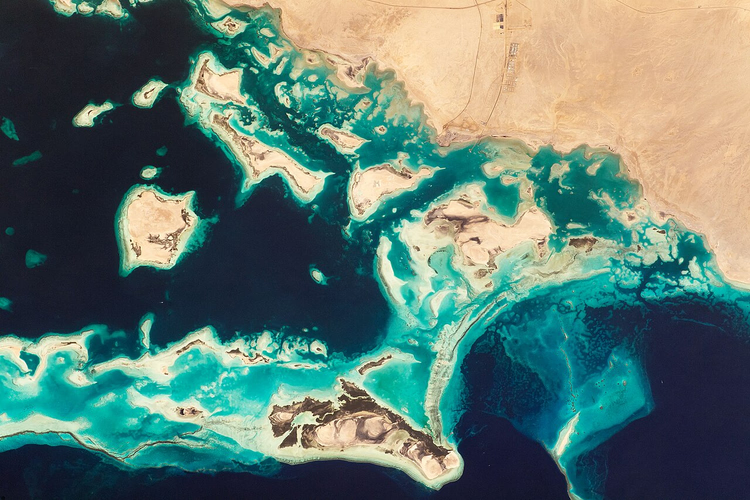
Saudi Arabia stands apart. If you are looking for untouched reefs, pay attention to it. Many of its areas still look very pristine. There are plenty of reefs in excellent condition, with intact structure and rich underwater life. This is exactly what makes the region so attractive to divers right now.
There are several reasons. Tourism here developed more slowly than in Egypt, so many reefs have seen almost no human pressure. The coastline is enormous, and there are far fewer boats on the water. For a diver, this is a chance to see a reef almost as it was decades ago. But the same heatwaves reach here too. In the shallow waters of the south, the signs are already visible, so pristine condition does not cancel out the overall threat.
But pristine does not mean invulnerable. This is especially visible in the upper 10 m. In the deep south in summer, the surface water heats up like a warm bath. And it is precisely in this shallow zone that the signs are visible. Corals lose color or die in places, simply because it is too hot for them. The contrast is stark. You dive on a deserted spot without a single boat around and still see that nature here too is struggling with heat.
What you can do to preserve reefs
A lot depends on the habits of each traveler. Global CO₂ emissions will not be reduced by a single tourist. But you can reduce the local pressure on the reef. And it works.
Start with sunscreen. There are almost no products that are completely harmless to corals, but choose options without oxybenzone and octinoxate, without microplastics and nanoparticles. Apply sunscreen in advance, on land, not in the water. Mineral products based on non-nano zinc oxide work best.
Next, the rules in the water. Do not touch corals with your hands. Keep your buoyancy under control and do not stand on the reef with your fins. Do not feed the fish. Choose dive centers that monitor group behavior and do not moor directly on the reef. There are no small things here, and every careful gesture adds up to the overall result.
There are also things beyond the water. Reduce single-use plastic on your trip, it too often ends up in the sea. Respect marine reserves and follow their rules. Do not buy souvenirs made of corals and shells, the demand for them destroys reefs. And if you choose a dive tour, ask the operator how they approach reef protection. The answer usually says a lot.
Think about the timing of your trip too. Peak heat comes at the end of summer, which is exactly when reefs struggle the most. The shoulder season and winter are not only more comfortable for you, but also gentler on the sea. This is not a strict rule, but a pleasant bonus to responsible travel.
⁉️🤔 Frequently asked questions
Is it worth going diving in the Red Sea in 2026?
Yes, it is. The Red Sea remains one of the most impressive diving areas in the world. After the difficult 2024, many reefs recovered, and 2025 was milder. Choose the northern coast and behave carefully in the water so as not to add extra pressure to the reef.
Where in Egypt have corals suffered the most?
The south was hit hardest. According to the HEPCA reef status report, in the Wadi El Gemal area about half of the surveyed colonies bleached. Near Hurghada in the north, the share of affected colonies was the lowest, about 9%. The further south, the more visible the signs of bleaching.
What is coral bleaching in simple terms?
When water overheats, the coral loses the tiny algae that give it color and nutrition. It turns white and weakens. If the heat goes away quickly, the coral can recover. If the warmth persists for a long time, it dies and turns into a dead limestone skeleton.
Do corals recover after bleaching?
Often yes. The recovery rate of Egyptian reefs is considered one of the highest in the world, reaching 70-85%, according to BleachWatch Egypt. But some colonies still die, and corals grow very slowly. That is why a full return to the previous state takes many years.
Why is the Gulf of Aqaba called a refuge for corals?
The gulf's corals adapted to heat over thousands of years. They tolerate exceedance of the average temperature by even 5 °C almost without harm, according to work by Kochman and Fine. In 2024, local reefs survived 113 days of heat and recovered. Such resilience is almost nonexistent in the world.
Finally, take a look at how living coral reefs work and why it is so important to protect them. A short nature film will show you the underwater life that is currently under threat.
In short: is it worth going diving in the Red Sea in 2026
It is worth going. The Red Sea remains one of the best diving destinations, despite the blow it took in 2024. But the picture has become uneven. The north is holding up, the south near Marsa Alam has suffered more, and the Gulf of Aqaba is showing surprising resilience.
- If healthy reefs matter to you: choose the north, Hurghada, Dahab, and the Gulf of Aqaba.
- If you are ready for contrasts: the south near Marsa Alam, where living and damaged areas sit side by side.
- If you want pristine conditions: take a closer look at the reefs of Saudi Arabia.
And most importantly: visit with care. How you behave in the water determines what kind of reef the next guest will find.

A small editorial team writing guides for independent travel. We travel ourselves, but we haven’t been everywhere, so we check prices, opening hours and how to get there against official sources.