

















Where to stay in Cape Town: 5 areas and hotels by budget
In Cape Town, the neighborhood matters more than the hotel's star rating. The view from the window, the evening crowd, and the travel time to Table Mountain change from street to street. The city stretches between the Atlantic Ocean and a mountain range, and the airport lies about 20 km from the center.
It's hard to figure it out on the first try. City Bowl, V&A Waterfront, Sea Point, Camps Bay, and De Waterkant sit close together on the map, but they live differently. Pick the wrong neighborhood, and you'll lose an hour every day on travel back and forth.
Below, we break down Cape Town's neighborhoods and hotels in every budget. The short answer: first-time visitors should choose City Bowl, those paying for convenience go to V&A Waterfront, those seeking local atmosphere head to Sea Point, those wanting views and a high budget go to Camps Bay, and those looking for design hotels go to De Waterkant.
Ad: this article contains affiliate links, we earn a commission if you book through them, at no extra cost to you.
What to know before traveling to Cape Town
💡 In short:
- Cape Town sits in the southwest of South Africa, between Table Mountain and the Atlantic Ocean.
- On your first visit, choose a neighborhood based on your trip's purpose: the center for museums and evenings out, the coast for the beach, De Waterkant for design and quiet.
- A car is needed for Cape Point and the wineries; in the center, Uber and the MyCiTi bus are enough.
Cape Town in facts
Parameter | As of |
|---|---|
Nearest airport | Cape Town International (CPT) |
Country | South Africa |
Currency | South African rand (ZAR) |
Languages | English, Afrikaans, Xhosa |
Time zone | UTC+2 |
Best time | November to March, southern summer |
Flight | direct flights from FRA, MUC, ZRH, and AMS, otherwise with a connection in Johannesburg, Doha, Dubai, or Amsterdam |
Visa | citizens of many EU countries and the US enter visa-free, check the current rules before departure |
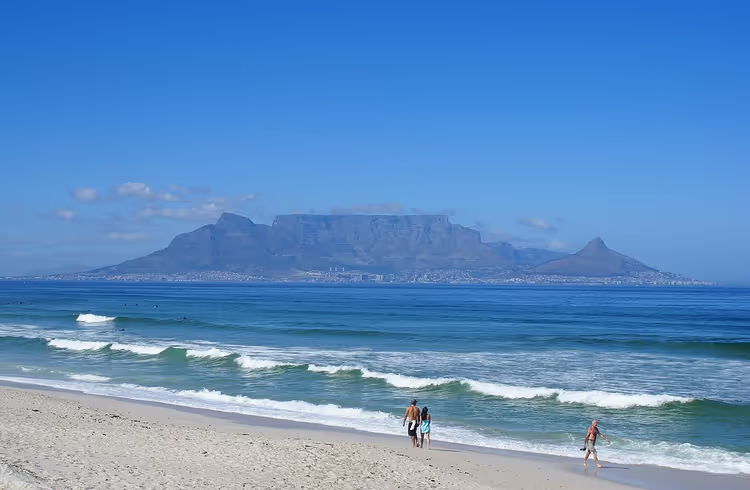 © Danie van der Merwe from Cape Town, South Africa · CC BYPhoto: Danie van der Merwe from Cape Town, South Africa, CC BY (https://creativecommons.org/licenses/by/2.0), Wikimedia Commons
Cape Town lies in the southwest of South Africa, at the foot of Table Mountain. It is the country's legislative capital and its second-largest city. The ocean, vineyards, and Cape Point are within an hour's drive of each other, and the city itself is considered one of the most scenic in the world.
When to go to Cape Town
The best time to visit Cape Town is the southern summer, from November to March. Days are long and sunny, and the beaches are in full swing. January and February are considered peak season: the air warms up to 30 °C, and the water at the beaches is the warmest of the year.
The city welcomes visitors year-round. In April, May, and October, there are fewer people, lower prices, and still good weather. Winter in June, July, and August brings rain, but the wineries and restaurants operate at full capacity.
If you're going for beaches and hikes, it's better to skip June and July. But for food and wine, the off-season works perfectly.
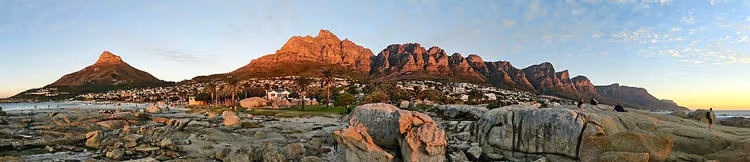 © Krigore · CC BY-SAPhoto: Krigore, CC BY-SA (https://creativecommons.org/licenses/by-sa/4.0), Wikimedia Commons
How many days do you need in Cape Town
Plan at least 5 to 7 days for Cape Town. Table Mountain, the Cape Peninsula, the wineries, Boulders Beach with penguins, Robben Island, and V&A Waterfront eat up time without you noticing. If your schedule allows, take 10 days and you'll still find something to fill every morning.
If you add a safari in Kruger National Park or the Garden Route, the whole of South Africa will take at least two weeks.
What to see in Cape Town and nearby
The city sits between the ocean and the mountain, so attractions are spread across different distances. In the center, there's Table Mountain with its cable car, Company's Garden, and museums. Closer to the coast are the Atlantic Seaboard beaches, the penguin colony at Boulders Beach, Cape Point, and the wineries of Stellenbosch and Franschhoek.
Table Mountain looms over City Bowl, and on a clear day you can see the entire peninsula from the summit. The Cape Peninsula deserves a separate trip: on the way to Cape Point, lookout points and fishing coves such as Hout Bay stretch along the road.
Museum lovers also have plenty to do. The South African Museum operates in the center. At V&A Waterfront, you'll find Zeitz MOCAA with contemporary African art, the Two Oceans Aquarium, and Nobel Square. Many spots are within steps of each other.
A food-focused day is easy to put together at markets and in the coves. At Oranjezicht City Farm Market, you grab street food; in Hout Bay, fresh kingklip is served at the table. In the evening, head out to Long Street or De Waterkant.
The wineries in Stellenbosch and Franschhoek welcome guests year-round, and they're also home to the region's best restaurants. Set aside a full day for the trip, either driving yourself or on a wine tour.
Plan your outings so that heavy days don't run back to back. One day for Cape Point, one for the wineries, one for the beach, and leave the center for a day without a car. Wind and cloud sometimes close the cable car, so keep a backup day for Table Mountain.
If it's your first time in the city, don't try to cover everything in three days. Mark two or three main stops per day and leave time for travel. Cape Town is spread out, and moving between neighborhoods takes longer than it looks on the map.
How to get to Cape Town
You need to fly into Cape Town International (CPT), which sits about 20 km from the city center. From Europe, there are direct flights from Frankfurt (FRA), Munich (MUC), Zurich (ZRH), and Amsterdam (AMS). From other cities, people usually fly with a connection in Johannesburg, Doha, Dubai, or Amsterdam. From the US, direct flights are sometimes available from Washington, Newark, and Atlanta.
From the airport to the city, you can take a metered taxi, Uber, or a pre-booked shuttle. After a long flight, it's better to book a transfer in advance: you walk out of the terminal and go straight to your ride, no haggling or searching for a car.
 © Andres de Wet · CC BY-SAPhoto: Andres de Wet, CC BY-SA (https://creativecommons.org/licenses/by-sa/3.0), Wikimedia Commons
How to get around Cape Town
The MyCiTi city bus connects the center, V&A Waterfront, Sea Point, and the airport. It's clean, reliable, and cheap. For longer trips to Cape Point, the wineries, and Boulders Beach, a car is still more convenient. Remember that in South Africa, people drive on the left side of the road.
If you don't want to drive, take day tours from the city. That way you'll see Cape Point and the wineries without parking, navigation, or extra stress.
Cape Town neighborhoods: where to stay
Every Cape Town neighborhood lives on its own terms. Some sit right at the water, others hide beneath the mountain, and some are only good for a single evening. Below are five options to help you pick yours.
City Bowl: for a first visit
City Bowl: the historic center in a natural amphitheater beneath Table Mountain. This is where you'll find Long Street with its bars, restaurants, and boutiques, and right next to it the colorful Bo-Kaap, the cultural and culinary heart of the city.
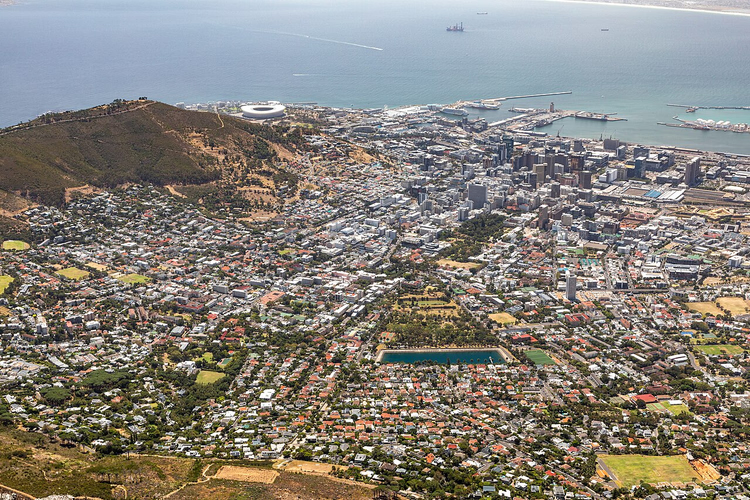 © Dietmar Rabich · CC BY-SAPhoto: Dietmar Rabich, CC BY-SA (https://creativecommons.org/licenses/by-sa/4.0), Wikimedia Commons
If you base yourself here, you can walk to the main attractions. Table Mountain, Company's Garden, and the museums are all nearby, and the city views open up right from the street.
It's also one of the most affordable neighborhoods in Cape Town. Hostels, guesthouses, and stylish mid-range hotels here cover every taste. Take a walk through Bo-Kaap at sunset: the colorful houses make for the best photos in the city.
V&A Waterfront: maximum convenience
If you want everything at your fingertips, V&A Waterfront won't disappoint. The historic port has been turned into a district with shops, restaurants, the Two Oceans Aquarium, Nobel Square, and the ferry to Robben Island. All of it is a short walk from one another.
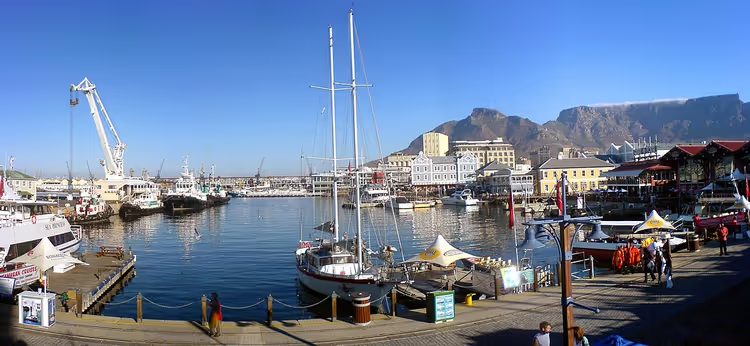 © Damien du Toit · CC BYPhoto: Damien du Toit, CC BY (https://creativecommons.org/licenses/by/2.0), Wikimedia Commons
The area looks well kept and lively at any time of day. Hotels here are pricier, but the location and views justify the cost. For a first trip without a car, this is the easiest choice.
Sea Point: local atmosphere
Sea Point lies on the Atlantic coast north of Camps Bay. It's a lively, cosmopolitan neighborhood with a strong restaurant scene, a promenade for walking, and the huge open-air Sea Point Pavilion pool right by the ocean.
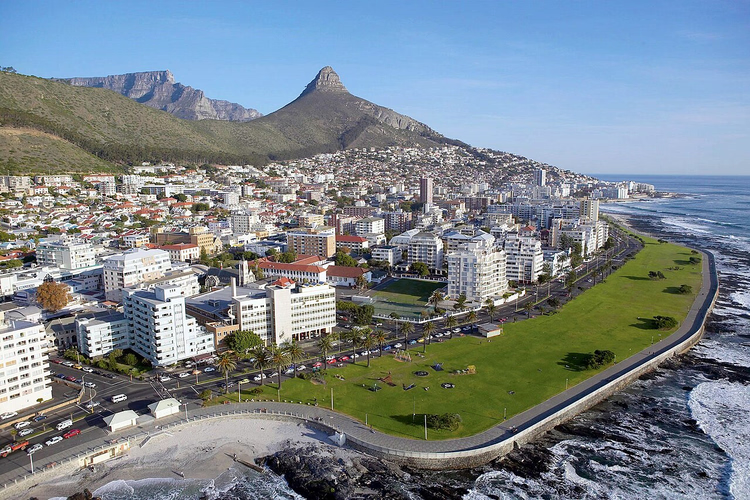 © Hilton1949 · CC BY-SAPhoto: Hilton1949, CC BY-SA (https://creativecommons.org/licenses/by-sa/3.0), Wikimedia Commons
You'll find more locals than tourists here. It feels more like living in the city than making a short stop. Accommodation in Sea Point is usually better value than in the tourist areas.
We recommend Sea Point if you're staying for a week or more and want to feel the city rather than just sleep in it.
Camps Bay and Clifton: beaches and villas
If you want glossy Cape Town, this is where you go. White sand, turquoise water, palm trees along the promenade, and villas on the mountainside. Camps Bay beach has long been the city's calling card, and the restaurants along the strip are great for a long lunch with a sunset view.
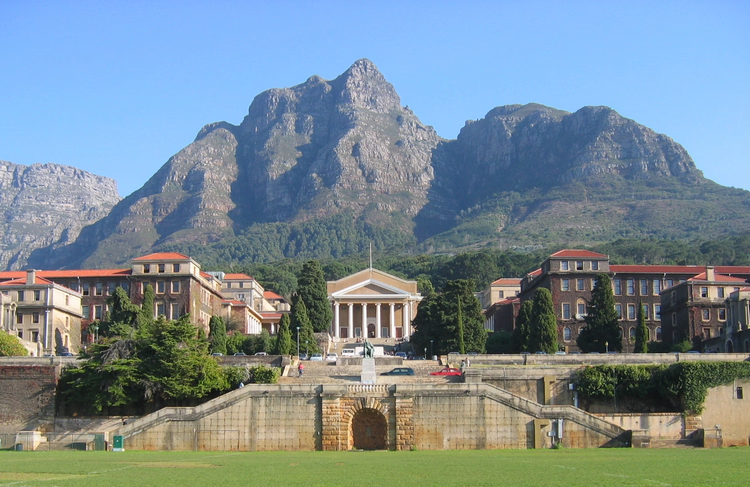 © Adrian Frith · CC BY-SAPhoto: Adrian Frith, CC BY-SA (https://creativecommons.org/licenses/by-sa/3.0), Wikimedia Commons
One important warning: the Atlantic Ocean water here is cold, the current brings it up from Antarctica. Don't expect warm swimming, but the views make up for it.
The area is geared toward big-budget travel. It's mostly villas, boutique hotels, and expensive guesthouses.
De Waterkant: design hotels
De Waterkant is tucked between City Bowl and V&A Waterfront. It's a small, cozy neighborhood with cobblestones and brightly painted Cape Dutch houses.
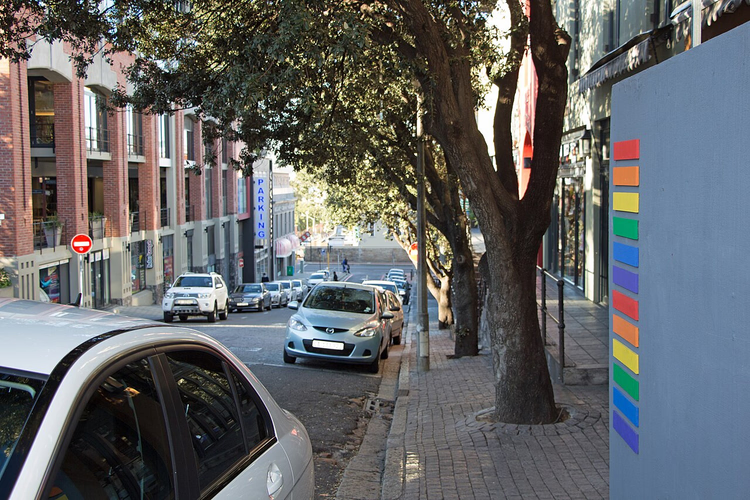 © HelenOnline · CC BY-SAPhoto: HelenOnline, CC BY-SA (https://creativecommons.org/licenses/by-sa/3.0), Wikimedia Commons
The area is known as Cape Town's friendly village for LGBTQ+ guests. There are plenty of boutique hotels, designer guesthouses, and apartments with kitchens. The center and the waterfront are nearby, everything is within walking distance.
Where to save on accommodation in Cape Town
Budget accommodation in Cape Town doesn't mean bad. Hostels and small guesthouses hold a high standard, and prices are noticeably lower than in Europe. Here are three central options worth checking.
The Backpack
Don't let the name put you off: this is one of the most famous and well-run hostels in South Africa. It has been welcoming budget travelers to Cape Town for decades. The hostel sits in the very heart of City Bowl, with a pool, a bar, and common areas where it's easy to meet people. There are also private rooms if a dorm doesn't suit you.
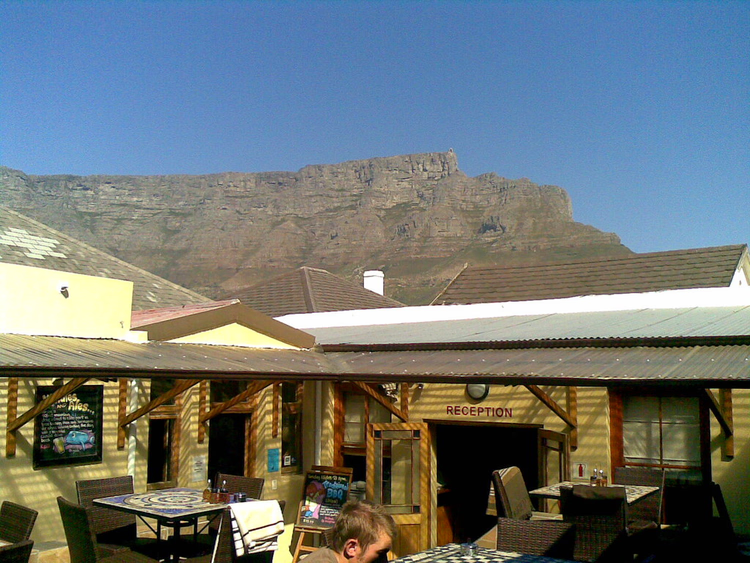 © Turntable Guy · CC BYPhoto: Turntable Guy, CC BY (https://creativecommons.org/licenses/by/2.0/), Flickr
- Location: center of City Bowl, Long Street and Bo-Kaap a step away.
- Who it's for: solo travelers who need a social base.
- Price: budget level, check current rates on Trip.com.
Once in Cape Town
Once in Cape Town sits on Kloof Street in the Gardens area and offers one of the best price-to-location ratios in the center. The rooms are clean, tidy, and tastefully done. From here it's easy to walk to both V&A Waterfront and Long Street.
The staff are happy to give city tips, and the breakfast gets praise in reviews. For budget-conscious travelers, this is a rare case where cheap doesn't mean bland.
- Location: Kloof Street, Gardens area.
- Who it's for: budget travelers who care about a central location.
- Price: budget level, find rooms on Trip.com.
Ashanti Lodge Gardens
Ashanti Lodge has long been a Cape Town classic: a big, bright hostel in a Victorian house with a garden, a rooftop bar, and a pool. The rooftop sunset alone is worth staying here for.
Budget travelers have loved this hostel for many years. It's a great base for meeting people and for exploring Long Street and City Bowl.
- Location: City Bowl, near Gardens and Long Street.
- Who it's for: those looking for social connections and wanting to be in the center.
- Price: budget level, see options on Trip.com.
Mid-range hotels in Cape Town
A mid-range budget gives you the most choice in Cape Town. Here you'll find designer hotels and historic houses with pools. Here are four options for different tastes.
The Gorgeous George
The Gorgeous George sits on St George's Mall right in the center and looks more expensive than its price. It's a restored historic building with modern design, a pool, and a rooftop bar with views of Table Mountain. The rooms are stylish and well equipped, and the hotel restaurant is strong.
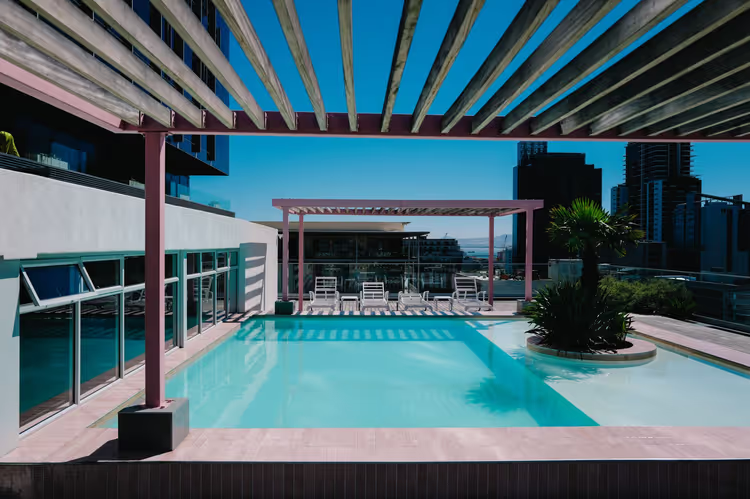
This is our top pick in the mid-range segment.
- Location: St George's Mall, in the heart of City Bowl.
- Who it's for: those who want design and a mountain view at a reasonable price.
- Price: mid-range for the city center, check rooms on Trip.com.
POD Camps Bay
POD Camps Bay sits right above Camps Bay beach with sweeping views of the ocean and the Twelve Apostles range. The rooms are modern and bright, the pool area is pleasant, and the beach is about a five-minute walk away.
- Location: Camps Bay, above the beach; you'll need an Uber to get downtown.
- Who it's for: those willing to pay for the view and a beach on your doorstep.
- The catch: the area is far from the city center, so budget for Uber rides.
- Price: mid-range for the coast, check dates on Trip.com.
Winchester Mansions
Winchester Mansions has long been a Cape Town classic. This historic hotel on the Sea Point waterfront holds on to its old-world elegance: Cape Dutch architecture, a courtyard with a pool, and ocean views from the windows in the morning. The hotel's Harvey's restaurant has been a Sea Point fixture for years.
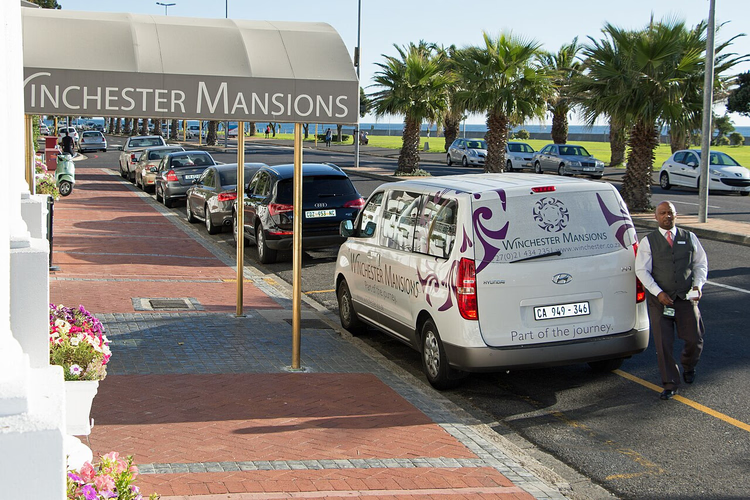 © HelenOnline · CC BY-SAPhoto: HelenOnline, CC BY-SA (https://creativecommons.org/licenses/by-sa/4.0), Wikimedia Commons
- Location: Sea Point waterfront, along the promenade.
- Who it's for: couples and those who value character over newness.
- Price: mid-range for the coast, see Trip.com.
15 On Orange
15 on Orange sits in the Gardens neighborhood on the slopes of Table Mountain. It's a modern hotel with a terrace pool and attentive service. Company's Garden and the South African Museum are an easy walk away, and the rooftop bar offers a mountain view.
- Location: Gardens neighborhood, slopes of Table Mountain.
- Who it's for: those who want a quiet, green area close to the city center.
- Price: mid-range for the city center, find rooms on Trip.com.
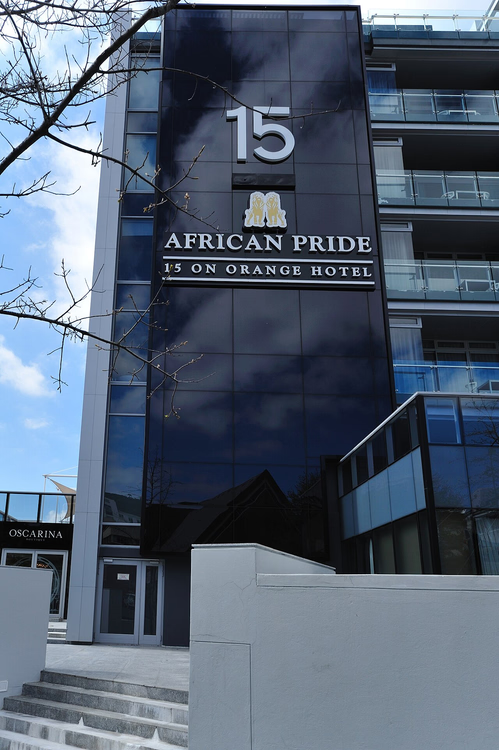 © Josephou · CC BY-SAPhoto: Josephou, CC BY-SA (https://creativecommons.org/licenses/by-sa/3.0), Wikimedia Commons
High-end hotels in Cape Town
If your budget allows, Cape Town offers world-class hotels. Below are four options for a special occasion.
The Silo Hotel
The Silo sits on top of Zeitz MOCAA in a former grain elevator. It's one of the most unusual hotels in Africa: the architecture is striking, the rooms feel like galleries, and the rooftop pool gives you a panorama of Table Mountain, the harbor, and the Atlantic.
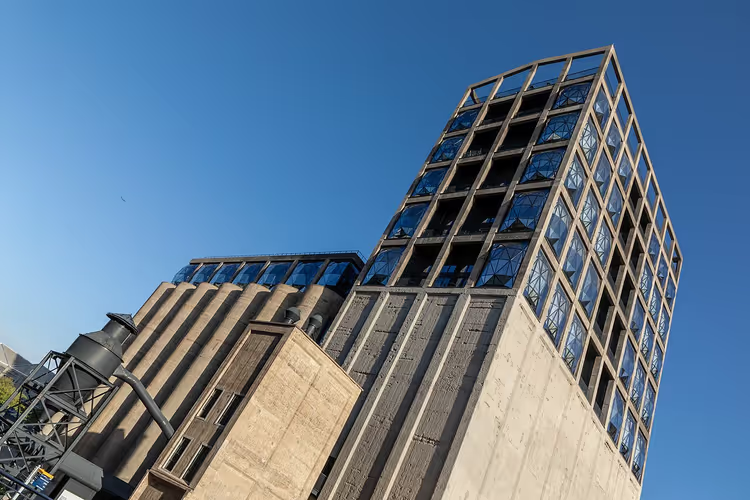 © Dietmar Rabich · CC BY-SAPhoto: Dietmar Rabich, CC BY-SA (https://creativecommons.org/licenses/by-sa/4.0), Wikimedia Commons
- Location: V&A Waterfront, above the Zeitz MOCAA museum.
- Who it's for: those who want a show-stopping hotel and the best view in the city.
- The catch: high price, staying here is an investment in the experience.
- Price: top price tier, check dates on Trip.com.
Belmond Mount Nelson
Belmond Mount Nelson, which locals call "Nellie," has been welcoming guests since 1899. The hotel sits in a garden at the foot of Table Mountain and maintains classic luxury: afternoon tea, a pool, impeccable service.
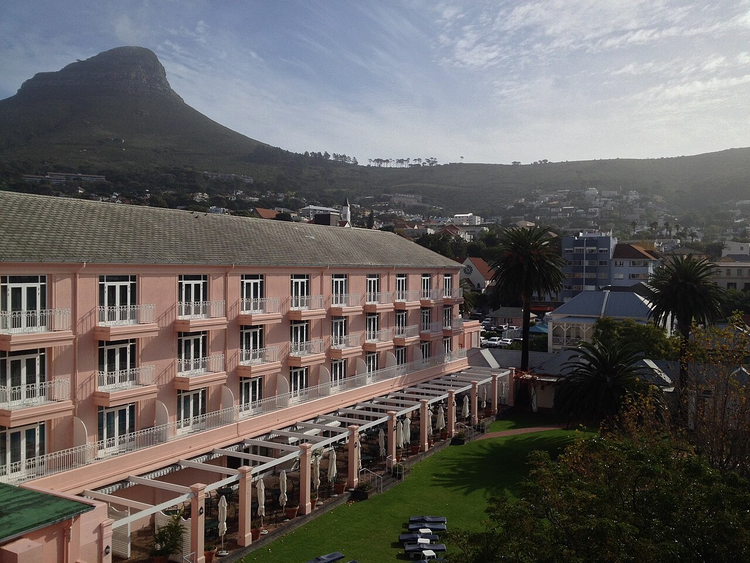 © Bernard303 · CC BY-SAPhoto: Bernard303, CC BY-SA (https://creativecommons.org/licenses/by-sa/4.0), Wikimedia Commons
- Location: gardens below Table Mountain, close to the city center.
- Who it's for: those celebrating an occasion and wanting history.
- Price: top price tier, check rooms on Trip.com.
Twelve apostles hotel & spa
Twelve Apostles sits between the Twelve Apostles mountain range and the Atlantic Ocean, on the road between Camps Bay and Hout Bay. The spa here is one of the best in the city, the pool terrace faces the water, and from the viewing areas you can sometimes spot whales and seals.
 © South African Tourism from South Africa · CC BYPhoto: South African Tourism from South Africa, CC BY (https://creativecommons.org/licenses/by/2.0), Wikimedia Commons
- Location: on the road between Camps Bay and Hout Bay.
- Who it's for: couples and those coming for the spa and quiet.
- The catch: without a car or taxi, the city is far away.
- Price: top price tier, check on Trip.com.
Ellerman House
Ellerman House: a small boutique hotel in a restored Edwardian mansion above Bantry Bay. Just 13 rooms, a panorama of the Atlantic, a serious wine collection, and very personal service.
- Location: Bantry Bay, above the ocean.
- Who it's for: those who want privacy and intimacy.
- Price: top price tier, check rooms on Trip.com.
Practical tips for your trip
Book Table Mountain in advance
Book the Table Mountain cable car in advance and go up in the morning. During the day the mountain is often covered by a cloud that locals call the tablecloth. In strong wind the cable car closes, so check the forecast and status on the official website.
Use basic caution
Cape Town is beautiful, but it's a big city. In the evening stick to busy streets, don't walk alone through empty blocks, don't flash valuables, and take Uber rather than hailing a car on the street. The tourist areas of Camps Bay, V&A Waterfront, Sea Point, and De Waterkant are usually calm and patrolled.
Try the local food
Cape Town's food scene is underrated globally. Try braai, the South African barbecue, bunny chow, fresh kingklip in Hout Bay, and street food at the Oranjezicht City Farm Market. For fine dining, people go to Chefs Warehouse, La Colombe, and The Test Kitchen.
Visit the winelands
Stellenbosch and Franschhoek are less than an hour from the city. The scenery, wine, and restaurants are world-class. Set aside a full day for the trip, either with a car or on a wine tour.
Check for power outages
South Africa has experienced rolling blackouts, known as load shedding. As of 09/2026 there are no outages, confirmed by the official Eskom portal. Just in case, install the EskomSePush app and keep a power bank handy.
Sort out your money
Local currency: South African rand (ZAR). Cards are widely accepted, but a little cash comes in handy for markets, small cafes, and tips. Exchange currency in advance or use a card with no withdrawal fees.
⁉️🤔 Frequently asked questions
Which Cape Town neighborhood should I choose for a first trip?
For a first trip, City Bowl and V&A Waterfront are the most convenient. In City Bowl you stay in the historic center and can walk to museums and Long Street. V&A Waterfront is pricier, but everything is at hand, including the ferry to Robben Island. If you want a beach and a view, look at Camps Bay.
How much does a ticket to Robben Island cost?
For foreign tourists, an adult ticket costs 600 rand, a child ticket 310 rand (as of 09/2026, Robben Island Museum). The ferry departs from Nelson Mandela Gateway at V&A Waterfront, and the whole tour takes about 3.5 hours. Departures are at 09:00, 11:00, 13:00, and 15:00, and it's best to book in advance.
Do I need a car in Cape Town?
For the center, a car isn't necessary: there's Uber, and the MyCiTi bus connects the center, V&A Waterfront, and Sea Point. But for Cape Point, the winelands, and Boulders Beach, a car makes the trip much easier.
Is Cape Town safe?
As in any big city, basic caution matters here. During the day tourist areas are calm; in the evening it's better to get around by Uber and avoid walking on empty streets.
When is the best time to visit Cape Town?
The best time is from November to March, the southern summer. If you want fewer people and lower prices, choose April, May, or October.
Find hotels in Cape Town
Compare prices across booking sites and filter for rooms with free cancellation.
Compare prices on Trip.comThe widget loads once you give your consent.
In short: what to book
If it's your first visit and you're short on time, take a hotel in City Bowl or near V&A Waterfront: you'll save hours on getting around. If you're coming for the beach and sunsets, look at Camps Bay and Sea Point. For design and a central location, De Waterkant is the answer.
Book in advance, especially for the southern summer, when demand and prices peak. To lock in the main logistics, use Cape Town hotels on Trip.com, tickets and tours, and car rental.

A small editorial team writing guides for independent travel. We travel ourselves, but we haven’t been everywhere, so we check prices, opening hours and how to get there against official sources.