
















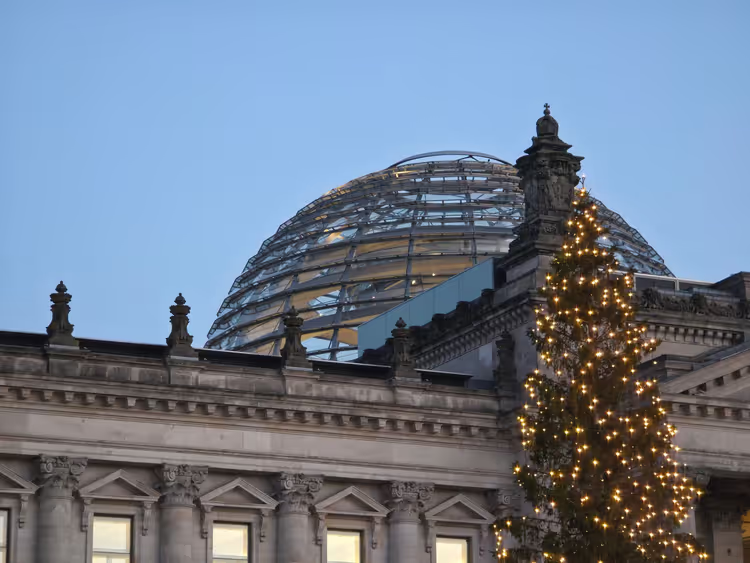
Reichstag dome in Berlin: free visit by appointment
The Reichstag in Berlin is open to visitors free of charge. But without advance registration, you won't even be allowed onto the observation deck. The dome and terrace welcome guests daily from 8:00 AM to midnight, with the last entry at 9:45 PM (as of 09/2026, dome opening hours). Available slots get booked up well in advance in summer, so it's worth choosing a date before your trip.
Below is how it all works: a brief history, the design of the glass dome, and the rules for visiting. Plus how to get to Platz der Republik and what to do if you couldn't book in advance.
Ad: this text contains affiliate links; we earn a commission from them, but the price for you stays the same.
What the Reichstag is and why it matters
💡 In short:
- Entry to the Reichstag and the dome is free; you only pay for a guided tour or lunch.
- The dome and terrace are open daily from 8:00 AM to midnight, with the last entry at 9:45 PM (as of 09/2026, Bundestag page about the dome).
 © Jörg Braukmann · CC BY-SAPhoto: Jörg Braukmann, CC BY-SA (https://creativecommons.org/licenses/by-sa/4.0), Wikimedia Commons
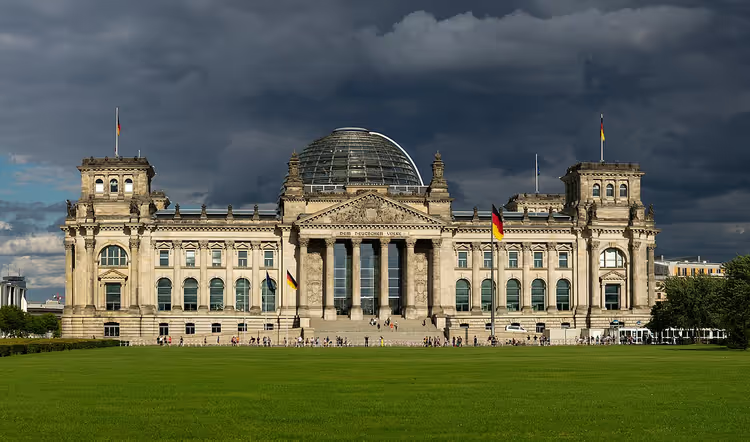
The word "Reichstag" translates from German as "state assembly building." The building's history began with the creation of the German Empire in 1871, when the parliament brought together 382 deputies (visitBerlin). At first, the elected representatives met in the Royal Porcelain Manufactory building, but there wasn't enough space. Having their own building became a matter of prestige for the young empire.
Over its history, the building has witnessed decisions that were pivotal for the country. In October 1918, the overthrow of the emperor and the creation of a republic were announced from its balcony (historical chronicle). Today, the German Bundestag works here: deputies elect the chancellor, pass laws, and oversee the government.
After the reunification of Germany on October 4, 1990, the Reichstag hosted the first symbolic session of the new parliament (tourist office data). In 1999, the Bundestag finally moved from Bonn to Berlin and took over the restored building. Since then, the Reichstag has been open to the public: people come here for sessions, tours, and simply for the view from above.
History: from the empire to the present day
Kaiser Wilhelm I laid the foundation stone on June 9, 1884 (history of the Reichstag). Approval of the project dragged on for years. Disputes over the location got in the way, and Count Athanasius Raczynski refused to give up his plot of land for the huge building.
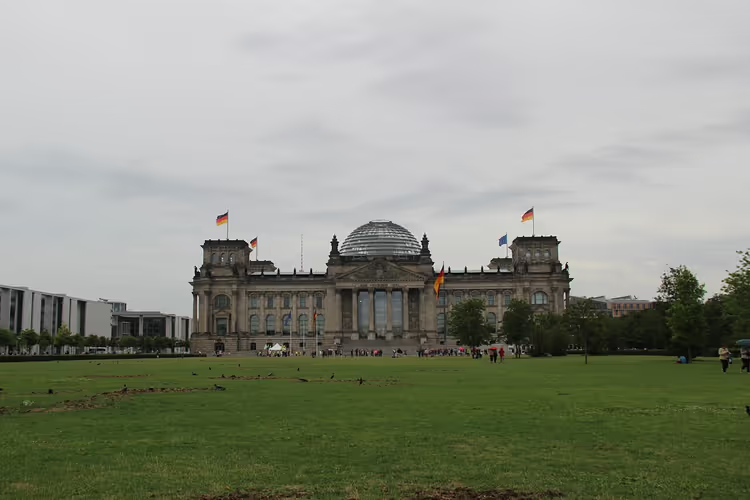
Construction was completed by 1894 under Wilhelm II, and parliament moved into the new halls (tourist office information). In July 1932, the National Socialist party won the elections, and Hermann Goring became president of the assembly. In January 1933, Adolf Hitler was appointed chancellor. The Weimar Republic ceased to exist at that point.
The fire of 1933
On February 27, 1933, the building was engulfed in fire (visitBerlin). The plenary hall suffered the most damage, and the dome was also charred. Police detained a suspect, Marinus van der Lubbe, a member of the Communist Party of the Netherlands.
A day later, Reich President Hindenburg signed a decree restricting civil rights, and the Communist Party was banned. Modern historians consider the arson a provocation by supporters of the dictator, not a communist uprising.
The Reichstag under the Nazis
In 1934, Hitler merged the offices of Fuhrer and president (visitBerlin). Parliament ceased to exist as a center of power: decisions were made in the Reich Chancellery and the bunker. The Nazis repurposed the building for their own needs, housing a hospital and a Luftwaffe office there.
For Soviet soldiers, the Reichstag remained a symbol of the enemy. It was above its roof that the Soviet flag was raised on May 1, 1945.
Restoration after the war
After the war, the building lay in ruins, and the Berlin Wall ran nearby. In 1954, the damaged dome was blown up and some of the bas-reliefs were removed from the facade (visitBerlin). The first restoration lasted from 1956 to 1972, but the building stood without a dome and served as an exhibition hall.
In 1991, the Bundestag voted to move from Bonn to Berlin, and the reconstruction was entrusted to the British architect Norman Foster. In June 1995, the artists Christo and Jeanne-Claude wrapped the Reichstag in silvery fabric covering about 100,000 m² (as of visitBerlin). For two weeks, the object attracted millions of viewers. The renovated Bundestag building opened on April 19, 1999.
The dome and the wall of remembrance
 © Thomas Quine · CC BYPhoto: Thomas Quine, CC BY (https://creativecommons.org/licenses/by/2.0), Wikimedia Commons
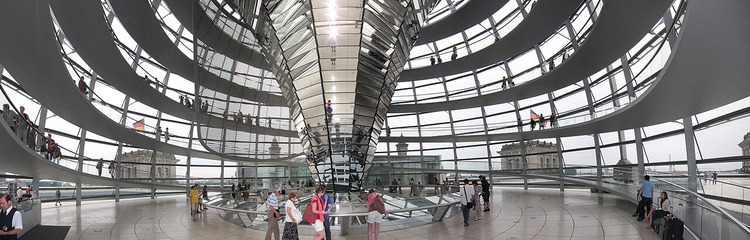
The main landmark of the modern Reichstag was created by Norman Foster. Its glass dome is encircled by two spiral ramps with a total length of 230 meters. The structure reaches a height of 23.5 meters, has a diameter of 38 meters, and weighs more than 1,200 tons (visitBerlin). The dome also works as a climate system: it lets in daylight and regulates the temperature inside.
At the center of the dome stands a funnel made of 360 mirrored elements (visitBerlin). A computer turns them to reflect light into the plenary chamber while simultaneously drawing air out. The upper level has an observation deck with a circular panorama of Berlin.
A second commemorative detail: the wall of remembrance with inscriptions left by Soviet soldiers who stormed the city in 1945. Many of the writings were erased during the first restoration, but later the deputies decided to keep them as a reminder of the war. The surface was treated with a transparent coating to preserve the inscriptions.
Paul Wallot's architecture
The author of the original design: Paul Wallot, one of nearly two hundred competition participants. He conceived the building as a symbol of imperial power. The structure is 47 meters high and 137 meters long, and its footprint is close to a square (visitBerlin).
Towers with allegorical sculptures rise at the corners. They personify the four kingdoms that united in 1871: Bavaria, Saxony, Württemberg, and Prussia. The appearance mixes elements of the Renaissance, Baroque, and Classicism, and the main facade resembles an ancient Roman portal with six pairs of columns.
In 1916, the inscription "To the German people" (Dem deutschen Volke) appeared on the pediment. The letters were cast from parts of Napoleonic cannons. Inside, the building is multi-level: the first level contains the plenary chamber with an area of 1,200 m², above it is a visitors' area, and higher still is the level of the federal president.
Opening hours and visiting procedure (as of: 09/2026)
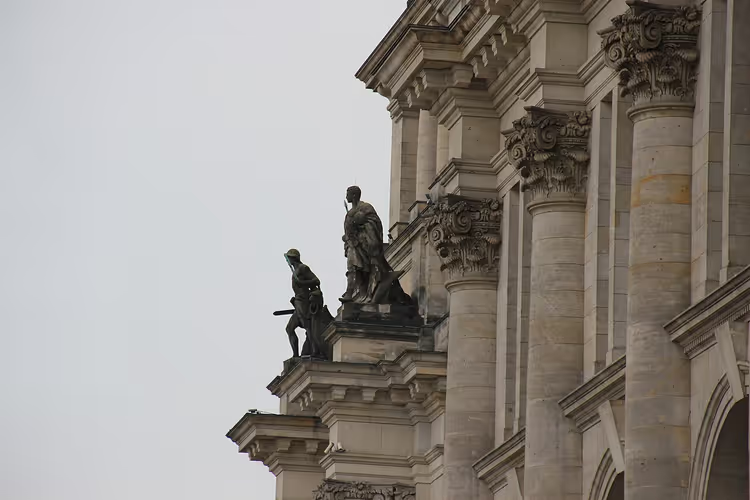
You can enter the Reichstag free of charge: the dome, the terrace, and the audio guide cost nothing. The building is open daily from 8:00 to 24:00, with the last entry at 21:45 (as of: 09/2026, verified on the Bundestag website). On certain days the dome is closed due to sessions, weather, or maintenance, so the date is confirmed the day before.
The entrance is to the right of the building. Due to fire safety regulations, no more than 600 people can be on the roof at the same time, and on session days the limit is reduced to 200 (visiting rules). About 90 minutes are allotted for viewing the interior spaces.
A free audio guide is available inside, including in Russian. It tells about the dome, the work of the Bundestag, and the views of the city, and there are separate versions for children and visitors with hearing impairments. You put on the headphones and follow the route at your own pace, with no one rushing you.
Separate from the visit, there is a rooftop restaurant, Dachgartenrestaurant. To have lunch with a view of the center, you book a table in advance, and registration for the dome is not required in that case (as of: 09/2026, Käfer Dachgartenrestaurant).
If you want not just to go up to the dome but to walk through the building with a guide, there are paid tours. Guided tours of Berlin are booked separately, and they do not replace the free registration for the observation deck.
Tours and tickets in Berlin
Guided tours, skip-the-line tickets and activities — most offers can be cancelled free of charge.
See offers on GetYourGuideThe widget loads once you give your consent.
How to register for a visit
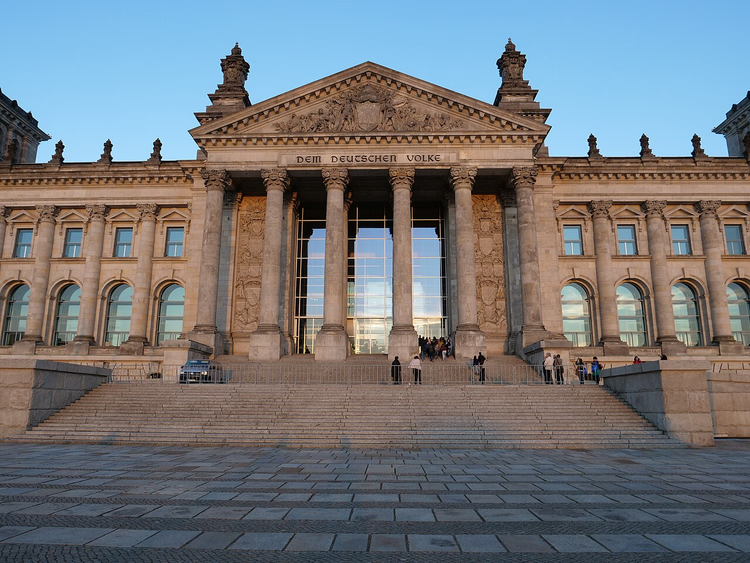 © Leonhard Lenz · CC BY-SAPhoto: Leonhard Lenz, CC BY-SA (https://creativecommons.org/licenses/by-sa/4.0), Wikimedia Commons
Admission is free, but you will not be let in without a booking. The registration form is available on the official Bundestag website (as of 09/2026, registration form). Requests are only accepted for the current and the next month, so do not leave your booking until the last days.
The process is as follows:
- Open the online registration form and select the interface language.
- Specify the type of tour, the number of people, and a convenient date. You can add alternative days and times.
- Enter the captcha and proceed to the questionnaire.
- Fill in the main guest's details: name, address, phone number, and email.
- Confirm that you agree to the rules and submit the request using the "Anfrage absenden" button.
- Confirm the visit via the link in the email and print the final confirmation.
At the entrance, show the printed confirmation and your passport. Leave backpacks and large bags at your hotel or in a luggage locker at the nearest station: you will not be allowed inside with them.
How to get to the Reichstag
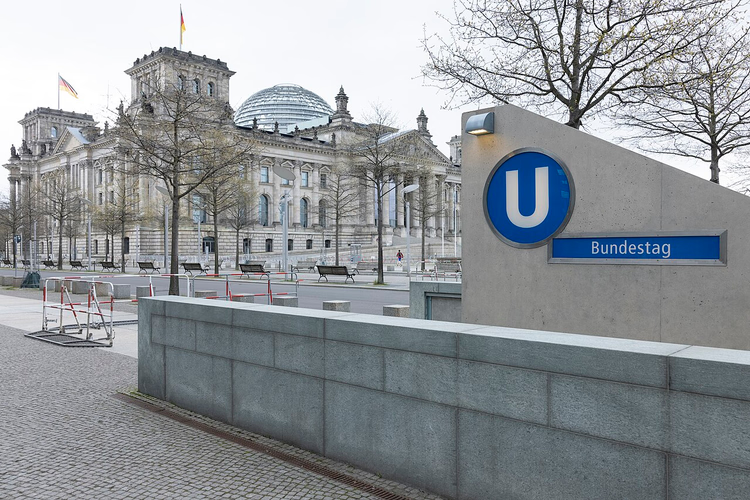 © Arne Müseler · CC BY-SAPhoto: Arne Müseler, CC BY-SA (https://creativecommons.org/licenses/by-sa/3.0/de/deed.en), Wikimedia Commons
The building stands in the center of Berlin on Platz der Republik, by the Spree River. Address: Platz der Republik 1, 11011 Berlin. The nearest stops are Bundestag U-Bahn station and Brandenburger Tor S-Bahn station, both a few minutes' walk from the entrance (as of 09/2026, visitBerlin). From the Brandenburg Gate you can walk straight there, and along the way you will see the Memorial to the Murdered Jews of Europe.
Reichstag on the map
Building coordinates: 52°31′7″ N, 13°22′34″ E (as of 09/2026, visitBerlin). If you are driving, it is easier to park away from Platz der Republik and walk the last few hundred meters. The map below shows the Reichstag's location.
⁉️🤔 Frequently asked questions
Can I visit the Reichstag for free?
Yes, admission to the dome and terrace is free. You only pay for a guided tour or lunch at the rooftop restaurant. Registration on the Bundestag website itself also costs nothing (as of 09/2026, Bundestag website). Paid tours do not replace registration and do not let you skip the wait for a slot.
How do I book the dome?
Registration is done online. You open the form on the Bundestag website, choose a date, time, and alternative options. Requests are accepted for the current and the next month. In summer, free slots are taken well in advance, so do not leave your booking until the last days.
How long does the visit take?
You get about 90 minutes for the indoor tour, plus time on the terrace and at the dome. Before going up, you go through a security check, so arrive a little before your slot. With an audio guide, the walk takes longer.
What if I could not book in advance?
There is a service pavilion near the building where, if you have your passport, you can sometimes get a pass for the nearest available time. Check available slots and opening hours on the official website (as of 09/2026, online booking). In high season, your chances are slim, so come in the morning.
Can I have lunch on the Reichstag roof?
Yes, there is a rooftop restaurant called Dachgartenrestaurant. It requires a separate table reservation, and dome registration is not required (as of 09/2026, rooftop table reservation). Book a window table in advance, especially for dinner.
In short: what is worth booking
The Reichstag is worth seeing for its glass dome and the panorama of Berlin, but viewing platform slots get taken early. Complete the free registration as soon as you know your travel dates. It only takes a few minutes.
- If this is your first time in Berlin: take a guided tour and add a free dome visit.
- If you are interested in politics: choose a day without sessions and book in advance.
- If you are traveling in summer: submit your request a month ahead.

A small editorial team writing guides for independent travel. We travel ourselves, but we haven’t been everywhere, so we check prices, opening hours and how to get there against official sources.