
















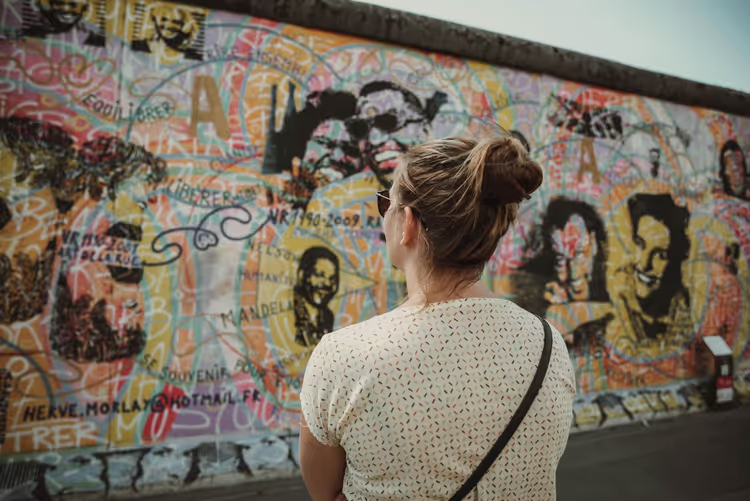
Berlin wall: what remains of it today and where to see it
The Berlin Wall in Berlin is long gone, but almost every visitor goes looking for it. What remains of the concrete ring is a line of cobblestones, a few original sections, and memorials. Many people expect a solid gray wall and end up disappointed on the ground.
Less survives than you might think. On the plus side, everything that remains can be seen for free and fits into a single day. We have gathered verified information: where to see the original segments, what the entry situation is, and how to get there.
Ad: this article contains affiliate links. We earn a commission if you book through them, at no extra cost to you.
Why Berlin was divided into two parts
💡 In short:
- What to see: remnants of the Wall, Gedenkstätte Berliner Mauer, Topographie des Terrors, Checkpoint Charlie, East Side Gallery.
- How much time: 2-3 hours for the memorial, about 1 hour for the gallery.
- How to get there: U8 to Bernauer Straße, U2 to Anhalter Bahnhof, S5/S7/S75 to Ostbahnhof.
- Prices and opening hours: 09/2026, verified on the memorial's official website
The division of Germany grew out of the aftermath of World War II. The capitulation of the Third Reich set off a redrawing of Europe into spheres of influence. In February 1945, the participants in the Yalta Conference (the US, Britain, and the USSR) agreed on Germany's postwar status. The borders of the four occupation zones were finalized in Potsdam, where negotiations ran from July 17 to August 2, 1945.
In May 1949, the Federal Republic of Germany was established, and six months later the GDR emerged. The inner-German border stretched from Bavaria to the Baltic Sea, cutting through cities, fields, and families. Berlin also became a divided city, but it remained an open zone. Residents moved freely between the two parts of the city.
GDR leader Walter Ulbricht was losing people. Thousands of skilled workers were leaving for West Germany via West Berlin, and he repeatedly wrote to Khrushchev about closing the border. The trigger came in 1961: the USSR and the US both claimed full control over the city. The Vienna talks on Berlin's status collapsed, and the Soviet leadership approved the GDR's proposal to tighten control.
How the Wall was built and expanded
On the night of August 13, 1961, the eastern part of the city was sealed off with barbed wire. By morning, troops had occupied the main transport arteries and set up barriers. By August 15, the border line was fully cordoned off, and the first concrete blocks appeared.
Construction crews blocked streets, bricked up windows in adjacent buildings, cut wires, and welded pipes shut. The Wall ran through subway stations, tram lines, railway crossings, and the Spree River. The Brandenburg Gate was fenced off on all sides, and the city's main symbol became inaccessible to residents of both the west and the east.
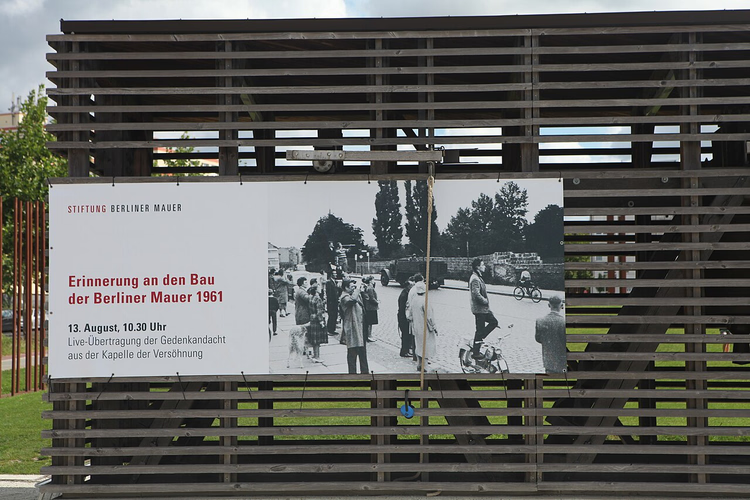
From 1962 to 1978, the structure was expanded and upgraded. Each version looked more forbidding than the last. By the late 1970s, some sections had metal mesh fitted with signal flares.
What the Wall actually was
The Berlin Wall was not a single slab but an entire system of concrete segments, mesh, a trench, and signaling devices. The core was assembled from reinforced blocks up to 3.6 m high. In 1975, smooth iron pipes were installed on top, impossible to grip with your hands.
Indicator | Value (as of 09/2026, mauermuseum.de) |
|---|---|
Total length | 155 km |
Length through Berlin | 43.1 km |
Length along the GDR border | 111.9 km |
Height of concrete segments | up to 3.6 m |
At the foot of the Wall stood anti-tank hedgehogs and barrier strips with spikes, popularly known as "Stalin's lawn." Some zones were also fitted with electrified barbed wire. The Wall was guarded by thousands of soldiers, dozens of watchtowers, and hundreds of posts with dogs, and crossing illegally was punishable by prison or death.
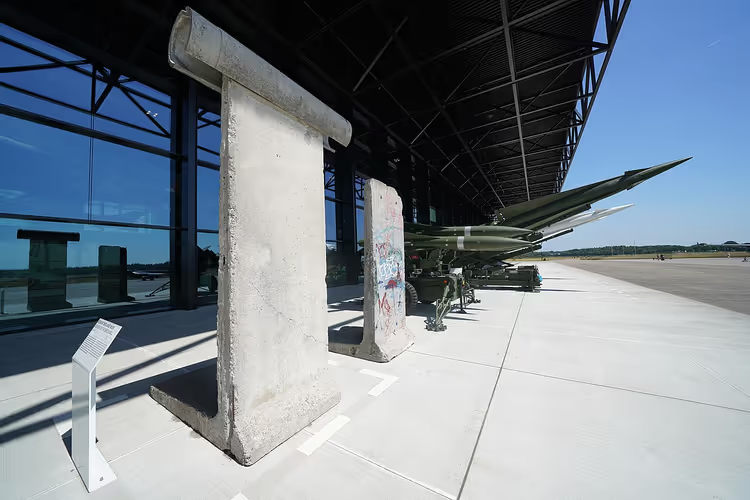 © bertknot from scarborough, australia · CC BY-SAPhoto: bertknot from scarborough, australia, CC BY-SA (https://creativecommons.org/licenses/by-sa/2.0), Wikimedia Commons
Between the fence and the wall ran an earthen ditch called the "death strip." The area was lit by floodlights and patrolled with dogs. That is why escape attempts so often ended in tragedy.
Crossing the border and the price of escape
The wall separated relatives and friends, and only pensioners were allowed to cross the border legally. Everyone else looked for loopholes, and many paid for them with their lives. According to the Stiftung Berliner Mauer, at least 140 people died at the wall (as of 09/2026, official list of victims).
The first victim was Günter Litfin: GDR border guards shot him in August 1961 as he tried to swim across the Spree. In 1966, a burst of gunfire killed two children, aged ten and thirteen. The last victims were Winfried Freudenberg, who crashed on March 8, 1989, in a homemade hot-air balloon, and Chris Gueffroy, who died under gunfire in February of that same year.
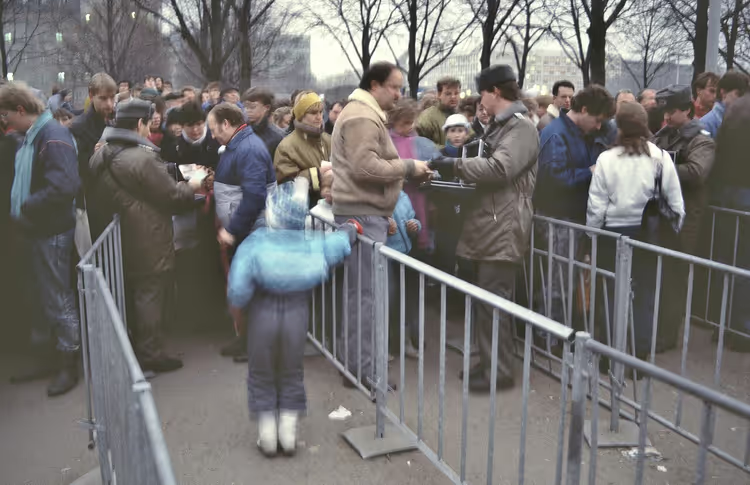 © Aad van der Drift · CC BYPhoto: Aad van der Drift, CC BY (https://creativecommons.org/licenses/by/2.0), Wikimedia Commons
Look at these numbers calmly: behind them stand real people with names. We cite only the data confirmed by the Stiftung Berliner Mauer foundation.
The fall of the wall
Mikhail Gorbachev began reforms in the USSR under the slogans "Glasnost" and "Perestroika." The GDR leadership lost Moscow's support and could no longer hold on to its citizens. Socialist Hungary, and then Czechoslovakia, opened their borders, and East Germans poured through them into West Germany. The wall was no longer needed.
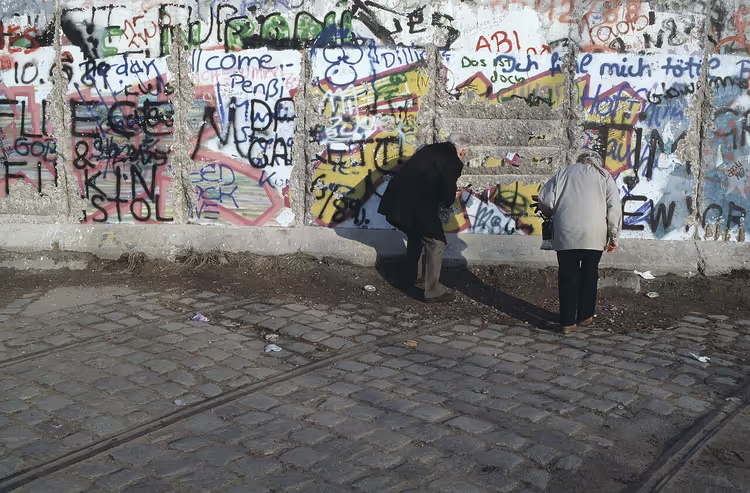 © Aad van der Drift · CC BYPhoto: Aad van der Drift, CC BY (https://creativecommons.org/licenses/by/2.0), Wikimedia Commons
On the evening of November 9, 1989, at a press conference, a question was asked about when the decision to open the crossings would take effect. Politburo member Günter Schabowski answered with the famous phrase: "As far as I know, this will happen... immediately, without delay." Berliners watching the broadcast were stunned at first. Then they rushed to the wall from both sides.
The border guards did not try to hold back the crowd. The reunification that people had dreamed of for nearly three decades had arrived. Official demolition began on June 13, 1990, on Bernauer Straße, but even before that, city residents had taken away countless fragments as souvenirs.
Interesting facts about the Berlin Wall
The history of the wall is still being studied, and some details you will not find in standard guidebooks. Here is what is worth knowing before your trip.
- On October 27, 1961, Soviet and American tanks faced off at the Friedrichstraße crossing: the armored vehicles stood opposite each other.
- On June 11, 1964, French President Charles de Gaulle warned the Soviet ambassador about the risk of nuclear war if a new conflict broke out around Berlin.
- Despite the heavy security, thousands of people made it across the wall, and some GDR service members used their official positions to do so.
- After the crossings opened, bars near the wall served free beer to East German border guards.
- Individual segments ended up around the world: you can see them at CIA headquarters and in the Vatican.
- Construction and security cost the GDR hundreds of millions of marks and became one of the reasons for the collapse of the socialist economy.
- On November 9, 2014, for the 25th anniversary of the wall's fall, thousands of glowing balloons were lit along the former border and rose into the sky that evening.
What remains of the Berlin Wall today
Today only small fragments remain, along with a double line of cobblestones that snakes through the city. Berlin authorities have opened museums and memorial centers nearby to preserve the memory of the victims. Below is what is actually worth your time.
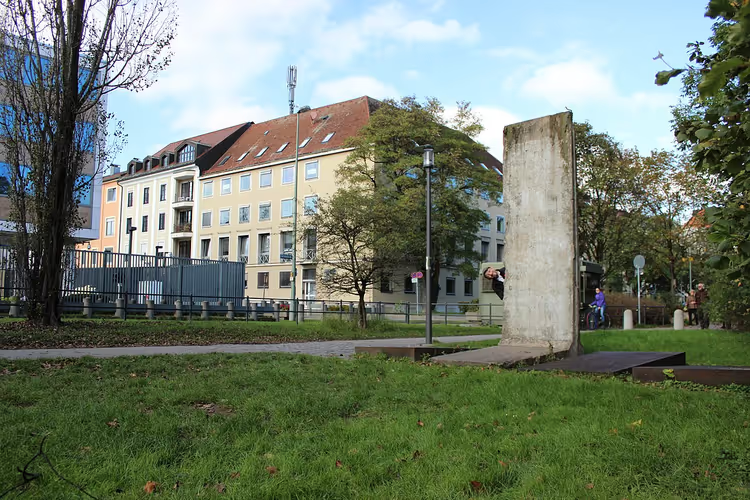 © Rainer Janicki · CC BY-SAPhoto: Rainer Janicki, CC BY-SA (https://creativecommons.org/licenses/by-sa/4.0), Wikimedia Commons
Gedenkstätte Berliner Mauer on Bernauer Straße
The main memorial stands on Bernauer Straße, where buildings once bordered the boundary and residents jumped from windows into the western part of the city. The "Window of Remembrance" installation is made of rusted iron and holds photographs of those who died. Nearby you'll find a section of gray concrete with the border strip, a watchtower, the Kapelle der Versöhnung on the site of a demolished church, a library, and a museum.
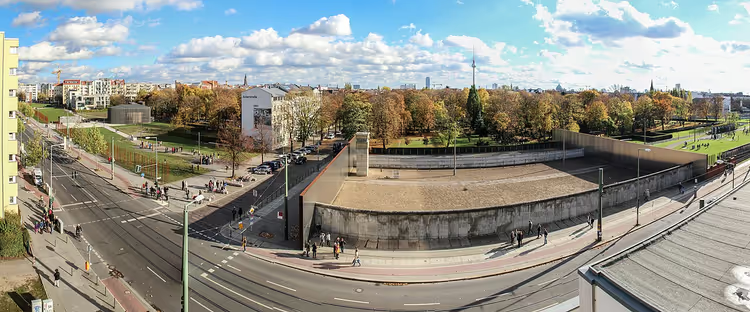 © Dietmar Rabich · CC BY-SAPhoto: Dietmar Rabich, CC BY-SA (https://creativecommons.org/licenses/by-sa/4.0), Wikimedia Commons
The grounds are open daily and free of charge, and admission to the documentation center is also free (as of 09/2026, on the Stiftung Berliner Mauer foundation website). The easiest way to get there is by U-Bahn: line U8, Bernauer Straße station. Who it's for: those who want to see an original section and understand how the border functioned. Not for: if you have only an hour in Berlin, head straight to East Side Gallery.
Topographie des Terrors
Topographie des Terrors is a reminder of the crimes of the Nazi regime. The documentation center stands on the site of SS Reichsführer Himmler's headquarters and features a permanent exhibition of photographs and documents about the genocide. Outdoors nearby lie the ruins of Gestapo barracks and basements, and an original section of the Berlin Wall runs along the site.
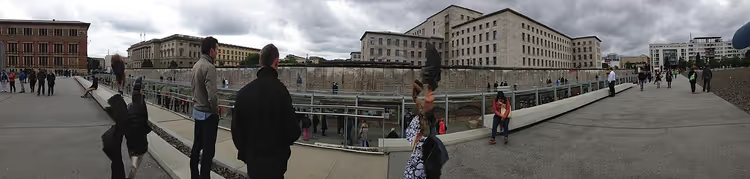 © Drrcs15 · CC BY-SAPhoto: Drrcs15, CC BY-SA (https://creativecommons.org/licenses/by-sa/3.0), Wikimedia Commons
Admission is free, and the exhibitions are open daily from 10 to 20 (as of 09/2026, topographie.de). The outdoor area closes at nightfall.
Address: Niederkirchnerstraße 8, nearest station U2 Anhalter Bahnhof. The catch: the outdoor section is already closed in the evening, so plan your visit before sunset.
Checkpoint Charlie
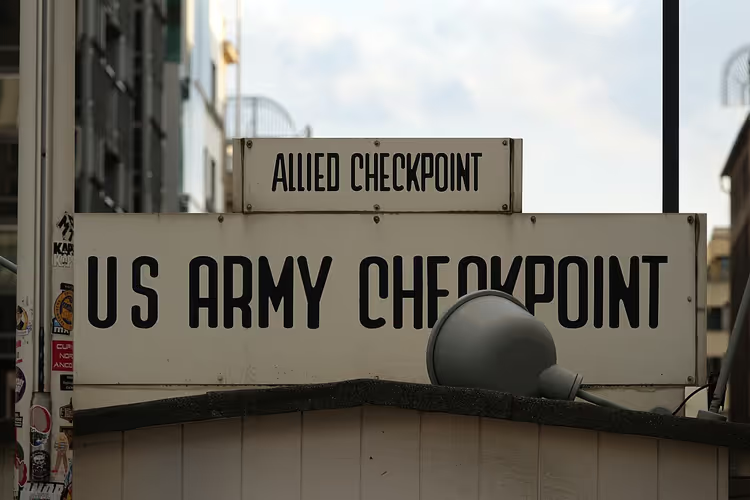
The former crossing for diplomats and officials is known for the standoff between Soviet and American tanks in 1961. Today the Mauermuseum nearby displays exhibits about escapes: scuba gear, hang gliders, hot air balloons. At the entrance stands a replica guardhouse with "soldiers" in American uniforms, and visitors happily take photos with them.
The museum is private, tickets are paid, and you should check the opening hours on the official website before your visit. Address: Friedrichstraße, Kochstraße U-Bahn station. The catch: admission is paid, unlike the city-run museums nearby.
 © Gzen92 · CC BY-SAPhoto: Gzen92, CC BY-SA (https://creativecommons.org/licenses/by-sa/4.0), Wikimedia Commons
East Side Gallery
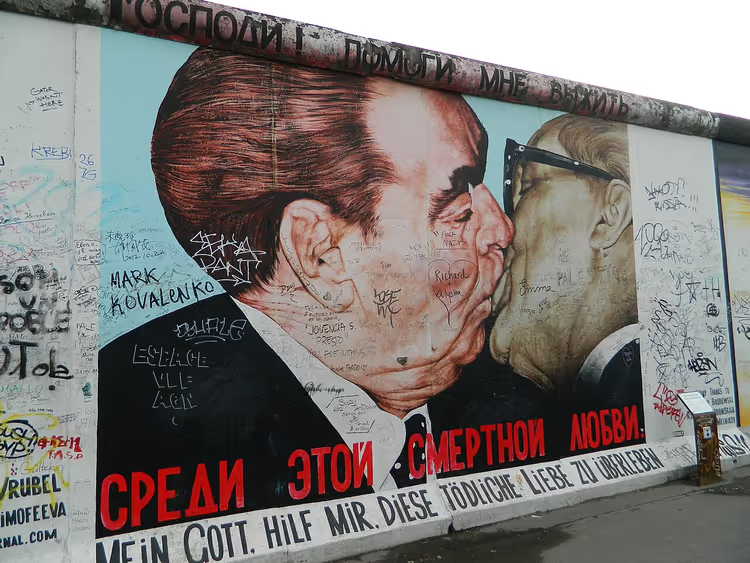
The longest surviving stretch of the Wall runs 1.3 km along Mühlenstraße (as of 09/2026, berlin.de). In spring 1990, 118 artists from 21 countries began painting it (as of 09/2026, according to the city portal). The result is the longest open-air gallery in the world. The most famous work is Dmitri Vrubel's "The Kiss" featuring Honecker and Brezhnev.
 © Freepenguin · CC BY-SAPhoto: Freepenguin, CC BY-SA (https://creativecommons.org/licenses/by-sa/3.0), Wikimedia Commons
Over the years, rain and wind have damaged many of the images. In 2009 the gallery was fully restored with funding from the city and sponsors. By midday, groups gather around the famous works; mornings and evenings are quieter here.
The gallery is open around the clock and free (as of 09/2026, Stiftung Berliner Mauer). Take the S-Bahn lines S5, S7, or S75 to Ostbahnhof or Warschauer Straße; the station is about a 5-minute walk away. The catch: by noon the popular murals are already crowded, so come early in the morning or closer to sunset.
Small sections of the wall also stand in the city center, for example near Potsdamer Platz, which was destroyed in the war and rebuilt at the end of the last century. You'll find another original segment at the Topographie des Terrors.
Tours and tickets in Berlin
Guided tours, skip-the-line tickets and activities — most offers can be cancelled free of charge.
See offers on GetYourGuideThe widget loads once you give your consent.
Where the Berlin Wall runs on the map
The line of the former wall reads on the map as a ring around the city center. On the map below you can zoom in on any section: it's handy for planning a route between the memorial, Checkpoint Charlie, and the East Side Gallery. Cobblestones in the center mark the exact path of the wall, so you won't lose your bearings.
⁉️🤔 Frequently asked questions
Where in Berlin can you see the actual wall?
Original sections survive in several places. The longest stretches for 1.3 km along Mühlenstraße: that's the East Side Gallery. The second large segment lies on Bernauer Straße in the memorial, and the third you'll see at the Topographie des Terrors on Niederkirchnerstraße. Small fragments stand at Potsdamer Platz and in other districts.
How much does it cost to visit the remains of the wall?
The memorial on Bernauer Straße, the Topographie des Terrors, and the East Side Gallery are free (as of 09/2026, Stiftung Berliner Mauer website). You only have to pay at the private Mauermuseum near Checkpoint Charlie. Allow at least two hours if you want to walk the entire memorial and stop by the documentation center.
How do you get to the memorial on Bernauer Straße?
The easiest way is the U8 subway to Bernauer Straße station; the exit leads directly to the memorial. The M10 tram to the Gedenkstätte Berliner Mauer stop also works. From Alexanderplatz the trip takes about 20 minutes. The grounds are open around the clock, and the observation tower operates during the day.
How many people died at the Berlin Wall?
According to Stiftung Berliner Mauer, at least 140 people died at the wall between 1961 and 1989 (as of 09/2026, foundation data on victims). They were refugees, border guards, and bystanders. The exact list is documented, and some of the biographies are read at the annual ceremony at the memorial.
Can you cover all the sites in one day?
Yes, if you start in the morning. First the memorial on Bernauer Straße, then the Topographie des Terrors and Checkpoint Charlie in the center, and finish at the East Side Gallery at sunset. Between the first three points it's easy to get around by subway and S-Bahn. The whole route will take you a full day.
In short: what's worth booking
If you have one free day in Berlin, start with the memorial on Bernauer Straße and save the gallery for the evening.
- If you're going with a guide: book a wall sites tour in advance.
- If you're traveling on your own: admission is free everywhere, and you can build your route along the cobblestone line.
- If you're interested in Cold War history: add the Mauermuseum near Checkpoint Charlie.
Wall sites tours are available on GetYourGuide.

A small editorial team writing guides for independent travel. We travel ourselves, but we haven’t been everywhere, so we check prices, opening hours and how to get there against official sources.