
















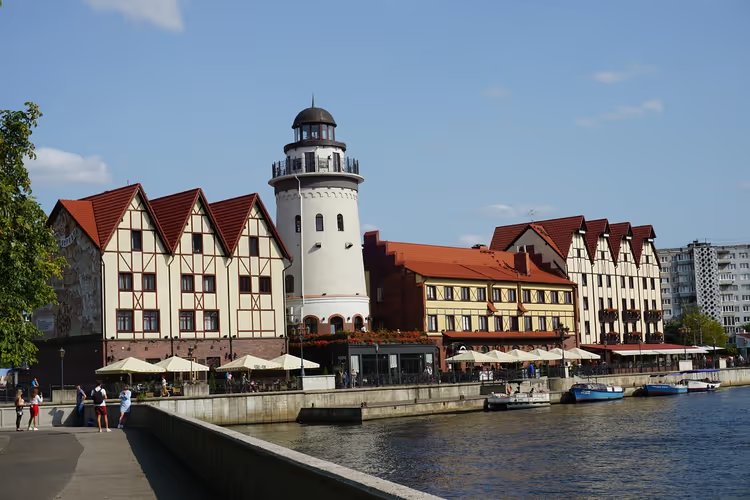
Sights of Kaliningrad: why we removed these guides
Here lay four pieces of content: a large list of the region's attractions, a three-day itinerary, a selection of museums, and a selection of excursions. All four have been removed across all language versions, and the old URLs now redirect here permanently.
We're answering the question readers came here with most often. The region was marketed as the part of Russia closest to Europe, a place you could visit for a weekend with almost no effort. We no longer offer or describe such a trip. There has been no direct air service from the EU since February 2022.
💡 At a glance:
- which four pieces of content were removed and what they contained
- why the "European Russia" framing described something other than what was actually there
- what the transport reality of the exclave looks like for an EU-based reader
- which Baltic cities remain in our active sections
- Last updated: 09/2026
Why we deleted these guides
Three of the four texts were lists, and the fourth was a ready-made weekend itinerary with prices and tips on how to allocate your time. All of that is practical material, and that is precisely what made the content what it was: an invitation to come.
Russia's full-scale invasion of Ukraine began on February 24, 2022 (UN press release GA/12407, 03.02.2022). For this region, the date matters twice over, because the entire point of the previous content rested on how easy the journey was, and the route closed almost immediately.
Let's talk about money without exaggeration. The share of oil and gas revenue in Russia's budget fell to roughly 22 percent in 2025 and 2026, while the share of non-oil-and-gas revenue rose to roughly 78 percent (OSW Centre for Eastern Studies, 09.12.2025). A visitor's spending falls squarely into the second category, and that is what our argument rests on, not oil and gas.
A separate note on historical names. In the previous texts, the city's German name was used as a marketing hook, a hint that the reader was traveling "almost home." We keep the historical name only where the subject is events before 1946, and we do not use it as bait.
What these texts actually described
The region our content presented as a seaside fringe of Gothic architecture and amber is in fact a base of Russia's Baltic Fleet and a deployment area for access-denial systems: S-400 air defense complexes, Iskander-M operational-tactical missile systems capable of carrying nuclear warheads, and Kh-35 and Oniks anti-ship missiles with a range of up to roughly 300 kilometers in modernized versions. An Iskander-M brigade of roughly twelve launchers has been permanently deployed there since 2018 (International Crisis Group).
The second factor is geographic. The Suwalki Corridor is a sparsely populated strip about 100 kilometers long along the Polish-Lithuanian border, the only land route between the Baltic states and the rest of NATO territory, and it is precisely because of this that the forces in the exclave are treated as a permanent source of tension (International Crisis Group).
We won't go further than that. This is not military analysis; we don't game out scenarios or tally anyone's capabilities. One conclusion is enough for us: the word "European" in the old headlines described a resemblance of facades, not the state of affairs, and the gap between those two things is the reason the texts were removed.
The road that isn't there
The transport aspect here is not a detail; it is the essence. On February 28, 2022, Council Regulation (EU) 2022/334 prohibited Russian air carriers from landing in, taking off from, or overflying the territory of the European Union; the ban covers aircraft registered in Russia or controlled by Russian persons and companies, including under code-share agreements (EUR-Lex). The same day, Russia announced mirror restrictions on the use of its airspace for aircraft from 36 countries, including EU member states (Leiden Law Blog).
We do not describe how people actually get there now: no routes, no connections, no border crossing points appear in this text, and none will. That is exactly the kind of practical information whose publication by an EU-based publisher falls under prohibited services, and at the same time it is something we are not prepared to advise a reader to do on the merits.
A word is also due about the genre of the other two removed pieces. The excursion roundup and the ready-made three-day itinerary are not a description of a place but a service in text form: they allocate your time, name providers, and steer you toward a purchase. In the guidance on the nineteenth sanctions package, guide services and related advertising services are explicitly listed among the prohibited services (Skadden, 11.2025), and the ban also extends to online platforms through which such services are booked and sold (Fieldfisher). Our previous format sat closer to that list than to a neutral description of the region, and that is the second reason updating was impossible.
What this means for you as an EU-based reader
Item | Status 09/2026 | Source |
|---|---|---|
Services related to tourism in Russia | Prohibited by Article 5n(2) of Regulation 833/2014 as amended by Regulation 2025/2033 of 23.10.2025 | |
Transition period | Ended 01.01.2026, no exceptions | |
Direct air service | Prohibited by Regulation 2022/334 of 28.02.2022, mirror restrictions introduced the same day | |
German Foreign Office advisory | "Vor Reisen in die Russische Föderation wird gewarnt" | |
Risk of arbitrary detention | The German Foreign Office warns about it for German citizens and dual nationals |
Where to go instead
The query was about the Baltics: brick Gothic, dunes, amber, the sea in the off-season, and a short trip from Germany. The live sections of the site answer that: Poland with Gdansk, Malbork and the Hel Peninsula, Germany with Rugen, Usedom and Lubeck, Finland with Helsinki and the coast. These are the same landscapes and the same architectural tradition, just without everything listed above.
The general explanation for the whole section is collected in the section hub. Thematic neighbors: our position on Pskov and Smolensk and our position on Nizhny Novgorod and Yekaterinburg.
Where we stand
We believe that the "European Russia" formula on which our previous texts about this area relied was promotional and misleading. In our assessment, calling a military enclave a convenient weekend destination means selling the reader a sense of closeness that exists neither legally nor in practice. We decided to remove all four pieces and explain why at the same address.
We do not do military analysis and do not intend to. The two paragraphs above are given with one link to a research organization and are needed only to show what kind of place the deleted guides were about.
We write about a state and its policies, not about people by passport. There are people in Russia who came out against the war and got prison sentences for it. Our decision not to publish guides to Russia is about money, sanctions and reader safety, not nationality.
Publication date: September 3, 2026. Last updated: September 3, 2026.
⁉️🤔 Frequently asked questions
The region is called the most European part of Russia. Isn't that true?
It is true about the architecture and false about everything else. Legally, the same law and the same legal framework apply there as in any other region of the country, and in terms of deployed forces it is one of the most militarized territories in the Baltic region.
You write about missiles in a tourism article. Isn't that too much?
We include two paragraphs with a reference to a research organization and go no further. The previous guides were completely silent about this, even though they described exactly this place, and we consider that silence a bigger problem than two paragraphs.
Can you at least tell us how to get there now?
No, and that is a deliberate decision. Describing routes, transfers, and border crossing points falls under practical travel information, which we have stopped providing, and under services prohibited for EU citizens and companies.
Why don't you use the German name of the city?
We do, but only when referring to history before 1946. In the guide title it worked as a promotional hint of closeness and familiarity, and that is exactly what we consider wrong.
What happened to the old links to these materials?
They all lead here. A reader who was looking for a list of sights or a three-day itinerary gets an explanation and a list of Baltic destinations we continue to cover.
In short
Four articles about Kaliningrad and the region have been removed entirely, and the old addresses redirect here. The region, which the previous texts called the most European part of Russia, is the base of the Baltic Fleet and a permanent deployment site for Iskander-M systems, and its position near the Suwalki corridor makes it a constant factor of tension in the region. Services related to tourism activities in Russia, and their advertising, are prohibited for EU citizens and companies from January 1, 2026. The Baltic destinations we continue to cover are listed above.
How you can help
We do not collect money and receive nothing from the links below. These are official websites of organizations working with the consequences of the war:
- UNHCR, the UN Refugee Agency, unhcr.org
- UNICEF, unicef.org
- Ukrainian Red Cross, redcross.org.ua
Sources
- UN General Assembly, resolution ES-11/1 "Aggression against Ukraine", 03/02/2022. https://press.un.org/en/2022/ga12407.doc.htm
- International Crisis Group, Kaliningrad and the Suwalki Gap: Conflicting Threat Perceptions in the Baltic Sea Region. https://www.crisisgroup.org/qna/europe/russia-europe/kaliningrad-and-suwalki-gap-conflicting-threat-perceptions-baltic-sea-region
- Council Regulation (EU) 2022/334 of 28/02/2022 on the closure of airspace, EUR-Lex. https://eur-lex.europa.eu/legal-content/EN/TXT/?uri=celex%3A32022R0334
- Leiden Law Blog, on reciprocal airspace restrictions for 36 countries. https://www.leidenlawblog.nl/articles/turbulence-in-the-air-and-space-industry-eu-sanctions-against-russia
- Council Regulation (EU) 2025/2033 of 23/10/2025 amending Regulation 833/2014, EUR-Lex. https://eur-lex.europa.eu/legal-content/EN/TXT/?uri=OJ:L_202502033
- Skadden, analysis of the EU's 19th sanctions package, 11/2025. https://www.skadden.com/insights/publications/2025/11/eu-adopts-19th-sanctions-package
- Auswärtiges Amt, Russische Föderation: Reise- und Sicherheitshinweise, as of 09/02/2026. https://www.auswaertiges-amt.de/de/service/laender/russischefoederation-node/russischefoederationsicherheit-201536?isLocal=false&isPreview=false
- Fieldfisher, analysis of the EU's 19th sanctions package, 2025. https://www.fieldfisher.com/en/insights/the-eu-s-19th-sanctions-package-against-russia
- Centre for Eastern Studies OSW, Russia's 2026 budget, 12/09/2025. https://www.osw.waw.pl/en/publikacje/osw-commentary/2025-12-09/russias-2026-budget-mounting-financial-challenges-and-economic
Link check date: 09/03/2026.

A small editorial team writing guides for independent travel. We travel ourselves, but we haven’t been everywhere, so we check prices, opening hours and how to get there against official sources.