


Pskov and Smolensk: why we removed these guides
This page used to contain four pieces: a list of Pskov sights, one-day and two-day itineraries for the city, and a Smolensk overview. All four have been removed across every language version, and the old URLs now redirect here permanently.
Both cities were marketed as quiet, authentic Russia near the EU border: close, inexpensive, fortress walls, and none of the capital's bustle. We no longer recommend this kind of trip. Proximity to the border changes neither the legal framework an EU-based publisher operates under nor the laws in force on the ground, and the price of one public word against the war there is exactly the same as in the capital.
💡 At a glance:
- which four pieces were removed and what they covered
- why the "it's practically Europe" argument doesn't hold up
- what public opposition to the war costs and which documents this is based on
- which border cities in Northern and Central Europe remain in our live sections
- Last updated: 09/2026
Why we deleted these guides
All four pieces were practical: what to see, how many days you need, where to stop along the way. That practical part was the whole reason people opened them, and without it they don't exist.
Russia's full-scale invasion of Ukraine began on February 24, 2022 (UN press release GA/12407, 03/02/2022). We believe that an editorial team based in the European Union cannot put together travel itineraries for this country after that date, and a city's proximity to the EU's external border changes nothing here: the legal regime is the same across the entire territory.
The financial side of the argument is the same as throughout this section, and it can be stated precisely. Oil and gas revenues fell to roughly 22 percent of Russia's budget in 2025 and 2026, while non-oil-and-gas revenues rose to roughly 78 percent (Centre for Eastern Studies OSW, 12/09/2025). A visitor's money reaches the budget through the second category, regardless of how small the city is.
Why "practically Europe" doesn't work
The old headlines were built on distance: it's closer to the EU border from here than to Moscow, so everything else must be closer too. That's a false equivalence, and it's worth unpacking because the whole genre rested on it.
Distance doesn't affect any of the parameters that led us to remove these pieces. The ban on services related to tourism in Russia applies to the entire country with no regional exceptions. The German Foreign Office travel warning covers the Russian Federation as a whole (Auswärtiges Amt). The laws discussed below were adopted at the federal level and apply uniformly everywhere.
That's also why we rejected the half-measure of keeping the piece with a note saying "travel is currently difficult." A page like that still works as an invitation, just with an apology in the first paragraph.
What one public word costs
Below are only documents and figures, each with a source.
Article 20.3.3 of the Code of Administrative Offenses was introduced on April 4, 2022 and punishes public actions aimed at discrediting the use of Russia's Armed Forces (ARTICLE 19). In 2023 alone, at least 2,830 cases were opened under this article (RFE/RL, 12/31/2023). Criminal Article 207.3, on publicly spreading knowingly false information about the use of the Armed Forces, carries up to fifteen years in prison under aggravated circumstances (Human Rights Watch, 03/07/2022; CPJ guide, 07/2022).
The scale of detentions is documented by the human rights project OVD-Info: 19,644 detentions of participants in anti-war protests, including at least 5,982 in the first four days alone, from February 24 to 28, 2022, and at least 413 cases of excessive force by police (OVD-Info).
The sentence handed down to Vladimir Kara-Murza shows that distance does not protect you in the other direction either. He was sentenced on April 17, 2023 to 25 years in prison on multiple charges. His speech in the Arizona House of Representatives on March 15, 2022, in which he condemned Russia's actions in Ukraine, formed the basis of the charge under Article 207.3 (Euronews, 17.04.2023). He was released in a prisoner exchange on August 1, 2024 (CNN, 01.08.2024).
A separate date that we cite strictly as a fact. Alexei Navalny died on February 16, 2024 in a penal colony while serving a nineteen-year sentence; on March 22, 2024, the EU Council, in connection with his death, imposed sanctions against 33 individuals and two organizations under the global human rights sanctions regime (EU Council, 22.03.2024). We do not attribute any specific actions to anyone and state exactly what is contained in the document.
What this means for you
Item | Status as of 09/2026 | Source |
|---|---|---|
Tourism-related services in Russia | Prohibited by Article 5n(2) of Regulation 833/2014 as amended by Regulation 2025/2033 of 23.10.2025 | |
Regional exceptions | None provided: the ban applies to the entire territory of the country | |
Public criticism of the army | Administrative Article 20.3.3 of the Code of Administrative Offenses since 04.04.2022, at least 2,830 cases in 2023 | |
Criminal liability | Article 207.3 of the Russian Criminal Code, up to 15 years for aggravated offenses | |
German Foreign Office advisory | "Vor Reisen in die Russische Föderation wird gewarnt" | |
Risk of arbitrary detention | The German Foreign Office warns of this for German citizens and dual nationals |
Where to go instead
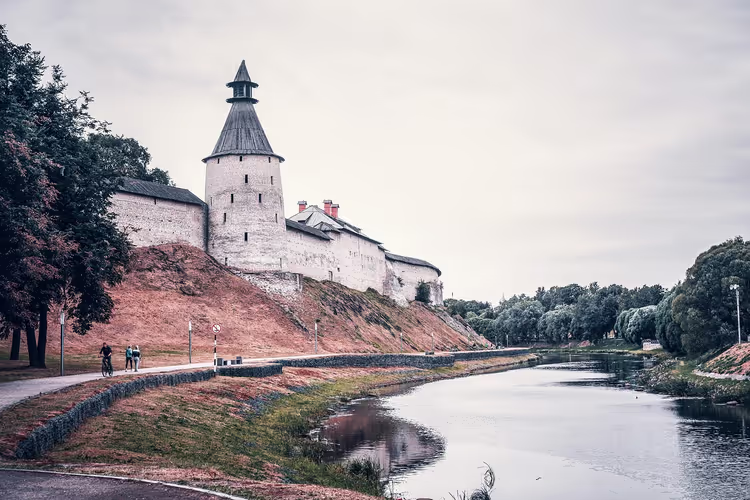
The query was about a small border town with a fortress and a river, a weekend destination from a neighboring country. The live sections of the site answer this: Poland with Zamość and Przemyśl, Finland with Lappeenranta, Imatra and Porvoo, Czechia with Cheb and Loket. It is the same format of a short trip to an old fortified town, just without everything listed above.
The overall explanation for the entire section is collected in the section hub. Related topics: our position on Tula and Ryazan and our position on Kaliningrad.
Where we stand
We believe that the word "quiet" in the previous headlines described not calm, but silence. In our assessment, a city where a person cannot go out with a placard does not stop being a city, but it does stop being a travel recommendation from an EU-based publisher, and proximity to the Union's border does not change that. We decided to remove all four articles and explain the reason at the same address.
Let us say separately what this text was written here for. People in Russia who publicly spoke out against the war received administrative cases, criminal sentences, and years in penal colonies for it. We name them not to decorate our position: without them, the picture would be incomplete and incorrect. Our decision is directed against state policy, not against those who resist that policy, and certainly not against those who simply live in these cities.
⁉️🤔 Frequently asked questions
It's a couple of hours from the EU border. Doesn't that mean anything?
Not for a travel text. Why distance changes nothing is explained in the section above.
You write about repression in a travel guide. Is that appropriate?
This is no longer a travel guide, but an explanation of why the travel guide no longer exists. The previous texts were silent about this, even though they described the same country, and we believe that silence was a mistake.
Are you claiming Navalny was killed?
No. We cite two facts from the documents: the date of death in the colony and the EU Council decision of March 22, 2024 on sanctions in connection with it. We claim nothing beyond that.
Doesn't a foreign visitor's arrival support local residents?
The argument is known, and we are not suppressing it. But for an EU-based publisher, the question is different: providing services related to tourism activities in Russia is directly prohibited, and we simply have no choice between support and refusal.
What is at these addresses now?
This page. A reader looking for a one-day itinerary gets an explanation and a list of destinations we continue to write about.
In short
Four guides about Pskov and Smolensk have been removed entirely, and the old URLs now redirect here. Proximity to the European Union border changes nothing, and the European border cities we continue to cover are listed above.
How you can help
We do not collect money and receive nothing from the links below. These are official websites of organizations working with the consequences of the war:
- UNHCR, the UN Refugee Agency, unhcr.org
- UNICEF, unicef.org
- Ukrainian Red Cross, redcross.org.ua
Sources
- UN General Assembly, resolution ES-11/1 "Aggression against Ukraine", 03/02/2022. https://press.un.org/en/2022/ga12407.doc.htm
- ARTICLE 19, on Article 20.3.3 of the Russian Code of Administrative Offenses on discrediting the Armed Forces. https://www.article19.org/resources/russia-repeal-legislation-that-penalises-criticism-of-armed-forces/
- RFE/RL, on the number of cases under Article 20.3.3 of the Code of Administrative Offenses in 2023, 12/31/2023. https://www.rferl.org/a/russia-suppression-dissent-putin-fear-ukraine-war/32754222.html
- Human Rights Watch, on Article 207.3 of the Russian Criminal Code, 03/07/2022. https://www.hrw.org/news/2022/03/07/russia-criminalizes-independent-war-reporting-anti-war-protests
- Committee to Protect Journalists, guide to "fake news" laws, 07/2022. https://cpj.org/wp-content/uploads/2022/07/Guide-to-Understanding-the-Laws-Relating-to-Fake-News-in-Russia.pdf
- OVD-Info, Repressions in Russia in 2022, detention data. https://ovd.info/en/repressions-russia-2022
- Euronews, on the sentencing of Vladimir Kara-Murza, 04/17/2023. https://www.euronews.com/2023/04/17/russian-opposition-activist-kara-murza-sentenced-to-25-years-in-prison
- CNN, on the prisoner exchange of 08/01/2024. https://www.cnn.com/2024/08/01/politics/russia-us-prisoner-swap/index.html
- Council of the EU, sanctions in connection with the death of Alexei Navalny, 03/22/2024. https://www.consilium.europa.eu/en/press/press-releases/2024/03/22/death-of-alexei-navalny-eu-sanctions-33-individuals-and-two-entities-under-its-global-human-rights-sanctions-regime/
- Council Regulation (EU) 2025/2033 of 10/23/2025 amending Regulation 833/2014, EUR-Lex. https://eur-lex.europa.eu/legal-content/EN/TXT/?uri=OJ:L_202502033
- Skadden, analysis of the EU's 19th sanctions package, 11/2025. https://www.skadden.com/insights/publications/2025/11/eu-adopts-19th-sanctions-package
- Auswärtiges Amt, Russische Föderation: Reise- und Sicherheitshinweise, as of 09/02/2026. https://www.auswaertiges-amt.de/de/service/laender/russischefoederation-node/russischefoederationsicherheit-201536?isLocal=false&isPreview=false
- Centre for Eastern Studies OSW, Russia's 2026 budget, 12/09/2025. https://www.osw.waw.pl/en/publikacje/osw-commentary/2025-12-09/russias-2026-budget-mounting-financial-challenges-and-economic
Link check dates: 03.09.2026.
Publication date: September 3, 2026. Last updated: September 3, 2026.

A small editorial team writing guides for independent travel. We travel ourselves, but we haven’t been everywhere, so we check prices, opening hours and how to get there against official sources.