
















Sistine Chapel: who painted it and how to buy a ticket without queuing
The Sistine Chapel was built by 1481, and conclaves began to be held there later. The ceiling and altar wall were painted by Michelangelo in the 16th century. The chapel stands at the end of the Vatican Museums route, and a single ticket grants access to the entire collection.
A standard ticket costs 20 €, and online booking adds a 5 € fee (as of 09/2026, rates and hours on the museums' website). Without a time slot you lose an hour in line at the entrance. Old prices from articles are no longer accurate, so below we break down who painted the chapel, what to see first, and how to buy a ticket for 2026.
Ad: the text contains affiliate links. We earn a commission from them, and the price for you does not change.
Who painted the Sistine Chapel
💡 In short:
- Viewing the chapel takes 30-40 minutes, but you will walk through the entire museum route to reach it.
- Prices and hours: 09/2026, verified on the official Vatican Museums website.
 © Vojtasekd · CC BYPhoto: Vojtasekd, CC BY (https://creativecommons.org/licenses/by/4.0), Wikimedia Commons
Two groups of masters worked on the chapel's paintings almost thirty years apart. First, Florentine painters of the 15th century decorated the walls: Sandro Botticelli, Domenico Ghirlandaio, Pietro Perugino, and Cosimo Rosselli. Their cycle includes sixteen frescoes on biblical subjects, and it is divided into two major lines.
Later, Pope Julius II invited the young sculptor Michelangelo to paint the ceiling. At the time, the master had no experience in painting on such a scale, but this work defined the chapel's appearance. He painted the ceiling from 1508 to 1512, and completed the altar wall under the next pontiff.
History of the chapel's construction
The chapel was built by 1481 on the orders of Pope Sixtus IV, who gave it his name. The pontiff went down in history for raising taxes, corruption, and public executions of heretics. He had other matters as well: he moved the papal residence to the Vatican and opened museums and libraries.
The turbulent politics of a fragmented Italy did not let the pope feel safe. Internal conspiracies and the threat from the Ottoman Empire demanded a sturdy building. In it, the pontiff, cardinals, and servants could take shelter in case of danger. That is why the chapel resembles a fortress rather than a temple.
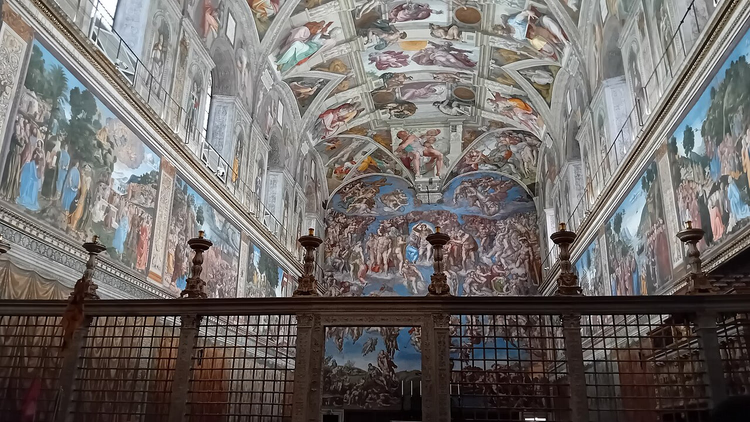
The project was prepared by the architect Baccio Pontelli. According to his design, the building received high walls capable of withstanding an assault, a rectangular three-story form, and pointed windows. The upper tier with embrasure windows was occupied by armed soldiers. The hall is elongated and lacks external pomp: ceremonial events were not initially planned here. The hall is about 40 meters long and 13 meters wide.
How the chapel is arranged inside
Inside, the chapel looks like a spacious hall with an oval vault and an altar at the far end. The floor is laid with mosaics, the walls and ceiling are covered with frescoes, and stone benches line the perimeter. The hall is divided by a marble screen with carved candelabra. The walls are divided into three tiers: the lower one is decorated with gold and silver draperies, the middle one holds the frescoes, and the upper one displays portraits of the first rulers of the Papal States.
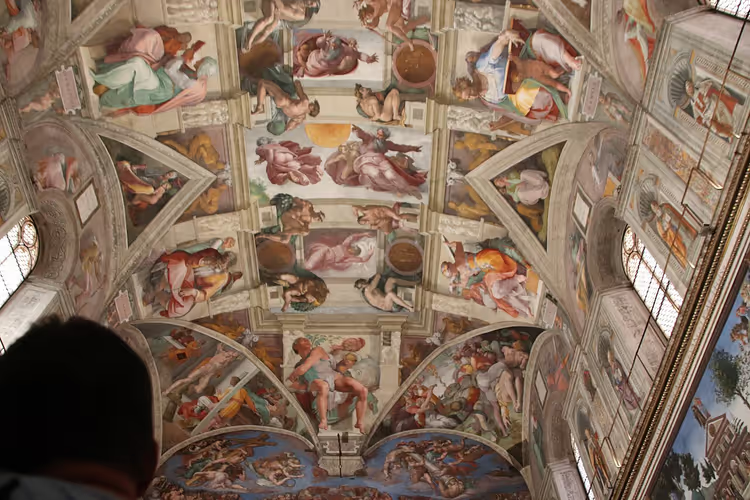
Originally, the ceiling was painted as a starry sky, but cracks soon appeared in it. Michelangelo undertook to repair the vault. The master assembled special "aerial scaffolding": it was anchored in holes above the windows and did not interfere with services because it hung without supports from below. In this way he covered an area of about 600 m² with painting.
Frescoes of the Sistine Chapel
The north wall is devoted to the story of Christ. The frescoes show the baptism, the temptation in the desert, the sermons, and the calling of the apostles. The action unfolds against a backdrop of Italian landscapes and architectural ensembles, and the paintings themselves contain many people besides the central figure of Christ.
 © Michelangelo · CC BY-SAPhoto: Michelangelo, CC BY-SA (https://creativecommons.org/licenses/by-sa/3.0), Wikimedia Commons
The south wall was given over to the deeds of Moses. Here, "The Youth of Moses" by Sandro Botticelli stands out: the artist fit several scenes into a single fresco. Moses kills the Egyptian, tends sheep, flees along a path, and leads his kinsmen out of Egypt. Both walls belong to the 15th-century cycle.
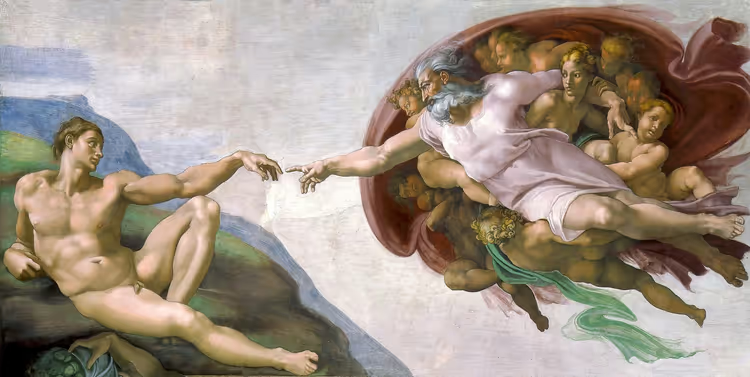
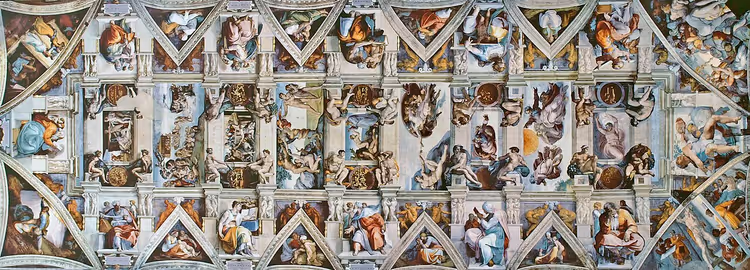
Michelangelo's ceiling is filled with vivid characters from the Old Testament. Biblical heroes and prophets are separated from one another by painted architectural framing. The artist lays out the story of the creation of the world, the separation of the sexes, the fall, and the punishment for transgression. The central episode, "The Creation of Adam," shows an athletic figure in a relaxed pose and the Creator reaching out a hand to it.
Among the other scenes on the vault are: "The Separation of Light from Darkness," "The Creation of the Sun and Moon," "The Creation of Eve," "Original Sin," and "The Expulsion from Paradise." Years after the ceiling, Michelangelo painted the altar wall with the fresco "The Last Judgment." He depicted more than 400 figures in complex poses and desperate gestures. At the center of the composition, Christ and the Virgin Mary judge the human race: the righteous on the left rise to heaven, the sinners on the right fall downward.
How the frescoes were restored
Over time, dust, soot from candles, and a leaking roof damaged the paintings. Restoration of the hall began in the late 1970s and proceeded with the support of the Vatican and a Japanese television channel that received exclusive filming rights. Specialists softened the grime with a chemical solution and then removed it with sterile sponges. The work went on for years and returned the frescoes to their original colors.
Interesting facts and secrets
The chapel serves as the site of the conclave: cardinals from around the world elect a new pope here behind closed doors. After the vote, a pipe is placed on the roof. Black smoke means the election has not produced a result, while white smoke announces a new pontiff.
Another topic of debate concerns Michelangelo's encoded messages. Researchers notice a silhouette of a human brain around the figure of God in "The Creation of Adam." According to this version, the master was showing the connection between the spiritual principle and higher intelligence. In many of the paintings, the artist depicts nude male bodies, and this is also read as a hidden hint.
Hours and tickets (as of 09/2026)
The chapel is included in the single Vatican Museums ticket. There is no separate ticket for the chapel alone, and you can only reach it along the general route.
What | Details (09/2026) |
|---|---|
Hours, Monday-Saturday | 8:00-20:00, last entry at 18:00 |
Last Sunday of the month | 9:00-14:00, entry until 12:30, free |
Full ticket | 20 €, online booking adds a 5 € fee |
Reduced, ages 6-18 and students up to 26 | 8 € |
Children under 6 | free |
Hours and prices are confirmed by the museum opening hours, and tickets are sold only through the official portal. Tickets for the 8:00 slot sell out weeks in advance, so book your time slot early. The entrance line is shorter in the morning, and the Last Judgment area is almost empty at that time.
If you want to lock in your entry time, check out Vatican Museums tickets with a time slot.
Tours and tickets in Sistine Chapel
Guided tours, skip-the-line tickets and activities — most offers can be cancelled free of charge.
See offers on TiqetsThe widget loads once you give your consent.
Where it is and how to get there
The chapel is in the Vatican next to St. Peter's Basilica. Museum address: Viale Vaticano. The closest metro stops are Ottaviano and Cipro on line A: from there you walk to the Vatican walls (according to the directions map on the museum website, 09/2026). Buses and trams also stop right at the museum entrance.
If you are coming from Termini station, take line A and get off at Ottaviano. From St. Peter's Square you can reach the museum entrance in a few minutes along the Vatican wall. There are few people at the entrance in the morning, so arrive by opening time.
Sistine Chapel on the map
Below is a map with the chapel marked. Open it in advance so you don't have to search for the entrance between the colonnade and the museum wall.
⁉️🤔 Frequently asked questions
Who painted the Sistine Chapel?
The walls were painted by a 15th-century Florentine team: Sandro Botticelli, Domenico Ghirlandaio, Pietro Perugino, and Cosimo Rosselli. The ceiling was painted by Michelangelo between 1508 and 1512, and the altar wall later.
How many years did Michelangelo spend painting the ceiling?
Work on the ceiling took about four years, from 1508 to 1512. The master completed the altar wall with "The Last Judgment" later, under a different pope.
How much does a ticket cost and when is admission free?
A combined ticket to the Vatican Museums and the chapel costs 20 €, and online booking adds a 5 € fee. Reduced admission for ages 6-18 and students up to 26 costs 8 €, and children under 6 enter free. On the last Sunday of the month, admission is free from 9:00 AM to 2:00 PM (as of 09/2026, museum rates).
What do the black and white smoke over the chapel mean?
After voting, the cardinals burn the ballots. Black smoke means the election is not complete and another round is needed. White smoke announces that the cardinals have elected a new pontiff.
Where is the entrance and how do you get to the chapel?
The museum entrance is located at Viale Vaticano. The most convenient way is to take metro line A to Ottaviano or Cipro station (as of 09/2026, how to get to the museums).
In short: what to book
The chapel is included in the combined Vatican Museums ticket, and there is no separate entrance to it. If you want to lock in a time and avoid standing in line, book a slot online and plan about three hours for your visit.
- If you have one day in Rome: an 8:00 AM ticket and a route that skips the distant halls.
- If you are with children: go in the morning and plan a break near St. Peter's Basilica.
- If you want a guide: look for an option with a tour at the entrance.

A small editorial team writing guides for independent travel. We travel ourselves, but we haven’t been everywhere, so we check prices, opening hours and how to get there against official sources.