
















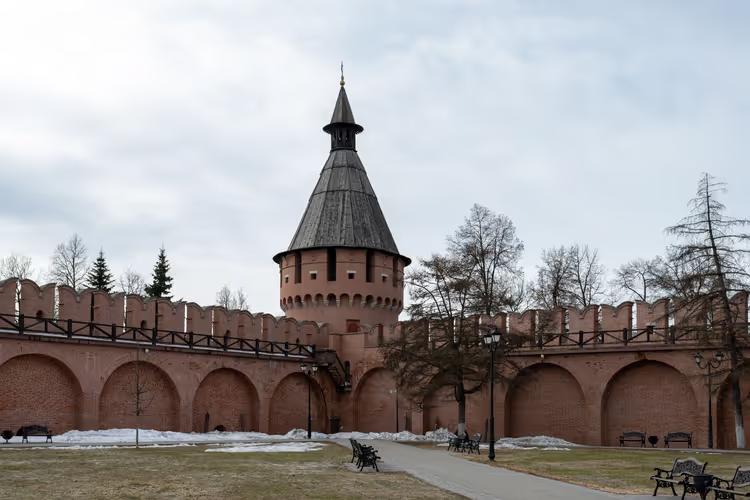
Tula and Ryazan: why we removed these guides
Here there used to be five pieces: two lists of sights, a one-day itinerary, and two museum roundups for two cities a few hours from Moscow. All five have been removed across all language versions, and the old URLs now redirect here permanently.
Both cities were sold the same way: a museum day, an affordable trip, a craft tradition, and an evening train back. We no longer offer that kind of trip. The reason is not the cities themselves or their museums, but that an editorial team based in the European Union cannot promote travel to a country waging war, and in how that country looks in the numbers we are obligated to report to our readers.
💡 At a glance:
- which five pieces were removed and what they covered
- what the ban on public dissent looks like in numbers, not words
- why we are not building the text around one city's arms-making history
- which museum cities in Central and Southeastern Europe remain in our live sections
- Last updated: 09/2026
Why we deleted these guides
The five texts consisted of lists and one ready-made walking plan: how many museums to fit in, what was inside, 2021 prices, where to have lunch between two stops. The practical part was the main content, not an appendix.
Russia's full-scale invasion of Ukraine began on February 24, 2022 (UN press release GA/12407, 03/02/2022). After that date, putting together a museum day in a Russian city for an EU-based reader became impossible for us, and the issue is not the size of the city but the genre of our own material.
The financial side looks like this. The share of oil and gas revenue in Russia's budget fell to roughly 22 percent in 2025 and 2026, while the share of non-oil-and-gas revenue rose to roughly 78 percent (OSW Centre for Eastern Studies, 12/09/2025). A museum ticket, lunch, and a train ride fall squarely into the second category, and that is the correct argument to make, rather than the familiar one about oil.
Numbers instead of words
We include this section not for effect, but because it answers the question of how the country on these pages differed from the country in reality.
According to the human rights project OVD-Info, 19,644 detentions were recorded at anti-war protests, including at least 5,982 in the first four days, from February 24 to 28, 2022, and at least 413 cases of excessive use of force by police (OVD-Info). Nearly six thousand people in four days is not an excess; it is how the system operates.
The legal framework for this was put in place quickly. Article 20.3.3 of the Code of Administrative Offenses was introduced on March 4, 2022, and punishes public actions aimed at discrediting the use of the Armed Forces (ARTICLE 19); in 2023 alone, at least 2,830 cases were opened under it (RFE/RL, 12/31/2023). Criminal Article 207.3, on knowingly false information about the use of the army, carries up to fifteen years in prison under aggravated circumstances (Human Rights Watch, 03/07/2022).
The upper end of this scale is shown by the sentence handed down on April 17, 2023, to Vladimir Kara-Murza: 25 years in prison for treason, based on his speech to the Arizona House of Representatives on March 15, 2022 (Euronews, 04/17/2023).
Our conclusion from these numbers concerns genre. A city where you cannot step outside with a placard is still a city; people live there, museums operate, and gingerbread is baked. But an EU-based publisher that in 2026 publishes a breezy museum itinerary there and does not mention any of the above is showing the reader a stage set instead of a place.
Why we are not writing about the arms-making history
A direct caveat is needed here, because the obvious move is one we are deliberately not making.
One of the two cities is historically tied to arms manufacturing, and it would be easy to build a striking narrative on that. We are not building it: we have no verified facts about that city's current enterprises, their sanctions status, or their role in the war. We could not find a single document we could cite with a date and reference number.
So the arms-making history is mentioned here in exactly one capacity: as something the previous guide described, taking readers through a museum exhibition. We draw no conclusions from it, and we will not import facts about other Russian cities where such documents do exist. This rule applies across the entire section: an argument is built on what is verifiable, not on association.
What this means for you
Item | Status 09/2026 | Source |
|---|---|---|
Services related to tourism in Russia | Prohibited by Article 5n(2) of Regulation 833/2014 as amended by Regulation 2025/2033 of 23.10.2025 | |
Transition period | Ended 01.01.2026, no exceptions | |
Routes and guide services | Explicitly named among those covered by the ban | |
Detentions at anti-war protests | See the "Numbers instead of words" section | |
German Foreign Office advisory | "Vor Reisen in die Russische Föderation wird gewarnt" |
Where to go instead
The query was about an inexpensive museum day in an old provincial town: a local history museum, a craft tradition, a kremlin or fortress, and the trip back in the evening. The live sections of the site answer this: Poland with Lublin, Torun and Sandomierz, Czechia with Olomouc, Kutna Hora and Telc, Hungary with Eger, Pecs and Szentendre, Bulgaria with Veliko Tarnovo and Plovdiv. We do not list museum names and prices here: the live country sections of the site handle that.
The overall explanation for the entire section is collected in the section hub. Thematic neighbors: our position on Pskov and Smolensk and our position on Nizhny Novgorod and Yekaterinburg.
Where we stand
We believe that a guide to a provincial town is also a statement, just a quiet one. In our assessment, by publishing a light museum route through a country where almost six thousand people were detained over four days of protests against the war, a publication tells its reader that everything is fine, without saying a single word about politics. We decided to remove all five pieces and explain the reason at the same address.
We also think it is right to say what we do not do. We do not attribute to these cities anything we could not confirm with a document, and we do not use historical associations as a substitute for fact. The reader has the right to know where the boundary of our knowledge lies.
We write about a state and its policies, not about people based on their passport. There are people in Russia who came out against the war and received prison sentences for it. Our decision not to publish guides to Russia concerns money, sanctions and reader safety, not nationality.
Publication date: September 3, 2026. Last updated: September 3, 2026.
⁉️🤔 Frequently asked questions
A museum is culture, not politics. Why delete the guide?
A guide to museums with prices and a daily itinerary is not culture, it is a travel planning service. It is precisely such services and their advertising that are prohibited for a person from the EU starting January 1, 2026. A story about the history of a collection is not covered by the ban, but that was not what the deleted texts contained.
One of the cities is historically tied to arms manufacturing. Why didn't you write about that?
Because we do not have verified facts about current enterprises in that city, and we will not build an accusation on a historical association. This rule applies across our entire section, and the text has a separate part devoted to it.
The detention figures cover the whole country, not these cities. Is that honest?
It is honest, because that is exactly what we say. The laws are federal, the statistics are nationwide, and nowhere do we claim that the data was collected specifically in these two cities.
Does refusing to travel really help residents?
We do not tell readers to go or not to go. We explain why we no longer publish material that organizes such a trip, and for a publisher from the EU this is not a matter of choice but a direct prohibition.
What happens to the old addresses of these five texts?
They lead here. Instead of an empty page, the reader gets an explanation and a list of destinations we continue to write about.
In short
Five pieces about Tula and Ryazan have been deleted in full, and the old addresses redirect here. The decision is based on numbers, not impressions: detentions at anti-war protests from the "Numbers instead of words" section, the administrative article on discrediting the army in force since March 4, 2022, with at least 2,830 cases under it in 2023 alone, a criminal article with a maximum of fifteen years, and a 25-year sentence for a speech delivered abroad. We do not use the arms history of one of the cities as an argument, because we have no verified documents about current enterprises there. The legal framework applies regardless of the purpose of the trip. The museum cities of Central and Southeastern Europe that we continue to write about are listed above.
How you can help
We do not collect money and receive nothing from the links below. These are official websites of organizations working with the consequences of the war:
- UNHCR, the UN Refugee Agency, unhcr.org
- UNICEF, unicef.org
- Ukrainian Red Cross, redcross.org.ua
Sources
- UN General Assembly, Resolution ES-11/1 "Aggression against Ukraine", 03/02/2022. https://press.un.org/en/2022/ga12407.doc.htm
- OVD-Info, Repressions in Russia in 2022, detention data. https://ovd.info/en/repressions-russia-2022
- ARTICLE 19, on Article 20.3.3 of the Russian Code of Administrative Offenses on discrediting the Armed Forces. https://www.article19.org/resources/russia-repeal-legislation-that-penalises-criticism-of-armed-forces/
- RFE/RL, on the number of cases under Article 20.3.3 of the Code of Administrative Offenses in 2023, 12/31/2023. https://www.rferl.org/a/russia-suppression-dissent-putin-fear-ukraine-war/32754222.html
- Human Rights Watch, on Article 207.3 of the Russian Criminal Code, 03/07/2022. https://www.hrw.org/news/2022/03/07/russia-criminalizes-independent-war-reporting-anti-war-protests
- Euronews, on the sentencing of Vladimir Kara-Murza, 04/17/2023. https://www.euronews.com/2023/04/17/russian-opposition-activist-kara-murza-sentenced-to-25-years-in-prison
- Council Regulation (EU) 2025/2033 of 10/23/2025 amending Regulation 833/2014, EUR-Lex. https://eur-lex.europa.eu/legal-content/EN/TXT/?uri=OJ:L_202502033
- Skadden, analysis of the EU's 19th sanctions package, 11/2025. https://www.skadden.com/insights/publications/2025/11/eu-adopts-19th-sanctions-package
- Auswärtiges Amt, Russische Föderation: Reise- und Sicherheitshinweise, as of 09/02/2026. https://www.auswaertiges-amt.de/de/service/laender/russischefoederation-node/russischefoederationsicherheit-201536?isLocal=false&isPreview=false
- Centre for Eastern Studies OSW, Russia's 2026 budget, 12/09/2025. https://www.osw.waw.pl/en/publikacje/osw-commentary/2025-12-09/russias-2026-budget-mounting-financial-challenges-and-economic
Link check date: 09/03/2026.

A small editorial team writing guides for independent travel. We travel ourselves, but we haven’t been everywhere, so we check prices, opening hours and how to get there against official sources.