
















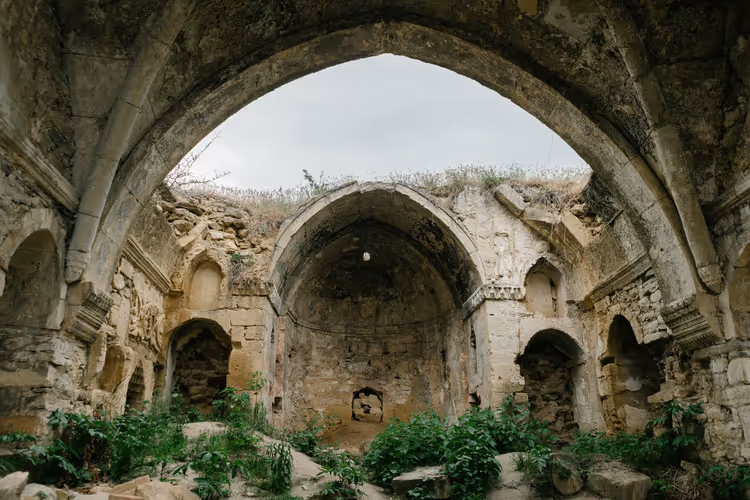
Valley of the Mills in Sorrento: ruins under Piazza Tasso where no one goes down
Sorrento sits on cliffs above the Tyrrhenian Sea. Its main square, Piazza Tasso, ends at the edge of a deep gorge, and an almost vertical wall drops down from it. There, in the shade and damp, an old mill has been rotting since the 1940s.
The Valley of the Mills (Vallone dei Mulini) cuts through the town from Piazza Tasso to the old harbor. You can see the ruins for free, and the mill at the bottom was abandoned back in the last century. Below we'll look at how the gorge formed, why the mill was left behind, and where to view it from.
Ad: this article contains affiliate links, we earn a commission if you book through them, at no extra cost to you.
What the Valley of the Mills is
💡 In short:
- The Valley of the Mills lies in a gorge below Piazza Tasso, and access inside is closed to everyone.
- You can see the ruins for free, from the curb of the square and from the neighboring street.
- The best light for photos is in the morning and after sunset, when the floodlights come on.
- History and geography: 09/2026, checked against data on Vallone dei Mulini.
You won't be allowed inside the Valley of the Mills. The town has placed the ruins under protection as a historic monument, and access down to the walls is closed. You only get a view from above: from the curb of Piazza Tasso and from the neighboring streets.
The viewing area is short, about ten steps. You stand at a low railing, with a cliff and the gray wall of the gorge below you. Ferns, ivy, and mosses grow at the bottom. The greenery covers almost the entire building, and through it you can only see the empty windows of the mill.
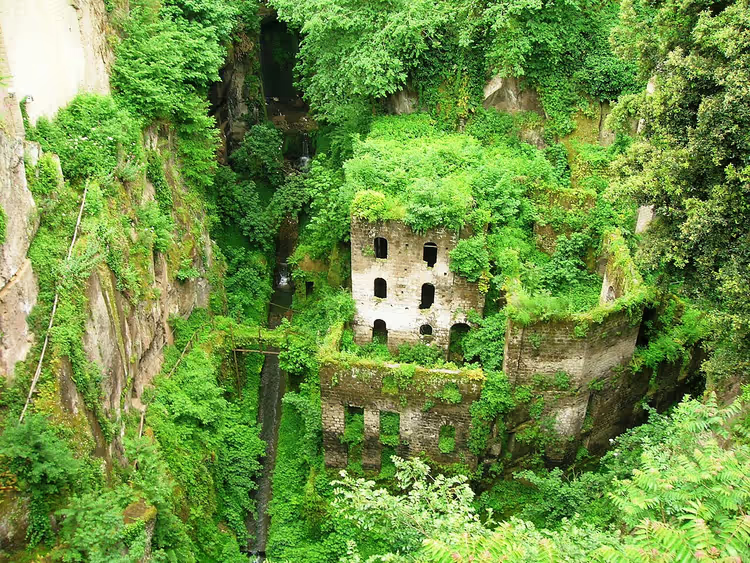 © Mentnafunangann · CC BY-SAPhoto: Mentnafunangann, CC BY-SA (https://creativecommons.org/licenses/by-sa/3.0), Wikimedia Commons
Where the gorge under the town came from
The gorge in the center of Sorrento is about 37,000 years old. After an eruption of the Phlegraean Fields (Campi Flegrei), water flows eroded the soft tuff and cut deep fissures here. One of them became the Valley of the Mills.
Tuff erodes easily, so gorges are common on the Sorrento Peninsula. The Valley of the Mills is not the only one in town. The cliffs drop vertically, and you'll see how residential buildings stand right above the precipice.
There is almost no wind inside, and humidity is high. Because of this, ferns and lichens that are rare for Italy have taken root at the bottom. Mosses cover the rocks so densely that the walls are barely visible.
History of the mills and where the name came from
The mills at the bottom of the rift were built from stone back in the 13th century. The millstones ground grain into flour for all of Sorrento, and wood was sawn nearby. The sawmill supplied boards to craftsmen in the surrounding settlements.
Water powered the mill. Streams from the surrounding hills filled the gorge in spring, and production ran at full capacity. In summer the flow weakened, but the mill held on thanks to the coolness and moisture at the bottom.
The town grew and increasingly squeezed the gorge. After Piazza Tasso was laid out, the bottom became damp and stuffy. The trade in the valley died out, and the building was eventually closed.
The valley got its name from the large mill that survived better than its neighbors. You'll immediately tell it apart from residential buildings: there are no windows, the staircases are overgrown, and the walls hold together on a single stone. The structure looks more like a medieval castle than a mill.
The sea, the bridge, and the buried gorge
The valley used to open directly to the sea. Streams ran along the bottom, and a salty wind from the bay blew from above. The gorge was a narrow corridor between the town and the harbor.
A narrow bridge was thrown across the rift. Residents used it to cross from one side of Sorrento to the other, with water rushing under their feet. Today you'll find an ordinary town square with cafes where the bridge once stood.
In 1866, Piazza Tasso was laid out here, and the bridge disappeared. Part of the gorge was filled in, and the outlet to the sea was closed forever. The mill was left without water and fresh wind.
The building was finally closed in the 1940s. Since then, no people have been inside, and the bottom of the gorge belongs to the plants.
Legends and nighttime floodlights
Locals love to tell strange stories about the mill. Neighbors supposedly heard voices and laughter from the gorge, and late passersby saw light in the empty windows.
Rescue workers were called out to such reports more than once, but never found any trace of a person.
In the evening, the floodlights come on. The mill walls and the dense greenery at the bottom are lit up, and the valley looks completely different from how it does during the day. You can come back here after dinner and catch that shot.
How to see the valley and when to go
Come in the morning, before the sun climbs high. At midday the light hits straight into the gorge, and you'll get a dark blob in your photo. In the evening, bring your camera after sunset, when the floodlights come on.
- How to get there: the curb of Piazza Tasso and Via Fuorimura, central Sorrento.
- Cost: free.
- Who it's for: for you, if you like abandoned ruins and views from above.
- The catch: you can only see the mill from above.
Parameter | Details |
|---|---|
Access inside | closed, ruins under town protection |
What you can see | 13th-century mill, greenery, and gorge walls |
From the square, streets drop steeply toward the sea. Walk from the square to Villa Comunale park; from there you get a view of the bay and the harbor. Wear comfortable shoes: the climb back up is not easy for everyone.
If you want to combine the valley with a walk through the town and along the coast, check out tours on GetYourGuide.
Tours and tickets in Sorrento
Guided tours, skip-the-line tickets and activities — most offers can be cancelled free of charge.
See offers on GetYourGuideThe widget loads once you give your consent.
Where the Valley of the Mills is on the map
The valley lies a stone's throw from Piazza Tasso, behind the buildings on its eastern side. On the map you'll see how the gorge cuts through the town and stretches toward the harbor. You can open it on the map in one click.
⁉️🤔 Frequently asked questions
Can you go down into the Valley of the Mills?
No, the ruins are under town protection. There are no tours inside, and climbing down the wall is dangerous and prohibited.
How much does it cost to see the valley?
Nothing, you can see it right from the street. This sets the Valley of the Mills apart from Sorrento's museums and churches, where tickets are sold separately. The only thing you'll pay for is coffee on the square.
When is the best time to go to the mill?
In the morning or in the evening after sunset, when the floodlights are on.
Why was the mill abandoned?
Because of Piazza Tasso. When it was laid out in 1866, the gorge lost its outlet to the sea and the fresh wind. It became hot and humid down below, working there was impossible, and the building was closed in the 1940s.
What is near the valley?
Piazza Tasso with its cafes and restaurants, and the streets of the old town lead down to the sea. On foot you can quickly reach Marina Grande harbor and the waterfront, where boats leave for Capri and Naples.
Video about the Valley of the Mills
From above, the valley looks different than it does from the level of the square. The video below will help you understand the scale of the gorge before your trip.
In short: what to book
The Valley of the Mills requires no tickets and doesn't take half a day. You'll spend half an hour at the viewpoint, but it fits well into a walk around Sorrento.
If you have one day, leave the valley for the morning, and after lunch take a tour of the Amalfi Coast. If you're traveling with kids, combine the viewpoint with a walk to the harbor and the sea.

A small editorial team writing guides for independent travel. We travel ourselves, but we haven’t been everywhere, so we check prices, opening hours and how to get there against official sources.