

















Villa Farnesina in Rome: Raphael's frescoes, tickets and opening hours
Villa Farnesina stands in quiet Trastevere, on the west bank of the Tiber. This early 16th-century mansion often gets lost in the shadow of ancient Rome. There are almost never lines here.
The villa owes its fame to its frescoes. Raphael painted the Loggia of Galatea and the Loggia of Cupid and Psyche here. Peruzzi, Sodoma, and Sebastiano del Piombo worked alongside him. The museum is compact and rich, and you can see it faster than the Vatican.
Ad: this article contains affiliate links. We earn a commission if you book through them, at no extra cost to you.
Let's go through the rooms in order, add current prices and hours, show the route from Termini, and name the honest catches.
History of construction
💡 In short:
- The villa is open Monday through Saturday, 9:00-14:00, last entry at 13:15 (as of 09/2026, opening hours on the official website).
- A full ticket costs 12 €, reduced 10 €, and children under 10 enter free.
- Walking from Termini is far, so bus 23 or 280 to the Via della Lungara stop works well.
 © Peter1936F · CC BY-SAPhoto: Peter1936F, CC BY-SA (https://creativecommons.org/licenses/by-sa/3.0), Wikimedia Commons
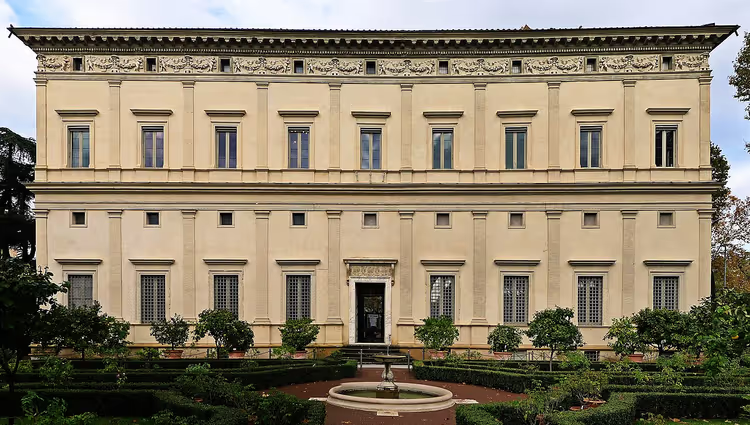
The villa was built in the early 16th century for the banker Agostino Chigi. He lent money to Roman popes and noble citizens. The country residence was commissioned from the architect Baldassare Peruzzi. The site was chosen on a quiet bank, across from the noisy center, and today that keeps the villa free of crowds.
Chigi was a patron of artists. Raphael, together with his pupils, painted the walls and ceilings of the rooms. Each room received frescoes on subjects from ancient myths. In the late 16th century the mansion passed to Cardinal Alessandro Farnese, an art collector. His family gave the villa its name.
Today the villa is managed by the Accademia dei Lincei, and it houses a museum and exhibition space. Its small size is a plus here. Raphael's masterpieces here don't require a whole day. You can see all the rooms at a relaxed pace.
Architecture and interiors
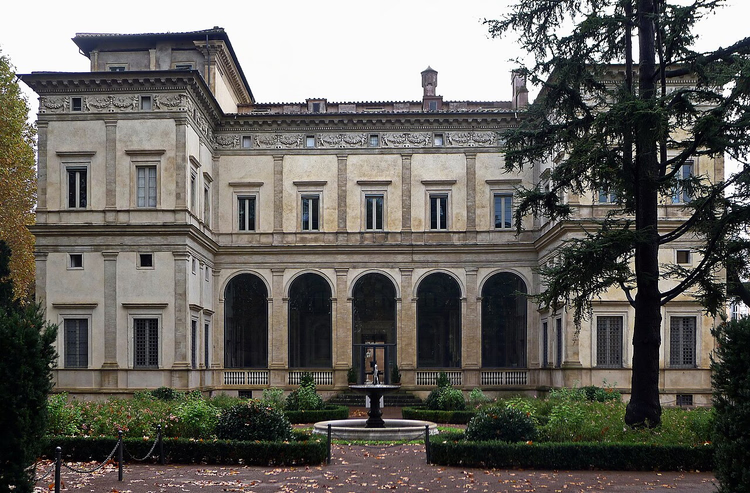
The villa has an unusual look for its era. The two-story pavilion-type mansion forms a horseshoe in plan. Two wings are connected by a glazed loggia with high arches. There are no columns, marble ornaments, or heavy stone cladding here.
 © Peter1936F · CC BY-SAPhoto: Peter1936F, CC BY-SA (https://creativecommons.org/licenses/by-sa/3.0), Wikimedia Commons
A frieze wraps around the facade. It is decorated with bas-reliefs on the attic, pilasters, and horizontal bands. A park is laid out in the courtyard. An avenue of orange and mandarin trees fills the air with a sweet scent in spring. In summer this part of the garden is shady and quiet.
Inside, rooms painted by 16th-century artists await you. Raphael, Peruzzi, Piombo, Penni, Romano, and Sodoma worked on the ensemble together. That is why the paintings are interconnected. Below we'll name the five rooms that people come here for.
Room of the Friezes
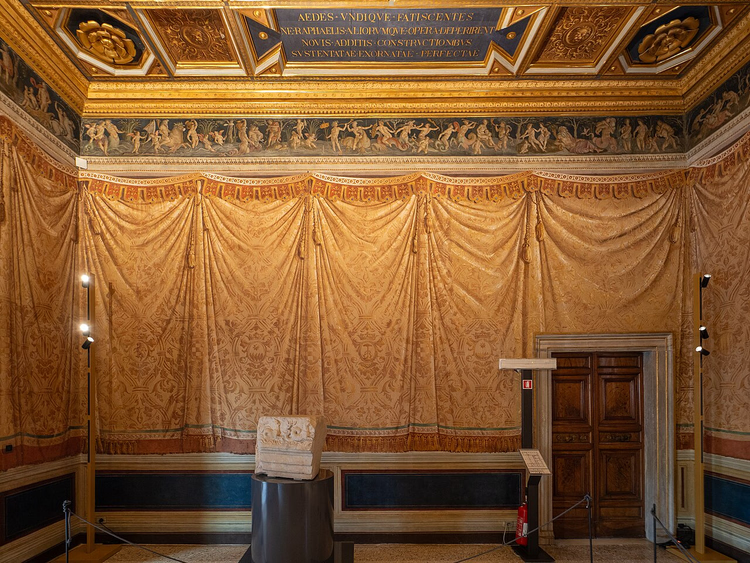
The main element of this room is the band of painting just below the ceiling. A wide stucco frieze wraps around the top of the walls. It carries multi-figure scenes and reads as a single continuous band.
 © C messier · CC BY-SAPhoto: C messier, CC BY-SA (https://creativecommons.org/licenses/by-sa/4.0), Wikimedia Commons
On the frieze you can see the labors of Hercules and hunting scenes from Greek mythology. The room was painted by the villa's architect himself, Baldassare Peruzzi. Don't just look up. The drawing runs in a continuous strip and connects all four walls of the room.
Loggia of Galatea
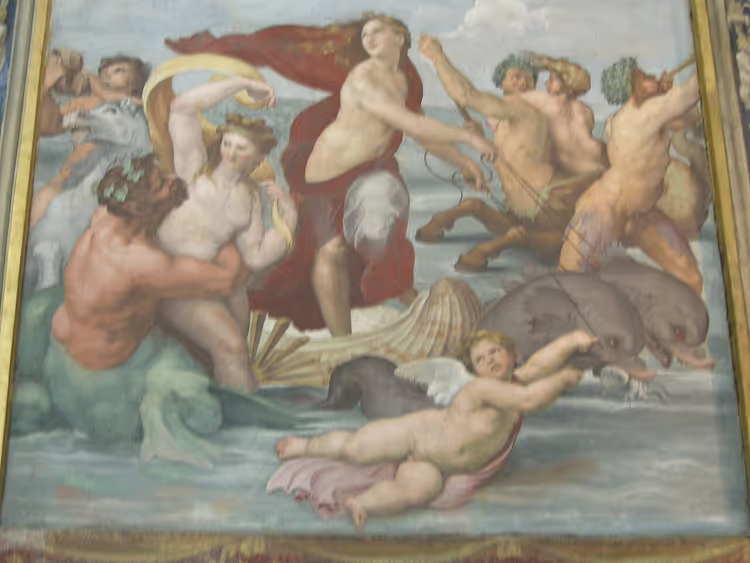
The Loggia of Galatea is decorated with the villa's most famous fresco. Raphael painted the "Triumph of Galatea" in the early 16th century. In the painting, the nymph Galatea races across the waves on a shell drawn by dolphins. She is fleeing from the one-eyed Polyphemus.
 © Combusken · CC BY-SAPhoto: Combusken, CC BY-SA (https://creativecommons.org/licenses/by-sa/3.0), Wikimedia Commons
The figures are painted with light golden lines, and the background consists of a soft blue sky and a deep blue sea. Next to Galatea you will see the huge figure of Polyphemus by Sebastiano del Piombo. The vaults of the room are decorated with polygonal medallions bearing silhouettes of ancient deities. The center of the ceiling features the Chigi family coat of arms.
Loggia of Cupid and Psyche
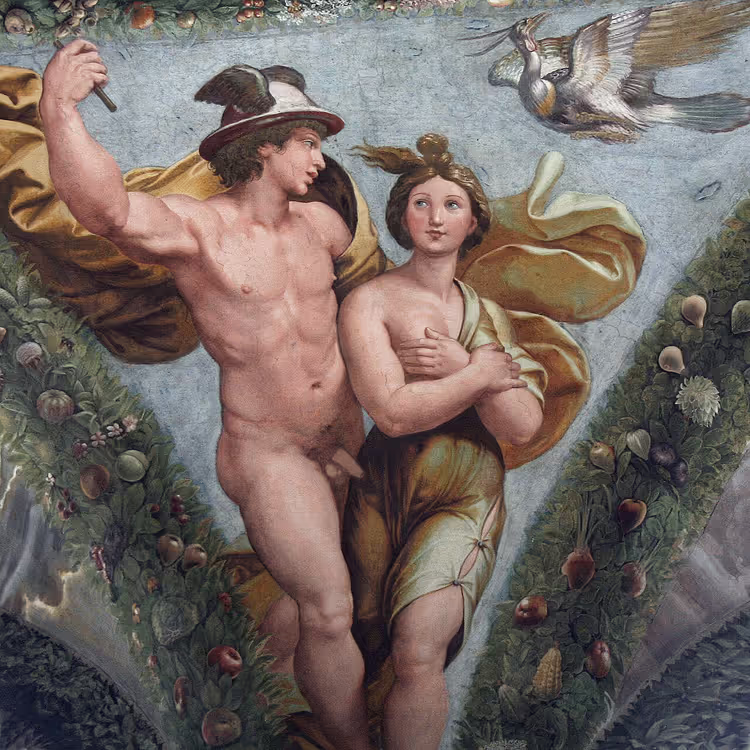
The Loggia of Cupid and Psyche serves as the villa's main entrance. It is the largest room on the ground floor. Its ceiling is painted with the love story of Cupid and Psyche: heavenly and earthly love.
 © Pom' · CC BY-SAPhoto: Pom', CC BY-SA (https://creativecommons.org/licenses/by-sa/2.0), Wikimedia Commons
The two central paintings resemble tapestries. They depict the feast of the gods and the wedding of Cupid and Psyche. A garland of leaves, vegetables, fruits, and berries runs along the walls. Its realism still amazes visitors today.
The composition was designed by Raphael, and his pupils completed it after his death. It's worth standing here in the morning. The light from the garden falls on the frescoes more softly, and photographs turn out better.
Hall of the Fireplace
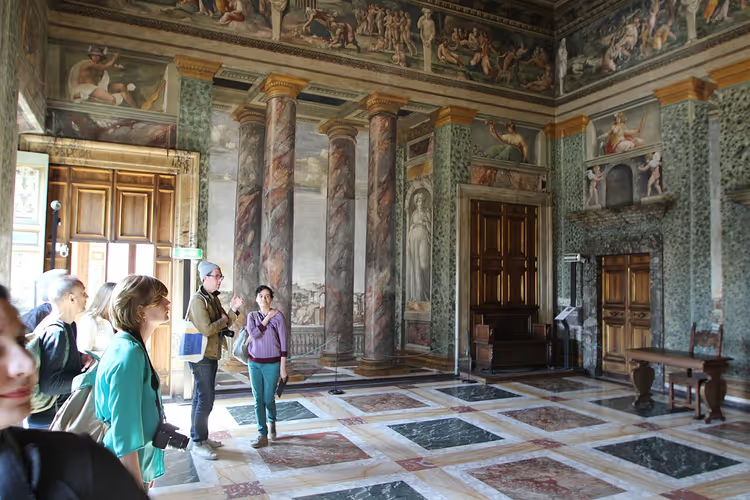
On the second floor you are greeted by the Hall of the Fireplace, or the Hall of Perspectives. It is built on an optical illusion. Peruzzi painted two rows of marble colonnades on the walls. Between the columns you can "see" the Colosseum, the Tiber, bell towers, and suburban landscapes, although it is all actually painting.
 © Nsatkinson · CC BY-SAPhoto: Nsatkinson, CC BY-SA (https://creativecommons.org/licenses/by-sa/4.0), Wikimedia Commons
The upper part of the room is wrapped by a frieze on Greek myths. Above the windows and doors, gods of Olympus sit in niches. They are Mars and Jupiter, Neptune and Juno, Diana and Minerva, Venus and Apollo, Saturn and Mercury. Above the fireplace is depicted the forge of Vulcan. Step closer to the wall, and the illusion begins to break down.
Wedding Hall
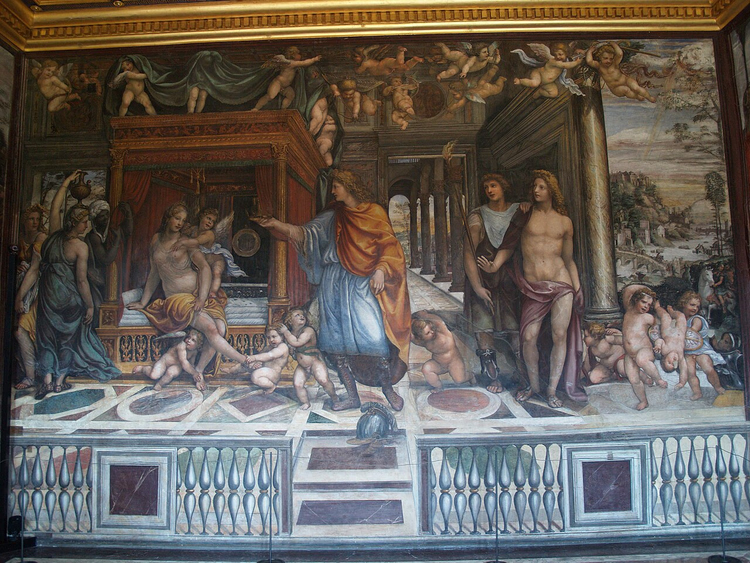
The Wedding Hall was once the bedroom of the villa's owners. According to legend, a gilded bed of carved ivory stood here. It was adorned with precious stones, and its value exceeded the price of the villa itself.
 © Miguel Hermoso Cuesta · CC BY-SAPhoto: Miguel Hermoso Cuesta, CC BY-SA (https://creativecommons.org/licenses/by-sa/3.0), Wikimedia Commons
The walls were painted by the Sienese artist Sodoma. The frescoes tell the story of Alexander the Great. Here you see his wedding to Roxana, the taming of Bucephalus, and the pardon of Darius's family. In the main painting, Roxana sits under a canopy. Winged cupids dress her while Alexander holds out a crown to his beloved.
Archaeological treasures
The villa also appeals to history lovers. In the late 19th century, during work on the embankment, the remains of an ancient Roman villa were found beneath the garden. Among the finds were ancient frescoes depicting gardens and fountains. Today they are considered historically significant.
 © Cm9462 · CC BY-SAPhoto: Cm9462, CC BY-SA (https://creativecommons.org/licenses/by-sa/4.0), Wikimedia Commons
These finds connect the Renaissance era with a much older layer of the city. For you, that is one more reason not to rush. Take in not only Raphael, but also the ancient layer beneath your feet.
Villa tours
The ticket gives you access to the rooms, but without explanations it is easy to miss half the stories. Professional guides work here. Groups are small, so you can study the frescoes without crowds or queues. The guide unpacks the mythological scenes and the legends that have grown up around the history of the mansion.
 © Bert Kaufmann from Roermond, Netherlands · CC BY-SAPhoto: Bert Kaufmann from Roermond, Netherlands, CC BY-SA (https://creativecommons.org/licenses/by-sa/2.0), Wikimedia Commons
You will see works by Raphael and his contemporaries at a relaxed pace. Nobody rushes you, and you can ask questions. If you want to go deeper, book a guided tour on GetYourGuide. It has one-day Rome options.
Opening hours and ticket prices
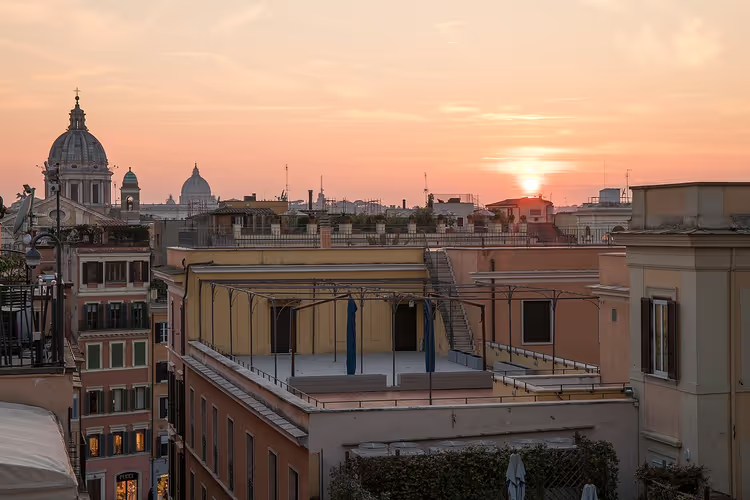
Hours and prices change, so check the official website. The villa is open Monday through Saturday, from 9:00 to 14:00, with last entry at 13:15 (as of 09/2026, opening hours on the villa's website). On Sundays the doors are closed. There is one exception: every second Sunday of the month, the villa opens from 9:00 to 17:00.
 © Luigi Guerrieri4 · CC BY-SAPhoto: Luigi Guerrieri4, CC BY-SA (https://creativecommons.org/licenses/by-sa/4.0), Wikimedia Commons
Visitor category | Ticket |
|---|---|
Adults, 18-65 | 12 € |
Visitors over 65, students, ICOM | 10 € |
Schoolchildren and teens 10-18 | 7 € |
Children under 10, visitors with disabilities with a companion | free |
Prices are valid from February 16, 2026 (as of 09/2026, current rates). Tickets can be bought at the ticket office or online. The ticket office accepts card payments; cash is no longer accepted. An audio guide in the app is sold separately for 3 €.
- The catch: the villa closes at 14:00, and on Sundays entry is only once a month. After lunch the rooms are inaccessible, so come in the morning.
It is more convenient to get a timed ticket in advance, especially in spring and on open days:
Tours and tickets in Rome
Guided tours, skip-the-line tickets and activities — most offers can be cancelled free of charge.
See offers on TiqetsThe widget loads once you give your consent.
How to get there and what is nearby
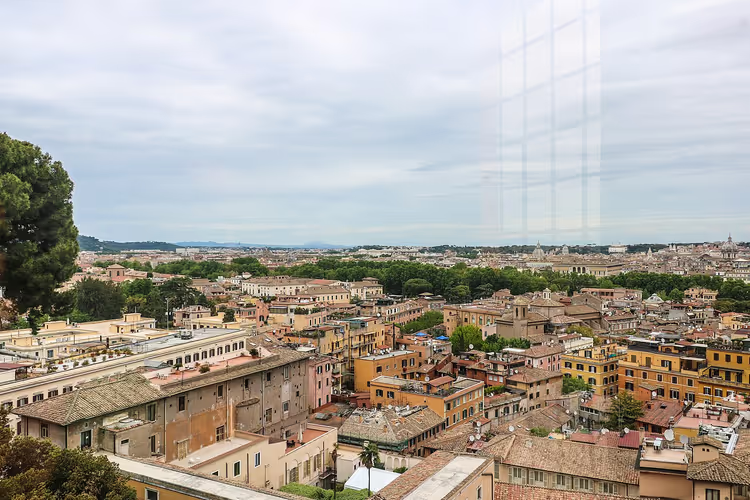
The villa is in Trastevere, on the opposite bank of the Tiber from the ancient ruins. The address is simple: Via della Lungara, 230 (as of 09/2026, villa contacts and address). Buses 23 and 280 go to the Via della Lungara stop right at the entrance.
 © Diego Baglieri · CC BY-SAPhoto: Diego Baglieri, CC BY-SA (https://creativecommons.org/licenses/by-sa/4.0), Wikimedia Commons
From Termini to the villa, you’ll need to transfer to bus 23 or 280. Walking from the station takes a long time, about 40 minutes, and in the heat it’s not worth it. If you’re flying into Fiumicino, compare airport transfers. A taxi to the center costs noticeably more than the bus.
The same street has palaces and gardens, so the visit is easy to combine with a walk through Trastevere. The neighborhood is narrow and lively, and it’s a pleasant place to have lunch after the museum.
Villa Farnesina on the map
The villa occupies a block between the Tiber and Via della Lungara. Below is a map you can use to plan a route from your hotel. Open it on your phone so you don't get lost in the alleys of Trastevere.
⁉️🤔 Frequently asked questions
How much does a ticket to Villa Farnesina cost in 2026?
A full adult ticket costs 12 €, and a reduced ticket for visitors over 65, students, and ICOM members costs 10 € (as of 09/2026, ticket prices). Children under 10 enter free, and students aged 10-18 pay 7 €. The audio guide in the app costs 3 €.
What days is the villa closed?
The villa is closed on Sundays. On other days it is open from 9:00 to 14:00, with the last entry at 13:15 (as of 09/2026, villa opening hours). Once a month, on the second Sunday, the doors open from 9:00 to 17:00. Arrive before noon so you can take your time going through all the rooms.
Can you take photos inside the villa?
Yes, you can take photos inside, but without flash. Video recording in the rooms and garden is prohibited, even on open days (as of 09/2026, visitor rules). Publishing photos requires separate permission from the Academy. Keep your phone ready at the "Triumph of Galatea."
How do I get to the villa from Termini station?
There is no direct route from Termini, so get to the villa by transferring to bus 280 (as of 09/2026, how to get to the villa). Get off at the Via della Lungara stop by the entrance. Walking from the station takes about 40 minutes, so in hot weather public transport is more comfortable. An alternative is bus 23, which also stops nearby.
How much time do you need for a visit?
An hour and a half to two hours is enough to see the villa. The rooms follow one after another, and you move quickly from fresco to fresco. If you take a guided tour, allow about two hours. See the garden and the Tiber embankment separately, before or after your visit. That way your visit won't feel rushed.
In short: what to book
If you have only one free day in Rome, put Villa Farnesina in the morning. For Raphael's sake, get a ticket for the first hour after opening. At that time you'll see the "Triumph of Galatea" almost alone. History lovers should add the audio guide in the app.
The rule is simple: before 10 a.m. you can go through the rooms comfortably, and after noon you'll be rushing toward closing time. After that, head down to the Tiber and stroll through Trastevere. One last tip: don't just look at the frescoes, look up at the ceilings too.
Get a timed ticket on Tiqets if you don't want to stand in line at the ticket office.

A small editorial team writing guides for independent travel. We travel ourselves, but we haven’t been everywhere, so we check prices, opening hours and how to get there against official sources.