
















Westminster Abbey in London: tickets 2026 and what to see inside
Westminster Abbey is open to tourists for only a few hours a day. The rest of the time services are held here, and visitors are not allowed inside. So you choose your visit time in advance and buy a ticket for a specific slot.
The Abbey stands on Parliament Square, next to Big Ben and the Palace of Westminster. You can realistically see all the halls in 2-3 hours if you arrive at opening time.
Ad: this text contains affiliate links, and we earn a commission from them, the price for you does not change.
Westminster Abbey: what you need to know
💡 In short:
- Adult ticket: £31, students and seniors £28, children 6-17 £14 (as of 09/2026, Abbey price list).
- Open for visits Mon-Fri 9:30-15:30 and Sat 9:30-15:00, on Sunday entry is for services only (visiting schedule).
- Allow 2-3 hours for your visit and buy your ticket online: without a slot you will stand at the north entrance for over an hour.
- Tickets and opening hours: 09/2026, verified on the official website.
The Abbey combines two roles. It is a working church where the organ sounds every day, and at the same time one of London's main attractions, drawing tourists from all over the world. Some halls are closed during services, so it is best to check the schedule the day before.
History of the Abbey's construction
According to legend, the Abbey was founded in the early Middle Ages. The Apostle Peter appeared to a fisherman on the banks of the Thames, and the first church was built on that spot. Later a Benedictine community settled here, and King Edward the Confessor received permission from the Pope to replace a pilgrimage to Rome with the building of a monastery.
 © TimothyBarkerJr · CC BY-SAPhoto: TimothyBarkerJr, CC BY-SA (https://creativecommons.org/licenses/by-sa/4.0), Wikimedia Commons
The current cathedral was begun under Henry III in the mid-13th century. The idea was twofold: it was a place of prayer and of coronations of monarchs, and later of their burials. The church was consecrated as the Collegiate Church of St Peter, and it has remained the country's main coronation site ever since.
Each successive ruler added something. Under Henry VIII the Abbey briefly became a cathedral, and under Elizabeth I it returned to direct crown control. Over the centuries these walls have seen more than a dozen royal weddings, including the wedding of Prince William and Catherine Middleton. The Abbey was added to the UNESCO World Heritage list at the end of the 20th century, and the flow of visitors has only grown since.
The Abbey also served as a center of education. Chapters of the Bible were translated into English here, and the monastery library was considered one of the richest in the country. Today you see not only a church, but also traces of a whole city in miniature: a school, a library, workshops and a garden.
Abbey plan: hall by hall
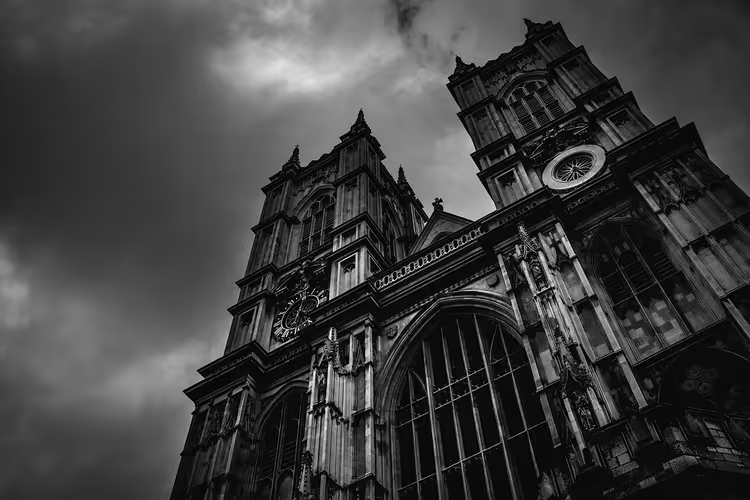
The cathedral stretches from west to east and follows the shape of a Latin cross. Two towers rise above the west facade, with statues of Justice, Truth, Peace, and Mercy between them. The most convenient way to tour it is hall by hall: first the nave, then the altar, Poets' Corner, and the Henry VII Chapel.
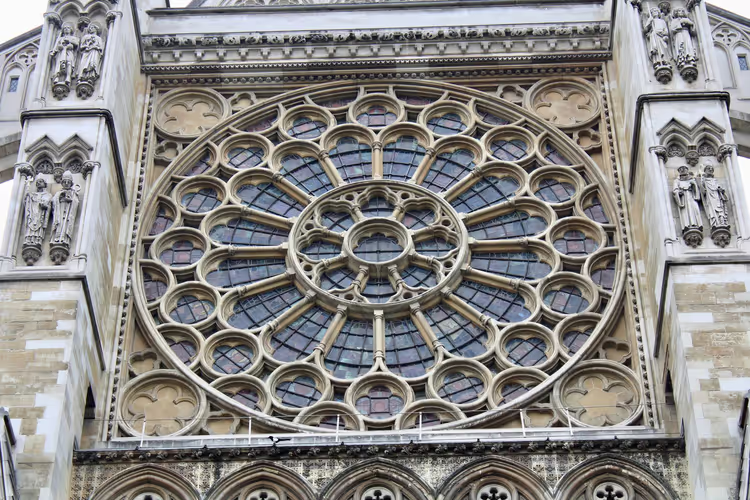
The exterior is completed by pointed arches and rose windows on the transept facades. These are what give the building the lightness that earned Gothic its reputation as stone lace. Below, four statues stand on either side of the doors, and higher up you can see niches with figures of 20th-century Christian martyrs.
The nave and the Tomb of the Unknown Warrior
The nave was completed in the early 16th century and remains the tallest in Great Britain to this day. Its height was made possible by external arches: they bear the load and free up the interior space. The light, narrow hall is supported by slender columns, with tombs and memorial plaques visible between them.
 © Robert Lamb · CC BY-SAPhoto: Robert Lamb, CC BY-SA (https://creativecommons.org/licenses/by-sa/2.0), Wikimedia Commons
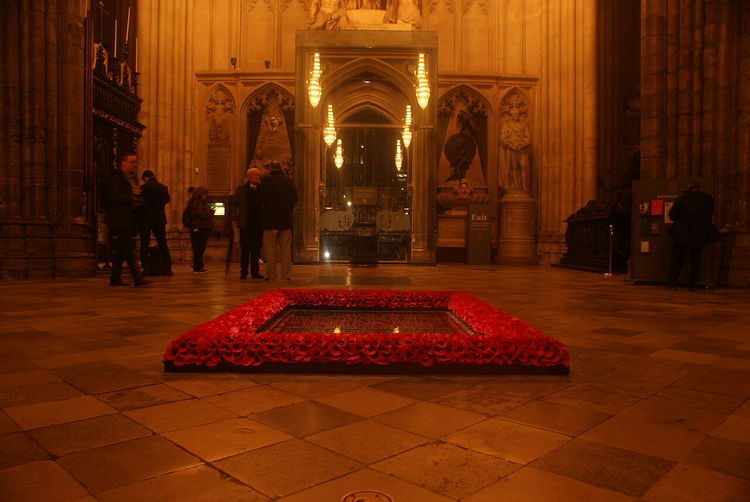
Look down at the west entrance and you will see the Tomb of the Unknown Warrior. Heads of state lay wreaths here during official visits, and this slab has long been one of the country's principal places of remembrance. The nave ceiling is adorned with crystal chandeliers donated by the Guinness family.
The altar and the Last Supper mosaic
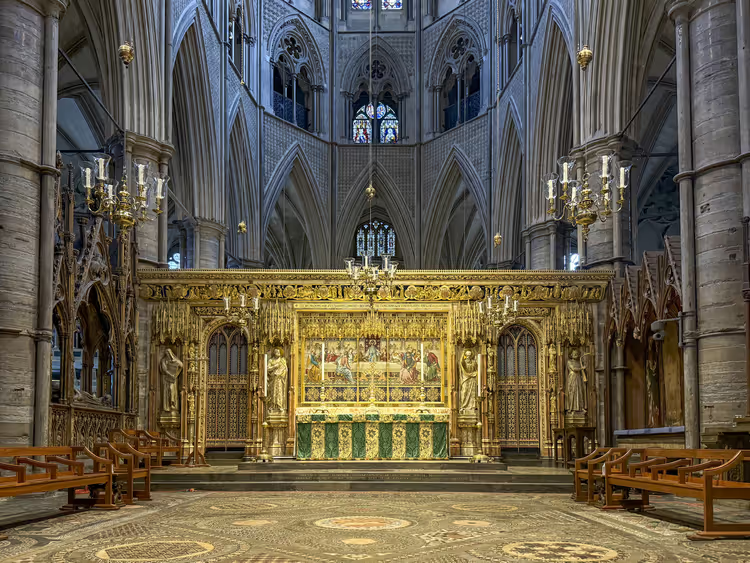
The altar appeared in the cathedral in the second half of the 19th century, designed by architect George Gilbert Scott. The sanctuary is decorated with the Last Supper mosaic, and the floor is laid in the Cosmatesque style typical of medieval Rome. The dean was so impressed by the Italian craftsmen's work that he brought one of them, Antonio Salviati, to decorate the church.
 © Hayden Soloviev · CC BYPhoto: Hayden Soloviev, CC BY (https://creativecommons.org/licenses/by/4.0), Wikimedia Commons
The floor in front of the altar was laid as early as the 13th century from dark limestone, onyx, glass, and porphyry. The pattern consists of thousands of tiny fragments, so the design looks three-dimensional even from a distance. Step closer to the railing and you can make out individual stones in this dark carpet.
Poets' Corner
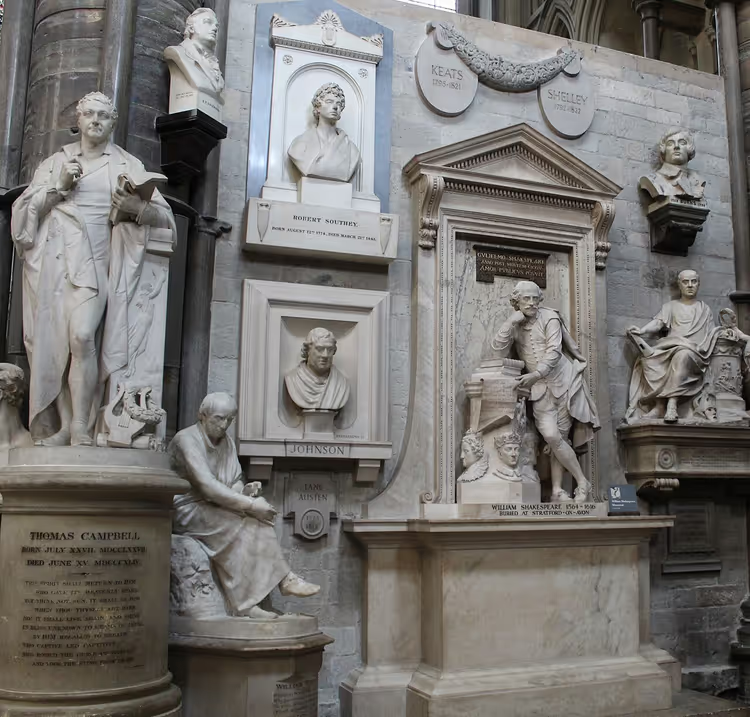
The most visited part of the church is in the south transept. Britain's literary figures are buried here, and the first was Geoffrey Chaucer, author of The Canterbury Tales. The second tomb appeared only two hundred years later, when Edmund Spenser was buried nearby.
 © 14GTR · CC BY-SAPhoto: 14GTR, CC BY-SA (https://creativecommons.org/licenses/by-sa/4.0), Wikimedia Commons
Since then, memorial plaques and burials of famous writers have become a tradition. Poets' Corner holds the graves of writers Charles Dickens and Samuel Johnson, as well as actor Laurence Olivier. No new burials have taken place here since the late 20th century, but names continue to be added to plaques and stained glass.
Henry VII Chapel
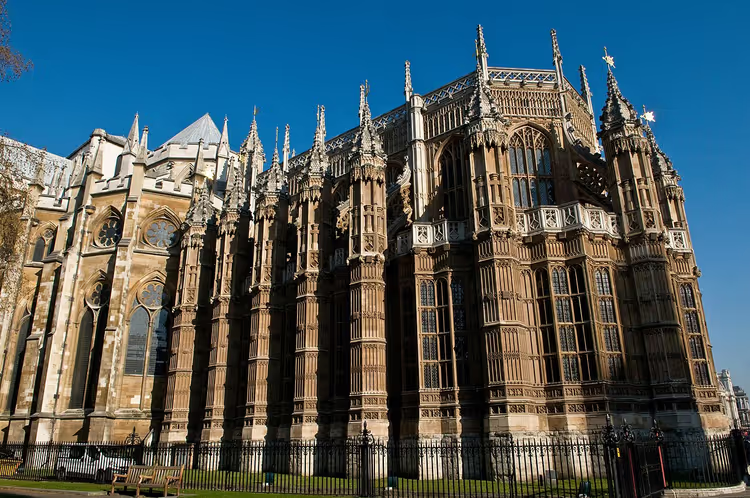
The ornate Lady Chapel is separated from the main complex by the brass east gates. It is considered a masterpiece of late Gothic: huge windows, delicate fan vaults, and pendants resembling gigantic stalactites. The overall picture is completed by figures of apostles under canopies and the multicolored military flags of the Order of the Bath.
 © Josh Hallett from Winter Haven, FL, USA · CC BY-SAPhoto: Josh Hallett from Winter Haven, FL, USA, CC BY-SA (https://creativecommons.org/licenses/by-sa/2.0), Wikimedia Commons
The chapel was founded by order of Henry VII in the early 16th century, and the king found his final resting place there. His wife Elizabeth of York is buried beside him. The tombs with gilded portraits were made by the Florentine Torrigiano, who was considered a rival of Michelangelo. Later, Mary Stuart, Elizabeth Tudor, and Oliver Cromwell were buried in the chapel.
The inner courtyard and cloisters
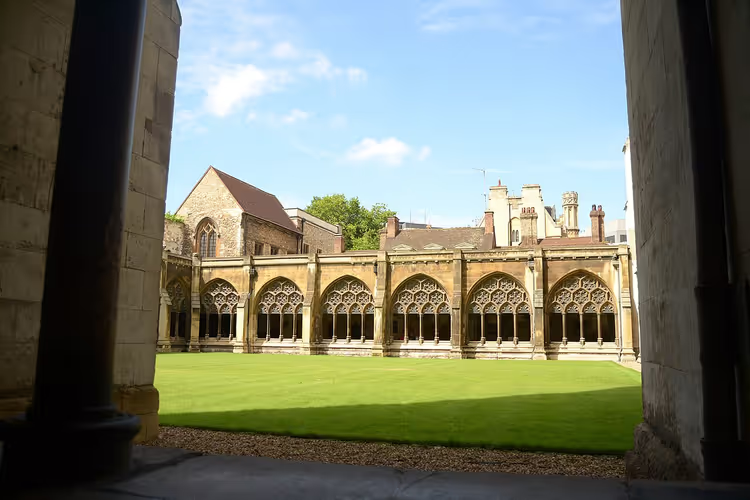
While touring the cathedral, take a look at the inner courtyard with its four cloisters. These are covered galleries of light stone built in the 13th and 14th centuries. At that time the courtyard was the heart of the monastery: the north gallery housed the library, the south led to the refectory, and the west held the abbot's house.
 © Xaviguillen · CC BY-SAPhoto: Xaviguillen, CC BY-SA (https://creativecommons.org/licenses/by-sa/3.0), Wikimedia Commons
Today the former cells hold church books, and the old sacristy houses a museum with wax figures of historical figures. Standing apart is the Little Cloister, on the site of which the monastery infirmary stood in the Middle Ages. There are almost no tourists here, so you can examine the stonework and grave slabs without rushing.
The Chapter House
A door from the mid-11th century separates the east cloister from the Chapter House, and it is considered the oldest in Great Britain. The east gallery leads into a Gothic octagonal hall where pointed windows with stained glass serve as the walls.
The stained glass pattern is echoed in the tiles of the stone floor, and a carved arcade runs around the room beneath the windows. The walls are covered with paintings on the theme of the Apocalypse. The hall's history goes back to the 13th century: first monks gathered here, later the Great Royal Council sat here, and then the House of Commons.
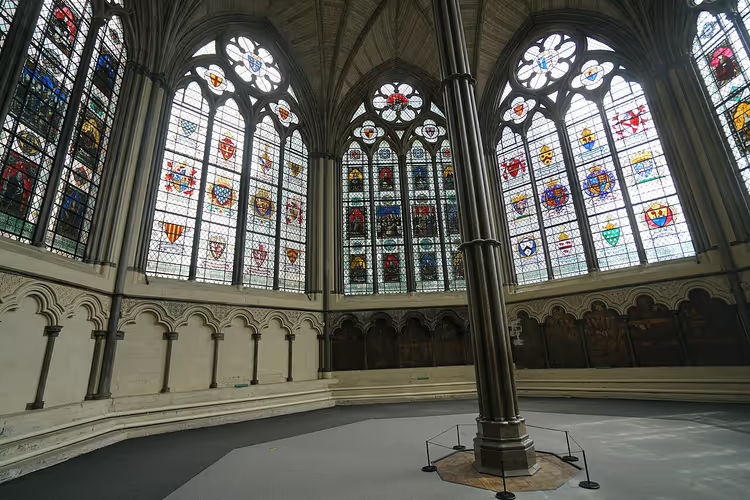 © ChrisVTG Photography · CC BY-SAPhoto: ChrisVTG Photography, CC BY-SA (https://creativecommons.org/licenses/by-sa/4.0), Wikimedia Commons
College Garden
Not far from the abbey lies College Garden, said to be the oldest in Great Britain. The first plane trees were planted here in the mid-19th century, and the grounds were divided into plots for fruit, vegetables, medicinal herbs, and flowers. Flower beds were laid out for monarchs who received treatment in the neighboring infirmary.
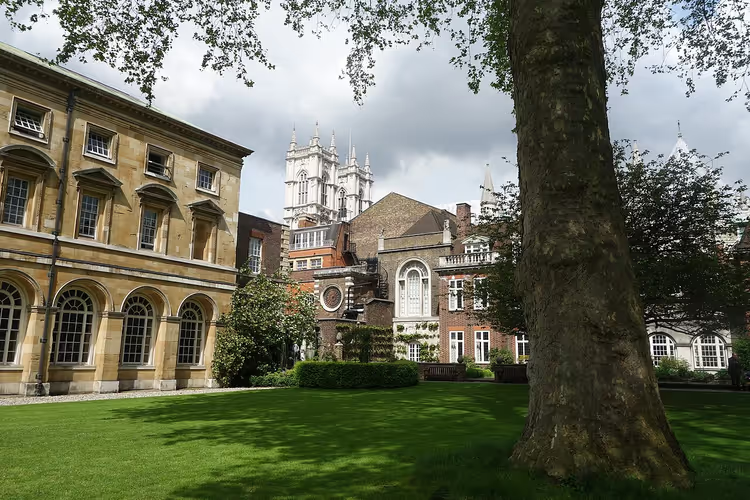 © Александр Спиридонов · CC BYPhoto: Александр Спиридонов, CC BY (https://creativecommons.org/licenses/by/3.0), Wikimedia Commons
Among the local attractions, the Crucifixion sculpture group by Enzo Plazzotta stands out. The garden remains private and is surrounded by ordinary residential houses. Access is therefore limited: you can enter on Tuesdays, Wednesdays, and Thursdays, with opening hours several hours longer in summer than in winter.
St Margaret's Church
The church of Margaret the Virgin of Antioch was founded in the 12th century and completely rebuilt in the late 15th century. In the early 17th century it became the parish church of Parliament. British Protestants preferred it to the lavish neighboring abbey, and that tradition lives on to this day.
The northwest tower was restored in the first half of the 18th century, when the facade was also clad in light Portland limestone. The church preserves an east window with a Flemish stained glass panel from the early 16th century, created in memory of the betrothal of Arthur Tudor to Catherine of Aragon.
 © Txllxt TxllxT · CC BY-SAPhoto: Txllxt TxllxT, CC BY-SA (https://creativecommons.org/licenses/by-sa/4.0), Wikimedia Commons
The Czech engraver Wenceslaus Hollar and the first printer William Caxton are buried here. Winston Churchill and Clementine Hozier chose this church for their wedding, as did many other famous English people.
Rules of conduct at the abbey
Westminster Abbey remains a working church, not a museum. Regardless of your denomination, it is worth following a few simple rules here. Remove your hat, speak quietly, and do not disturb worshippers.
If you come for a service, take a seat and do not walk around the halls during the liturgy. Leave food and drinks outside the church, and it is better to leave large backpacks and suitcases at your hotel. Check the photography rules at the entrance: photos are prohibited in certain areas.
Dress modestly, especially in summer, since shorts and open tank tops are inappropriate here. Respect for the congregation is part of the visit, not a formality. On weekdays it is calmer to explore the halls, because on weekends you tire more quickly from the noise and crowds.
Tickets and opening hours
The abbey is open for sightseeing on weekdays from 9:30 to 15:30, on Saturdays from 9:30 to 15:00 (as of 09/2026, abbey opening hours). On Sundays tourist tickets are not sold, since entry is only for worship. Last entry is usually half an hour before closing, so do not put off your visit until the evening.
An adult ticket costs £31, for students and seniors £28, for children aged 6-17 £14, and children under 6 enter free (as of 09/2026, 2026 ticket prices). The audio guide is included in the price, no separate payment is needed.
 © Txllxt TxllxT · CC BY-SAPhoto: Txllxt TxllxT, CC BY-SA (https://creativecommons.org/licenses/by-sa/4.0), Wikimedia Commons
Opening hours and prices were checked on 14.09.2026 on the abbey pricing page. Buy your ticket online for a specific time, otherwise you will stand in the general queue at the north entrance. Westminster Abbey tickets with audio guide are convenient to compare in advance, but at the ticket office the choice of time slots is already smaller.
With the London Pass you enter the abbey at no extra charge, if the multi-attraction card has already been purchased. On Wednesdays the abbey sometimes stays open longer, and the evening ticket costs less, but this schedule changes, so check it on the day of your visit.
Tours and tickets in Westminster Abbey
Guided tours, skip-the-line tickets and activities — most offers can be cancelled free of charge.
See offers on TiqetsThe widget loads once you give your consent.
What to see near the abbey
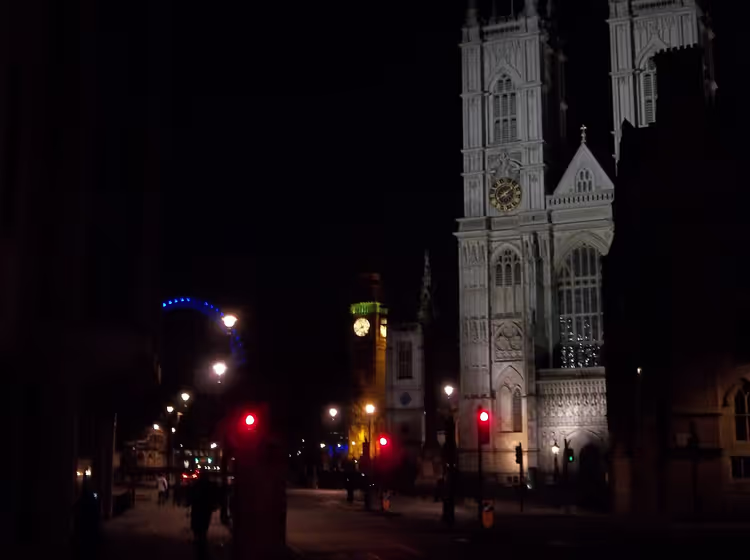
Once you leave the abbey, you find yourself on Parliament Square. On one side, Big Ben and the Palace of Westminster, where the British Parliament sits, are buzzing. On the other, just across Westminster Bridge, stands the London Eye, and it is only a ten-minute stroll away.
The observation wheel lifts you to bird's-eye height, and from there you can see the whole embankment and the dome of St Paul's Cathedral. Get a London Eye ticket with a fixed entry time, because on weekends the line stretches along the bridge.
If you have time left, add the Tower and Tower Bridge to your route. You can easily walk there along the embankment or take a boat down the Thames. St Paul's Cathedral and Madame Tussauds are farther away, so it is better to plan them for a separate day.
How to get there from Westminster station
The abbey occupies the south side of Parliament Square, west of the Palace of Westminster and a couple of minutes from the Thames. The nearest Underground station is called Westminster and serves the Jubilee, Circle and District lines. From the exit to the north entrance is about five minutes on foot (according to the map).
The second convenient station, St James's Park, is on the District and Circle lines, and from there you walk through the park. Buses stop on Victoria Street and around the square. If you arrive by train, you can walk from Waterloo station to the abbey across the bridge or take the Underground one stop.
Visitors enter through the north entrance (North Door), and that is where the line forms. Come at opening time, and you will reach the altar and Poets' Corner before the tour groups. The abbey's location is marked on the map below.
Westminster Abbey on the map
Below is an interactive map showing the abbey's location relative to Parliament Square, Big Ben and the Thames. It is handy for planning your route from the Underground and figuring out exactly where to find the north entrance.
⁉️🤔 Frequently asked questions
How much does a Westminster Abbey ticket cost?
An adult ticket costs £31, children under 6 enter free (as of 09/2026, admission prices). Tickets are sold for a specific entry time.
What hours is the abbey open to tourists?
On weekdays the abbey is open from 9:30 to 15:30, on Saturdays until 15:00 (as of 09/2026, opening hours). On Sundays, visitors are only admitted for services.
Can you get into the abbey for free?
Children under 6 enter free, as do worshippers attending services. Another option is Choral Evensong, which is free to attend. If you have a London Pass, you can visit the abbey at no extra cost.
How long does a visit take?
Allow a couple of hours for the nave, the altar, Poets' Corner and the Henry VII Chapel. With the audio guide and the cloisters, three hours easily slip by. If you want to catch the halls half-empty, come at opening time or pick a weekday.
How do you get to the abbey by Underground?
The nearest station is called Westminster (Jubilee, Circle and District lines), and from there to the north entrance is about five minutes on foot (according to the map). St James's Park on the District and Circle lines also works. Buses run along Victoria Street.
In short: what to book
If you are in London for the first time, get an abbey ticket for the morning, while the halls are still half-empty. If you want one evening view of the city, add the London Eye after the abbey. If you are staying in the capital for several days, compare London hotel prices on Trip.com and choose accommodation near Westminster so you can walk to the abbey.
Buy your abbey ticket online in advance, otherwise you risk spending half your visit standing in line.

A small editorial team writing guides for independent travel. We travel ourselves, but we haven’t been everywhere, so we check prices, opening hours and how to get there against official sources.