
















20 Parks in Paris: where to walk for free and what to pay for
Paris is known for its tower and the Louvre, while its parks stay in the background. Yet this is exactly where the city relaxes: in some gardens Parisians have lunch on a bench, in others they hide from the August heat, in still others they go boating and ride attractions. Choosing three or four out of two dozen green spaces for one trip is not easy, so below is a practical roundup of the main parks in Paris.
Most city gardens are open free of charge all year round, and the gates close by season: later in summer, earlier in winter. This is how Jardin des Tuileries works, for example (as of 09/2026, official Louvre website). You only pay for amusement parks (Disneyland Paris, Parc Astérix, France Miniature, Aquaboulevard) and for individual museums inside the gardens.
The list includes 20 parks of different formats: central gardens for a short walk, forested areas for a full day, theme parks for children. The parks are not arranged by geography, so it is easier to check the route against the map at the end of the article. For each one you will find what makes it different from its neighbors on the list and what to plan for in advance.
Ad: this article contains affiliate links, we earn a commission if you book through them, at no extra cost to you.
Our pick: 20 parks in Paris
💡 In short:
- In the center, go for Jardin des Tuileries and Jardin du Luxembourg: free entry, museums and metro nearby.
- For a full day in nature, Bois de Boulogne and Bois de Vincennes work well.
- With children, plan for Disneyland Paris, Parc Astérix and Aquaboulevard; tickets are cheaper in advance.
- Jardin des Tuileries opening hours: 09/2026, verified on the Louvre gardens page.
# | Park | What makes it different | Who it suits | Entry |
|---|---|---|---|---|
1 | Jardin des Tuileries | The city's oldest garden by the Louvre | First walk | free |
2 | Champ de Mars | Lawn right under the Eiffel Tower | Evening with a view | free |
3 | Bois de Boulogne | Forest with lakes and the Bagatelle palace | Full day | free |
4 | Parc de la Villette | Science, music and a canal | With children and teens | free |
5 | Parc floral de Paris | Four flower pavilions | Quiet day | ticket |
6 | France Miniature | 160 miniature models of France | With children | ticket |
7 | Parc Astérix | 30 rides based on the comics | Teens and families | ticket |
8 | Disneyland Paris | Two Disney parks | With children | ticket |
9 | Aquaboulevard | Water park within the city | With children | ticket |
10 | Jardin du Luxembourg | Palace, pond and toy sailboats | Classic walk | free |
11 | Parc des Buttes-Chaumont | Cliffs, a temple and a suspension bridge | Terrain lovers | free |
12 | Parc Montsouris | Lake and cascade on a former quarry site | Picnic | free |
13 | Bois de Vincennes | Lakes, a castle and a pagoda | Biking and boating | free |
14 | Jardin des plantes | Botany, a menagerie and galleries | With children | free |
15 | Parc de Belleville | Terraces and the longest cascade | City panorama | free |
16 | Château de Fontainebleau | Palace and period-style park | Day outside the city | ticket |
17 | Parc de Bagatelle | Rose garden and lake in Bois de Boulogne | Roses and quiet | ticket |
18 | Jardins de Versailles | Gardens of Louis XIV | Must-see classic | seasonal |
19 | Parc André-Citroën | Themed gardens on a former factory site | Design and Seine views | free |
20 | Parc de Bercy | Vineyards and gardens by the Seine | Families with children | free |
The list is not arranged from the center to the outskirts: free gardens and paid parks are mixed together. Use the "Entry" column as your guide. If you are short on time, start with Jardin des Tuileries, Champ de Mars and Jardin du Luxembourg.
1. Jardin des Tuileries
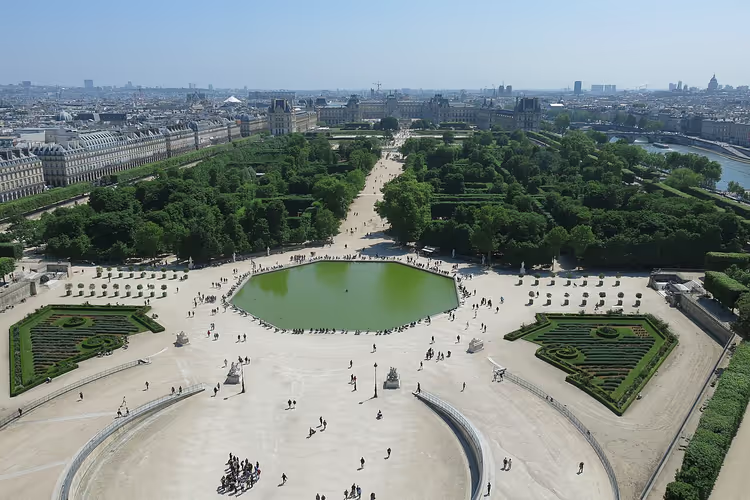
The oldest public garden in Paris lies between the Louvre and Place de la Concorde. It was laid out in 1564 for the palace of Catherine de' Medici, and it opened to city residents as early as the 17th century (as of 09/2026, Louvre gardens on the official website). The axial layout was set by André Le Nôtre: you walk in a straight line from the Arc du Carrousel to the obelisk.
From there begins the textbook "French garden." Clipped chestnut trees stand in neat rows, green metal chairs are set around the octagonal basin, and sculptures line the walkways, including copies of works by Rodin. Along the western edge are two museums: Musée de l'Orangerie with Claude Monet's "Water Lilies" panels and Jeu de Paume with contemporary photography.
Entry to the garden itself is free, but for the museums you need a timed ticket. In summer, the walk-up line for the Louvre and Orangerie stretches along the terrace. Skip-the-line Louvre ticket on GetYourGuide.
- Who it's for: a first walk through the city and for those combining the garden with a museum.
- The catch: the center is crowded all day, with almost no quiet corners.
2. Champ de Mars
 © Ank Kumar · CC BY-SAPhoto: Ank Kumar, CC BY-SA (https://creativecommons.org/licenses/by-sa/4.0), Wikimedia Commons
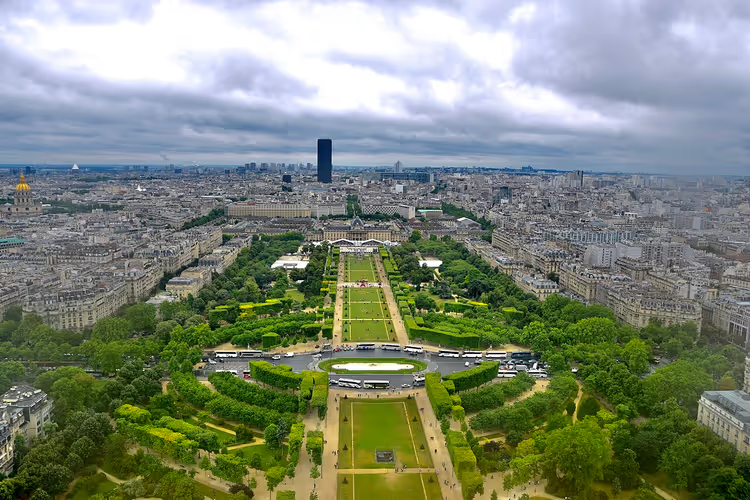
A narrow strip of lawns runs from the Eiffel Tower to the École Militaire. This is not an ordinary square but a former military parade ground: Blanchard's hot-air balloon rose into the sky here, and in the century before last horse races were held. Today you come here not for attractions but for the view of the tower from any point on the lawn.
In the evening the lights come on, and the tower sparkles every hour. Come at sunset. A blanket, cheese and a bottle of wine turn an ordinary evening into that quintessential Parisian one. A time slot for going up is best booked in advance; sunset slots sell out first: Eiffel Tower ascent with a time slot.
- Who it's for: a romantic evening and photos with the tower without the crowd at its base.
- Not for: those looking for shade and cool in July.
3. Bois de Boulogne
 © Guilhem Vellut from Paris, France · CC BYPhoto: Guilhem Vellut from Paris, France, CC BY (https://creativecommons.org/licenses/by/2.0), Wikimedia Commons
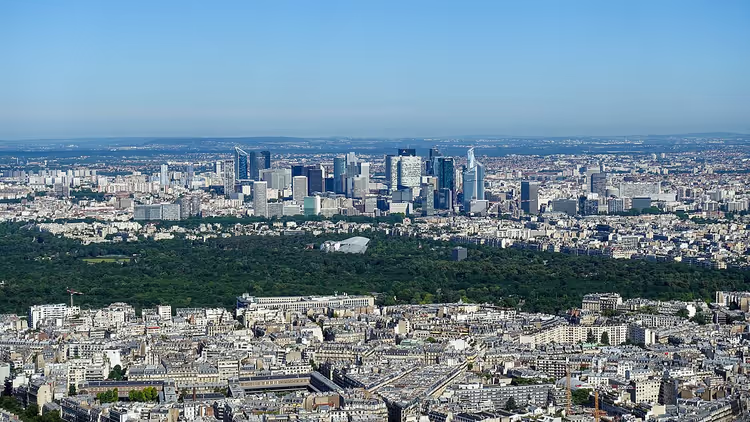
The western woodland is two and a half times larger than New York's Central Park. The royal Rouvre oak forest once stood here, where French kings hunted, and today Parisians call the Bois de Boulogne the "western lungs" of the capital. You can spend anywhere from a couple of hours to a full day here.
Several separate worlds are hidden inside: two lakes with boats, a racetrack, the children's Jardin d'Acclimatation, and the Bagatelle palace with its rose garden. Visiting the palace requires a ticket; entry to the forest itself and its paths is free. Tickets to Paris parks and museums on Tiqets.
- Who it's for: for a long walk or bike ride and for families with children.
- The catch: by car, the roads here have roundabouts, and in the evening some of the alleys are poorly lit.
4. Parc de la Villette
 © Jean-Marie Hullot from France · CC BY-SAPhoto: Jean-Marie Hullot from France, CC BY-SA (https://creativecommons.org/licenses/by-sa/2.0), Wikimedia Commons
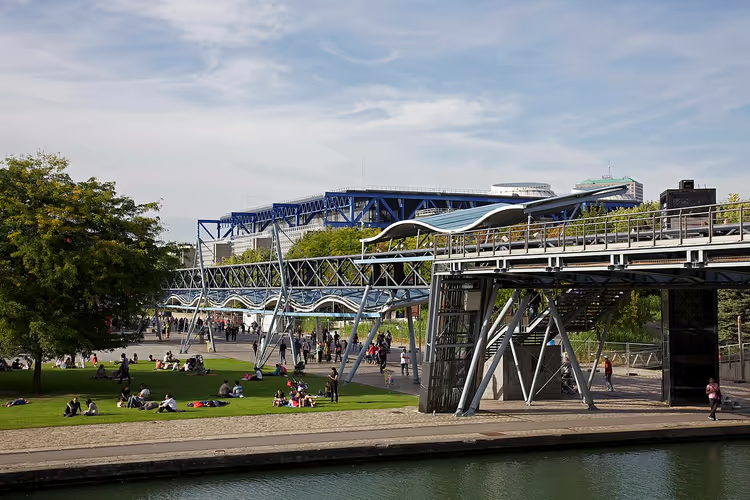
The largest park inside the city combines nature with an industrial landscape. Bright themed pavilions are scattered along the Canal de l'Ourcq, and landscaped paths lead from one area to another. This is not a quiet garden in the classical sense, but a place for events: exhibitions, concerts, theater, and cinema right on the lawn.
The southern part is occupied by the Cité des Sciences et de l'Industrie, one of the most visited cultural centers in Paris after the Louvre. The spherical Géode also stands here, showing films on a huge curved screen. For children and teenagers, this is a ready-made half-day plan. You just need to choose a showtime in advance. Tickets to the science and entertainment center on Tiqets.
- Who it's for: for families with children and for those who want to combine a walk with a museum.
- The catch: you have to walk a lot between pavilions, so plan on comfortable shoes.
5. Parc floral de Paris
 © Christophe Meneboeuf · CC BY-SAPhoto: Christophe Meneboeuf, CC BY-SA (https://creativecommons.org/licenses/by-sa/3.0), Wikimedia Commons
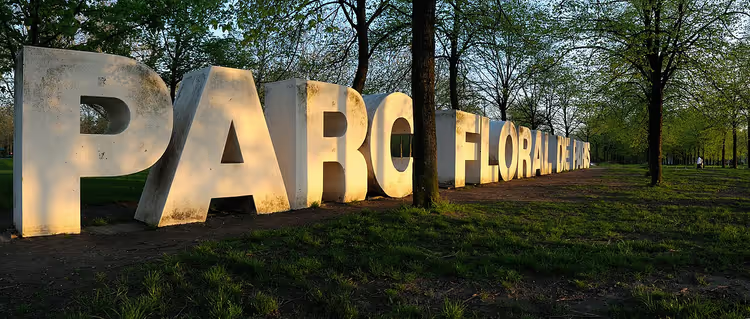
The botanical park in the Bois de Vincennes is built around four pavilions, each with its own microclimate. In one, tulips and daffodils bloom; in another, you'll find miniature trees in the Japanese style. Entry to the garden is paid, because this is not a city square but a separate open-air exhibition.
- Who it's for: for a calm day among flower beds and for photographers.
- The catch: the park closes in the early evening, so an evening stroll won't work.
6. France Miniature
 © Henry Salomé (Jaser !) 18:06, 2 November 2006 (UTC) · CC BY-SAPhoto: Henry Salomé (Jaser !) 18:06, 2 November 2006 (UTC), CC BY-SA (http://creativecommons.org/licenses/by-sa/3.0/), Wikimedia Commons
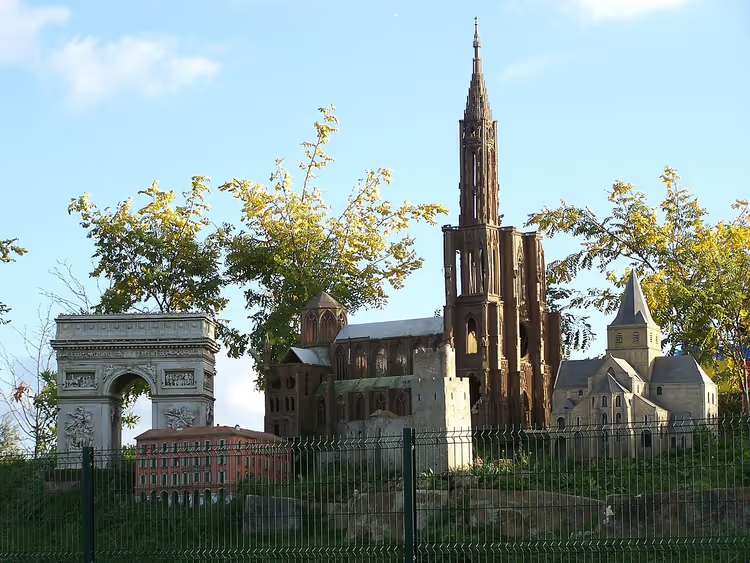
The park packs about 160 scale models of France's main landmarks into a compact area. In half an hour you "travel" across the whole country, from the Eiffel Tower to Fort Boyard, with Gothic provinces and wine regions standing side by side. Small trains and moving figures bring the models to life, so kids don't get bored here.
The models are built to a single scale and reproduce the originals down to the smallest details, including roof tiles and garden paths. The park is seasonal: it's open from spring to fall and closed in winter. Check the calendar before your trip (as of 09/2026, France Miniature). Tickets for the theme park are cheaper bought online in advance: France Miniature tickets on GetYourGuide.
- Who it's for: families with kids and anyone who wants to see all of France in one day.
- The catch: the park only operates in season, it's closed in winter.
7. Parc Astérix
 © cnb · CC BY-SAPhoto: cnb, CC BY-SA (https://creativecommons.org/licenses/by-sa/3.0), Wikimedia Commons
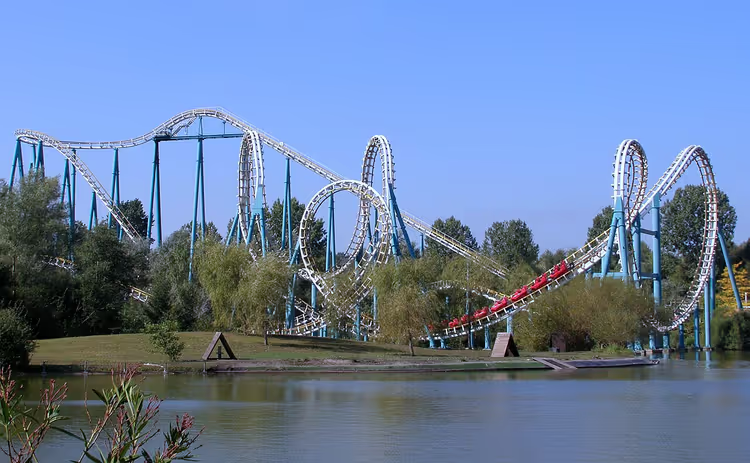
The theme park based on the Asterix and Obelix comics grew up near Paris and became the main alternative to Disney for those who want extreme roller coasters. Thirty rides are grouped into five themed zones, and in the central tent performers stage a daily battle between the Gauls and the Romans. A river-rafting ride takes you past Gallic settlements and defeated Roman legions.
The park is seasonal: it runs from April to November and is closed in winter. A "Malin" dated ticket costs €49 for both adults and children (as of 09/2026, Parc Astérix). These dated tickets are cheaper than gate prices, and quantities are limited: Parc Astérix tickets on GetYourGuide.
- Who it's for: teenagers, young adults, and active families.
- Not for: toddlers and anyone who can't handle tall roller coasters.
8. Disneyland Paris
 © flightlog · CC BYPhoto: flightlog, CC BY (https://creativecommons.org/licenses/by/2.0), Wikimedia Commons
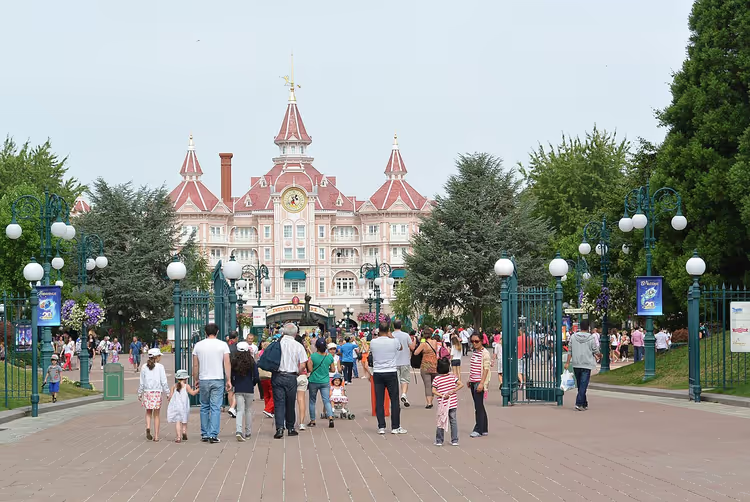
France's most visited entertainment complex sits outside the city, at Marne-la-Vallée Chessy station. RER A from Châtelet-Les Halles takes you there, and the station exit leads straight to the park gates. Inside there are two separate parks: Disneyland Park with Sleeping Beauty Castle and Walt Disney Studios with movie- and car-themed rides.
Sleeping Beauty Castle, Alice's mazes, Robinson's hut, and the Big Thunder Mountain ride in the Wild West are familiar to both kids and adults from the films. Ticket prices depend on the date and whether you want one park or two. That's why a dated ticket for a specific day is always cheaper than a spontaneous visit. Shows and parades run on a schedule: Disneyland Paris tickets on GetYourGuide.
- Who it's for: families with kids and first-time visitors to Paris.
- The catch: on weekends and during school holidays, tickets cost more and ride lines are longer.
9. Aquaboulevard
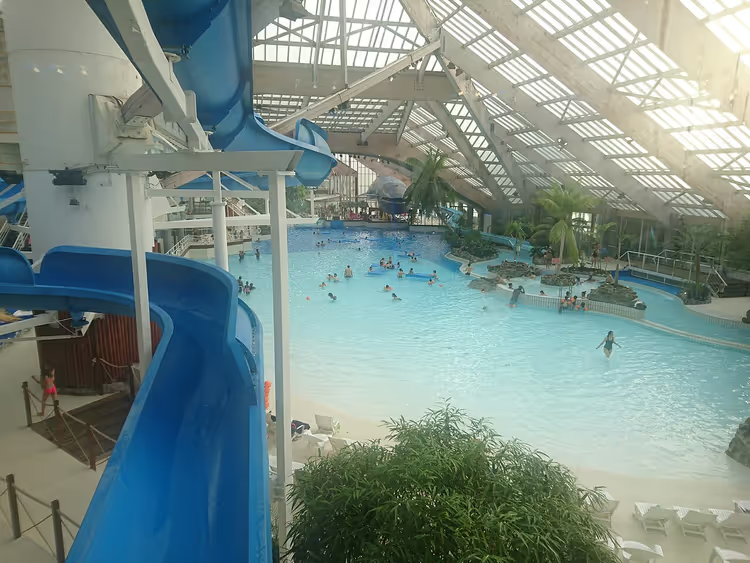
Europe's largest urban water park operates right inside Paris, in the fifteenth arrondissement. Under a glass dome, water and air temperatures are kept at a constant 29 °C year-round, so you can swim here even in January (as of 09/2026, Aquaboulevard). You'll find a wave pool, a seawater pool, slides for kids and adults, open-air beaches with palm trees, and counter-current channels.
The thirty-meter "Blue Whale," dreamed up by explorer Jacques-Yves Cousteau, delights children, while teenagers never leave the water cannons and the surf simulator. Kids are admitted from age three. But you need to keep a close eye on little ones: on weekends, lines build up at the slides. Aquaboulevard tickets on GetYourGuide.
- Who it's for: families with children and anyone who wants to swim in the cold season.
- Not for: those looking for quiet relaxation by the water.
10. Jardin du Luxembourg
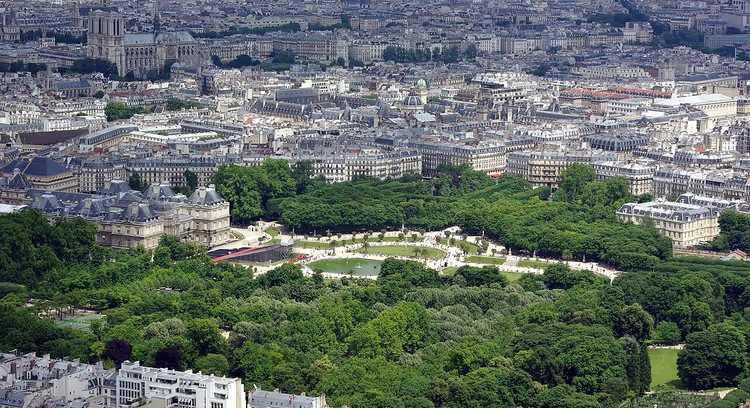
Parisians' favorite garden is laid out around the palace where the Senate now sits. Marie de' Medici created it in the early 17th century, modeled on Florentine gardens, and terraces, a large fountain, and the axial layout survive from that era. You come here not for attractions but for a classic stroll: green lawns, shady alleys, and a music pavilion with an open stage. Admission is free.
Children sail old wooden boats on the large pond while street performers entertain the crowds around them. On Saturdays, concerts are held in the pavilion, and you can attend them for free simply by walking through the main gates. In winter, chairs are set out around braziers along the paths, and the garden stays just as lively.
- Who it's for: a classic stroll in the center and families with children.
- The catch: toward evening, the pond with the boats is always noisy and crowded.
11. Parc des Buttes-Chaumont
 © M.Minderhoud · CC BY-SAPhoto: M.Minderhoud, CC BY-SA (http://creativecommons.org/licenses/by-sa/3.0/), Wikimedia Commons
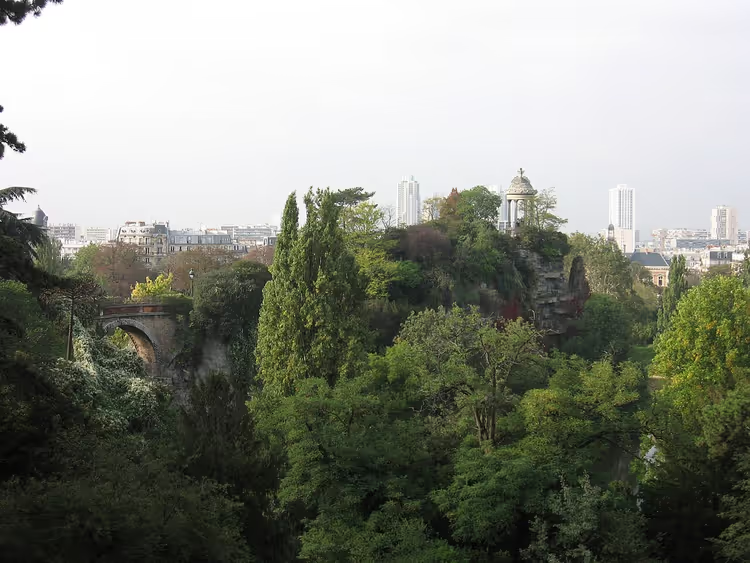
The name translates as "bare hill," and the site's history is grim at first: in the 18th century, it was a municipal dump. Under Baron Haussmann, the area was turned into a public park in three years: trash was hauled away, roads were laid, terraces were built, and thousands of trees were planted. The main surprise awaits you at the top. On a rock about fifty meters high stands the Temple of Sybil, reached by a suspension bridge sixty-three meters long.
The terrain with its elevation changes makes a walk feel like a small journey: paths descend to the lake, then climb back up to viewpoints. From the top, you get a panorama of northern Paris, and below there are cafes and playgrounds.
- Who it's for: a walk with good views and anyone who doesn't mind stairs.
- The catch: steep staircases and elevation changes are inconvenient with a stroller.
12. Parc Montsouris
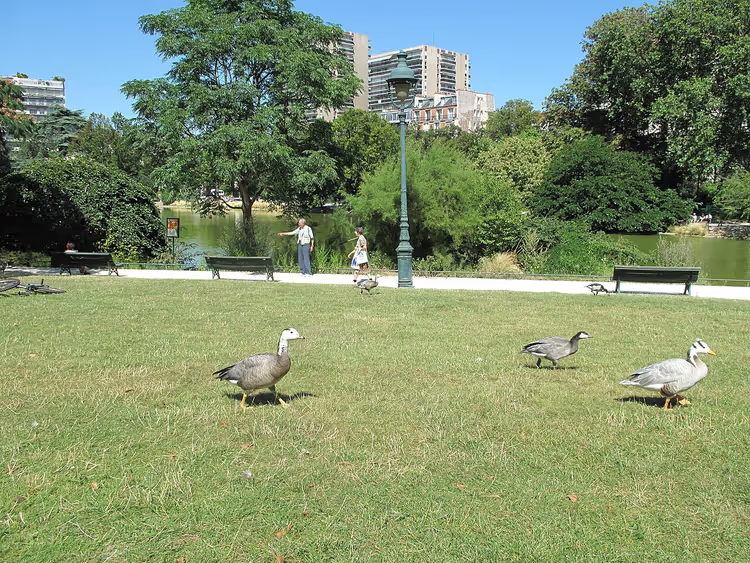
Baron Haussmann's second park was created on the site of a former quarry in the second half of the 19th century. The same gardeners who worked on Buttes-Chaumont designed it, so the terrain again plays the leading role: hills, an artificial lake, a stone cascade, and a network of winding paths. Lawns, trees, and shrubs are planted so that you forget the city within minutes.
During the day, students with laptops, runners, and families with children gather here. In the mornings, the park is quiet, and it's one of the best spots in southern Paris for a picnic on the grass. Pavilions, a theater, and concert venues come alive closer to the weekend, when city events take place.
- Who it's for: picnics, reading, and quiet walks away from the center.
- The catch: lighting is weak in the evening, and some paths are hard to see.
13. Bois de Vincennes
 © Unknown author · CC BY-SAPhoto: Unknown author, CC BY-SA (http://creativecommons.org/licenses/by-sa/3.0/), Wikimedia Commons
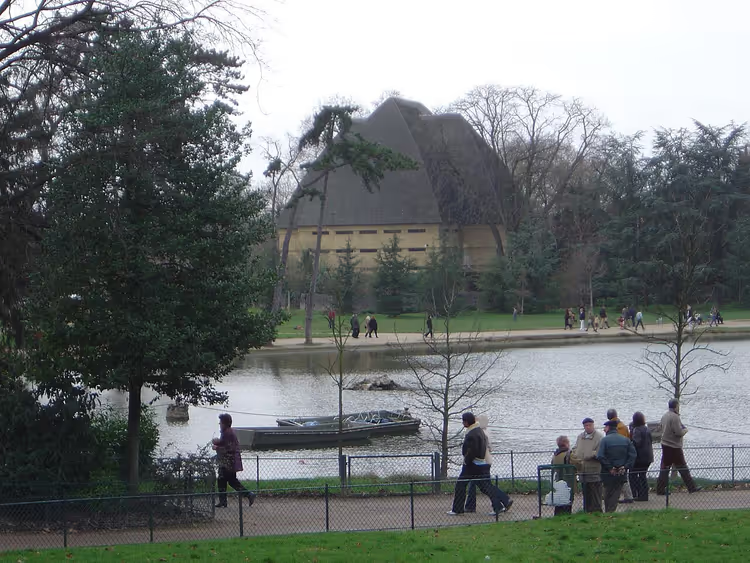
Paris's eastern woodland covers about a thousand hectares and was once royal hunting grounds. Napoleon III turned it into a strolling park with lakes, fountains, and sculptural compositions. Inside are a royal chateau, a Buddhist pagoda with a gilded Buddha statue, a butterfly garden, and a historic 19th-century redoubt.
You can go boating on the lakes or cycling along the alleys. You can also simply walk with a thermos. In summer, people picnic on the lawns, and in winter the alleys are almost empty. Tickets for Paris walks and family attractions on GetYourGuide.
- Who it's for: a full day in nature and bike rides.
- The catch: you can't cover the whole woodland in one visit, so pick one corner and don't try to see it all.
14. Jardin des plantes
 © Benh LIEU SONG · CC BYPhoto: Benh LIEU SONG, CC BY (https://creativecommons.org/licenses/by/3.0), Wikimedia Commons
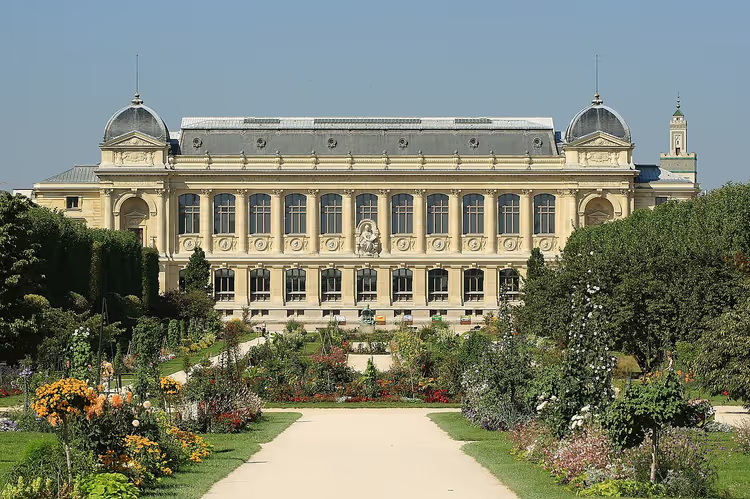
Jardin des plantes opened in the 17th century at the initiative of royal physicians who taught students using living plants. Today it's an open-air museum: themed greenhouses, a rose garden, an alpine garden, a mineralogy gallery, and a small menagerie. Across thirty hectares, plants from a wide range of climate zones are collected, more than a thousand species in total.
Children love the Great Labyrinth, which spirals up to the top of a hill where Paris's oldest metal gazebo stands, a hundred years older than the Eiffel Tower. Admission to the garden itself is free, while galleries and the menagerie are paid separately: tickets to the galleries and menagerie on Tiqets.
- Who it's for: families with children and botany lovers.
- The catch: the interesting galleries and the menagerie require separate tickets.
15. Parc de Belleville
 © Mbzt · CC BYPhoto: Mbzt, CC BY (https://creativecommons.org/licenses/by/3.0), Wikimedia Commons
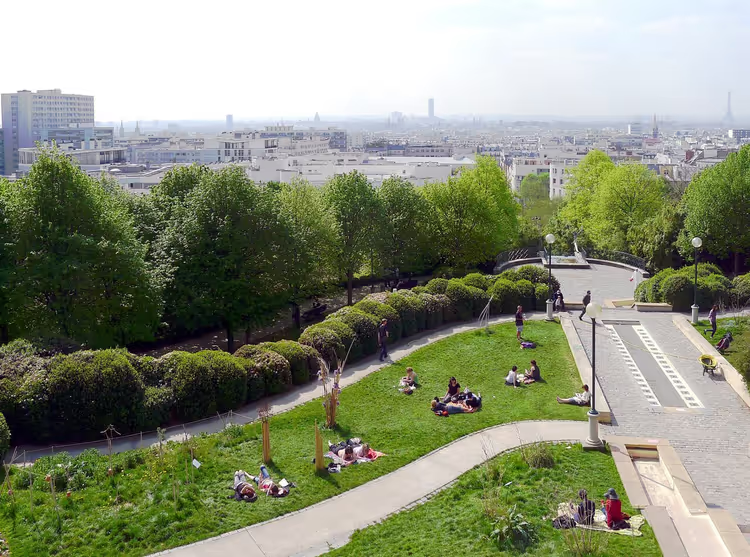
The park spreads across a high hill in the Belleville quarter, which was a separate village before it became part of Paris. A vineyard and a winery remain from the old settlement, and the garden itself is known for its scenic terraces. The main reason people come here: they offer one of the best panoramas of Paris, and you see the whole city without the crowds of observation decks.
The city's longest cascading fountain runs down the slope, surrounded by flower beds and trimmed shrubs. There is an open-air theater with performances almost every evening. The "House of Air" environmental pavilion teaches about air quality through exhibitions and experiments, and kids find it engaging.
- Who it's for: panoramic photos and evening walks.
- Not for: those who find it hard to walk uphill.
16. Château de Fontainebleau
 © user:Carolus · CC BYPhoto: user:Carolus, CC BY (https://creativecommons.org/licenses/by/2.5), Wikimedia Commons
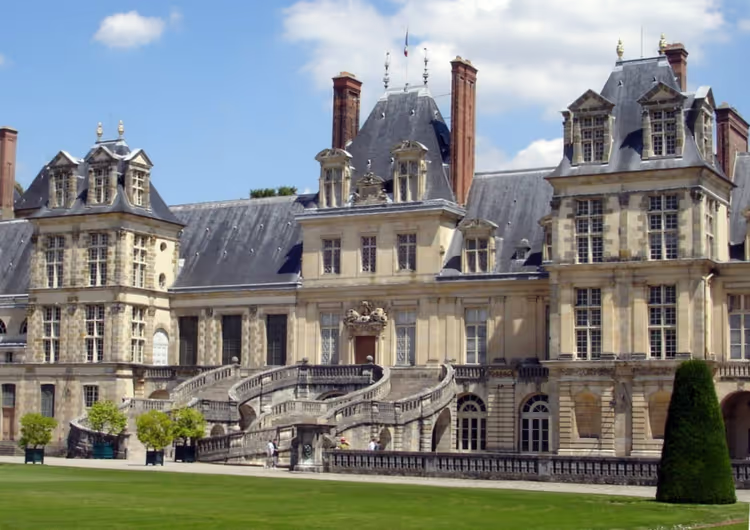
Château de Fontainebleau, an hour from Paris, combines several architectural styles and witnessed the reigns of French kings from Francis I to Napoleon. Austere Gothic, classical symmetry, and Renaissance luxury are woven into a single appearance, and the Chapel of the Holy Trinity is stunning in its decoration. Around the palace lies a park with gardens, ponds, a canal, and long alleys that changed under each monarch.
People come here for a full day: first the palace, then a walk in the park and lunch by the water. From Paris, the easiest way is by train from Gare de Lyon to Fontainebleau-Avon station, then a bus takes you the rest of the way. Paris to Fontainebleau train tickets on Trip.com.
- Who it's for: a full day outside the city and for those who love history and gardens.
- The catch: without a palace ticket you only see the park, and in season it's best to book tickets in advance.
17. Parc de Bagatelle
 © Benchaum · CC BY-SAPhoto: Benchaum, CC BY-SA (https://creativecommons.org/licenses/by-sa/3.0), Wikimedia Commons
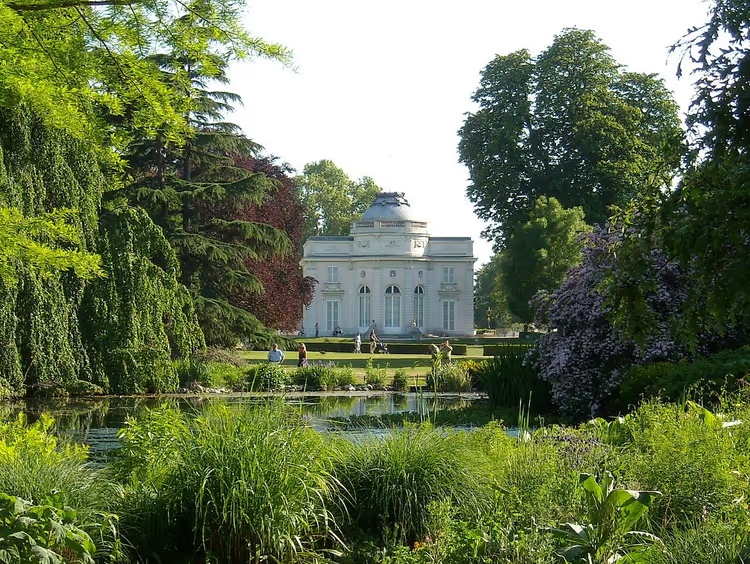
The name of the palace and park translates as "trifle": the Count of Artois bet that he could build a palace in two months, and he won the wager. Around it grew a garden in English and Chinese styles with a lake, a river, cascading waterfalls, grottoes, and bridges. After reconstruction under Napoleon III, a rose garden was laid out here, and that is the main reason people come.
In June, thousands of rose bushes bloom in the park and a competition for the most beautiful rose takes place. The park sits inside the Bois de Boulogne, so it's easy to combine with a walk in the woods. Entry to the park is paid, and the palace itself can be viewed from outside or on scheduled tours.
- Who it's for: a quiet day among roses and for those who value silence.
- The catch: in rose garden season there are many groups here, and quiet hours are almost nonexistent.
18. Jardins de Versailles
 © Chabe01 · CC BY-SAPhoto: Chabe01, CC BY-SA (https://creativecommons.org/licenses/by-sa/4.0), Wikimedia Commons
Jardins de Versailles set the standard for formal gardens across Europe: axial alleys, basins, fountains, and geometric bosquets. They were created under Louis XIV, and the entire palace and park ensemble is a UNESCO site. Allow at least half a day for the gardens: distances here are measured in kilometers, not steps.
An important practical note. On days of large musical shows, entry to the gardens is paid; at other times you can enter freely. Exact dates and the fountain calendar change by season, so check them on the palace's official website before your trip. On show days, fountains run on a schedule, and the spectacle is worth planning around. Skip-the-line Versailles ticket with audio guide on GetYourGuide.
- Who it's for: essential classics and for those ready to walk a lot.
- The catch: in high season the gardens are paid, and fountains run on a show schedule.
19. Parc André-Citroën
 © Guilhem Vellut from Paris, France · CC BYPhoto: Guilhem Vellut from Paris, France, CC BY (https://creativecommons.org/licenses/by/2.0), Wikimedia Commons
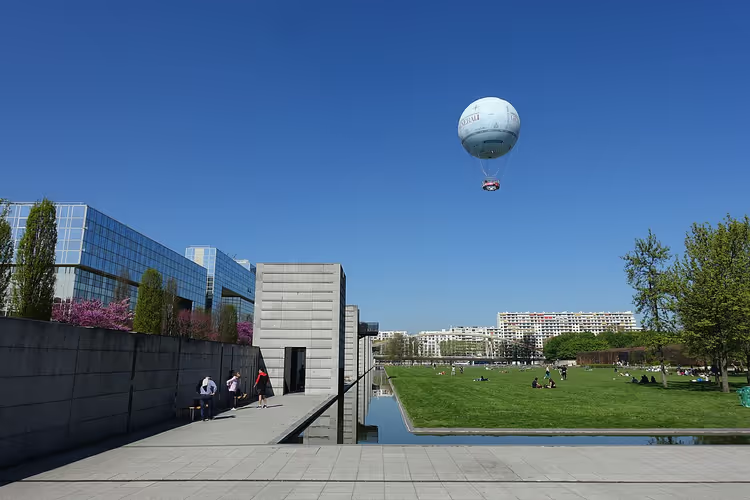
The riverside park grew on the site of the Citroën factory and was named after the brand's founder. The center is occupied by a huge lawn, around which unusual objects are arranged, designed by landscape architects with philosophical undertones. Between two greenhouses with Mediterranean and tropical flora, there is a plaza with "dancing" fountains where children run through unexpectedly shooting jets of water.
Eight themed gardens are built around colors: white with light-toned plants, black, blue, red, and gold, each tied to its own phenomenon or substance. From here you get some of the best views of the Seine, and a tourist bus route passes nearby. Hop-on Hop-off bus around Paris on GetYourGuide.
- Who it's for: lovers of modern design and families with children.
- The catch: young trees provide little shade, so walking in the heat is uncomfortable.
20. Parc de Bercy
 © Chabe01 · CC BY-SAPhoto: Chabe01, CC BY-SA (https://creativecommons.org/licenses/by-sa/4.0), Wikimedia Commons
The park on the right bank of the Seine covers almost fourteen hectares in the twelfth arrondissement and grew on the site of a wine depot. Relict oaks, chestnuts, maples, and lindens remain in its appearance, along with old buildings of the wine village and cobblestone paths. As a reminder of the past, a greenhouse, a fruit-bearing garden, and a vegetable plot with scarecrows remain.
People love to rollerblade, play soccer, and have picnics by the water here. In the evening, a lit river boat passes by, and the park becomes a convenient starting point for a walk along the Seine. Evening Seine cruise on GetYourGuide.
- Who it's for: families with children and an evening walk by the river.
- The catch: on weekends, lawns are quickly taken by teams and groups, so look for a free spot in the morning.
Paris parks on the map
Below is a map that makes it easy to plan your route: central parks are close together, while forest areas and amusement parks are located near the city's edges. Mark your points in advance so you don't waste time traveling between outlying areas.
⁉️🤔 Frequently asked questions
How much does it cost to enter Paris parks?
Most city gardens and woods are free year-round, including Jardin des Tuileries, Jardin du Luxembourg, and Bois de Vincennes. You pay for the amusement parks Disneyland Paris, Parc Astérix, France Miniature, and Aquaboulevard, as well as the botanical Parc floral de Paris. Inside the free gardens, museums, galleries, and the menagerie are charged separately.
Which Paris park should I choose with kids?
For an active day, go with Disneyland Paris, Parc Astérix, or Aquaboulevard: they have rides, slides, and wave pools. For a calmer option, Jardin des plantes with its menagerie and large maze, Parc de la Villette with the Cité des Sciences, and Jardin d'Acclimatation in Bois de Boulogne all work well.
Where can I have a picnic with a view of the Eiffel Tower?
For a picnic with that view, Champ de Mars is the best choice: the lawn stretches from the tower to the École Militaire, and the view opens up from any spot. Come in the afternoon, grab a spot closer to the path, and wait for the lights. In the evening, the tower sparkles every hour.
Do I need to buy amusement park tickets in advance?
Yes, if you're going in high season or on weekends. Dated tickets online cost less, while at the entrance ticket office you pay full price and risk standing in line. For example, a "Malin" ticket at Parc Astérix for a specific date costs €49 for an adult and a child (as of 09/2026, Parc Astérix).
What is the oldest park in Paris?
The oldest public garden in Paris is called Jardin des Tuileries: it was laid out in 1564 for the palace of Catherine de' Medici. The garden opened to the public back in the 17th century, and André Le Nôtre gave it its axial layout. Today entry is free, and along the western edge you'll find Musée de l'Orangerie and Jeu de Paume, which require a separate ticket.
Tours and tickets in Paris
Guided tours, skip-the-line tickets and activities — most offers can be cancelled free of charge.
See offers on TiqetsThe widget loads once you give your consent.
In short: what's worth booking
If you have one day in the center: go to Jardin des Tuileries and Jardin du Luxembourg, both free and close to museums. If you're traveling with kids: get dated tickets for Disneyland Paris and Parc Astérix in advance, they cost more at the ticket office. If you want a full day in nature: choose Bois de Boulogne or Bois de Vincennes and don't try to cover them in one go. If you're planning museums and observation decks: book tickets online in advance.
Book accommodation and flights around your amusement park dates: Paris park and museum tickets on Tiqets, Paris hotels on Trip.com.
It's easier to compare flights to Paris in advance: flights on Kiwi.com.

A small editorial team writing guides for independent travel. We travel ourselves, but we haven’t been everywhere, so we check prices, opening hours and how to get there against official sources.