
















25 Places in Wroclaw: what to see, opening hours and prices
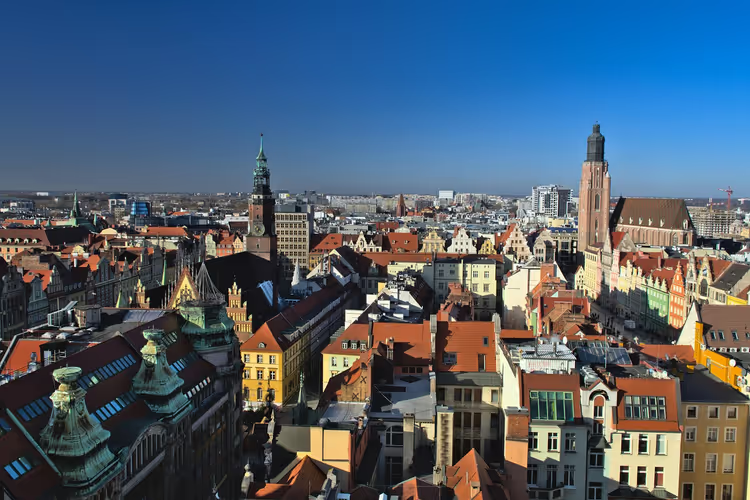
Wrocław sits on dozens of bridges and islands. It's a city where Gothic architecture stands next to concrete modernism, and bronze gnomes wander the streets. It's easy to lose half a day on the Market Square and never make it to the main museums.
We've put together 25 places in Wrocław worth seeing and checked tickets, opening hours, and prices as of 15.09.2026. You'll quickly see what's free to visit, where you need a time slot, and what's better saved for the evening.
Ad: this article contains affiliate links, we earn a commission if you book through them, at no extra cost to you.
What to consider before sightseeing
💡 In short:
- In one day you can realistically cover the Market Square, the Town Hall, and Ostrów Tumski; the zoo and the Racławice Panorama need separate time.
- Wrocław's churches, bridges, and parks are free; paid attractions include the zoo, the Racławice Panorama, Hydropolis, Kolejkowo, and the Sky Tower observation deck.
- Book Africarium and Racławice Panorama tickets online: on weekends the ticket office becomes a bottleneck.
- Prices and opening hours: 15.09.2026, verified on the official zoo website and the Panorama Racławicka page.
1. City Town Hall
 © Jg44.89 · CC BY-SAPhoto: Jg44.89, CC BY-SA (https://creativecommons.org/licenses/by-sa/4.0), Wikimedia Commons
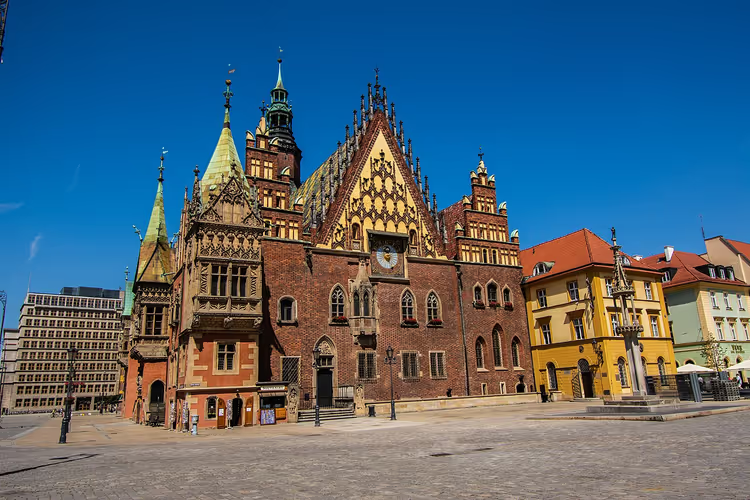
The Town Hall on the Market Square is the city's most recognizable symbol. The building was constructed in the early Gothic style starting in the 13th century, and in 1945 it was almost completely destroyed. The Poles restored its original appearance, preserving the pointed towers and the delicate metal tracery on the central facade.
Take a look at the clocks. On the southern facade under the pediment there's an astronomical clock, and on the tall tower on the eastern side there's a mechanical one with chimes. During the day the square is crowded, so if you want photos without people, come before 9 a.m.
- How to get there: Market Square, about a 5-minute walk from the "Rynek" tram stop (see map).
- Cost: viewing the facade and the square is free; entry to the museum inside the Town Hall is paid.
- Who it's for / Not for: for a first introduction to the city and lovers of Gothic architecture; not suitable during the day if you want quiet and uncrowded photos.
- The catch: on weekends you can't cross the Market Square without running into tour groups.
2. Royal Palace
 © Fred Romero from Paris, France · CC BYPhoto: Fred Romero from Paris, France, CC BY (https://creativecommons.org/licenses/by/2.0), Wikimedia Commons
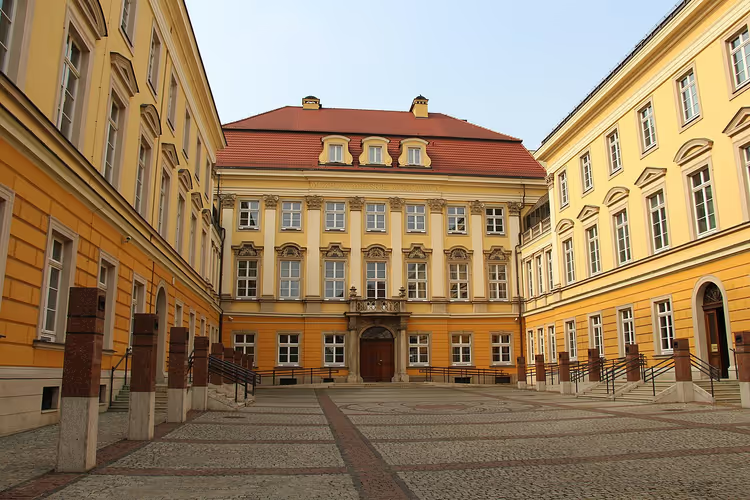
The Royal Palace was built in 1717 for the Prussian king in the Venetian style that was fashionable at the time. Later, Frederick the Great bought the building and commissioned his court architect to expand it, adding Baroque elements on the outside and Rococo on the inside.
The royal reception halls and private chambers were lavishly decorated. In 1795, architect Langhans added a new staircase and wings, and in 1846 the palace was remodeled in the spirit of the Florentine Renaissance.
In 1926, when the palace passed to the city, the Palace Museum opened here with an exhibition about Frederick the Great. After the destruction of 1945, part of the building was dismantled, and the surviving rooms housed the archaeological and ethnographic museums.
A major renovation began in 2004 and took four years. Since 2008, the palace has housed a museum dedicated to the history of Wrocław. A separate reason to step into the courtyard: a fountain with statues of Polish kings, framed by sculpted lawn greenery.
- How to get there: a stone's throw from the Market Square, next to Kazimierza Wielkiego Street (see map).
- Cost: museum admission is paid; check prices and hours on the museum's official website.
- Who it's for / Not for: for the history of Silesia and Baroque interiors; ten minutes is enough for a quick look at the facade.
- The catch: some halls are periodically closed for exhibition changes.
3. Wrocław Cathedral
 © Strumyczek · CC BY-SAPhoto: Strumyczek, CC BY-SA (https://creativecommons.org/licenses/by-sa/4.0), Wikimedia Commons
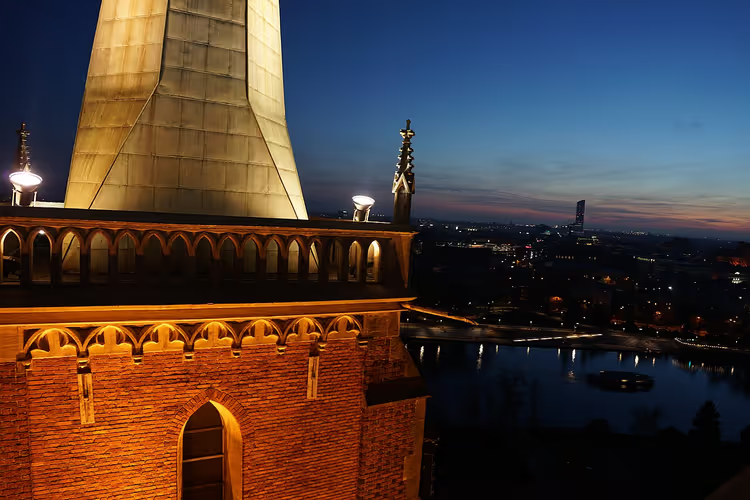
The two hundred-meter Gothic spires of Wrocław Cathedral are visible from the other bank of the Oder. Construction began in 1272, and it's considered the first Gothic cathedral in Poland. Its official name is the Cathedral of St. John the Baptist, the patron saint of the city and all of Lower Silesia.
The cathedral was heavily damaged in World War II but was carefully restored. Restorers recreated the Baroque interiors and made stained glass windows that are considered works of art in their own right.
Inside, chapels from the 14th to 16th centuries survive with wall panels and decorations. The central hall with its white marble altar and statues of saints looks especially ornate. The organ was installed in 1913 and for a time was the largest church organ in Poland.
- How to get there: Katedralna Street on Ostrów Tumski, about a 15-minute walk from the Market Square (see map).
- Cost: entry is free; climbing the cathedral towers is paid.
- Who it's for / Not for: for climbing the observation deck and organ music; allow just half an hour for a quick visit.
- The catch: during services, tourist access is restricted.
4. Zoo
 © Beata Zdyb · CC BY-SAPhoto: Beata Zdyb, CC BY-SA (https://creativecommons.org/licenses/by-sa/3.0/pl/deed.en), Wikimedia Commons
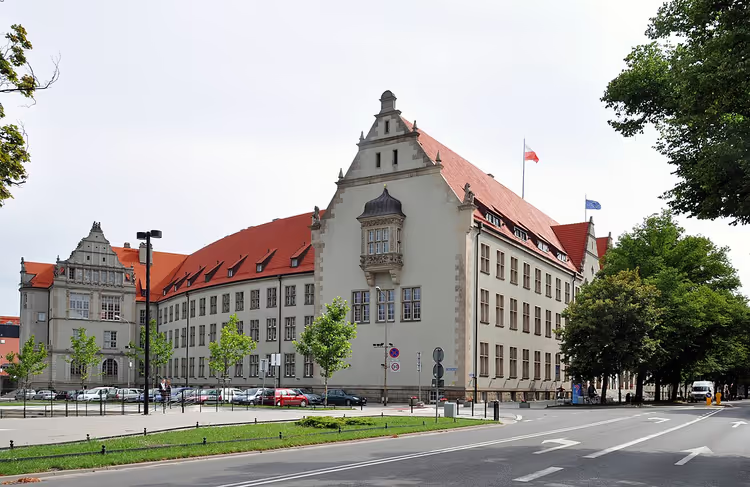
Wrocław Zoo opened in 1865, when the city was still called Breslau. It's one of the oldest zoos in Poland, and it's not small: the grounds cover more than thirty hectares. Today it's home to more than 12,000 animals (according to ZOO Wrocław, 09/2026).
The main attraction, Africarium, is a huge oceanarium with sharks, rays, and marine life. It's included in the single ticket, but entry works on timed sessions. Rare animals and birds live here in different types of ecosystems, not just in cages.
Address: ul. Wróblewskiego 1-5. The advice is simple: come at opening time. The zoo is large, you can't cover it in a couple of hours, and by midday a line forms at the entrance.
- How to get there: by tram from the center to the zoo stop, about 20 minutes (see map).
- Cost: a single ticket that includes Africarium; check prices and hours on the zoo website.
- Who it's for / Not for: for families with children and animal lovers; not suitable for a quick one-hour stroll.
- The catch: in high season there are long lines at the ticket offices and at Africarium.
5. Centennial Hall
 © Jonashtand · CC BY-SAPhoto: Jonashtand, CC BY-SA (https://creativecommons.org/licenses/by-sa/4.0), Wikimedia Commons
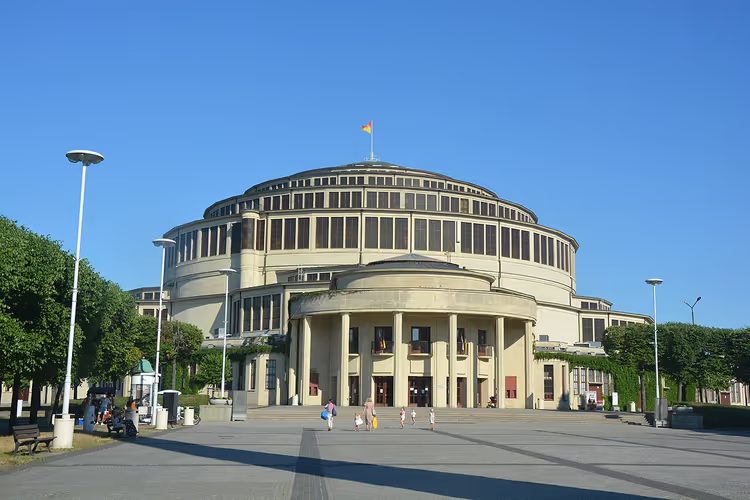
The Centennial Hall was built for the 100th anniversary of the Battle of Leipzig in 1813. The design by Wrocław architect Max Berg was selected at an exhibition in 1907. Since 2006, the building has been on the UNESCO World Heritage List.
The reinforced concrete and glass structure became a round colossus with a dome about forty meters high. The main hall seats six thousand people, with spacious corridors and dozens of exhibition rooms around it. For the grand opening, the world's largest organ was installed here, and it served until 1946.
Address: Park Szczytnicki, ul. Wystawowa 1.
- How to get there: by tram to the stop at Park Szczytnicki, near the fountain (see map).
- Cost: entry to the hall itself is usually with a ticket to an event or a guided tour, check details in advance.
- Who it's for / Not for: for 20th-century architecture and concerts; a casual drop-in may not work out.
- The catch: without an event or a tour, you can't get inside.
6. Racławice Panorama
 © Barbara Maliszewska · CC BY-SAPhoto: Barbara Maliszewska, CC BY-SA (https://creativecommons.org/licenses/by-sa/3.0/pl/deed.en), Wikimedia Commons
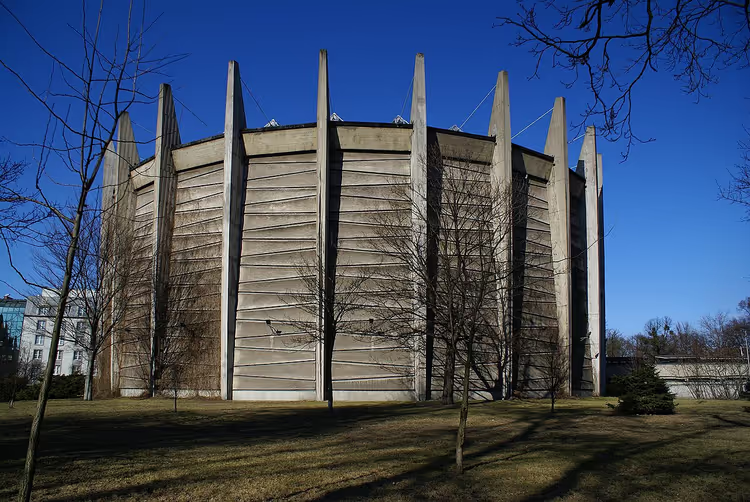
The Racławice Panorama is a huge canvas commemorating the Battle of Racławice in 1794. The painting is over a hundred meters long and up to fifteen meters high. Artists Jan Styka and Wojciech Kossak worked on it for almost a year on Belgian canvas and used hundreds of kilograms of paint.
The canvas was first shown in Lviv in 1894. During the war it was damaged by bombing, and in 1946 it was transferred to Wrocław, where it was kept rolled up for a long time. In 1985, a separate rotunda was built for the panorama, and it became a pilgrimage site for tourists.
One ticket covers four museums at once: the Racławice Panorama itself, the permanent exhibitions of the National Museum, the Ethnographic Museum, and the Four Domes Pavilion, valid for three months (as of 09/2026, official museum page).
- Address: ul. Purkyniego 11, near the Market Square and the Oder embankment (see map).
- Cost: adult ticket 50 zł, reduced 35 zł, family 35 zł per person (as of 09/2026, Panorama Racławicka ticket prices).
- Hours: in summer daily 8:30-19:00, in winter closed on Mondays, other days from 9:30 (as of 09/2026, museum opening hours).
- Who it's for / Not for: for history and painting; for young children, a half-hour session may be too long.
- The catch: the panorama can only be viewed in timed sessions, and in high season tickets sell out in advance.
7. White Stork Synagogue
 © Isabelles Knowledge · CC BY-SAPhoto: Isabelles Knowledge, CC BY-SA (https://creativecommons.org/licenses/by-sa/4.0), Wikimedia Commons
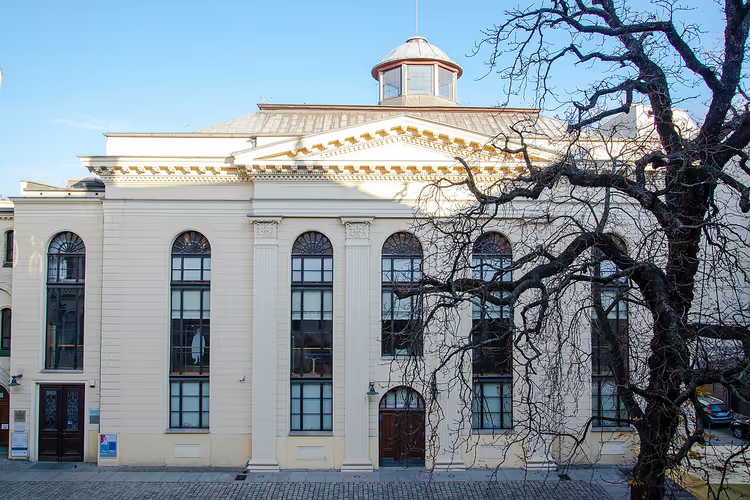
The White Stork Synagogue got its name from a tavern of the same name that once stood on this site. The building was constructed in the 19th century and survived the Holocaust. During the occupation, the Nazis used it as a warehouse for looted goods, and the courtyard served as a departure point for sending Jews to camps.
After the war, the building once again became the center of the Jewish community, and later housed a library and a music academy. Only in 1995 did a private company buy the building and return it to the community. Restoration was completed in 2010, and the only surviving element of the original interior is the intricate wooden carving on the arches.
Today the synagogue hosts prayers, concerts, lectures, exhibitions, and theater performances.
- Address: ul. Włodkowica 7, near the Krupnicze bridges (see map).
- Cost: free entry.
- Who it's for / Not for: for history and concerts; not intended for loud tour groups.
- The catch: during services and rehearsals, free entry is restricted.
8. Cathedral of St. Mary Magdalene
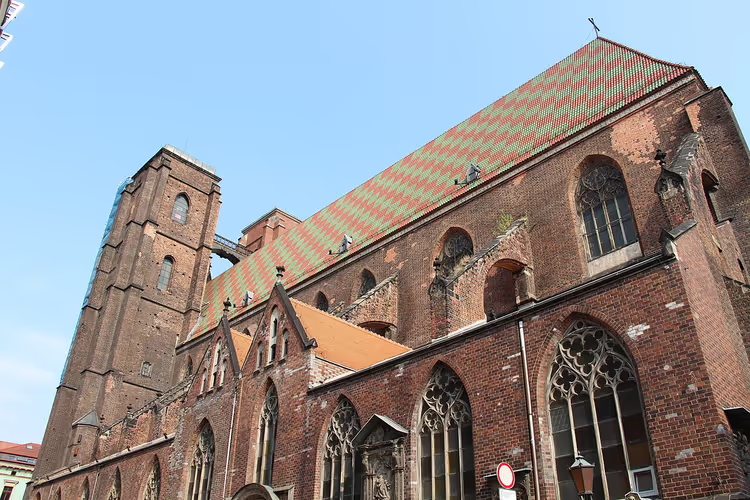 © Fred Romero from Paris, France · CC BYPhoto: Fred Romero from Paris, France, CC BY (https://creativecommons.org/licenses/by/2.0), Wikimedia Commons
The Church of St. Mary Magdalene was built in the 14th century in a strict Gothic style. It is not the first church on this site: the first cathedral was destroyed by the Mongols, and the second burned down in 1342. The current building has served parishioners for seven centuries.
During 20th-century restorations, a 12th-century Romanesque portal from the Ołbin Benedictine monastery was brought here. The holy entrance is decorated with reliefs of griffins, roses, and scenes from Christ's childhood, and it is the church's main relic. Inside, the central hall is free of ornamentation but full of light and calm.
- Address: ul. Oławska 19, near the Market Square (see map).
- Cost: free entry, climbing the cathedral towers costs a small fee.
- Who it's for / Not for: for Gothic architecture and the Romanesque portal; there is little to see inside for a long tour.
- The catch: the interior is modest, and some tourists expect more.
9. Old City Prison
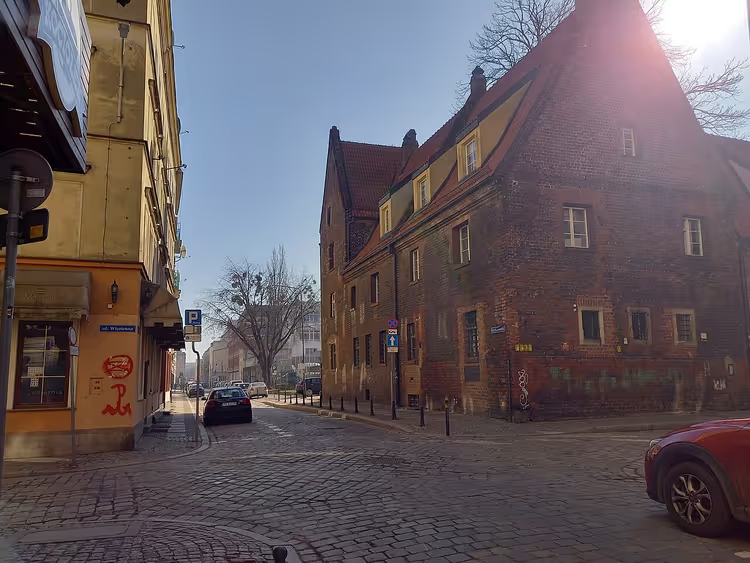 © Joee · CC BY-SAPhoto: Joee, CC BY-SA (https://creativecommons.org/licenses/by-sa/4.0), Wikimedia Commons
In the basement beer hall on the corner of Więzienna and Nożownicza streets, it is easy to miss that you are drinking beer in a former torture chamber. The old prison building was constructed back in the 14th century. It was initially small and square, and by the 17th century it had grown into a rectangle through additions.
Up to a hundred prisoners were held here. Particularly dangerous criminals and those sentenced to death were sent down to underground cells, while noble prisoners were housed on the first floor. After World War II, the prison was closed and given to the institute of archaeology. The old name stuck to the summer cafe in the courtyard, and only the inscriptions carved into the walls remind visitors of the past. Wrocław dwarfs sit peacefully next to them.
- Address: ul. Więzienna 9, near the Market Square (see map).
- Cost: viewing the building from outside is free, the cafe in the courtyard operates on a menu basis.
- Who it's for / Not for: for lovers of urban legends; not suitable for those expecting strict museum interiors.
- The catch: almost nothing of the prison remains except the inscriptions on the walls.
10. "Transition 1977-2005" Sculpture Group
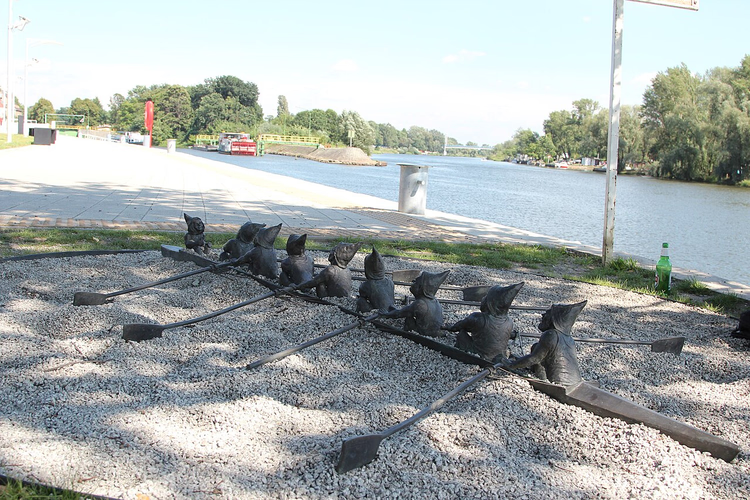 © Fallaner · CC BY-SAPhoto: Fallaner, CC BY-SA (https://creativecommons.org/licenses/by-sa/4.0), Wikimedia Commons
The "Transition 1977-2005" sculpture group originally stood in central Warsaw, but was dismantled in 1981. The composition was restored only twenty-four years later, this time in Wrocław. It is a monument to the victims of martial law.
The composition consists of two parts, with seven human figures in each. Some figures descend underground, while others emerge from it. The first part commemorates those who disappeared without a trace, the second those who fought and defeated the regime. The location was not chosen by chance: this is where the largest demonstrations and rallies took place.
- Getting there: in the city center, within walking distance of the Market Square (see map).
- Cost: free, it is an open-air city sculpture.
- Who it's for / Not for: for understanding Poland's recent history; not the most advantageous spot for photogenic views.
- The catch: without context, the meaning of the figures is unclear; a brief explanation is needed.
11. Church of St. Elizabeth
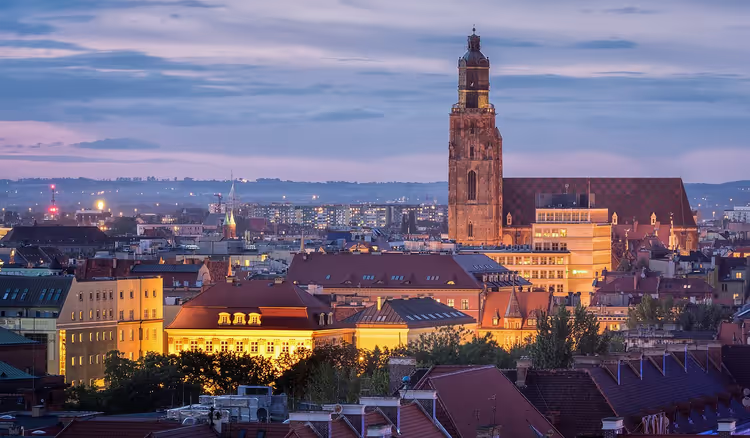 © Jar.ciurus · CC BY-SAPhoto: Jar.ciurus, CC BY-SA (https://creativecommons.org/licenses/by-sa/3.0/pl/deed.en), Wikimedia Commons
The Church of St. Elizabeth stands on the Market Square and was built in the 14th century. Over the centuries, the building survived several fires, with the tower and spire suffering the most, and they still stand out noticeably against the rest of the structure. In the 16th century, a strong hurricane destroyed the tower, which was later rebuilt.
The church is considered one of the finest examples of Gothic architecture in Europe. The bell tower, about ninety meters high, has a small observation deck. From here you can see the entire city, and in clear weather, the mountains on the horizon. A narrow spiral staircase inside the tower leads to the top. The interiors are decorated with elegant stained glass windows.
- Getting there: Market Square, entrance from the square side (see map).
- Cost: free entry, climbing to the observation deck is paid.
- Who it's for / Not for: for a panoramic view of the city from above; for a quiet visit, go early in the morning.
- The catch: the narrow spiral staircase is not suitable for people with claustrophobia.
12. Jaś and Małgosia Houses
 © Jg44.89 · CC BY-SAPhoto: Jg44.89, CC BY-SA (https://creativecommons.org/licenses/by-sa/4.0), Wikimedia Commons
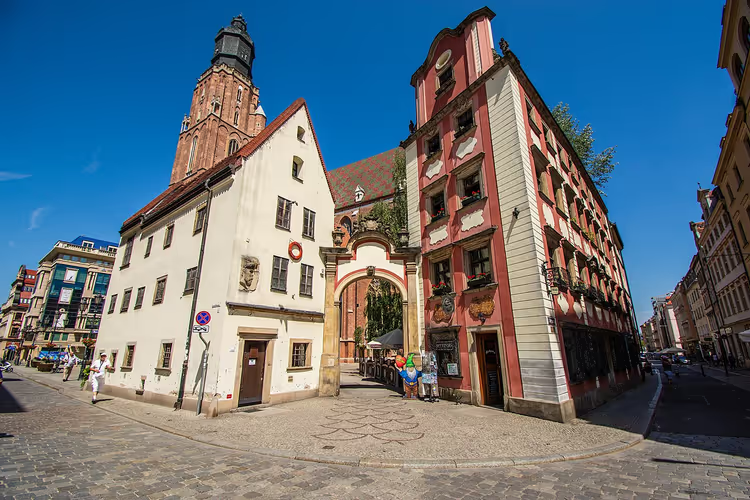
Next to the Church of St. Elizabeth stand two houses named after characters from a folk tale, the equivalent of which is known as "Hansel and Gretel" by the Brothers Grimm. The Jaś and Małgosia houses are all that remains of the medieval quarter where artisans, bell ringers, and merchants lived.
The buildings stand at an angle to each other and are painted in restrained tones: one in cream-white, the other in pink-white. They are connected by an arch that leads to the church. Today it is one of the most photographed spots in the city, and the quarter itself is described in almost every guidebook.
- Getting there: corner of the Market Square, next to the Church of St. Elizabeth (see map).
- Cost: free.
- Who it's for / Not for: for a short stop and photos; there is no space inside for a long visit.
- The catch: the area is tiny, and there is almost always someone taking photos here.
13. Wrocław Opera
 © Diego Delso · CC BY-SAPhoto: Diego Delso, CC BY-SA (https://creativecommons.org/licenses/by-sa/4.0), Wikimedia Commons
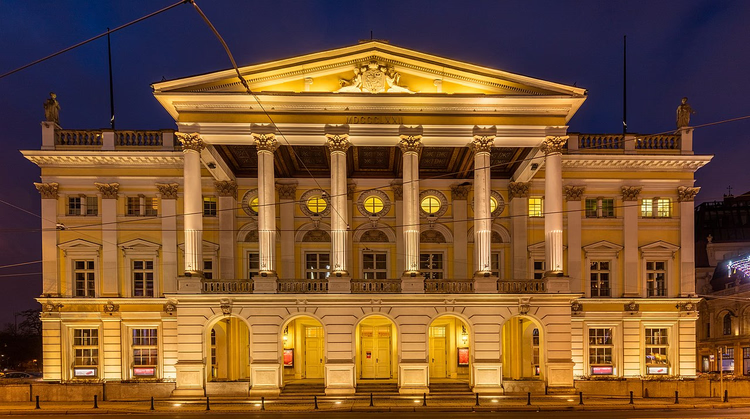
The Wrocław Opera was built in the 19th century by Carl Ferdinand Langhans. The classicist building is recognized as a historic architectural monument. At the end of the 20th century, the opera was flooded, but the building was quickly restored.
The repertoire is broad: opera and ballet from different eras and styles, including works by Mozart and Prokofiev. Sometimes productions are taken to city venues: parks, squares, and the National Museum. Ticket prices vary, from inexpensive balcony seats to the upper price range in the orchestra section.
- Getting there: in the center, about a 10-minute walk from the Market Square (see map).
- Cost: prices depend on the seat; check current tickets on the opera's official website.
- Who it's for / Not for: for an evening of opera or ballet; you cannot just drop in without a ticket.
- The catch: tickets for popular productions sell out in advance.
14. National Forum of Music
 © Łukasz Rajchert · CC BY-SAPhoto: Łukasz Rajchert, CC BY-SA (https://creativecommons.org/licenses/by-sa/4.0), Wikimedia Commons
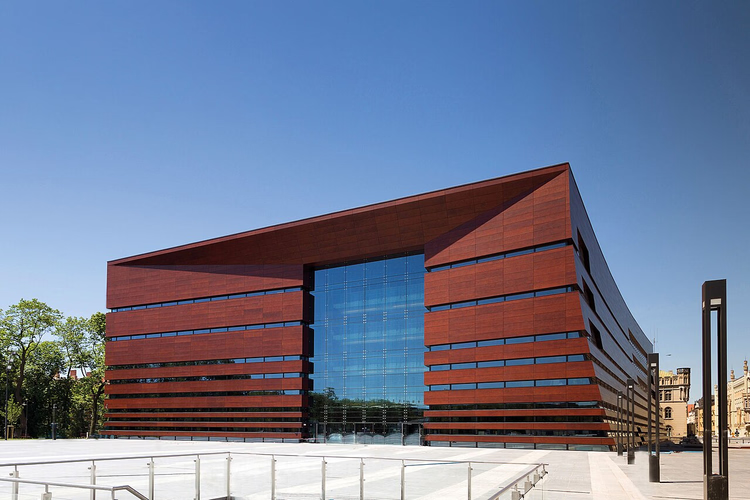
The National Forum of Music is a modern cultural institution and one of the largest music centers in Europe. Inside there is a recording studio, conference rooms, a library, offices, rehearsal spaces, and several concert halls with a total capacity of several thousand seats.
The Forum oversees the activities of a dozen musical ensembles in the city. Major international festivals are held here. Tickets for these and for regular concerts are sold at box offices and on the official website, where the full repertoire is also published.
- Getting there: in the center, a few minutes from the Market Square (see map).
- Cost: concerts are ticketed; prices and the schedule are on the Forum's official website.
- Who it's for / Not for: for classical music and modern halls; it is noisy during the day from rehearsals if you want quiet.
- The catch: during festival days, the halls are full and tickets are harder to get.
15. National Museum
 © Jar.ciurus · CC BY-SAPhoto: Jar.ciurus, CC BY-SA (https://creativecommons.org/licenses/by-sa/3.0/pl/deed.en), Wikimedia Commons
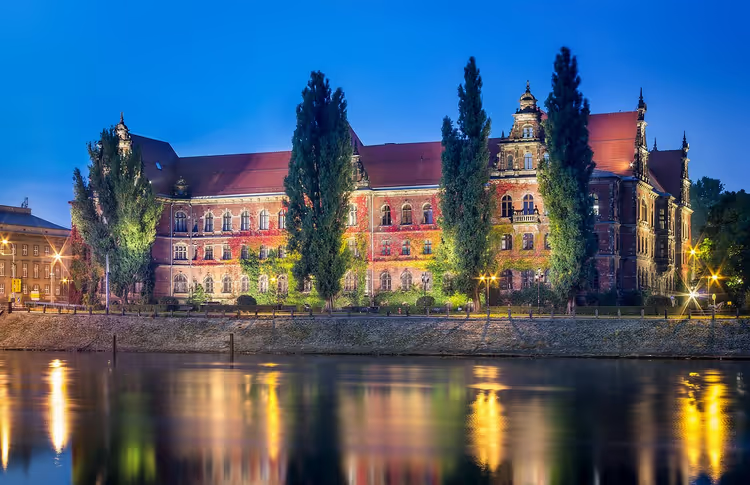
The National Museum is one of the city's main museums. The building was constructed in the 19th century and resembles traditional German art museums. The collection consists mainly of paintings and sculptures by local artists.
The first floor is dedicated to religious themes. Upstairs you'll find statues, paintings from the 13th to 17th centuries, jewelry, sarcophagi, and hand-carved furniture. The building itself is almost entirely covered in climbing plants, so from a distance it looks like it's been abandoned for centuries.
- Getting there: by the Oder River, next to the Racławice Panorama rotunda (see map).
- Cost: ticketed entry, included in the Racławice Panorama combined ticket (as of 09/2026, Racławice Panorama tickets).
- Who it's for / Not for: for Silesian painting and sculpture; the museum is a bit large for a quick half-hour visit.
- The catch: some halls are periodically closed for exhibition changes.
16. Kolejkowo
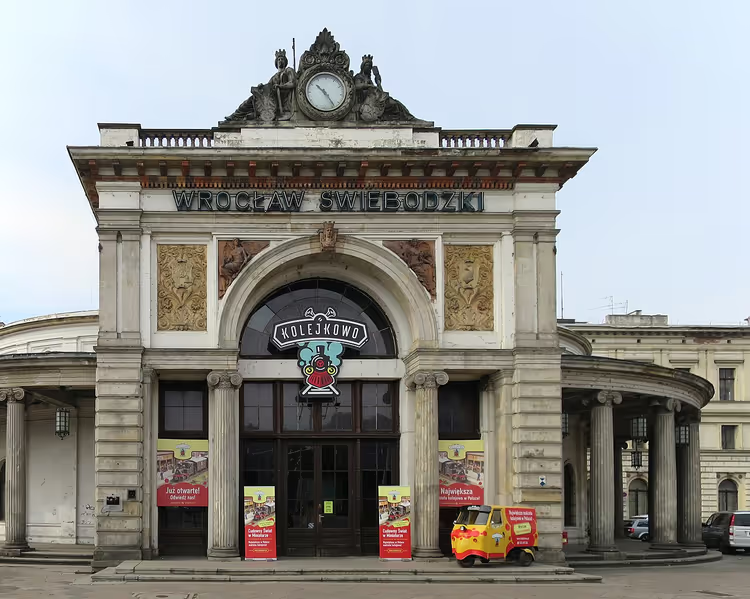 © Travelarz · CC BY-SAPhoto: Travelarz, CC BY-SA (https://creativecommons.org/licenses/by-sa/3.0/pl/deed.en), Wikimedia Commons
Kolejkowo is the largest urban railway model in Poland. It's housed in an old train station building near the Market Square. The total track length is several hundred meters, with dozens of trains and cars running along them.
Besides trains, the model features over a thousand figurines of people. They aren't placed randomly but act out entire scenes: a wedding, a local band performing, workers at a bar after their shift. Everything is so detailed that you can see food on the wedding tables and prices on vegetables at the local market.
- Getting there: city center, within walking distance of the Market Square (see map).
- Cost: ticketed entry, prices and opening hours on the museum's official website.
- Who it's for / Not for: for families with children and miniature enthusiasts; it's a meditative place, not for quick adult tours.
- The catch: school groups come on weekends, and it gets noisy.
17. Hydropolis
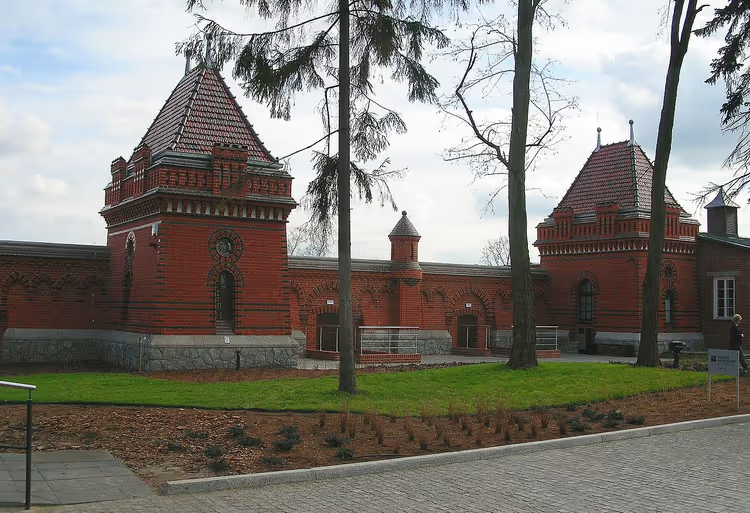 © Robert Niedźwiedzki · CC BY-SAPhoto: Robert Niedźwiedzki, CC BY-SA (https://creativecommons.org/licenses/by-sa/4.0), Wikimedia Commons
Hydropolis is a modern interactive museum set up in a former drinking water reservoir. Here you can learn almost everything about water. Lecture halls with projectors and multimedia labs host workshops and water experiments.
The museum's particular pride is an exact replica of the bathyscaphe Trieste, which made a record dive into the Mariana Trench in 1960. Nearby are models of unusual ocean creatures and an example of ancient marine engineering, the Greek ship Syracusia. The museum is open daily, with longer hours on weekends than on weekdays.
- Address: ul. Na Grobli 17, by the Oder River (see map).
- Cost: ticketed entry, discounted and family tickets available; prices and hours at bilety.hydropolis.pl.
- Who it's for / Not for: for families with children and science lovers; weekends aren't the best days for a quiet visit.
- The catch: on rainy weekends the interactive halls are overcrowded.
18. University of Wrocław
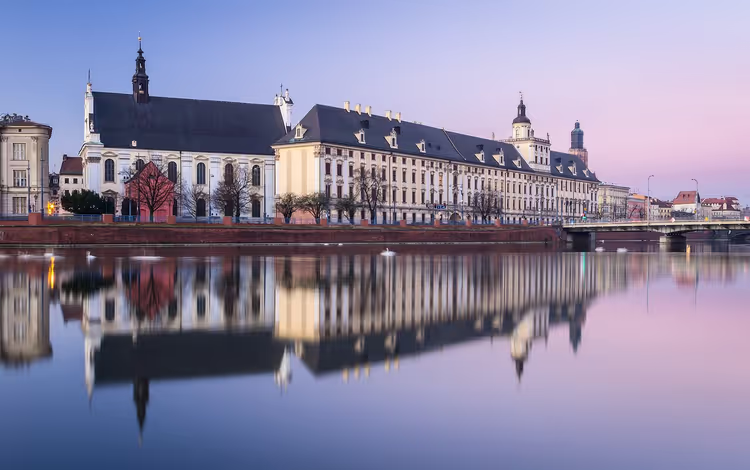 © Jar.ciurus · CC BY-SAPhoto: Jar.ciurus, CC BY-SA (https://creativecommons.org/licenses/by-sa/3.0/pl/deed.en), Wikimedia Commons
The University of Wrocław opened in 1702, and in 1945-1946 it was reorganized and granted state status. The first attempts to establish a higher school here date back to the early 16th century: King Vladislaus II of Hungary signed a decree founding a university. Due to constant wars, the idea was abandoned at the time.
In 1638 a school opened in Wrocław, and on its basis the Leopoldina University was created in 1702, named after Holy Roman Emperor Leopold I. Today more than thirty thousand students study here, and alumni include singer Anna German and director Stanisław Lenartowicz.
- Getting there: in the center, a few minutes from the Market Square (see map).
- Cost: visiting the main building is free, some historic halls require a ticket.
- Who it's for / Not for: for architecture and the history of education; there's enough to see for a quick stopover visit.
- The catch: during the academic year some rooms are closed to visitors.
19. Railway station
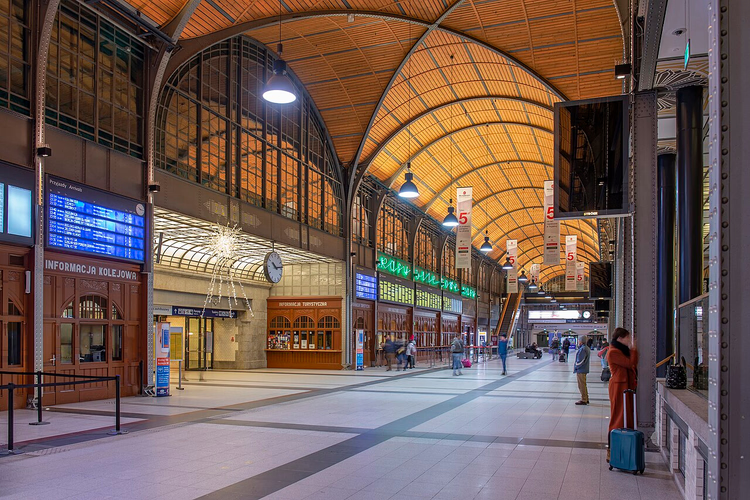 © Marek Śliwecki · CC BY-SAPhoto: Marek Śliwecki, CC BY-SA (https://creativecommons.org/licenses/by-sa/4.0), Wikimedia Commons
Wrocław's main railway station (Wrocław Główny) was built in 1857, when the city was still part of Prussia. The first expansion took place at the turn of the 20th century and was completed in 1904.
During World War II the building was severely damaged, and warehouses and shelters were built under the station square. After the war the station was repaired, and a space for a small cinema was added. A major renovation took place a few years ago: the number of platforms increased, and the shelters were converted into a parking garage.
- Getting there: from the Market Square by tram or about 25 minutes on foot (see map).
- Cost: free entry to the building.
- Who it's for / Not for: for transit and fans of station architecture; there's not much to see for a dedicated excursion.
- The catch: the station is large, and it's a long walk with luggage to the far platforms.
20. Sky Tower
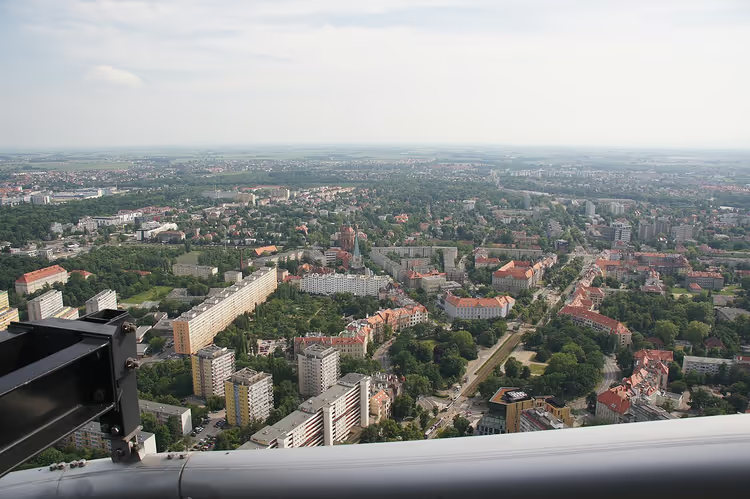 © Barbara Maliszewska · CC BY-SAPhoto: Barbara Maliszewska, CC BY-SA (https://creativecommons.org/licenses/by-sa/3.0/pl/deed.en), Wikimedia Commons
Sky Tower is the tallest building in the city and the third tallest in Poland, built in 2012. The complex consists of three buildings: the first houses galleries and an entertainment center, while the other two contain apartments and offices.
On the top level there's the highest observation deck in Poland with panoramic views of the city. Book your ticket online in advance; the price depends on the time slot, with details on the official website.
- Getting there: southern part of the center, next to a large shopping gallery (see map).
- Cost: observation deck ticket is paid, check the price on the official Sky Tower website.
- Who it's for / Not for: for city panoramas and sunsets; not suitable for those afraid of heights and glass elevators.
- The catch: visibility is limited in cloudy weather, check the forecast in advance.
21. Grunwald Bridge
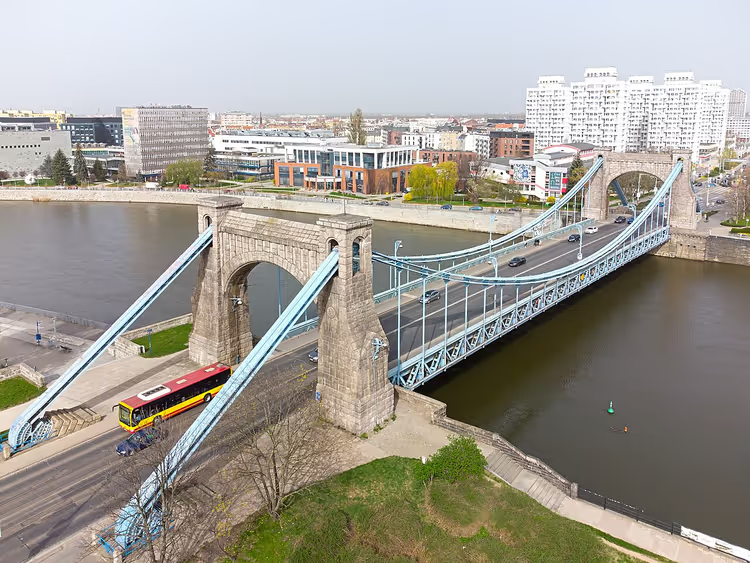 © Emptywords · CC BY-SAPhoto: Emptywords, CC BY-SA (https://creativecommons.org/licenses/by-sa/4.0), Wikimedia Commons
Grunwald Bridge is one of the longest bridges in Poland, over a hundred meters long. It was built in 1910, and Emperor Wilhelm II personally attended the grand opening. Over the years the bridge has been named the Imperial Bridge and the Freedom Bridge.
It offers a wide view of the Oder and the city embankments.
- Getting there: about 15 minutes on foot from the Market Square (see map).
- Cost: free.
- Who it's for / Not for: for a stroll and river views; it's noisy from traffic for a quiet stop.
- The catch: the bridge carries heavy traffic, and the pedestrian section is narrow.
22. Tumski Bridge
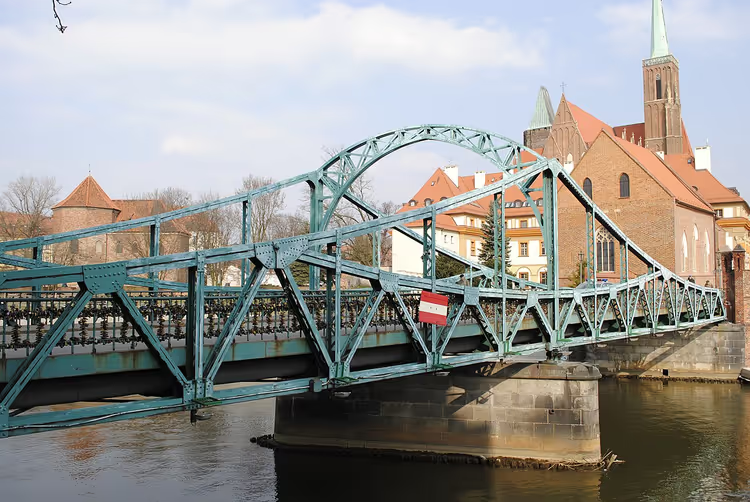 © Daviidos · CC BY-SAPhoto: Daviidos, CC BY-SA (https://creativecommons.org/licenses/by-sa/4.0), Wikimedia Commons
Tumski Bridge leads from the old town to Ostrow Tumski. The island is home to a Catholic church, the university library, and the school of management and law. The pedestrian steel bridge was built in 1889 on the site of an older wooden one.
Statues of Saints Hedwig and John the Baptist stand at the entrance from the old town side. In the evening, gas lamps are lit on the island, and the view becomes especially atmospheric.
- How to get there: about a 15-minute walk from Market Square (see map).
- Cost: free, the bridge is pedestrian-only.
- Who it's for / Not for: for an evening stroll to Ostrow Tumski; not suitable for driving.
- The catch: the bridge is narrow, and at peak hours there is a dense flow of pedestrians.
23. Park Szczytnicki
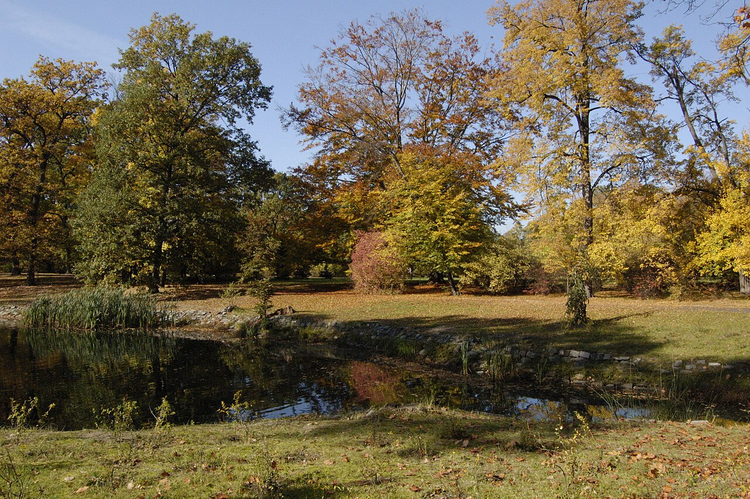 © Jaroslaw Komar · CC BY-SAPhoto: Jaroslaw Komar, CC BY-SA (https://creativecommons.org/licenses/by-sa/3.0), Wikimedia Commons
Park Szczytnicki is one of the largest parks in Wroclaw, covering about one hundred hectares. The park dates back to the 18th century, when residents of the area around the village of Szczytniki began coming here on weekends. In the late 18th century, the commander of the Breslau garrison, F. L. Hohenlohe, bought part of the wooded park and created an English-style park.
In the 19th century, horse races were held here for more than seventy years. The park is home to the wooden Church of St. John of Nepomuk, built in the late 16th and early 17th centuries. The church originally stood in a different location and was moved here only in 1913.
- How to get there: by tram to the stops at the park entrance (see map).
- Cost: free entry.
- Who it's for / Not for: for a long walk and a picnic; the park is too large for a quick 20-minute visit.
- The catch: the grounds are huge, and it's easy to go the wrong way without a map.
24. Ogród Japoński
 © Hanc Tomasz · CC BY-SAPhoto: Hanc Tomasz, CC BY-SA (https://creativecommons.org/licenses/by-sa/3.0), Wikimedia Commons
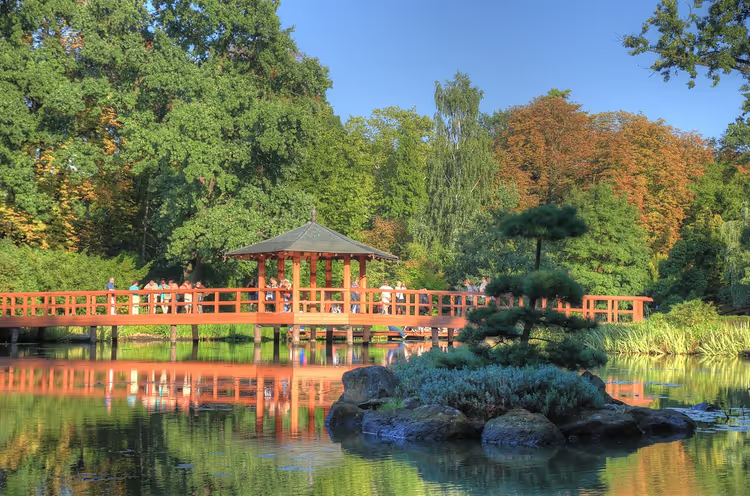
Japanese Garden is part of Park Szczytnicki, created in the early 20th century by Count Fritz von Hochberg. The renowned Japanese gardener Mankichi Arai worked on the project: his approach and the stone fragments brought from Japan defined the garden's style.
The garden was abandoned during World War I and restored only in 1997. Two months later it was severely damaged by a flood, and the new restoration took two years. Today it features several ponds with fish, artificial waterfalls, and Japanese-style pavilions.
- Getting there: inside Park Szczytnicki, separate entrance (see map).
- Cost: paid entry, tickets are bought on site.
- Who it's for / Not for: for a quiet stroll and photos; the space is tight for large groups.
- The catch: in April and May there's a line to see the cherry blossoms.
25. Multimedia Fountain
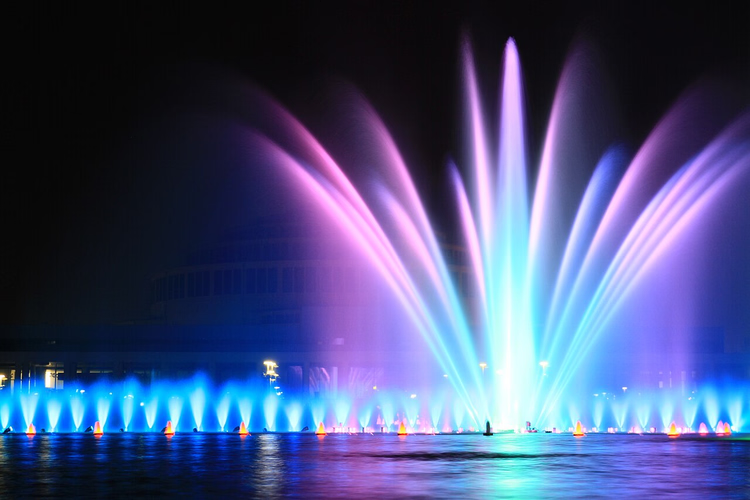
The musical fountain opened in 2009 next to the Centennial Hall in Park Szczytnicki. The basin covers about one hectare, and the fountain itself has several hundred water nozzles. It also features fire jets, numerous light points, a projector, and a laser installation.
In the evening, locals and visitors watch the light and music show. The fountain operates in the warm season from late April. In winter, its basin is used as an open-air ice rink.
- Getting there: next to the Centennial Hall in Park Szczytnicki (see map).
- Cost: the show is free.
- Who it's for / Not for: for the evening show in the warm season; the place is noisy if you want quiet.
- The catch: sessions depend on the weather, and the show is canceled in strong wind.
Wrocław attractions on the map
All 25 points are compactly located: the center, Ostrów Tumski, and Park Szczytnicki to the east. Below is an interactive map where you can zoom in on the area you need and plan a day route. Check distances in advance so you don't waste time getting around.
Ready-made guided tours of Wrocław take care of logistics: you're driven between points and hear the history along the way. For a first visit, this saves time.
Tours and tickets in Wroclaw
Guided tours, skip-the-line tickets and activities — most offers can be cancelled free of charge.
See offers on GetYourGuideThe widget loads once you give your consent.
⁉️🤔 Frequently asked questions
How many days do you need for Wrocław?
Two days are enough for the main sights. On the first day, walk around the Market Square, the Town Hall, Ostrów Tumski, and both bridges. On the second, visit the zoo, the Racławice Panorama, and Park Szczytnicki with the fountain. If you have less time, choose the center and one paid attraction.
What can you see in Wrocław for free?
The Market Square, both bridges, Park Szczytnicki, the Multimedia Fountain, and the White Stork Synagogue are free. You can view the Town Hall and cathedrals from outside without a ticket. You'll need to pay for museums, the zoo, Hydropolis, Kolejkowo, and observation decks.
How do you buy tickets to the Racławice Panorama and the zoo?
Online in advance. A Panorama ticket costs 50 zł, reduced 35 zł (as of 09/2026, Panorama Racławicka prices). For the zoo, book a morning slot: in the afternoon and on weekends a line forms at the entrance.
Where do you look for Wrocław's dwarfs?
All over the center. Bronze figurines hide near the Town Hall, on Więzienna Street next to the former prison, and by St. Elizabeth's Church. There are several hundred of them in total, and there's no single map, so people search for dwarfs on foot, examining walls and building corners.
What to see in Wrocław with kids?
The zoo with the Africarium, Kolejkowo with its model railway, and Hydropolis with hands-on experiments. All three are interactive and take time: allow at least two to three hours for each. Between them, it's easy to walk in Park Szczytnicki.
In short: what's worth booking
If you have one day, get a ticket to the Racławice Panorama and don't miss the Market Square. If you're traveling with kids, start with the Africarium, then Kolejkowo. If you want the city from above, plan the Sky Tower observation deck for sunset.
The matrix is simple. One day: the center, Ostrów Tumski, the bridges. Two days: plus the zoo, the Panorama, and Park Szczytnicki. With kids: Africarium, Kolejkowo, Hydropolis. Book your Racławice Panorama slot, Africarium entry, and Sky Tower observation deck ticket in advance. You can find tours and city tickets conveniently on GetYourGuide.

A small editorial team writing guides for independent travel. We travel ourselves, but we haven’t been everywhere, so we check prices, opening hours and how to get there against official sources.