
















Gate of Europe in Madrid: how the first leaning skyscrapers were built
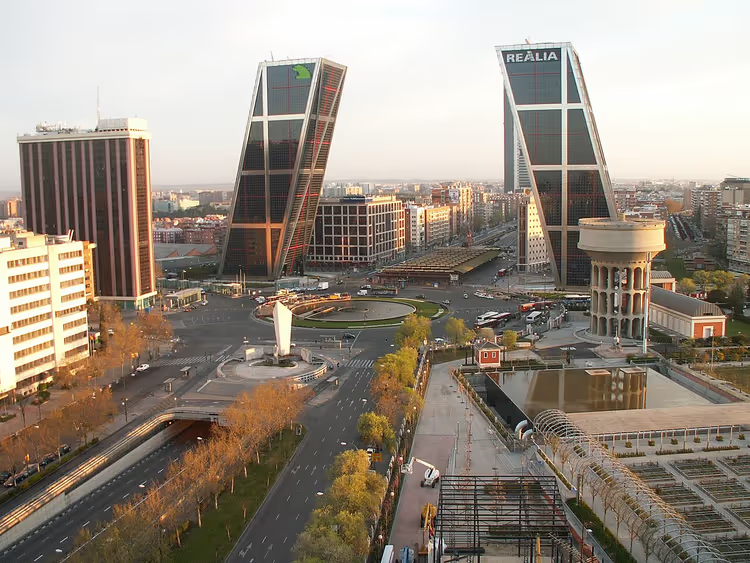
Above Plaza de Castilla, two towers lean toward each other. In Madrid they are called the Gate of Europe (Puerta de Europa) or the KIO towers. Both are considered the world's first leaning skyscrapers.
Tourists are not allowed inside: the entrance and opening hours for visitors are not published. So people come here for the view and photos.
Below you will learn why the towers were tilted, how engineers kept them from falling, what scandal put the project in the news, and how to get there by metro.
Ad: this article contains affiliate links, we earn a commission if you book through them, at no extra cost to you.
What the Gate of Europe is
💡 In short:
- What it is: two leaning office skyscrapers on Plaza de Castilla (as of 09/2026, tower listing on the official Madrid portal).
- Why go: the world's first leaning towers, a 14.3° tilt, free viewing from outside.
- How to get there: Plaza de Castilla or Chamartín metro, plus Cercanías commuter trains.
- Height, tilt, and transport data: as of 09/2026, verified on the official Madrid tourism website.
Construction history
The project was designed by American architects Philip Johnson and John Burgee of the New York firm John Burgee Architects. The client was the Kuwait Investment Office, which is why the towers were quickly nicknamed the KIO towers. Construction ran from 1989 to 1996. Both towers were built in parallel, so the main work was completed almost simultaneously.
The architects wanted to move away from right angles and standard solutions. The novelty lay not in height but in the tilt. Against the backdrop of Madrid's historic buildings, the pair of symmetrical structures looked like a challenge. Locals quickly accepted them as part of the cityscape.
Architectural and structural features
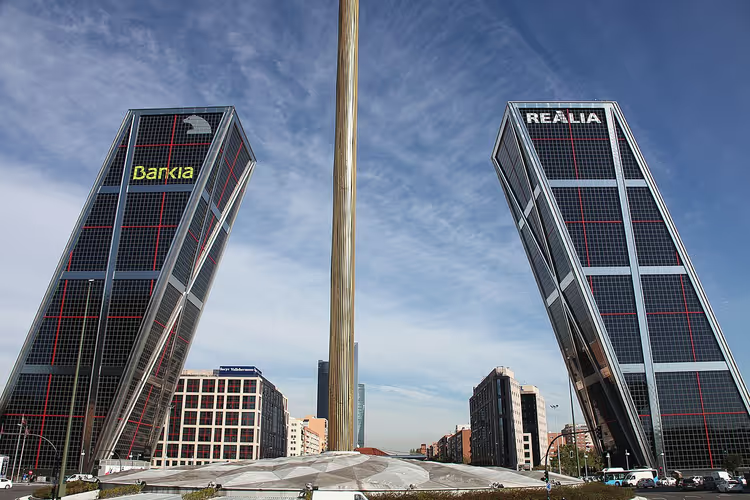
Each tower is 115 meters tall and has 26 floors. The bases are square, 35 meters per side, and the tilt reaches 14.3 degrees (as of 09/2026, tower page on the tourism portal). The upper floors extend beyond the base, so the buildings look unstable, although this is the result of precise calculations. The Leaning Tower of Pisa tilts about 4° and stands about 56 m tall. The Gate of Europe surpasses it in both tilt and height.
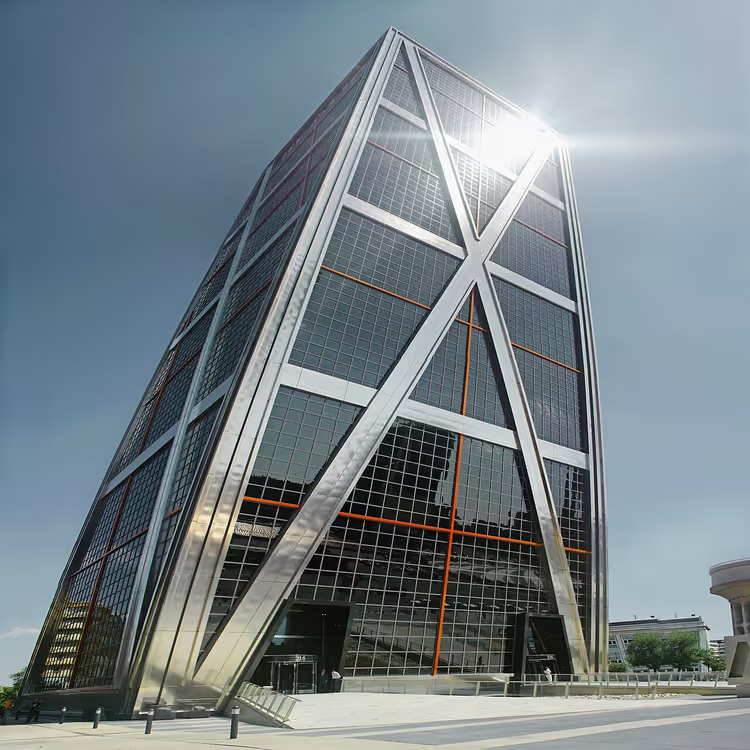
Stability is provided by massive concrete counterweights in the basements. The structural frame consists of heavy steel beams, some of which are exposed on the facade and wrap around the building perimeter. No one has exactly replicated this scheme to date.
 © Rick Ligthelm from Rotterdam, The Netherlands · CC BYPhoto: Rick Ligthelm from Rotterdam, The Netherlands, CC BY (https://creativecommons.org/licenses/by/2.0), Wikimedia Commons
The facades are assembled from glass, aluminum, and stainless steel, with thin red lines showing through the white background. Because of the tilt, each floor differs in area and shape. Eight elevators serve the upper floors, but four of them only go to the 13th floor; above that you need to transfer to another elevator.
Each tower has a helipad on the roof. The western one is outlined with a blue stripe and the eastern one with a red stripe, so pilots do not confuse the landing spots.
What is inside the KIO towers
The towers stand in the northern part of the city and once marked the entrance to Madrid. Over recent decades the capital has expanded far beyond them, so today the towers serve more as a landmark than a boundary. Bright, spacious floors are occupied by offices of various companies.
The plaza by the towers has become popular with artists: installations, openings, and performances take place here.
 © Fred Romero from Paris, France · CC BYPhoto: Fred Romero from Paris, France, CC BY (https://creativecommons.org/licenses/by/2.0), Wikimedia Commons
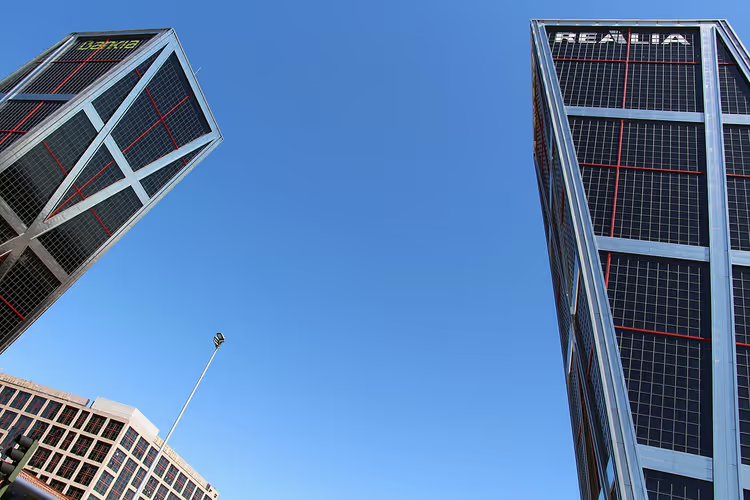
Filmmakers also took notice of the site: even before construction was finished, the black comedy "El día de la bestia" (1995) was filmed here, and later the towers appeared in other films and games. The buildings themselves also received their own names: the left tower is called Puerta de Europa 1, the right one Puerta de Europa 2.
Who owns the twin towers
The complex originally belonged to the Kuwait Investment Office, which financed the construction. After the collapse of the Grupo Torras group, the company was forced to sell the buildings. Today the owners are CaixaBank and Realia.
At the center of a financial scandal
The construction was not without a criminal investigation. Money for the leaning skyscrapers flowed through financier Javier de la Rosa. He was accused of embezzling large sums allocated for construction, and the case went to court. According to investigators, part of the funds belonging to the Kuwait Investment Office was misappropriated. The top manager was sentenced to a long prison term, and other participants in the scheme also became defendants in the high-profile case.
Where they are and how to get there
The towers stand at Paseo de la Castellana, 189-216, right on Plaza de Castilla.
 © Juanedc from Zaragoza, España · CC BYPhoto: Juanedc from Zaragoza, España, CC BY (https://creativecommons.org/licenses/by/2.0), Wikimedia Commons
The easiest way to get there is by metro. Plaza de Castilla station serves lines L1, L9, and L10, while Chamartín station next to the train station serves L1 and L10. You can walk from Madrid-Chamartín station, which is also served by Cercanías commuter trains. Many bus routes, including night buses, go to the plaza. The best place to view the site is from the plaza side: from there you can clearly see the tilt of both towers.
Gate of Europe on the map
The towers are marked on Plaza de Castilla. The map will help you plan a route from your hotel to the site.
⁉️🤔 Frequently asked questions
Where is the Gate of Europe in Madrid and how do you get there?
The towers stand on Plaza de Castilla at Paseo de la Castellana, 189-216, in the northern part of the city. The most convenient way to get there is by metro: Plaza de Castilla station serves lines L1, L9, and L10 (as of 09/2026, metro lines on the Madrid portal). From Madrid-Chamartín station, served by Cercanías commuter trains, you can walk to the towers in a few minutes. The metro is more convenient than a taxi here: traffic on Paseo de la Castellana is heavy at rush hour. The landmark is easy to spot: the two leaning towers are visible from the wide boulevard from far away.
Can you go inside the towers?
No, they are office buildings, not an observation deck. Only employees of the companies are allowed inside, and the entrance and opening hours for visitors are not published. Tourists view the Gate of Europe from outside, from the plaza and Paseo de la Castellana boulevard. The tilt and lighting are visible at any time of day, and viewing is free.
How much do the towers lean?
The deviation from vertical reaches 14.3 degrees; the Leaning Tower of Pisa measures about 4°. The buildings are still stable: they are held by concrete counterweights and a steel frame. The tilt was part of the design from the start, not a construction error.
Who is the architect of the Gate of Europe?
The project was designed by American architects Philip Johnson and John Burgee of the firm John Burgee Architects. The concept was based on rejecting rectangular geometry: the architects wanted a recognizable silhouette.
Tours and tickets in Madrid
Guided tours, skip-the-line tickets and activities — most offers can be cancelled free of charge.
See offers on GetYourGuideThe widget loads once you give your consent.
In short: what to book
You do not need to book a visit to the Gate of Europe: it is a free city attraction, not a museum with tickets. However, it is worth planning transport and accommodation in Madrid in advance. If you want to see the towers with a guide and cover the center, take a Madrid sightseeing tour on GetYourGuide. The rule is simple: if you have half a day, walk along Paseo de la Castellana; if you have a full day, add a city sightseeing tour.

A small editorial team writing guides for independent travel. We travel ourselves, but we haven’t been everywhere, so we check prices, opening hours and how to get there against official sources.