
















Mesa Verde national park: how to get inside the cliff dwellings of Colorado
In the cliffs of southwestern Colorado, real cities are hidden. Spanish colonizers named this plateau "Mesa Verde," meaning "green table." Against the backdrop of scorched mountains, the dense juniper truly looked like an oasis.
Today it is a national park with hundreds of cliff dwellings in sandstone alcoves. Some are visible from overlooks, while others can only be entered with a ranger.
Entry is paid, and the rate depends on the season and type of vehicle (as of 09/2026, official park website).
Ad: this article contains affiliate links, we earn a commission if you book through them, at no extra cost to you.
What Mesa Verde is and why go there
💡 In short:
- The park is open year-round; separate reservations are needed only for tours inside the dwellings.
- Entry costs from 20 to 30 dollars per vehicle.
- Tickets and hours: 09/2026, verified on the official website
Mesa Verde occupies a plateau in southwestern Colorado, between the towns of Cortez and Mancos. Elevation here ranges from 7,000 to 8,500 feet, so the weather changes quickly even in summer (as of 09/2026, park hours page).
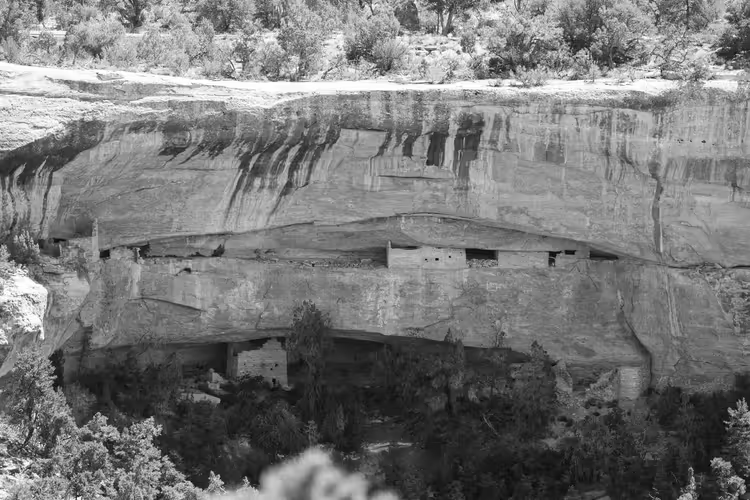
The park's main feature is that it contains not one ruin but entire "multi-story" settlements in cliff alcoves. The walls are built of sandstone blocks with clay mortar. Hand-and-toe holds and yucca ladders led inside.
There are several hundred settlements on the plateau, but only a portion are open for viewing: the rest sit in hard-to-reach alcoves.
History: cowboy Wetherill and the "Ancestral Puebloans"
Europeans began settling the plateau only in the late 19th century. The land was well suited for grazing cattle, which is what cowboy Richard Wetherill did. During a snowstorm, he spotted a fortress with towers on a neighboring cliff that seemed to float in the air.
 © W. Bulach · CC BY-SAPhoto: W. Bulach, CC BY-SA (https://creativecommons.org/licenses/by-sa/4.0), Wikimedia Commons
Returning after the storm passed, Wetherill saw a multi-story building in the cliff with dozens of black windows. With his brothers, he built a ladder and spent a year exploring the area, finding several dozen more abandoned settlements.
He called the people who lived in these houses "Anasazi." In the Navajo language, the word means "ancestors." It later turned out that their descendants were the Pueblo peoples: the Hopi, Taos, Acoma, and Zuni. The ancient inhabitants themselves are now called "Ancestral Puebloans."
Cliff dwellings: how they were built and how people lived
The world learned about the ancient cities from the scientific work of Swedish explorer Gustaf Nordenskiöld. The publication led to trouble: "pot hunters" looted artifacts and destroyed some of the structures. The government then placed the site under protection and created a national park where altering anything is prohibited.
The first people to come here were hunters and gatherers. They lived in pit houses covered with branches and later transitioned to settled agriculture and construction.
In natural cliff alcoves, they built houses with many rooms. Such dwellings protected against the weather: in summer it was not as hot inside, and in winter there was no wind. Sandstone blocks and wooden beams were bonded with clay, and walls were plastered and decorated with ornamentation.

At its peak, several thousand people lived here. On the plateau they grew beans and corn, gathered nuts and berries, and hunted game. Water was always at the bottom of the canyon, and the walk home with a full basket was hard.
Reaching the alcoves from below and above was not easy. In addition to footholds in the rock, the Indians wove ladders from yucca and cut tunnels through the stone.
Household work took place in the courtyards; the rooms were cramped. The spacious round ceremonial chambers are called "kivas," with storage rooms nearby. All of this makes up the cities of the Ancestral Puebloans.
Cliff Palace, Balcony House, and other dwellings
Household work took place in the courtyards; the rooms were cramped. The spacious round ceremonial chambers are called "kivas," with storage rooms nearby. All of this makes up the cities of the Ancestral Puebloans.
 © w_lemay · CC BY-SAPhoto: w_lemay, CC BY-SA (https://creativecommons.org/licenses/by-sa/2.0), Wikimedia Commons
The park's largest dwelling, Cliff Palace, was built between 1190 and 1280, and more than a hundred people lived here (as of 09/2026, NPS tour description). The route takes 45 minutes: you descend uneven steps, climb four ladders, and the elevation change reaches 100 feet.
Balcony House is considered the park's most "athletic" dwelling. On the way out, you climb a 32-foot ladder, crawl on all fours through a tunnel 12 feet long and 18 inches wide, and then scramble up exposed rock. This route is not for those afraid of heights.
On Wetherill Mesa, Long House and Step House are available. Long House is considered the park's second-largest dwelling, and the tour lasts 90 minutes (as of 09/2026, NPS data on Wetherill Mesa). You explore Step House on your own, without a reservation, and rangers nearby answer questions.
Many dwellings are closed to entry: the approach to them is dangerous. That is why you can only go inside with a ranger.
Overlooks and the mystery of the departure
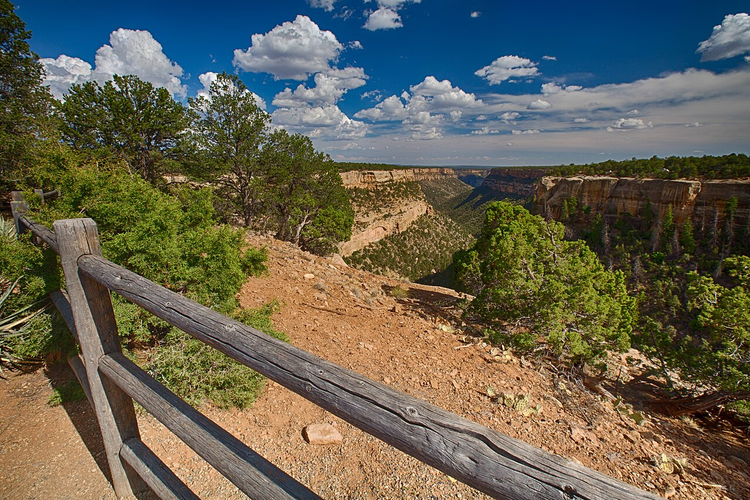
If a tour is not for you, view the cities from above. Cliff Palace is visible from the Sun Temple stop on Mesa Top Loop, and Spruce Tree House from the overlook near the museum (as of 09/2026, NPS on overlooks). From the rim, the old houses look like toys.
 © Will Thomas · CC BY-SAPhoto: Will Thomas, CC BY-SA (https://creativecommons.org/licenses/by-sa/3.0), Wikimedia Commons
What is striking is something else: all of this was built by people who did not know metal. Their tools were made of wood, bone, and stone, and they cut beams for ceilings with stone axes.
Why the Puebloans left here is not known for certain. According to one theory, the plateau was abandoned due to a prolonged drought; according to another, due to raids. There is no evidence for either theory.
Today the park is listed as a UNESCO World Heritage Site. This protects both the dwellings and the landscape around them.
Tickets and hours (2026)
The park is open year-round, and no entrance reservation is needed (as of 09/2026, park hours). Payment is by card only; cash is not accepted at the entrance (as of 09/2026, payment rules).
Entrance | Price | Period |
|---|---|---|
Car | $30 | May 1 - October 22 |
Car | $20 | October 23 - April 30 |
Motorcycle | $25 | May 1 - October 22 |
On foot or by bicycle | $15 | Year-round |
As of 09/2026, fees on the park website. The ticket is valid for seven days. There is an annual pass for $55 and the federal America the Beautiful pass, which also covers entry to other US parks.
In 2026, the museum is open daily: from May 4 through October 21, 8:30 AM to 4:30 PM, and in spring and late fall until 3:00 PM (as of 09/2026, museum hours). It is closed on Thanksgiving, Christmas, and New Year's Day.
The road to Wetherill Mesa is open from May 22 through October 21, with the last entry at 2:00 PM (as of 09/2026, Wetherill Mesa hours).
If you want to go inside a dwelling, you need a ranger-led tour. Reservations open on recreation.gov 14 days in advance, and spots go quickly (as of 09/2026, tour reservations). If you want a ready-made trip, day tours of the park on GetYourGuide are a good option.
Tours and tickets in Mesa Verde
Guided tours, skip-the-line tickets and activities — most offers can be cancelled free of charge.
See offers on GetYourGuideThe widget loads once you give your consent.
How to get there and what is closed in winter
The park is in southwestern Colorado. The nearest airports with car rental are Cortez (CEZ) and Durango (DRO), and there is a parking lot and entrance station at the park gate.
The roads inside are long: some dwellings take 55 to 90 minutes to reach by car, plus the walking portion (as of 09/2026, travel times per the NPS). Plan for at least half a day in the park, ideally a full day.
In winter, the overlooks and the museum are open. Far View Lodge, the campground at Morefield, and most cafes close for the season (as of 09/2026, park winter schedule).
Mesa Verde National Park on the map
Below is a map of the park: it is handy for planning a route between the overlooks and the dwellings.
⁉️🤔 Frequently asked questions
How much does entrance to Mesa Verde National Park cost?
A car costs $30 from May 1 through October 22 and $20 from October 23 through April 30. The ticket covers all passengers. Pedestrians and cyclists pay $15, and an annual pass is available for $55. Card payment only (as of 09/2026, current rates).
Can you go inside the cliff dwellings?
All dwellings can only be entered on a ranger-led tour, with the exception of Step House on Wetherill Mesa. Reservations open on recreation.gov 14 days before the date, and spots sell out quickly. In 2026, the tour season runs from May 4 through October 21 (as of 09/2026, dwelling visit rules).
Which tour is harder, Balcony House or Cliff Palace?
Balcony House is harder: on the way out you face a tall ladder, a narrow tunnel, and an exposed cliff. Cliff Palace is easier: a descent down steps, four ladders, and a 30 m elevation change over 45 minutes (as of 09/2026, route difficulty).
When is the best time to visit Mesa Verde?
Summer has the largest crowds, and the weather is changeable: heat, downpours, and strong winds are possible. Fall is quieter and cooler, with tours running through October 21. In winter, only the overlooks and the museum are open (as of 09/2026, NPS on seasons).
What should you see if you don't have time for a tour?
Stop at the Mesa Top Loop overlooks and the museum. From there you can see the cliff dwellings without spending time on the climb. A couple of hours is enough to see the overlooks (as of 09/2026, list of overlooks).
In short: what to book
Mesa Verde is easy to see in one day, but tours inside the dwellings need to be booked in advance. If you want to see Cliff Palace with a ranger, grab a spot on recreation.gov two weeks ahead.
If you have one day: see Cliff Palace and Spruce Tree House from the overlooks, and spend the rest of your time along Mesa Top Loop.
If you're up for ladders: choose Balcony House or Long House, they give you the most intense experience.
If you're traveling with kids and want an easy route: take Step House without a reservation plus the overlooks.
If you prefer a ready-made itinerary, it's worth comparing tours on GetYourGuide.

A small editorial team writing guides for independent travel. We travel ourselves, but we haven’t been everywhere, so we check prices, opening hours and how to get there against official sources.