

















Best eSIM for Israel in 2026: plans and networks compared
How much does mobile data cost in Israel in autumn 2026? The spread is wide: 1 GB for 3 days from Airalo costs 4 USD, while a week of unlimited data from Holafly comes to 27.50 USD (as of 09/2026, Airalo plans, Holafly's weekly unlimited plan). The price of internet on a trip can differ several times over.
Most European carriers charge a lot for roaming in Israel, and a local SIM is only sold in a carrier store once you have landed. An eSIM solves this ahead of time: you pick a plan online, install the profile at home and get online right after touchdown. From there, three questions matter: how many days you are in the country, whether you need calls, and which network the plan runs on.
We compared six providers and converted all prices to US dollars. Below you will find plans for three scenarios: a trip of a few days, a week, and two weeks or longer. We also look separately at the Partner, Cellcom, Pelephone and HOT Mobile networks and at coverage where the signal is weakest: in Eilat, at the Dead Sea and in the Negev.
Ad: this article contains affiliate links, we earn a commission from them, and the price for you stays the same.
Which eSIM to choose for Israel in 2026
💡 In short:
- Check that your phone is unlocked and supports eSIM, otherwise the plan will not install.
- For a few days, take a 1 GB plan: at Airalo it costs 4 USD for 3 days.
- For a week with calls, SIM to Israel fits: 150 GB for 25 USD for 7 days.
- For two weeks and longer, plans of 20 GB and more at around 1 USD per gigabyte are better value.
- Prices and validity: 09/2026, checked on the Airalo website, in the SimOptions catalogue and on the SIM to Israel plans page.
The main takeaway from the comparison is simple. In 2026, fixed-data plans are the cheapest way to get online in Israel, and unlimited almost always means overpaying. A 20 GB plan for 30 days from Airalo costs 16.50 USD, which is about 0.83 USD per gigabyte (as of 09/2026, Airalo data-only plans). Unlimited data for 7 days from the same provider costs 26.50 USD.
If you need calls, the picture changes. SIM to Israel sells a single 150 GB plan with unlimited calls and SMS within Israel, calls to the US and Canada, and a US or Canadian number; a week costs 25 USD, a month 45 USD (as of 09/2026, SIM to Israel plans). For a family trip with tethering, this is the largest data allowance in the comparison.
Choose your plan in this order. First, count your days in the country. Then decide whether you need a number for calls or whether messaging apps will do. Only after that should you compare brands: some have a cheaper gigabyte, others are clearer about the network and tethering terms.
Factor in your route within the country as well. If you are only visiting Tel Aviv, Jerusalem and Haifa, the network hardly affects how the connection feels. If Eilat, the Dead Sea or the Negev desert are on your plan, check which network the plan runs on and take extra data for offline maps.
eSIM plan comparison in dollars
All prices in the table are converted to US dollars. Saily shows its plans in euros, so we converted its prices at the ECB rate for 15.09.2026: 1 € = 1.1539 USD, with the original price in brackets (as of 09/2026, ECB reference rates). The final amount when you pay by card depends on your bank's exchange rate.
Provider | A few days | A week | A month, large plan | Calls and number | Network in Israel |
|---|---|---|---|---|---|
SIM to Israel | no short plans | 150 GB, 7 days: 25 USD | 150 GB, 30 days: 45 USD | calls and SMS, US or Canadian number | not stated |
Airalo | 1 GB, 3 days: 4 USD | 3 GB, 7 days: 6 USD | 20 GB, 30 days: 16.50 USD | voice plans from 5.50 USD | Annatel (virtual operator) |
Saily | 1 GB, 7 days: 4.03 USD (3.49 €) | 5 GB, 30 days: 8.07 USD (6.99 €) | 20 GB, 30 days: 17.30 USD (14.99 €) | none | not stated |
Jetpac | from 4 USD | price on the website | 40 GB, 30 days: 41.50 USD | voice packs from 1.99 USD | not stated |
SimOptions | 1 GB, 7 days: 4.50 USD | 5 GB, 30 days: 6.90 USD | 50 GB, 30 days: 49.90 USD | none | Partner and Cellcom |
Holafly | unlimited, 3 days: 12.50 USD | unlimited, 7 days: 27.50 USD | unlimited, 30 days: 73.90 USD | none | Partner, Pelephone, HOT Mobile |
Sources for the prices in the table: SIM to Israel, Airalo, Saily, Jetpac, SimOptions and Holafly, all checked on 16.09.2026. Providers often run discounts, so check the price on the website before you pay.
Here is what the table shows. On short plans, the difference between brands stays within a dollar, so you can choose by how convenient the app is. The cheapest entry point comes from Airalo and Jetpac at 4 USD and Saily at 4.03 USD, while at SimOptions the same gigabyte costs 4.50 USD but lasts 7 days (as of 09/2026, Airalo, Israel, SimOptions, Israel).
From 10 GB upwards, the gap widens. Airalo asks 11.50 USD for 10 GB for 30 days, SimOptions 12.90 USD, Jetpac 13.50 USD (as of 09/2026, Airalo 10 GB plans, Jetpac plans). A two-dollar difference over a month is small, and here the network and tethering terms matter more to you than the price.
Unlimited costs two to three times more than a fixed plan. At Holafly 7 days cost 27.50 USD, at Airalo 26.50 USD, and at Jetpac unlimited data for 30 days costs 87 USD (as of 09/2026, Holafly unlimited, Jetpac unlimited). For the price of a week of unlimited data, you get 20 GB for a month and still keep part of your budget.
SIM to Israel is a case of its own. It is not the cheapest gigabyte for a short stay, but it is the only plan in the comparison where 25 USD gets you both 150 GB and calls. If you are travelling for a week and calling hotels, guides or the car rental office, this plan covers everything in one purchase.
What the table does not show is transparency. SimOptions and Holafly name the Israeli networks, Airalo states a virtual operator, and SIM to Israel, Saily and Jetpac do not name the network on the plan page. For a trip around Tel Aviv that is a minor detail, for a route to the south of the country it no longer is, and that is what the next section covers.
Israel's networks: Partner, Cellcom, Pelephone and HOT Mobile
Israel has four network operators: Partner, Cellcom, Pelephone and HOT Mobile. On top of their networks, virtual operators such as Golan Telecom, Rami Levy and 019 Mobile sell service. A tourist eSIM almost always runs through one of them, even if the packaging carries an international brand.
One fact matters for you. According to a review of the Israeli mobile market, three operators have rolled out 5G: Cellcom, Partner and Pelephone, while HOT Mobile has no separate 5G plans (as of 01/2026, review of 5G in Israel). Virtual operators do not get 5G access, even if they run on a network with 5G: that requires a direct agreement with one of the three operators.
Now apply this to the providers in the table. SimOptions names the Partner and Cellcom networks and advertises 5G on all its Israel plans (as of 09/2026, SimOptions networks in Israel). Holafly lists Partner, Pelephone and HOT Mobile and promises 5G where it is available, with 4G and LTE elsewhere (as of 09/2026, Holafly networks).
With Airalo, things are more nuanced. The provider's Israel plans run through Annatel, which is a virtual operator (as of 09/2026, Airalo's Israel page). If the rule about virtual operators and 5G from the review above applies to this plan too, count on 4G. That is enough for maps, messaging apps and bookings, less so for downloading large files at peak times.
Saily, Jetpac and SIM to Israel do not name the network on the plan page. That does not mean their connection is poor. It means you cannot check in advance which operator will serve you or whether you will get 5G. For a short city trip the risk is minimal, for a long route around the country it is worth keeping in mind.
The difference between 4G and 5G in Israel is noticeable. On a good 5G signal, download speeds reach 300-700 Mbps, while a typical 4G connection delivers 30-80 Mbps (as of 01/2026, speed measurements in the review). But even 30 Mbps is more than enough for navigation, a video call and uploading photos to the cloud.
The practical takeaway for you. If you want to know the network in advance, choose SimOptions or Holafly. If the price per gigabyte matters more and your route is mostly urban, take Airalo or Saily and do not overpay for transparency that changes almost nothing in Tel Aviv.
Coverage: Tel Aviv, Eilat, the Dead Sea and the Negev
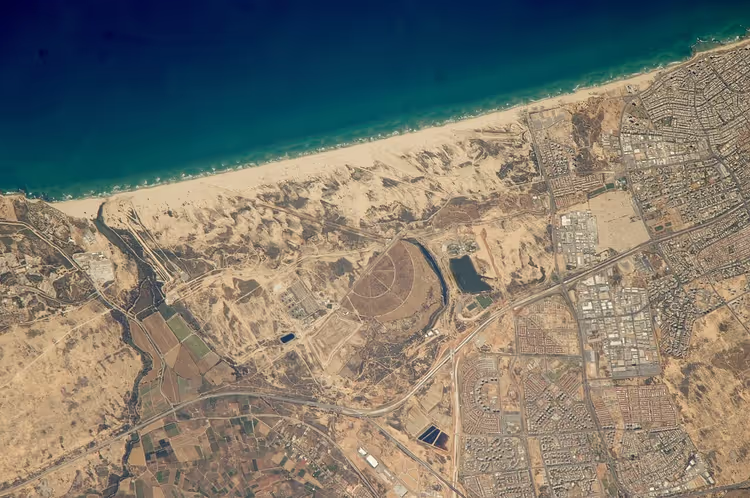
Coverage in Israel is uneven, and here your route matters more than the eSIM brand. 5G is strongest in the Tel Aviv metropolitan area. In central Jerusalem the signal is solid, in the city's outlying districts it is patchy. Haifa has good coverage in the centre and in the Carmel area (as of 01/2026, coverage map by region).
 © Tiia Monto · CC BY-SAPhoto: Tiia Monto, CC BY-SA (https://creativecommons.org/licenses/by-sa/3.0), Wikimedia Commons
In the south the picture is different. In Eilat 5G is still being rolled out, so you will spend part of your time in the city on 4G. At the Dead Sea the terrain limits the signal, and only 4G is available there. In the Negev desert outside Be'er Sheva and Arad there is practically no 5G, and coverage is also limited in the small towns and villages of the Galilee (as of 01/2026, review of coverage in the south and north).
Here is what that means for a trip to the Dead Sea. You drive from Jerusalem or Tel Aviv along a highway where the signal shifts between 5G and 4G, and right at the shore it stays on 4G. Download offline maps and tickets in advance, while you are in the city. That way, signal drops on the highway will not get in the way of navigation.
The advice for Eilat is similar. The city is in the far south, and the road there runs through the Negev, where the network dips between towns. If you are driving a rental car, download the whole route before leaving Be'er Sheva. Once you are in Eilat, you can work comfortably on 4G.
Choosing a plan for a southern route. Take a plan with data to spare, not an unlimited one with a speed cap: on 4G you will not burn through gigabytes faster than usual. If you want to know the network, look at SimOptions with Partner and Cellcom, or at Holafly, which runs on three networks.
One last point, about the north. In the Galilee, coverage in villages is weaker than in cities. For a day trip from Haifa this is not critical, for a week in guesthouses keep offline maps and save your bookings to your phone's memory.
The six eSIM providers one by one
The summary table shows starting prices, but you often need a specific amount of data for a specific period. Below are each provider's full range of Israel plans, the installation terms and the main catch. All prices were checked on the official pages on 16.09.2026.

SIM to Israel
SIM to Israel has the simplest plan logic: one 150 GB plan that you take for the period you need. The price includes unlimited calls and SMS within Israel, calls to the US and Canada, and a US or Canadian number with unlimited incoming calls (as of 09/2026, SIM to Israel plans and terms). A number like this is handy for staying in touch with family and for incoming calls from North America.
The second advantage for you is the data allowance. You are unlikely to use up 150 GB even with video and tethering to a laptop. The provider sells not only eSIMs but also physical SIM cards for Israel with the same set of services, so a family with different phones can buy both formats from one seller.

Validity (8 SIM to Israel plans, 09/2026) | Data | Price |
|---|---|---|
7 days | 150 GB | 25 USD |
10 days | 150 GB | 29 USD |
14 days | 150 GB | 35 USD |
21 days | 150 GB | 39 USD |
30 days | 150 GB | 45 USD |
45 days | 150 GB | 79 USD |
60 days | 150 GB | 89 USD |
90 days | 150 GB | 120 USD |
Work it out like this: a week's trip costs you 25 USD, two weeks 35 USD, a month 45 USD (as of 09/2026, SIM to Israel prices by validity). After 30 days the price jumps sharply: 45 days cost 79 USD, so for a month and a half, compare this plan with a local SIM.
The catch: the provider does not name the Israeli operator's network or 5G support on the plans page, so you will only find out the speed once you are there.
Airalo
Airalo sells three ranges for Israel: data only, data with minutes and SMS, and unlimited plans. The plans run through the virtual operator Annatel. Before you buy an Israel eSIM, the provider asks you to complete an identity check with your passport, and the profile has to be installed within 30 days of purchase (as of 09/2026, Airalo terms for Israel).
Data only (Airalo data-only, 09/2026) | Validity | Price |
|---|---|---|
1 GB | 3 days | 4 USD |
3 GB | 7 days | 6 USD |
5 GB | 15 days | 7.50 USD |
5 GB | 30 days | 8 USD |
10 GB | 30 days | 11.50 USD |
20 GB | 30 days | 16.50 USD |
Data, minutes and SMS (Airalo voice plans, 09/2026) | Validity | Price |
|---|---|---|
1 GB + 10 minutes + 10 SMS | 3 days | 5.50 USD |
3 GB + 30 minutes + 30 SMS | 7 days | 8 USD |
5 GB + 50 minutes + 50 SMS | 15 days | 10 USD |
5 GB + 50 minutes + 50 SMS | 30 days | 13.50 USD |
10 GB + 100 minutes + 100 SMS | 30 days | 22 USD |
20 GB + 200 minutes + 200 SMS | 30 days | 34 USD |
Unlimited (Airalo unlimited plans, 09/2026) | Validity | Price |
|---|---|---|
Unlimited plan | 3 days | 12.50 USD |
Unlimited plan | 5 days | 18 USD |
Unlimited plan | 7 days | 26.50 USD |
Unlimited plan | 10 days | 34 USD |
Unlimited plan | 15 days | 48 USD |
Unlimited plan | 30 days | 69 USD |
Airalo's strength for you is its ladder of data sizes. The 5 GB plan for 15 days at 7.50 USD covers a week with room to spare, and 20 GB for a month at 16.50 USD gives one of the best prices per gigabyte in the comparison (as of 09/2026, Airalo prices for 5 and 20 GB). Voice plans cost roughly twice as much, so only take them if you need local calls.
The catch: Annatel is a virtual operator, and according to the market review these have no access to 5G, so count on 4G.
Saily
Saily is developed by the team behind NordVPN. For Israel, the provider sells data-only plans, with no calls or SMS. Prices on the Israel page are shown in euros, and in the table we converted them to dollars at the ECB rate for 15.09.2026: 1 € = 1.1539 USD (as of 09/2026, Saily plans for Israel, ECB rate).
Plan (Saily, Israel, 09/2026) | Validity | Price in USD (in euros) |
|---|---|---|
1 GB | 7 days | 4.03 USD (3.49 €) |
3 GB | 30 days | 6.33 USD (5.49 €) |
5 GB | 30 days | 8.07 USD (6.99 €) |
10 GB | 30 days | 12.10 USD (10.49 €) |
20 GB | 30 days | 17.30 USD (14.99 €) |
On price, Saily is level with Airalo. The starter gigabyte lasts 7 days instead of three, which is more convenient for a short trip (as of 09/2026, Saily starter plan). At 20 GB, Saily is less than a dollar more expensive than Airalo, so the choice here comes down to whose app you are more used to.
The provider's weak spot is transparency. The plan page states neither the Israeli network nor 5G support. For a week in Tel Aviv this is not critical, but for a route through the Negev you will not be able to tell in advance whose signal you will be picking up.
The catch: Saily does not publish the network or 5G support, so you will only be able to judge connection quality in the south of the country once you are there.
Jetpac
Jetpac sells data plans for Israel without calls or SMS, and voice packs can be added separately from 1.99 USD. The smallest plan starts at 4 USD, and at the time of checking the large plans came with a 23% discount (as of 09/2026, Jetpac plans for Israel). Tethering to other devices is allowed.
Plan (Jetpac, Israel, 09/2026) | Validity | Price |
|---|---|---|
smallest plan | short validity | from 4 USD |
10 GB | 30 days | 13.50 USD |
15 GB | 30 days | 20 USD (discounted) |
30 GB | 30 days | 40 USD (discounted) |
40 GB | 30 days | 41.50 USD (discounted) |
Unlimited | 30 days | 87 USD |
Jetpac's main feature for you is the perks around your flight. Under the provider's terms, if your flight is delayed you get airport lounge access through SmartDelay, and on plans of 3 GB and up, WhatsApp, Uber and Google Maps do not use your data (as of 09/2026, Jetpac perks). Check the terms of the perks on the plan page before you pay.
Jetpac's unlimited plan for 30 days costs 87 USD and runs at normal speed only for the first 3 GB per day, after which the speed drops to 1 Mbps (as of 09/2026, Jetpac unlimited terms). For a month in the country, the 40 GB plan at 41.50 USD works out at half the price.
The catch: the network in Israel is not stated on the plan page, and the discounts on large plans are temporary, so check the price on the day you buy.
SimOptions
SimOptions sells data-only plans for Israel on the Partner and Cellcom networks with 5G support. A purchased eSIM can be activated within a year, and the plan starts automatically the first time you connect to a network in Israel (as of 09/2026, SimOptions terms for Israel). So you buy the plan in advance and do not lose days while you are flying.

Plan (SimOptions plans, 09/2026) | Validity | Price |
|---|---|---|
1 GB | 7 days | 4.50 USD |
3 GB | 30 days | 5.90 USD |
5 GB | 30 days | 6.90 USD |
10 GB | 30 days | 12.90 USD |
20 GB | 30 days | 24.90 USD |
30 GB | 30 days | 31.90 USD |
50 GB | 30 days | 49.90 USD |
SimOptions is strongest for you at the small and large ends. 3 GB for 30 days at 5.90 USD and 5 GB at 6.90 USD are cheaper than the equivalents from its rivals, and 50 GB at 49.90 USD works out at about 1 USD per gigabyte on a known network (as of 09/2026, SimOptions prices for 3, 5 and 50 GB). At 20 GB, the provider is more expensive than Airalo and Saily.
The catch: there are no calls and no number, and the 20 GB plan at 24.90 USD is noticeably pricier than the equivalents from Airalo and Saily.
Holafly
Holafly sells only unlimited plans for Israel, for periods from 3 to 30 days. The plans run on the Partner, Pelephone and HOT Mobile networks, on 5G where it is available. You can tether up to 1 GB per day, and on top of the plan the provider gives you 1 GB of backup data per month (as of 09/2026, Holafly terms for Israel).
Unlimited (Holafly plans, 09/2026) | Validity | Price |
|---|---|---|
Unlimited plan | 3 days | 12.50 USD |
Unlimited plan | 5 days | 20.50 USD |
Unlimited plan | 7 days | 27.50 USD |
Unlimited plan | 10 days | 36.50 USD |
Unlimited plan | 15 days | 50.50 USD |
Unlimited plan | 30 days | 73.90 USD |
On paper, unlimited is convenient: you do not count gigabytes. But Holafly has a fair usage policy under which your speed may be reduced temporarily, for no longer than a day according to the provider's terms (as of 09/2026, Holafly Fair Usage Policy). There is no number and no calls, so you will need messaging apps to talk.
The catch: this is the most expensive option in the comparison, and tethering is capped at 1 GB per day, so for working from a laptop the unlimited plan offers almost no advantage.
Other eSIM providers for Israel
Besides the six services in the table, tourist eSIMs for Israel are sold by Nomad, GigSky, aloSIM, Ubigi, Airhub and Yesim. Firsty, like Holafly, bets on unlimited data, while Roamless sells a balance for different countries instead of a plan for a single trip. We did not include their plans in the table because their ranges are close to the ones reviewed above.
If none of the six plans suits you, compare one more provider: Yesim plans for Israel. Look at the same three things: the price per gigabyte, the validity period and the network name in the plan description.
Scenario 1: a trip of a few days
A short trip means a layover, a business visit or a weekend in Tel Aviv and Jerusalem. You need data for taxis, maps, messaging apps and boarding passes. A 1 GB plan is enough for that, provided you have Wi-Fi at the hotel in the evening.
Three providers offer the cheapest entry point. Airalo sells 1 GB for 3 days at 4 USD, Saily 1 GB for 7 days at 4.03 USD (3.49 €), Jetpac its smallest plan from 4 USD (as of 09/2026, Airalo for 3 days, Saily for 7 days, Jetpac, smallest plan). SimOptions asks 4.50 USD for the same gigabyte for a week.
If you are worried that a gigabyte will not be enough, take 3 GB for 30 days from SimOptions at 5.90 USD (as of 09/2026, SimOptions 3 GB plan). The difference from 1 GB is less than a dollar and a half, and the validity also covers a return visit within the month.
You will almost never need unlimited data for a short stay. Three days at Holafly cost 12.50 USD, and the same at Airalo (as of 09/2026, Holafly for 3 days). That is three times the price of a gigabyte, which is usually enough for a couple of days in the city.
Who it's for: transit, a business trip, a weekend in one city with hotel Wi-Fi. Not for: a trip where you work from a laptop or make frequent video calls.
Scenario 2: a week in Israel
A week means the classic route: Tel Aviv, Jerusalem, a day at the Dead Sea and possibly Haifa. You move around a lot, use navigation and upload photos. Here the choice depends on whether you need calls.
Data only. Airalo offers 3 GB for 7 days at 6 USD or 5 GB for 15 days at 7.50 USD, and SimOptions 5 GB for 30 days at 6.90 USD on the Partner and Cellcom networks (as of 09/2026, Airalo weekly plans, SimOptions 5 GB plan). For a southern route with a weak signal at the Dead Sea, we would choose a network that is known in advance, which means SimOptions.
Data and calls. SimOptions and Airalo without voice will not help here, while the Airalo plan with 3 GB and 30 minutes for 7 days costs 8 USD (as of 09/2026, Airalo voice plans). If you make more calls than that, take SIM to Israel: 150 GB, unlimited calls within Israel and to the US and Canada for 25 USD for 7 days.
Lots of data without calls. If you share your connection with the family or watch video on the road, a week of unlimited data costs 26.50 USD at Airalo and 27.50 USD at Holafly (as of 09/2026, Airalo unlimited, a week of unlimited data at Holafly). Meanwhile SIM to Israel gives you 150 GB plus calls for 25 USD, so unlimited for a week loses on every count.
Who it's for: the classic one-week route around the country, a family with one phone acting as the hotspot. Not for: a trip without calls where 3-5 GB is enough: in that case you do not need 150 GB.
Scenario 3: two weeks and longer
Two weeks or more usually means a route across the whole country: the north, Jerusalem, Eilat and the Negev. Here you are no longer paying for an entry point but for volume, and the price per gigabyte becomes the main criterion.
The best price per gigabyte for a month in the comparison comes from Airalo and Saily. 20 GB for 30 days costs 16.50 USD at Airalo and 17.30 USD (14.99 €) at Saily (as of 09/2026, Airalo 20 GB, Saily 20 GB). That is about 0.85 USD per gigabyte, and the networks of both providers are either not stated on the plan page or virtual.
If you need a lot of data on a known network, look at SimOptions: 30 GB for 31.90 USD and 50 GB for 49.90 USD on the Partner and Cellcom networks (as of 09/2026, SimOptions large plans). At Jetpac, 40 GB for 30 days cost 41.50 USD with the discount at the time of checking.
With calls for two weeks, SIM to Israel wins again. 14 days cost 35 USD, 21 days 39 USD, 30 days 45 USD, and in every case that is 150 GB with calls (as of 09/2026, SIM to Israel validity periods). By comparison, 15 days of unlimited data at Holafly cost 50.50 USD and come without a number.
For a long route, keep one more provider in reserve. If your main plan runs out early, topping up with another plan is easier than hunting for a carrier store in Eilat: compare Yesim plans for two weeks in advance, while you are on Wi-Fi.
Who it's for: a route around the whole country, remote work, a family tethering several devices. Not for: a month in one city with home Wi-Fi: 5-10 GB will do there.
Unlimited or a plan with data to spare
Unlimited eSIMs for Israel are sold by Holafly, Airalo, Jetpac and Firsty. It sounds convenient, but you almost always overpay. Unlimited plans come with speed or tethering limits, and these are described in the terms, not in the plan name.
Compare the terms. At Holafly, tethering is capped at 1 GB per day, and your speed may be reduced temporarily under the fair usage policy. At Jetpac, the 30-day unlimited plan at 87 USD runs at normal speed only for the first 3 GB per day, then at up to 1 Mbps (as of 09/2026, Holafly terms, Jetpac terms).
Now the price. A week of unlimited data at Holafly costs 27.50 USD. For that money, at Airalo you get 20 GB for 30 days at 16.50 USD plus another 5 GB for 15 days at 7.50 USD (as of 09/2026, Airalo plans). That makes 25 GB, which is far more than enough for a week.
When unlimited is justified. If you work from a laptop, upload video and do not want to keep an eye on your remaining balance, unlimited takes that stress away. But for working from a laptop, Holafly's tethering cap is a serious limitation, while the 50 GB plan from SimOptions can be tethered in full within its allowance.
The practical takeaway for you. If you are not sure you use more than 2-3 GB a day, you do not need unlimited. A 10-20 GB plan covers the same needs and costs two to three times less.
Why an eSIM instead of roaming
An eSIM remains the simplest way to get online in Israel. You pick a plan on the website or in the app, pay by card and get a QR code on screen and by email. No carrier stores and no swapping a plastic card.
The main point is not to overpay for roaming. Without data, a smartphone is almost useless on a trip: you cannot order a taxi through an app, plan a route or check a booking. You need a stable data connection for the whole holiday at a fixed price.
A separate advantage for you is how quickly you get going. With the eSIM installed, you are online right after landing and do not have to look for a carrier desk in the terminal after a long flight.
The eSIM profile lives inside the phone. You do not swap plastic or lose the card, and several profiles sit side by side on one device: your home one, the Israeli one and a spare for the next country. If Israel is one stop on a longer route, look at regional plans that work in several countries at once.
Why roaming packages lose out
Roaming packages from home carriers often limit speed or data, and are sometimes billed by the megabyte. You only find out the final amount after you return, when the bill arrives.
The price comparison is obvious. An eSIM plan for a week in Israel starts at 6 USD for 3 GB at Airalo (as of 09/2026, Airalo weekly plan). Compare that figure with your carrier's roaming offer before the trip: the difference is usually clear right away.
Where and when to buy an eSIM for Israel
You have two routes: online from an international provider before the trip, or from an Israeli operator after you arrive. The first option is faster and gives you data right after landing. The second makes sense for a long stay, when you need a local number.
Ordering online
Online, you buy the eSIM from one of the providers reviewed above. Usually all you need is an email address, and the profile arrives right after payment. There is one exception in the comparison: Airalo asks you to complete an identity check with your passport before buying an Israel eSIM (as of 09/2026, Airalo requirements). Keep that in mind and do not leave the purchase to the last evening.
If you want to compare one more option before you fly, take a look at Yesim plans for a trip to Israel. Judge it by the same criteria as the six services in the table.
Buying after arrival
Partner, Cellcom, Pelephone and HOT Mobile sell SIM cards for tourists in their stores, and virtual operators such as 019 Mobile operate alongside them. The airport arrivals area usually offers physical SIM cards, and the prices there are aimed at tourists. So it is better to cover your first hours with an eSIM and plan the store visit once you are in the city.
When to order and activate
You can order a plan at any time. Providers give you a window for installation: at Airalo the profile has to be installed within 30 days of purchase, at SimOptions the eSIM can be activated within a year, and the plan starts the first time you connect to a network in Israel (as of 09/2026, Airalo installation window, SimOptions activation window).
Something else matters more: the moment the plan's validity starts running. With some providers the clock starts at installation, with others at the first connection to an Israeli network. Read this in the description before you buy, otherwise you will lose days while still at home. Install the profile the day before your flight or on the day of departure, while you have a stable home connection.
How to install and activate an eSIM
Installing an eSIM takes less time than signing up for a new app. Providers send instructions, but in practice all you need is the QR code or the install button in the app.
The steps are as follows. After payment you see a QR code on screen, and at the same time an email with the same code arrives in your inbox. Scan the code with the camera of the phone you are installing the eSIM on and follow the system prompts. In a minute or two the profile will appear in your mobile network settings.
There is one important condition. The phone must be online during installation, otherwise you will get an error. If you opened the QR code on the same phone, send it to a second screen: a laptop or your travel companion's phone. Provider apps can usually install the profile without scanning.
The profile then shows up in the settings as a separate line. You select it for mobile data and keep your home SIM active for calls and SMS. Both profiles work in parallel, and you switch between them with a couple of taps.
Check the settings before you fly. The Israeli profile should be selected for mobile data, with data roaming switched on for it, and mobile data on your home SIM switched off. Otherwise you will land without internet, and your home carrier's bill will balloon in a single evening.
And one more thing. Do not delete your home profile after installing the Israeli one. You need it for SMS with confirmation codes from your bank and other services, while your data already goes through the eSIM.
What to check before ordering an eSIM
Below are general rules that apply to any trip, not just Israel. Read them before you pay, so you do not lose money on a plan that will not install.
Your phone is unlocked
An eSIM only works in unlocked phones. If your device is not tied to your home carrier, you can install any eSIM at no extra cost. If it is locked, ask your carrier to unlock it before the trip. If the carrier refuses, that leaves a portable Wi-Fi router or a second unlocked phone acting as a hotspot.
Your phone supports eSIM
Most current models from well-known brands support eSIM, while older devices often do not. The quickest way to check: open the list of supported devices on your chosen provider's website and find your model. If it is not supported, order a physical SIM card for Israel in advance: SIM to Israel, for example, sells that format too.
Provider reliability
All the providers in the comparison work with Israeli operators directly or through partners and publish the plan terms on their pages. The difference between them is transparency: SimOptions and Holafly name the networks, Airalo states the operator Annatel, and the rest do not disclose the network. Each has a support team for outages and refunds, and it is better to sort out questions before you fly, not from the terminal.
Your home number stays
For many people this is the deciding reason to choose an eSIM. The new profile works alongside your home SIM. You switch off mobile data on the home SIM but keep it for calls and SMS. The Israeli eSIM handles your data in the meantime, and you keep receiving your bank login codes.
Calls and a phone number
In the comparison, calls and a number come with SIM to Israel and with Airalo's voice plans, while at Jetpac voice packs are bought separately. Saily, SimOptions and Holafly are data only: there is no number, calls and SMS are not received, and that is normal behaviour for the plan. For talking to a hotel or a guide, messaging apps will do.
eSIM, local SIM or international SIM
There are three ways to get data in Israel: an eSIM, a local operator's SIM or an international physical SIM. The choice for you depends on the length of the trip, how much data you use and the type of phone.
A local operator's SIM
If you are spending a month or longer in the country, an Israeli operator's SIM can work out cheaper for a large data allowance. You get a local number and calls. But you cannot buy it in advance, you will have to find a store after your flight, and the plans in the arrivals area are aimed at tourists.
An international physical SIM
This option suits you if your phone does not support eSIM. The card is ordered online and delivered before the trip, and you are online right after landing. Some of these cards work in several countries, which is handy for a long route.
Price and speed
On the pure price per gigabyte, a local SIM is often better value for a long stay, but you have to add the time spent at the store. You set up an eSIM from home, and your price is fixed in advance.
On speed, the difference is technical. According to the review of the Israeli market, virtual operators' plans do not get 5G access, and at peak times their traffic may be served after the main operator's own subscribers (as of 01/2026, review of Israel's networks). For maps, messaging apps and bookings you will hardly notice the difference.
⁉️🤔 Frequently asked questions
How many gigabytes do you need for a trip to Israel?
For a few days in the city with hotel Wi-Fi, 1 GB is usually enough. For a week with navigation and photos, take 3-5 GB: at Airalo 3 GB for 7 days costs 6 USD, at SimOptions 5 GB for 30 days costs 6.90 USD (as of 09/2026, Airalo 3 GB plan, SimOptions, 5 GB for a month).
Which eSIM for Israel is good for calls?
Calls are included in the SIM to Israel plan: unlimited within Israel, calls to the US and Canada and a US or Canadian number, with a week costing 25 USD. Airalo has plans with minutes and SMS from 5.50 USD. Saily, SimOptions and Holafly are data only, so you will be calling through messaging apps.
Does 5G work on a tourist eSIM in Israel?
It depends on the network. Cellcom, Partner and Pelephone have 5G, while virtual operators do not get access to it. SimOptions runs on the Partner and Cellcom networks with 5G, Holafly on 5G where it is available. At the Dead Sea only 4G is available, and in the Negev outside Be'er Sheva and Arad there is practically no 5G.
Will there be internet at the Dead Sea and in Eilat?
Yes, but mostly on 4G. At the Dead Sea the terrain limits the signal, in Eilat 5G is still being rolled out, and in the Negev between Be'er Sheva and Eilat coverage dips. Download offline maps and tickets in the city before you set off, and signal drops on the highway will not disrupt your route.
What should you do if your phone does not support eSIM?
Order a physical SIM card for Israel before the trip, for example from SIM to Israel, which sells the same 150 GB plan with calls as a plastic card. The second option is an Israeli operator's SIM from a carrier store after you arrive, but it will take up time on your first day.
The short version: what to book
If you are travelling for a few days, take 1 GB from Airalo at 4 USD or from Saily at 4.03 USD (3.49 €). For a week without calls, 3-5 GB from Airalo or SimOptions at 6-7 USD will do, and with calls, SIM to Israel at 25 USD. For two weeks and longer, choose 20 GB from Airalo or Saily, or 30-50 GB from SimOptions on a known network (as of 09/2026, SimOptions range for Israel).
Before you pay, check that your phone is unlocked and supports eSIM, and install the profile the day before your flight. If you want to compare one more provider, open Yesim's eSIM plans for Israel and check the price per gigabyte against the table above.

A small editorial team writing guides for independent travel. We travel ourselves, but we haven’t been everywhere, so we check prices, opening hours and how to get there against official sources.