
















 AIIllustrative image: AI-generated
Mobile service in Sri Lanka: how to choose a local SIM or eSIM for your trip
You walk out of the Colombo airport terminal and the first thing you look for is a way to get online. Without navigation the ride to your hotel costs noticeably more, and the map on your phone won't load. A couple of days without a connection turns into a string of small losses of time and money.
Mobile internet in Sri Lanka solves almost everything. With it you hail a tuk-tuk through an app, check the Kandy to Ella train timetable and book accommodation on the go. Wi-Fi in hotels and guesthouses is unreliable, so counting on it alone is risky.
There are two ways to go. The first: a cheap local SIM card from Dialog, Mobitel or Hutch, bought right at the airport. The second: an international eSIM from Holafly, Airalo, Nomad, Saily or ETravelSIM, which you switch on before departure and which works from the first minute after landing.
Below we've gone through both scenarios in full: coverage and speed on the island, prices, passport registration and the pitfalls. By the end you'll know what to pick for your particular trip.

Ad: this article contains affiliate links, we earn a commission through them, and the price for you stays the same.
Mobile service in Sri Lanka: operators and coverage
💡 In short:
- A local SIM from Dialog is cheaper than any eSIM and holds a signal even in remote parts of the island.
- You set up an eSIM before departure and get online right after landing.
- For a short trip an eSIM is enough, for a long route add a local SIM card.
- Prices and terms: 09/2026, checked on the official Dialog website.
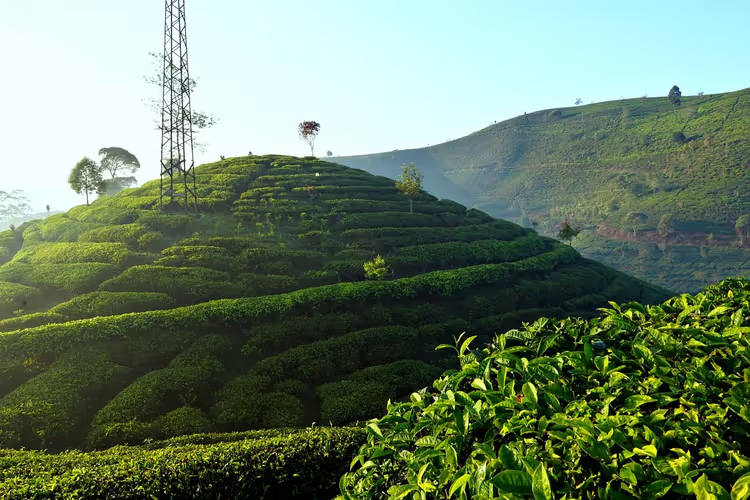
Three operators work on the island. The biggest are Dialog Axiata and SLT Mobitel, which have the largest networks and the most subscribers. Hutch is usually cheaper, but you pay for the low price with coverage outside the cities.
If you're doing a round trip of the country, go with the Dialog network. According to the Opensignal report for February 2026, Dialog takes eight awards, including best network and every award in the coverage category. SLT Mobitel comes right behind, while Hutch works reliably mainly in the cities.
Technically, all the networks are built on GSM, and 4G/LTE is the standard. The fifth generation is being rolled out by two operators with nationwide programmes: Dialog Axiata and SLT Mobitel. Dialog has brought its number of 5G base stations up to 1000 and keeps expanding (as of 09/2026, Dialog). Commercial 5G is already live in Colombo and a few other large cities.
The frequency bands on the island are standard, so most modern smartphones from Europe work without restrictions. Something else matters more: your phone must not be locked to your home operator. Check this before the trip, otherwise a foreign card simply won't work.
 AIIllustrative image: AI-generated
The island's networks
Dialog Axiata leads in both subscriber numbers and coverage area. It reaches even remote villages, which matters for round-the-island routes.
SLT Mobitel is almost on a par with Dialog and covers the whole country. The operator is tied to the state and focuses on combined plans with call minutes.
Airtel operated mainly in the big cities and urban areas. Since 30 August 2024 Airtel Lanka no longer exists as a separate company, it has become part of Dialog (as of 09/2026, operator's announcement).
Hutch maintains a network along the popular tourist routes and often offers the lowest data prices.
The networks differ not only in reach but also in traffic priority. International eSIMs connect to local operators as guests, so at peak hours their speed is sometimes lower than that of local card holders with a direct contract.
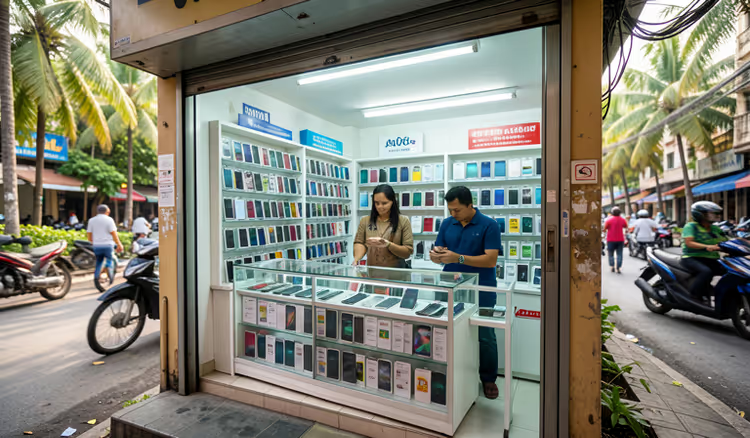
Colombo airport is the main place to buy. The Dialog and Mobitel counters are open around the clock, and Hutch sometimes has a counter too. Paperwork and activation take a few minutes, and registration is done with your passport.
Registration is mandatory for any local SIM: without a passport they won't sell you a card. Your details go into the operator's database, and sometimes that takes longer than the installation itself. So don't leave the purchase to the last minutes before your flight.
If you have two SIM slots or eSIM support, keep your home card active and add a local one. That way you receive bank codes and stay in touch with home.
Think through a backup plan. If your main SIM stops working, a downloaded route map and the hotel address on paper will save you. Don't leave buying a connection to the last evening before departure.
Where the signal drops
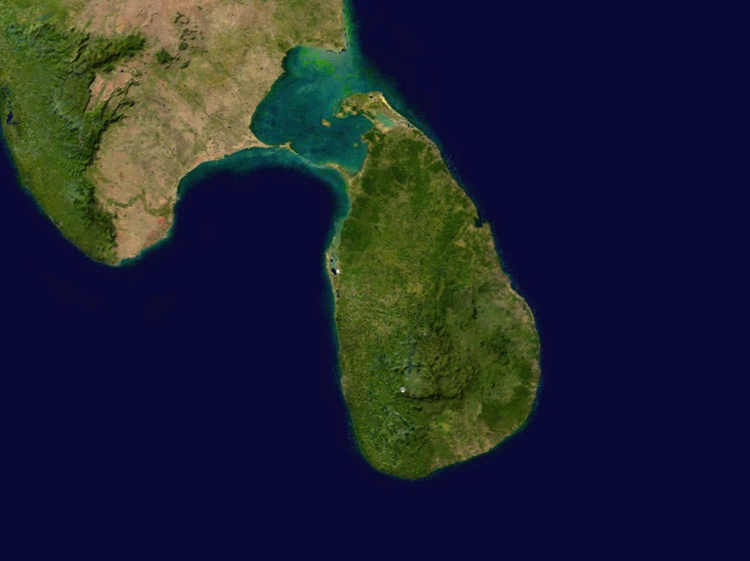
In Colombo, Kandy, Galle and along the south coast you'll get stable 4G, and increasingly 5G too. Things are worst in the mountainous centre, in remote villages and in the national parks. On the Kandy to Ella train or in a tuk-tuk climbing into the highlands, the signal disappears completely at times.
Speed and connection quality
Mobile internet speed in Sri Lanka is adequate but not record-breaking. In the cities it's enough for maps, messengers, email and social media. In rural areas the connection weakens, and HD streaming or a video call may freeze in places.
In the evening, when the network is overloaded, speeds dip for every operator. Even so, mobile data is usually more reliable than hotel Wi-Fi. That is exactly why you shouldn't build your whole trip around hotel internet alone.
In many guesthouses and small hotels the Wi-Fi works only in the lobby or is switched off at night. Mobile internet spares you these surprises. Data goes slowly, too, as long as you don't watch video in high quality.
Coverage by region
The Cultural Triangle is Anuradhapura, Polonnaruwa and Sigiriya. The connection here is reliable: tourist roads link the ancient cities, and the towers stand close together. A local SIM is enough for maps and bookings.
In Yala National Park and in the forests the signal weakens but rarely drops out. A safari usually takes half a day, so the lack of internet isn't a problem. Download a map of the park in advance.
Jaffna in the north was a weak-coverage zone for a long time. Towers have now appeared there, but in remote villages in the northern part of the island the connection is still worse than in the south.
The hill country around Nuwara Eliya and Ella is the toughest stretch. High hills and narrow valleys block the signal. This is where the Dialog network and a map downloaded in advance come in handy.
Mirissa, Unawatuna and Hikkaduwa on the south coast are well covered. There is 4G along the beaches, and in some spots 5G already. For a beach holiday that is more than enough.
How much data you need
For navigation, messengers and social media over two weeks, a small package is usually enough. Maps use little data as long as you don't load street panoramas.
Video and video calls eat up gigabytes. If you shoot a lot and post stories, get a package with room to spare or an unlimited one.
Download offline maps, music and series in advance. Then on the road you don't spend mobile data on entertainment and don't depend on a weak signal in the mountains.
Turn off automatic photo sync to the cloud over mobile data. That one setting saves more data than any number of small tricks.
Check your usage on the first day. It will tell you whether the package will last the whole trip, and you'll have time to top up without rushing.
How to choose a network for your route
If your route is the classic Colombo, Kandy, Ella, Yala, Mirissa and Galle, go with Dialog or Mobitel. Both networks cover these places without surprises.
For the north and east coasts, choose Dialog. Its coverage reaches furthest into remote areas.
If you're in Colombo almost the whole time, any operator will do. All the networks work in the capital, and the speed is enough for any task.
For a short stopover in Colombo on the way to another country, get an eSIM. It activates at home, and for a couple of days it isn't worth spending time at an operator's counter.
Local SIM cards: plans and registration
A local SIM card is worth the money if you're on the island for a long time or want a local number for calls and SMS. Every operator has prepaid plans for tourists, so getting connected takes just minutes.
How much local operators charge
Dialog's prepaid tourist packages start at 20 GB and include calls and SMS within the country, while the larger ones go up to 100 GB (as of 09/2026, official Dialog website). By European standards that is a very low price per gigabyte.
Even Dialog, considered the most expensive operator on the island, offers good value for money. Basic plans at Mobitel and Hutch are usually lower still. On a long trip, the price gap between a local SIM and an eSIM becomes noticeable as early as the second week.
Tourist packages from the local operators all work the same way. You pay once for a bundle of data, minutes and SMS for a set period. When the period ends, the package doesn't vanish straight away, but its data stops working and you buy a new one.
You can top up in several ways: by card in the operator's app, at a phone shop or with a top-up card from a store. The app is the simplest option, but you need internet to set it up, so it's best to sort it out on day one at the airport.
Checking your balance and expiry date is easy with a USSD code or in the app. Write the code down while the seller is explaining it in person. Memory fails you on the road, and the SIM runs out at the most awkward moment.
Mobitel often offers the best bundles with minutes, so it's handy if you make a lot of calls within the country: booking accommodation, calling a driver, checking timetables. Its coverage is almost as good as Dialog's, except in the most remote areas.
Hutch is the choice of those who are saving money and staying in the cities. The lowest package prices come with a weaker network in the mountains, so it's a riskier pick for a round trip.
The airport isn't the only place to buy a card. Operators have shops in Colombo, Kandy, Galle and other cities, but there you'll spend time on getting there and queuing. For a short trip the airport is more convenient.
If your data runs out before the package expires, topping up is easier than changing operator. With most local cards it takes a single request, and your remaining balance is kept.
Don't throw away the card's packaging. It usually has the number, the top-up code and the activation instructions printed on it. You'll need these details if you have to contact support.
How the operators differ
Dialog Axiata has the widest network and leads on coverage in the backcountry. The tourist SIM is sold right at the airport, there is an app, and eSIM is available on some plans.
SLT Mobitel works across the whole country and often wins on price for combined packages with minutes. It also has a tourist counter at Colombo airport.
Hutch bets on the lowest price and keeps a decent network along the main routes. In the mountains and far from the cities it is weaker.
Local operators compared
Operator | Network | Pros | The catch | Best for |
|---|---|---|---|---|
Dialog Axiata | The largest 4G network and a 5G network under construction, nationwide | Best coverage even in the backcountry, stable speed, tourist counter, eSIM available | The most expensive of the local operators, airport queues in high season | Round trips, remote regions, long stays |
SLT Mobitel | Second-largest 4G network, almost nationwide coverage | Plans almost on a par with Dialog, good-value packages with minutes, promotions | Weaker deep in the interior, the range of packages is less clear | Those who need both data and local calls |
Hutch | 4G in urban areas and along the main highways | Lowest prices, tourist package | Weak coverage in rural areas, unreliable in the mountains | Budget trips in the cities |
Pros and cons of a local SIM card
A local card gives you your own number: you receive incoming calls and SMS. You get priority on the local network, and over a long stay the price per gigabyte usually works out the lowest.
There's a catch with this option too. Until you buy and activate the card you stay offline, so it's better to cover the first days with an eSIM. You need to register with your passport. The paperwork takes time. You're tied to one operator, and the card doesn't work outside Sri Lanka.
If your home card is also a physical one, you'll have to take it out and find a safe place to keep it. Many people choose an eSIM for exactly this reason: the home SIM stays in the phone, and you go on receiving calls and SMS without roaming bills.
How to buy and register
Buy right at Colombo airport: the Dialog and Mobitel counters are open around the clock.
Bring your passport, registration can't be done without it.
Tell the seller how long your trip is so they can pick the right amount of data.
Registration and activation take a few minutes, the staff are used to tourists.
For a round trip, go with Dialog: its network is the best on the island.

Local SIM or eSIM: how to choose
The decision depends on the length of your trip, the style of your route and whether you need calls. Let's look at three typical scenarios so that you neither overpay nor end up without a connection.
From a few days to a month in the cities and the south. Get an eSIM: you're online right after landing, you don't waste time at an operator's counter, and your home card stays in the phone.
More than a month, or a route into the island's interior. Add a local SIM from Dialog. It's cheaper over a long stay and holds the network better in remote areas.
The combined option. Keep the eSIM for data and get a local SIM for calls and SMS. That way you get both the best price and the best coverage.
If you're unsure, start with an eSIM for your first trip. You can always buy a local card later in any city, not only at the airport. See current plans and ordering terms on the eSIM page for Sri Lanka.
A separate word on calls. Most international eSIMs are data only, and you can call and message through WhatsApp or Skype. A local SIM takes care of regular calls and SMS within the country.
What it costs in total
Let's compare using a two-week trip as an example. A 10 GB eSIM package costs about $11.50 (as of 09/2026, eSIM plans). A local Dialog card with a comparable amount of data will be cheaper, but it takes time to set up and needs separate registration.
For a short holiday the difference is small, and the convenience of an eSIM usually wins. Over a month or longer, the savings from a local card become noticeable, especially if you buy a lot of extra data.
Take the first day into account too. If you arrive in the evening, the operator's counter may be busy and your hotel far away. An eSIM removes that risk: you're online while still in the taxi.
How to set up a dual connection
The most flexible option is a combination. Leave your home card in the slot and activate the eSIM for data. That way you receive calls and codes, while the internet runs through the eSIM without roaming.
If you need a local number for calls, add a physical Dialog card. In a phone with two slots this works without conflicts, and your costs stay under control.
Check your settings before the trip. Make sure the right profile is selected for mobile data and that data roaming is turned off on your home card. Otherwise your phone may slip into expensive roaming through background traffic.
Who should choose what
For a family with children, predictability matters more, so get a package with room to spare and switch on the eSIM before departure. Then at the airport you're dealing with the kids, not standing in a queue for a card.
Those who work on the road need stable internet and tethering. Here, look at packages with a large data allowance and hotspot support.
Budget travellers will do well with a local card. It's cheaper over a long stay, and the extra minutes of paperwork aren't critical.
For those travelling on through Asia, a single regional eSIM package is more convenient. Separate cards for each country will cost more and take more time.
On arrival, don't rush to buy the first card you see. Compare at least two offers at the counter: data, validity and price per gigabyte. Sellers are usually accommodating and will pick an option to suit your route.
Keep the receipt and the packaging. If there are activation problems, this will speed up your support request. Also take a photo of the card number so you don't have to hunt for it later.
If you only need a connection for maps and messengers, don't overpay for unlimited data. A small package will be more than enough, and the difference is better spent on an excursion.
eSIM for Sri Lanka: how it works
In recent years eSIM has become the most popular way to stay online while travelling. You buy a package online and receive a digital profile that you simply install on your phone. No plastic cards and no hunting for an operator's shop.
What an eSIM is
eSIM stands for embedded SIM, meaning a built-in SIM card. It's already inside the smartphone and needs no physical swap. The operator's profile is downloaded by QR code or straight from an app in a matter of minutes.
The main condition: your phone must support eSIM. That means iPhones from the XS onwards and most modern Android phones. If you're not sure about your model, check the provider's compatibility list before buying your tickets. The second option is simpler: look in your phone's settings for an eSIM entry.
Pros and cons of eSIM
An eSIM has four main advantages. You get online right after landing without spending time at an operator's counter. Your home SIM stays in the phone, and you go on receiving calls and SMS. Installation takes a couple of minutes. The packages are flexible and can be matched to the length of your trip.
There's a catch as well. Most often an eSIM is data only, and calls go through messengers. You depend on another provider's network. Not every phone is compatible. And per gigabyte an eSIM is usually more expensive than a local card.
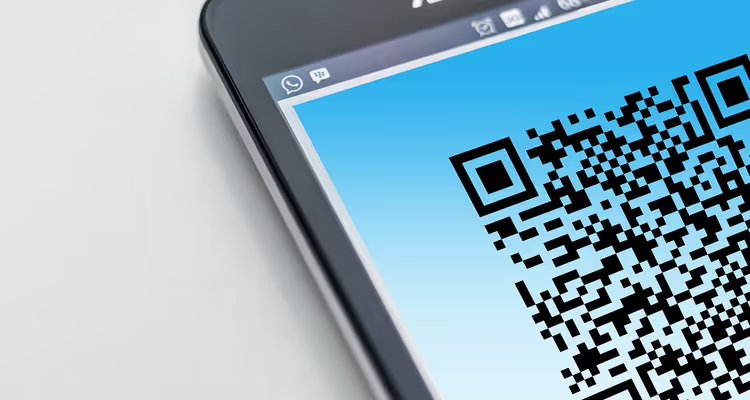
Put simply, with an eSIM you pay a small premium in exchange for convenience. For a short trip that's justified, for a long journey it's cheaper to cover part of your data with a local card.
When an eSIM beats a local SIM
An eSIM wins on trips of a few days to a month. You don't lose your first evening to paperwork and can get straight to the everyday tasks: calling a taxi, finding a place to stay, messaging home. You can order the package before departure and switch it on at the airport with one tap.
There's a separate advantage for those who care about their home number. The home SIM stays active, so you receive bank codes and calls from family. It's easy to compare current eSIM plans for Sri Lanka on a single page.
Holafly eSIM for Sri Lanka
Holafly bets on unlimited packages. You don't keep an eye on your remaining data or buy extra gigabytes halfway through your holiday. That said, the unlimited data is subject to a fair use policy: with very heavy usage your speed may be slowed.
The provider connects to major local networks, including Dialog and Mobitel, and holds a solid connection outside the cities. Support is available around the clock. Hotspot is there, but with a limit on the number of connected devices.
This is an option for those who stream a lot, work online or simply don't want to count gigabytes. You'll pay extra for the comfort: per unit of data, Holafly is more expensive than its competitors. You can activate a Holafly package for Sri Lanka in advance, before departure.
Airalo eSIM for Sri Lanka
Airalo is good for small and medium amounts of data. The plans are flexible, and you can top up your package in the app at any time. For short trips and budget travel it's a convenient choice.
The partner networks are major local operators, so coverage is good in the cities and on the coast. Hotspot is supported. On large amounts of data, Airalo works out more expensive than some competitors.
Go with Airalo if you don't need much data and want to pay for a specific amount. You can add data without installing a new profile, right from the app. It's worth comparing the Airalo options for Sri Lanka in advance, before you leave.
Nomad eSIM for Sri Lanka
Nomad is considered one of the most stable providers for the island. Everything is managed through the app, and changing or topping up packages is simple. The profile isn't reinstalled when you change plan.
The range includes regular packages and an option with a daily limit. Once the daily allowance is used up, the speed drops to a minimum, so true unlimited data is not what Nomad is about. Hotspot is unavailable on most plans.
On the other hand, Nomad has the cheapest entry point for a small amount of data, and a long-validity package gives a good price per gigabyte. If you're travelling with several stops and your needs change along the way, Nomad packages for Sri Lanka are a good fit.
Saily eSIM for Sri Lanka
Saily bets on simplicity and security. Besides mobile data, the provider offers a built-in VPN and protection against harmful websites. For a trip that's a nice bonus, especially if you log in to banking apps.
Activation is by QR code or directly in the app, and hotspot is allowed. Prices are listed in dollars, which is inconvenient if you pay with a euro card. Far from Colombo, reception is sometimes weaker than with the big operators.
At the same time, Saily automatically loads the new plan after a top-up, with no reinstallation. That saves time when your data runs out on the road. Saily packages make sense for those who value comfort and data protection.
ETravelSIM for Sri Lanka
ETravelSIM offers a wide choice of packages, including small ones and nearly unlimited ones. The particular feature is that the unlimited data is capped by a daily limit, after which the speed is reduced. Read the terms of your chosen plan carefully.
The provider is a good fit if Sri Lanka is only one part of an Asian route: it has multi-country packages for the region. Installation is simple and support is responsive, although the app is less polished than competitors' apps.
Go with ETravelSIM when you're travelling on through Asia after the island and want one provider for every country. It's worth choosing an ETravelSIM package in advance so you can activate the profile as soon as you're at the airport.
What to check before buying an eSIM
Before you pay, run through a short checklist. It will save you money and spare you surprises once you're on the island.
Data only, or calls as well. Most travel eSIMs don't give you a local number. If you need to make phone calls, get a package with voice or add a local card.
Fair use. Unlimited packages have a hidden daily threshold. Past it the speed drops to a minimum, and video no longer loads.
Tethering. Hotspot isn't allowed by everyone. If you work from a laptop, check this condition before buying.
Activation period. With some providers the clock starts when the profile is installed, with others when you first connect to the network. The difference affects when you should switch the eSIM on.
Multi-country. If you're travelling on after Sri Lanka, a regional package will be cheaper than several separate ones.
Device compatibility. Check that your phone supports eSIM and that it has room left for the profile.
Refunds and support. Find out whether you'll get your money back if the profile doesn't work, and what language support is in.
A separate word on network priority. A guest eSIM profile may get lower speeds than a local subscriber's direct card. In practice you won't see a difference for maps and messengers, but when streaming at peak hour it's sometimes noticeable.
Keep your home SIM active. Then you go on receiving bank codes and calls, while the eSIM works quietly in the background for data. This is the main advantage of a digital profile over a physical card.
If you're torn between two providers, take the one with the better refund terms. A mistake is cheaper to fix before the trip than hunting for support on the island.
eSIM comparison for Sri Lanka: table of plans
Every provider has packages for different trip lengths, but the spread in price per gigabyte is wide. Below we've pulled the benchmarks into one table so you can quickly compare data, validity and price.
Fixed eSIM packages for Sri Lanka run from $3.99 for 1 GB to $28.03 for 20 GB, and unlimited data starts at roughly $4.32 a day (as of 09/2026, eSIMcomparisons.com). A 10 GB package for 30 days can be had for around $11.50 (as of 09/2026, eSIM.co). The cheapest paid packages start at about $1.69 (as of 09/2026, eSIM overview).
Provider | Data and validity | Price benchmark | Key feature | Where to look |
|---|---|---|---|---|
Holafly | Unlimited, from one day to a month | from $12.50 for 3 days (as of 09/2026, Holafly) | Unlimited data, 24/7 support | |
Airalo | from 1 GB to 20 GB | from $4.50 for 1 GB (as of 09/2026, Airalo) | Flexible validity, hotspot | |
Nomad | Regular packages and a daily limit | from $4 to get started (as of 09/2026, Nomad) | Stability, the cheapest entry point | |
Saily | up to 20 GB and unlimited | billed in dollars | VPN and web protection | |
ETravelSIM | small and nearly unlimited packages | mid-range pricing | Multi-country across Asia |
Which package suits whom
A small amount of data for a short trip: Nomad and Airalo. The cheapest entry point and flexible validity.
A month with a medium amount of data: ETravelSIM. A good price per gigabyte over a long stay.
Lots of streaming and online work: Holafly. Unlimited data takes away the question of how much you have left.
Security and simplicity: Saily. VPN and web protection in one package.
All of Asia, not just the island: ETravelSIM. One provider for several countries.
If you want a single piece of advice, for most travellers we would pick Nomad: a cheap entry point, a reliable connection on the major local networks and a clear app. You can look at the current eSIM packages for the island before buying your tickets.
How to read the prices and not overpay
Look not at the package price but at the price per gigabyte and the validity. Work out both figures, otherwise an offer that looks like a bargain will turn out to be expensive.
Pay attention to the terms of unlimited data. With some providers it's capped by a daily threshold, after which the speed drops. Formally it's unlimited, in practice you get slow internet.
Check whether tethering is included in the plan. If you work from a laptop, the lack of hotspot will make the package useless.
Take the length of your trip into account. A package with spare days isn't always better value than two short ones: the extra you pay for unused days can be noticeable.
Don't buy the most expensive package in advance. Start with a medium amount of data, and if you run short, top up in the app. That way you won't overpay for data you never use.
How to vet a provider before buying
Read up on which local networks the provider connects to. If Dialog and Mobitel are on the list, coverage will be good across the whole island.
Check the support. A round-the-clock chat is more useful than a contact form if you need internet at night.
Find out the refund rules. If the profile doesn't activate, you should know how to get your money back and how long it takes.
Look at fresh reviews from the last few months. Old reviews don't reflect current speeds and prices.
Make sure you have a backup option. A second profile or a local card will save you if the first package lets you down.
The verdict on what to choose
For a short trip, get an eSIM from Nomad or Airalo. For a long route, add a local Dialog card. If you need security and simplicity, look at Saily, and for the whole of Asia ETravelSIM is more convenient.
Connectivity and settings on the trip: practical tips
A few habits will save you money and nerves on the island. They work with both an eSIM and a local card.
Download offline maps in advance. For remote areas, save the regions you need in Google Maps, otherwise navigation will disappear along with the signal.
Turn off roaming with your home operator. That way you won't get an accidental data bill while switching between networks.
Check how to top up. Find out in advance how to extend your package: online, in the app or at an operator's shop.
Keep an eye on the network type. If your settings are on 3G only, the internet will be slow. Force 4G or 5G if your phone can do it.
Read the plan's terms. Pay attention to the validity period, fair use limits and whether tethering is allowed.
Check your phone's compatibility. For an eSIM you need profile support, and for a local network the right frequency bands.
A separate word on calls. With an eSIM you'll mostly talk over WhatsApp, while regular calls and SMS within the country are available only on a local card. If phone calls matter to you, add a Dialog starter pack with a small balance to your eSIM.
Getting around Sri Lanka
Connectivity has a direct effect on transport, so a few words about getting around. Between cities the train is the most convenient: tickets for popular stretches sell out in advance, and the timetable is worth checking in an app.
Within cities you hail a tuk-tuk through an app or hire a private driver for the day. Buses are cheap but slow. Train tickets and trips around the country are easy to book in advance through a service for Sri Lanka.
On a long route, a connection helps you track journey statuses and change plans on the go. Without internet you depend on timetables on a scrap of paper and on drivers who don't always know the best way.
Money and insurance on the trip
Cards are widely accepted in Sri Lanka, but a surcharge is often added for paying by card. It's better value to withdraw cash from an ATM and pay by card only where there's no extra charge. Check your bank's fees in advance.
Medical insurance is a must for a trip to the tropics. It covers treatment and transport, which would otherwise cost a tidy sum. It's worth comparing travel medical insurance terms before you leave, not in a local clinic.
Even with a good connection, keep an offline copy of your accommodation booking and your policy on your phone. In remote areas the signal drops out, while documents saved on your phone are always at hand.
When to go and what to keep in mind on the trip
Planning affects connectivity too, so a few words on timing. The best time for the south and west is the dry season from November to April. The north and east, including Arugam Bay, are best visited in the season from May to September. The centre of the island is most comfortable from January to March.
Allow two to three weeks for a full round trip. In a shorter time you'll see only the coast, while the mountains and ancient cities will stay out of the picture. A good option is to extend the trip and add a few days in the neighbouring Maldives.
When packing, don't forget a charger and a power bank. A phone with the map open and navigation running drains faster than usual, and sockets aren't always available on the road between cities.
On water, remember a simple rule: buy bottled drinking water, and it's safer to skip the ice in street cafes. This lowers the risk of an upset stomach in your very first week.
Choose clothes for a humid climate: light items, swimwear, a hat and closed shoes for temples. Shoulders and knees are covered at Buddhist sites, so keep a wrap in your backpack.
For temples and shrines, a small supply of loose change comes in handy. Shoes are taken off at the entrance, so lace-ups are inconvenient: bring sandals that are easy to slip off.
If you're travelling in the rainy season, build flexibility into your route. A short downpour can close a road in the mountains, and you'll have to change plans on the go. Mobile internet comes to the rescue again here: you quickly find an alternative and book new accommodation.
Common mistakes when buying a connection
Buying a connection on the last evening
The airport counters are open around the clock, but in high season a queue forms in front of them, and someone tired after a flight rarely compares plans carefully. If the eSIM profile isn't set up in advance, the first evening goes on everyday tasks without internet, and this is one of the most common reasons for a spoiled start to a holiday.
Taking the cheapest plan for a round trip
A discount on a package doesn't make up for having no network in the mountains, where the route passes through Ella and Nuwara Eliya. Saving a few hundred rupees turns into lost navigation at the moment you need it, so for a long trip it's wiser to choose an operator with good coverage.
Forgetting your passport
Card registration is mandatory, and without a passport the seller will refuse. A copy or a photo of the document isn't always accepted, because the details are entered into the operator's database on the spot.
Not checking for an operator lock
A phone bought on an instalment plan from your home operator may be locked to its network. A local card won't work in such a handset, and unlocking takes days and means contacting the operator before you leave.
Leaving data roaming switched on
Background apps quietly use up data on your home card, and the bill arrives once you're back home. Data roaming with your home operator is worth turning off straight away, and the right profile should be selected manually.
Watching video without spare data
Streaming and video calls eat through a package quickly, and in the mountains and on the coast the speed is unstable. If your work involves video calls, it's wiser to take a package with a large allowance or unlimited data than to top up every couple of days.
Ignoring the fair use terms
Unlimited data is almost always capped by a daily threshold, after which the speed drops to a minimum. A traveller who was counting on fast internet all month is disappointed when video stops loading in the second week.
Not saving the top-up code and card number
The details from the packaging will come in handy if you need the operator's support. A photo of the code saves time when your balance runs out on the road between cities.
Activating the eSIM too early
With some providers the validity period counts from the installation of the profile, so buying a month before your flight can cost you weeks of paid data. Find out exactly when the clock starts, and only then install the profile.
Relying on hotel Wi-Fi alone
The quality of hotel internet is unpredictable, and in remote guesthouses there may be none at all. A mobile network fills this gap and makes your route flexible: plans change along the way, and booking takes minutes.
Not downloading offline maps
In the national parks and the highlands the signal drops out, and navigation without maps loaded in advance becomes useless. A couple of minutes spent downloading the areas you need saves hours of wandering along an unfamiliar road.
Buying a card second-hand from a reseller
In the resorts you're sometimes offered ready-made cards by street sellers. The price is higher, there are no guarantees, and the registration may be in someone else's name. An operator's official counter at the airport or a shop in town is more reliable and often cheaper.
Not checking frequency compatibility
Most modern smartphones work on the local networks without restrictions, but rare models made for a specific market don't support every band. Checking the specifications before you leave spares you slow internet and constant switching between network generations.
Skimping on security on open networks
Public Wi-Fi in a cafe is convenient, but your data isn't protected on it. Logging in to banking apps and entering passwords over such a network is risky, while mobile internet from your own profile is safer and needs no extra setup.
Not checking your balance and expiry date
A package runs out at the most awkward moment, most often on the road. A quick balance check on the first day and a reminder on your phone help you renew the plan in good time.
⁉️🤔 Frequently asked questions
Do I need a Sri Lanka SIM card before I fly?
That's up to you. An international eSIM can be activated in advance, and you'll be online right after landing. A local card can only be bought on the spot, so it won't help you in the first hours. For a short trip it's simpler to get an eSIM straight away and add a physical card later.
Which network should I choose for a round trip?
In remote areas the Dialog network is the most reliable. If you plan to travel around the island a lot, get a plan or an eSIM with access to Dialog. Hutch works mainly in the cities, so it's a poorer fit for long journeys between Kandy, Ella and the south coast.
What do I do when my data runs out?
Most providers let you buy more data without reinstalling the profile. With an eSIM this is done in the app and often automatically, with a local card you need credit. Check how to top up right after buying, so you aren't looking for it on the road when the internet has already stopped working.
Can I make calls and receive SMS with an eSIM?
Usually not. International eSIMs are mostly data only, and calls go through WhatsApp or Skype. A local card gives you a number and regular SMS. If you need phone calls for practical reasons, combine an eSIM for data with a local SIM for calls.
Does a foreign eSIM count as roaming?
No. With a travel eSIM the provider already has an agreement with the local network, so for you it's an ordinary connection within the country, with no roaming bills. That is exactly why connection quality depends not on your home operator but on which local networks the provider connects to.
Which eSIM provider is best for Sri Lanka?
For small and medium amounts of data, Nomad and Airalo are a good fit. If you need security and simplicity, go with Saily. For the best value over a long stay and for trips around Asia, look at ETravelSIM. If you want unlimited data without counting gigabytes, go with Holafly. For your own trip the choice is easy to narrow down by length and amount of data.
In brief: what's worth booking
Connectivity in Sri Lanka can be sorted in two ways, and a combination gives the best result. For a short or medium trip, get an eSIM: you're online straight away and don't spend your first evening on paperwork. For a long route into the island's interior, add a local SIM from Dialog so you don't lose your connection in the backcountry.
The decision matrix is simple. If you have less than a month and a route along the cities and the south, get an eSIM. If you're going for a long time and plan on remote areas, get a local Dialog card. If you need both data and calls, combine the two options.
One order is worth placing before departure. Check whether your phone supports eSIM, and compare plans in advance. You can set up an eSIM package for Sri Lanka today, and pick up a local card at Colombo airport at your leisure.

A small editorial team writing guides for independent travel. We travel ourselves, but we haven’t been everywhere, so we check prices, opening hours and how to get there against official sources.