
















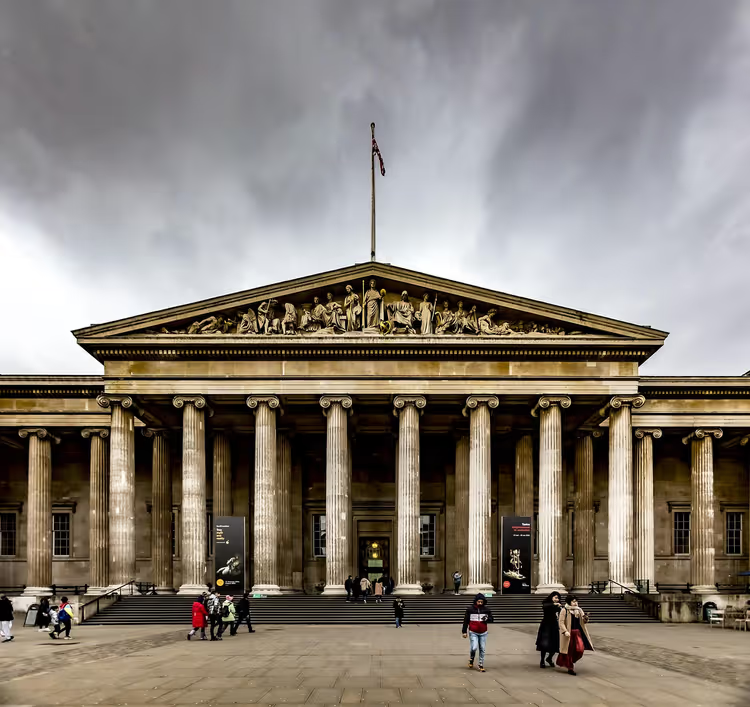
British museum: what to see and how to get in without queuing
The British Museum in London takes time. In 2025 it welcomed about 6.44 million visitors (as of 09/2026, ALVA). In summer there is a line at the Great Russell Street entrance, and inside it is easy to get lost: 94 galleries and roughly 8 million objects (as of 09/2026, museum collection).
We have sorted the museum out for you. Below are hours and admission, the departments with their key objects, the route from the Tube, and honest answers to frequently asked questions, so you know right away what to see first.
Ad: this article contains affiliate links: we earn a commission if you book through them, at no extra cost to you.
What to know before your visit
💡 In short:
- Admission to the permanent galleries is free; you only pay for temporary exhibitions.
- The museum is open daily from 10:00 to 17:00, with longer hours on Fridays (as of 09/2026, opening hours).
- The nearest Tube stations are Tottenham Court Road and Holborn, about a five-minute walk.
- Prices and opening hours: 09/2026, checked on the museum's official website.
Check the hours before your trip: individual galleries are sometimes closed.
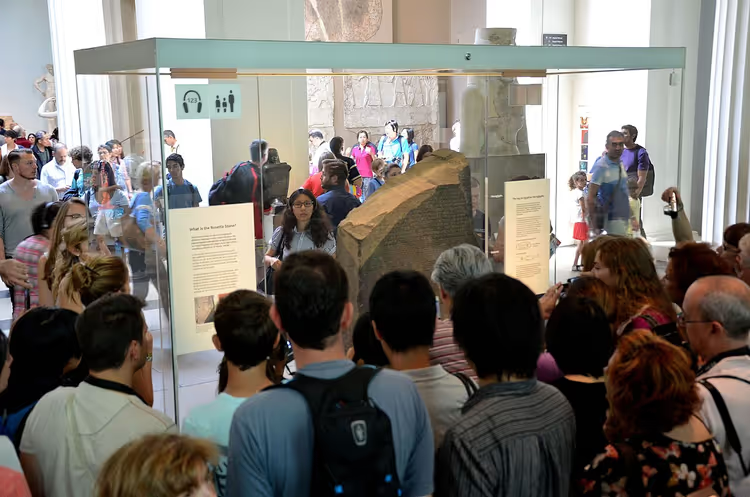
Come at opening time or after 15:00. In the morning the rooms with the Rosetta Stone and Egyptian mummies are almost empty; at midday you can barely move there. Midweek is calmer than weekends.
Plan for at least three hours. In that time you can cover Egypt, the classical world, and the Middle East. If you stay longer, add Asia and the coin gallery.
Two entrances lead inside: the main one on Great Russell Street and a side one on Montague Place (as of 09/2026, britishmuseum.org). The second entrance is usually shorter, so use it at peak times.
History of the museum
 © Elliott Brown from Birmingham, United Kingdom · CC BY-SAPhoto: Elliott Brown from Birmingham, United Kingdom, CC BY-SA (https://creativecommons.org/licenses/by-sa/2.0), Wikimedia Commons
The museum was founded in 1753 by an act of Parliament (as of 09/2026, on the museum's founding). Its core was three private collections: the holdings of the physician and naturalist Hans Sloane, the manuscripts of Robert Cotton, and the books of Robert Harley, Earl of Oxford.
Sloane collected everything: plants, coins, antiquities, and books. He bequeathed his collection to the nation, and Parliament paid his heirs an agreed sum. Cotton's manuscripts gave the museum the foundation of its future library, and Harley's books supplemented it.
The museum welcomed its first visitors in 1759 at Montagu House in Bloomsbury (as of 09/2026, first visitors). George II donated his library to it and issued a decree: English publishers were required to send one copy of every book. That law still applies today.
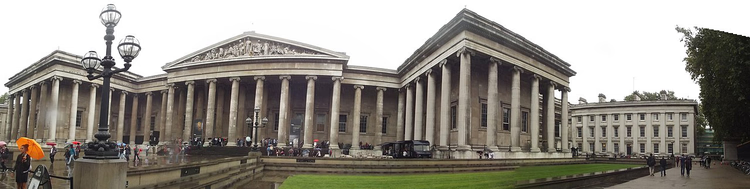
The collections kept growing, and space ran out. In 1823, Montagu House was demolished and construction began on a new building designed by Robert Smirke (as of 09/2026, building architecture). The classical facade with columns remains the face of the museum today, and in the 19th century a domed reading room was added.
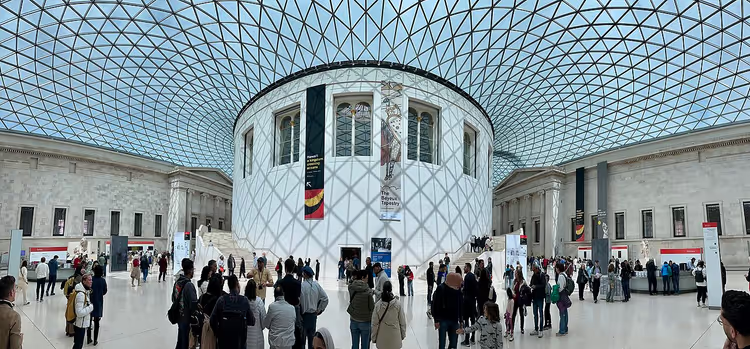
In 2000, Norman Foster covered the inner courtyard with a glass roof, creating the Great Court (as of 09/2026, glass roof over the courtyard). Tours start here, and this is also where the security screening line forms.
A restoration workshop was established at the museum in 1918, and it has operated continuously since 1931 (as of 09/2026, museum history). Two major institutions later split off from the museum: the Natural History Museum in 1881 and the British Library in 1973.
Museum departments and collections
 © APK · CC BYPhoto: APK, CC BY (https://creativecommons.org/licenses/by/4.0), Wikimedia Commons
The collection grew not only through purchases and gifts. Many objects came to London during the colonial era, and disputes about their return continue to this day. Below are the main departments worth distinguishing so you don't waste time running around the entire building.
Department of ancient Egypt and Sudan
 © Adrian Grycuk · CC BY-SAPhoto: Adrian Grycuk, CC BY-SA (https://creativecommons.org/licenses/by-sa/3.0/pl/deed.en), Wikimedia Commons
This is the second most comprehensive Egyptian department in the world after the Cairo Museum, and it is enough to trace the entire history of the country. The foundation was laid by Hans Sloane's gift: he donated the first authentic objects to the museum.
The collection then grew through trophies and excavations. After Napoleon's army was defeated in Egypt in 1801, the antiquities he had collected were brought to London, including the Rosetta Stone (as of 09/2026, reference on the stone). In the early 20th century, the Egypt Exploration Fund worked in Egypt, and finds went straight to England, sometimes without the consent of local authorities.
Most visitors head to the fourth gallery. Here you will see three things:
- The Amarna letters: clay tablets with correspondence between Egyptian and Syrian rulers.
- The Battlefield Palette: a stone slab with battle scenes.
- The Rosetta Stone: a decree of Ptolemy written in three different scripts.
Nearby is a large collection of mummies and sarcophagi, only slightly inferior to the one in Cairo. Far from everything is on display: most of the holdings are in storage, where you won't be allowed.
Department of Greece and Rome
 © Unknown author · CC BY-SAPhoto: Unknown author, CC BY-SA (https://creativecommons.org/licenses/by-sa/2.0), Wikimedia Commons
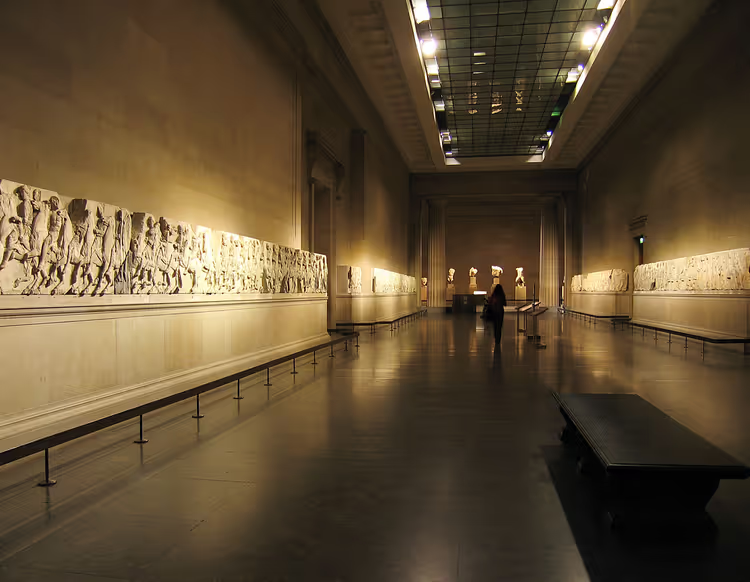
The second most important department and the largest by area. It covers Crete, Athens, Mycenae, Lycia, Ephesus and Cyprus, as well as the entire history of the Roman Empire. It houses the Parthenon sculptures, which Greece demands be returned (as of 09/2026, reference on the marbles).
There is no systematic display, but the cases show how people lived from the Etruscans to late Rome:
- Etruscan case: chariot racing and burial rites came to the Romans from them.
- Bronze, glass and clay vessels with battle scenes and portraits of heroes.
- Everyday objects: oil lamps, candle holders, combs and hairpins.
- Statues of fired clay, marble and bronze.
- Surgical instruments, next to figures of the human body in cross-section.
- Gold jewelry that modern jewelers cannot always replicate.
The highlights here are fragments of two wonders of the ancient world: the Temple of Artemis at Ephesus and the Mausoleum at Halicarnassus. Look for them at the end of the gallery.
Department of the Middle East
 © Allan Gluck · CC BYPhoto: Allan Gluck, CC BY (https://creativecommons.org/licenses/by/4.0), Wikimedia Commons
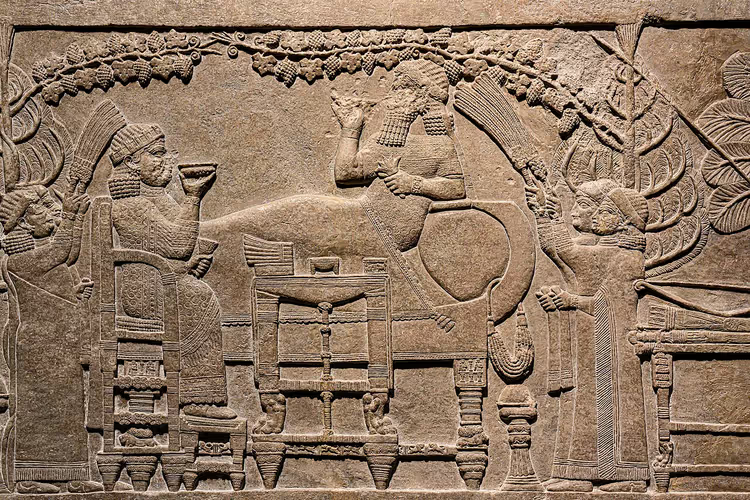
The first objects arrived here in 1772, and today it is one of the largest collections from the region in the world (as of 09/2026, description of the Middle Eastern collection). The main influx came in the 19th century, when excavations began in Mesopotamia and Iran.
Particularly valuable items include:
- Reliefs from Assyrian palaces and the archives of Assyrian kings.
- A collection of Islamic art: tiles, ceramics, glass and personal seals.
- The Oxus Treasure with silver and gold jewelry.
- The Library of Ashurbanipal: clay tablets with cuneiform, including a tablet about the Great Flood from the Epic of Gilgamesh.
- The Sumerian collection from the city of Ur: the oldest board game and the oldest stringed instrument, as well as the "Standard of Ur".
Only a small part of the holdings is on display; the rest is available only to researchers. So the department is worth viewing slowly and with an audio guide.
Department of Prehistory and Europe
 © Ilya Grigorik · CC BY-SAPhoto: Ilya Grigorik, CC BY-SA (https://creativecommons.org/licenses/by-sa/3.0), Wikimedia Commons
This department brings together finds from the Stone Age to the Middle Ages, and the early medieval period is represented by the largest collection in the world. The sections are arranged by era:
- Prehistoric: from the lovers figurine from Bethlehem to the hoard of silver objects from Cordoba.
- Roman Britain: wooden writing tablets and jewelry. Worth singling out is the Lycurgus Cup: it was not made in Britain, and its glass changes color from red to green depending on the angle of light.
- Early medieval: weapons, objects from noble burials and the Franks Casket made of whalebone.
- Medieval: the Crosier of Kells, the St. Agnes Cup, a reliquary for the Crown of Thorns and the Lewis chessmen.
Almost all the objects are in excellent condition, so they are interesting to examine even without labels.
Department of Asia

The department covers the Asian part of the world, except for Western Asia: that belongs to the Middle Eastern collection. The chronology is broad, from the Neolithic to the present day. It also houses the largest collection of Japanese art in the West.
Look at the inlay work: even ordinary utensils are decorated with semi-precious stones.
Department of Africa, Oceania and the Americas
 © Osama Shukir Muhammed Amin FRCP(Glasg) · CC BY-SAPhoto: Osama Shukir Muhammed Amin FRCP(Glasg), CC BY-SA (https://creativecommons.org/licenses/by-sa/4.0), Wikimedia Commons
The core of the collection was formed by the collections of William Oldman, Henry Christy and Harry Beasley. The collection continues to grow, and some objects are more than two million years old (as of 09/2026, description of the Africa and Oceania department). These objects show the life of Africa, Oceania and both Americas.
The Americas take center stage: Maya door lintels, Aztec turquoise work and finds from Mexico. For Africa, the collection is strong in weapons and textiles, as well as bronze busts from Benin and a brass head of a Yoruba ruler. From the Caribbean region, there are Zemi statues from Jamaica.
Department of Coins and Medals
 © Photograph by Mike Peel ( www.mikepeel.net ). · CC BY-SAPhoto: Photograph by Mike Peel ( www.mikepeel.net )., CC BY-SA (https://creativecommons.org/licenses/by-sa/4.0), Wikimedia Commons
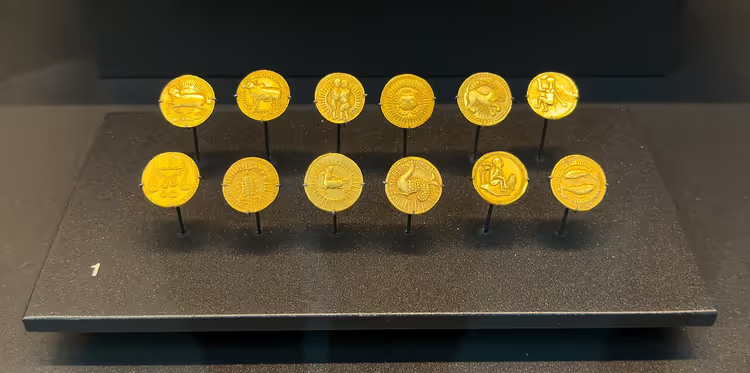
One of the largest departments in the museum. The collection numbers in the millions of objects, but only a small part is displayed in the gallery. The exhibition answers simple questions: where coins were first minted, why money is needed and how it was counterfeited. It also explains how a fake coin differs from a real one and why states removed counterfeits from circulation.
A separate highlight is Michael Crawford's electronic "Living Catalog." It describes the coins of the Roman Republic in order, so numismatists and students use it like a textbook. Data is added to the catalog constantly, and the photographs are in high resolution. If you are interested in economics, you will be here for a long time.
Department of Prints and Drawings
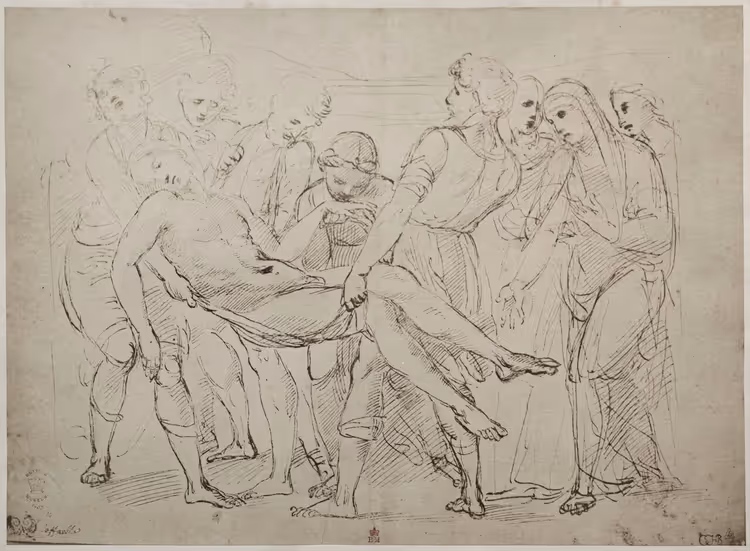
In importance, the department is compared to the Uffizi Gallery, the Hermitage, the Albertina and the Louvre. It holds millions of prints and tens of thousands of drawings, including works by British artists. Some of the sheets can be found in the museum's electronic catalog.
Key works:
- "Head of the Dead Christ" by Albrecht Dürer.
- A sketch of war machines by Leonardo da Vinci with a note about the harm of war.
- "Nude Man with Raised Arms" by Raphael.
- "Knight, Death and the Devil" by Dürer, an engraving on a copper plate.
- A portrait drawing by Michelangelo.
- "Portrait of an Englishwoman" by Hans Holbein the Younger.
The department has no permanent exhibition: drawings and prints are shown only in temporary exhibitions.
Hundreds of thousands of sheets have already been digitized, so you can look up the works you need in the catalog in advance. The department also holds drawings by British artists that you will hardly find in other museums.
Famous exhibits
 © Lewis Clarke · CC BY-SAPhoto: Lewis Clarke, CC BY-SA (https://creativecommons.org/licenses/by-sa/2.0), Wikimedia Commons
After the departments, take a look at the objects that draw the main crowds.
- The Rosetta Stone. The inscriptions on it became the key to deciphering Egyptian script and helped Champollion (as of 09/2026, how the script was deciphered).
- The mummy of the singer of Amun-Ra, Katebet. The sarcophagus was originally made for a man, and the priestess's organs were not fully removed.
- The Parthenon sculptures. A controversial set: Greece demands the return of the marbles taken away in the 19th century (as of 09/2026, Greece's demands).
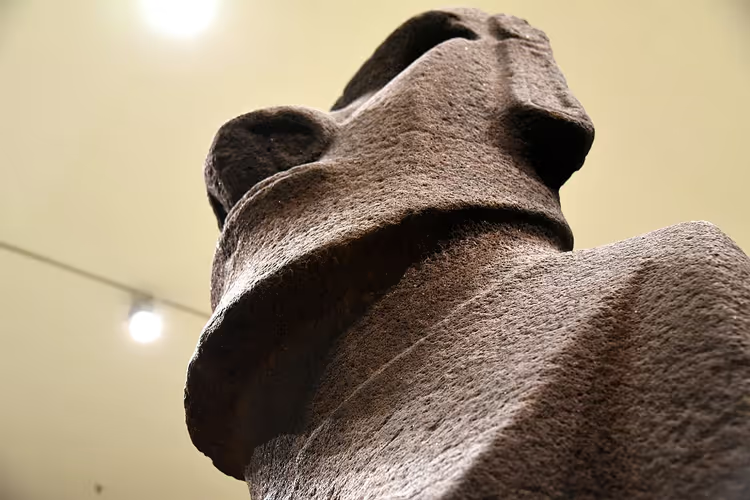
- Hoa Hakananai'a. A basalt statue from Easter Island, with paint flaking off in places.
- A fragment of the Great Sphinx's beard, found in Giza.
If you only need these items, don't waste energy on the whole route. Egypt and antiquity account for most of the list.
Library and reading room
 © Thaler Tamas · CC BY-SAPhoto: Thaler Tamas, CC BY-SA (https://creativecommons.org/licenses/by-sa/4.0), Wikimedia Commons
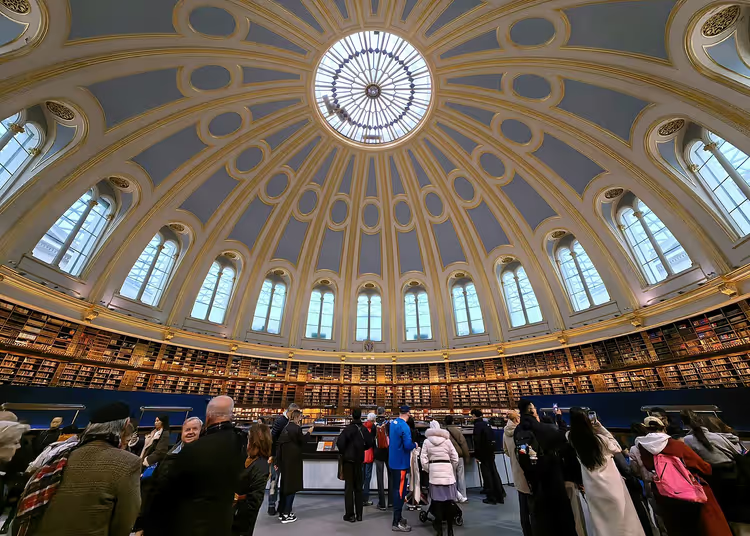
The library grew out of the same three collections and received its status in 1753 (as of 09/2026, about the history of the collection).
In 1823, King George IV gave the library tens of thousands of volumes, and in the second half of the 19th century the reading room opened to the public. Karl Marx and Vladimir Lenin worked here.
Today the collections are digitized, and you order the book you need in advance through the catalog. Part of the former collection, including the Codex Sinaiticus, moved to the British Library after 1973 (as of 09/2026, British Library status).
Tickets, hours and tours
For temporary exhibitions, it is better to buy tickets online: the ticket office at the entrance is slower.
The fastest way to see the museum is with a guide: you will cover the main galleries in a couple of hours and won't get lost. Book a British Museum tour with skip-the-line entry on GetYourGuide.
Tours and tickets in London
Guided tours, skip-the-line tickets and activities — most offers can be cancelled free of charge.
See offers on GetYourGuideThe widget loads once you give your consent.
Where else to go in London
The British Museum is in Bloomsbury, near the British Library and Russell Square. If you have time, walk to Covent Garden: it is about 15 minutes on foot along New Oxford Street.
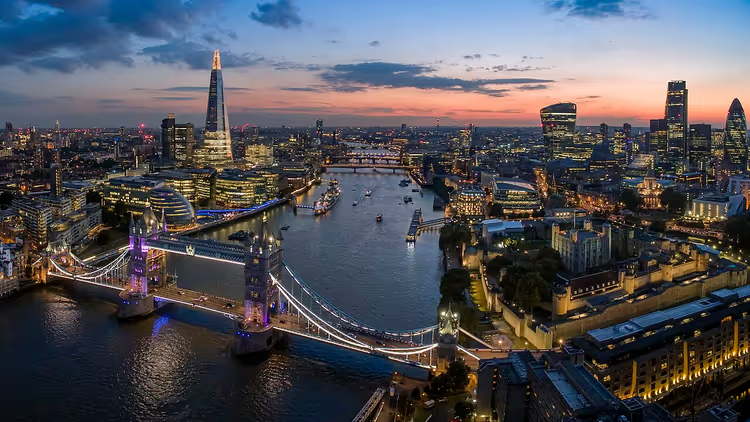
Further down your list are other areas: the Tower and Tower Bridge, Westminster Abbey, St Paul's Cathedral and the London Eye. All of them are further from Bloomsbury, so it is easier to get there by tube than on foot. For one of them, it is convenient to buy a ticket in advance so you don't have to queue at the ticket office: Tower of London ticket with skip-the-line entry.
How to get to the museum
Address: Great Russell Street, Bloomsbury, London WC1B 3DG (as of 09/2026, address and entrance).
More than twenty bus routes pass by the museum.
Choose Tottenham Court Road if you are coming from the center: there are cafes on the way from the station. If you arrive by train, go to Tottenham Court Road tube station and walk from there: changing to a bus will only make the journey longer.
British Museum on the map
The museum occupies a block between Great Russell Street and Montague Place. Open the map and build a route from your hotel or station. If you are walking from Trafalgar Square, allow about half an hour for the journey.
⁉️🤔 Frequently asked questions
How much does it cost to enter the British Museum?
Entry to the permanent galleries is free for everyone; you only pay for temporary exhibitions. Tickets for those are sold online and on site, and prices depend on the project. Check the opening hours on the official website before your trip: some galleries are closed on installation days.
How much time do you need to see it?
Three hours is enough for the highlights: Egypt, Greece and Rome, and the famous exhibits. If you want to cover the other departments too, plan a full day. Over several visits you can take your time, and you still don't need a ticket.
When is it least crowded?
It is quietest in the middle of the week and right after opening. Come at 10:00 or after 15:00, and there is almost no queue at the Rosetta Stone and the Egyptian mummies. In summer and during school holidays, it is better to book a tour in advance.
How do you get there from the tube?
The closest stations are Tottenham Court Road and Holborn, each about 500 m away. Russell Square and Goodge Street are slightly further. The entrance on Montague Place is usually less busy than the main one on Great Russell Street.
Can you take photos in the museum?
In the permanent galleries, photography is allowed for personal use; it is better not to bring a flash or tripod. Temporary exhibitions sometimes prohibit photography: check the signs at the gallery entrance. Confirm the rules on the museum's official website.
In short: what to book
If you are short on time: arrive at opening, get an audio guide and head straight to Egypt and Greece and Rome. If you are traveling with children: start with the mummies and finish in the coin room. If you want to see the city as a whole: check out London tours on GetYourGuide.

A small editorial team writing guides for independent travel. We travel ourselves, but we haven’t been everywhere, so we check prices, opening hours and how to get there against official sources.