
















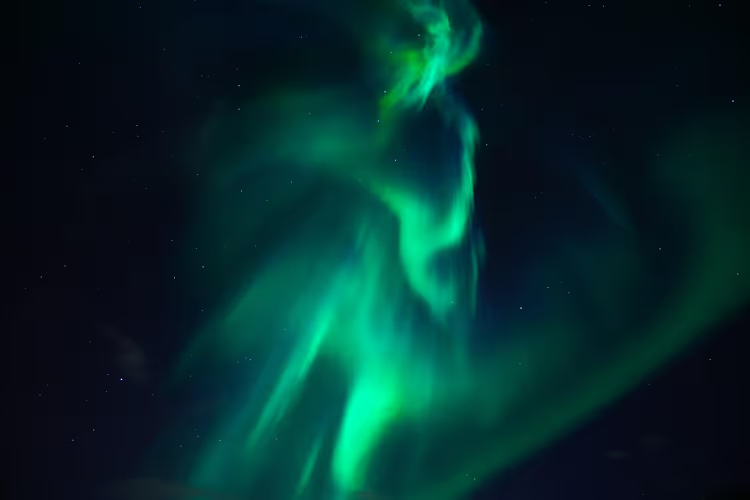
Northern lights in Abisko: season, tours and the ride up to the viewing platform
Abisko sits under the auroral oval in the north of Sweden.
The surrounding mountains keep clear skies over the valley even when the whole region is covered in clouds. That is why people come here specifically, to the national park by Lake Torneträsk, to see the northern lights. The Aurora Sky Station observation point on Mount Nuolja operates in the evenings, and the ascent to 900 m takes 20 minutes (as of 09/2026, Aurora Sky Station website).
Below, we cover the season, prices, tours, and the clothing you will need to stand under the lights all night.
Ad: this article contains affiliate links, we earn a commission if you book through them, at no extra cost to you.
Why you can see the lights in Abisko when the whole north is covered in clouds
💡 In short:
- The hunting season runs from late September to early April, with the peak from mid-November to mid-March.
- The Aurora Sky Station observation point sits on Mount Nuolja at 900 m, and the ascent takes 20 minutes.
- Plan for at least 3-4 nights: one clear night guarantees nothing.
- Prices and opening hours: 09/2026, verified on the official station website
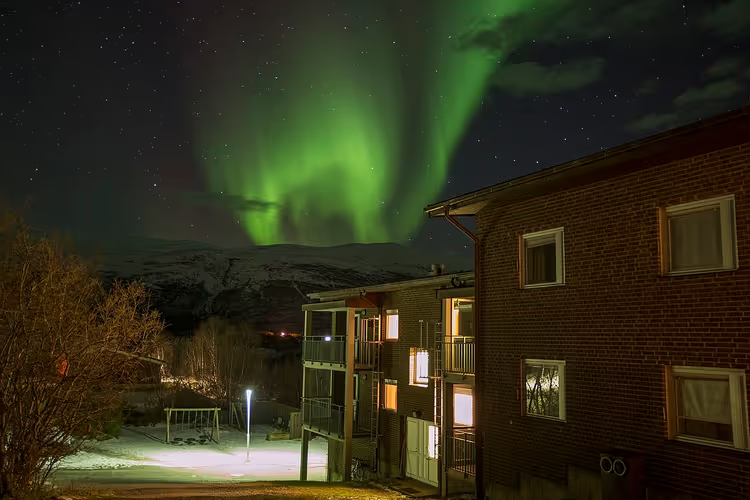
Abisko is considered the best place to see the northern lights in Sweden. The reason is not luck alone, but a combination of geography, microclimate, and infrastructure. The national park lies about 200 km north of the Arctic Circle, directly under the auroral oval (as of 09/2026, official station website).
The auroral oval is a ring-shaped zone around the Earth's geomagnetic pole. Inside it, solar wind particles collide with the atmosphere and ignite green and purple bands. The closer you are to the center of the oval, the more frequent the bursts.
The combination of clear nights, darkness, a position under the oval, and easy access makes Abisko one of the most reliable places in the world for hunting the lights. Below, we break down each of these reasons in detail.
Inside Abisko National Park: the "blue hole" and dark skies
Abisko National Park occupies a valley between the mountains and Lake Torneträsk. All the conditions for the lights come together here, but the main one is the climate. Locals call it the "blue hole," and there is no exaggeration in that name.
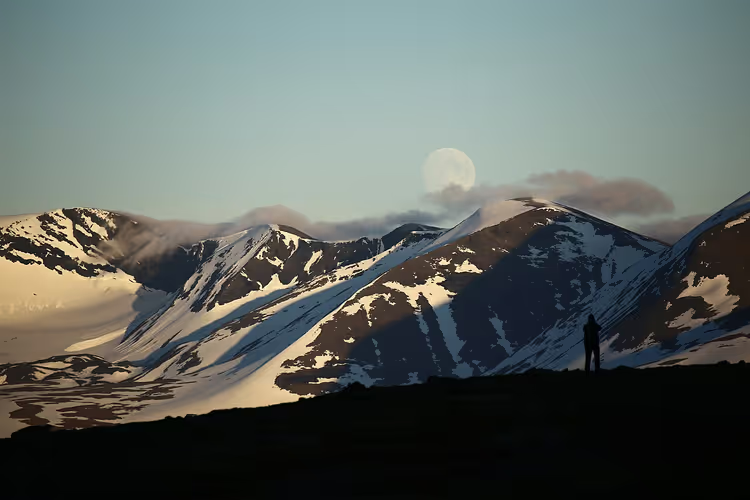 © Jojoo64 · CC BY-SAPhoto: Jojoo64, CC BY-SA (https://creativecommons.org/licenses/by-sa/4.0), Wikimedia Commons
How the "blue hole" microclimate works
A patch of clear sky often remains over Abisko even when neighboring areas are covered in clouds. The surrounding mountains act as a rain shadow. Moist air rises up the slopes, releases its precipitation, and arrives in the valley already dry.
That is why Abisko is considered one of the driest places in Sweden, despite its northern latitude. It receives noticeably less precipitation than neighboring valleys, and clear nights are more frequent here than anywhere else in the region.
The effect is especially pronounced in winter. While a cloud front hangs over all of Northern Scandinavia, a window of clear sky often opens over the valley. It is precisely in those windows that the lights flare up. For an aurora hunter, this means one thing: you are not dependent on a single lucky evening, you get several attempts per trip.
Minimal light pollution
The second factor is the absence of light pollution. The park lies far from major cities, so the night sky stays truly black rather than gray-orange, as in the suburbs of Europe.
Under such a sky you can see not only the lights, but also the Milky Way, meteors, and faint bursts that are simply invisible in lit areas. For photographers, this is a decisive advantage: the shot comes out clean, without an orange glow on the horizon.
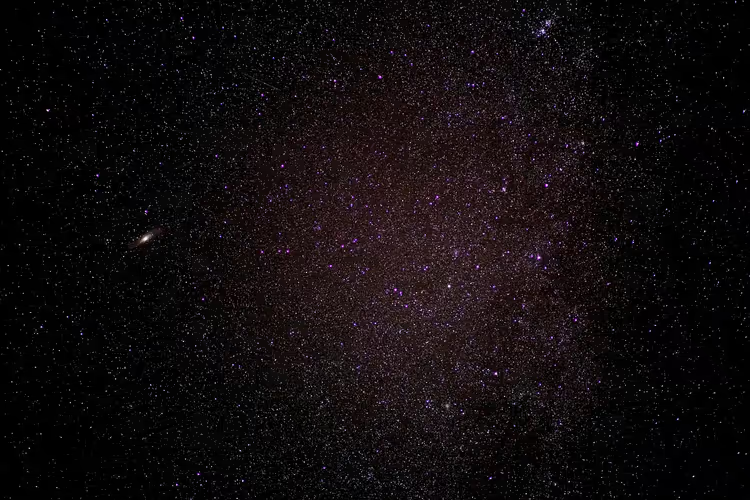
Dark skies also matter for your eyes. When there are no streetlights around, your vision adapts faster, and you begin to make out the structure of the lights: not a uniform green patch, but bands, arcs, and "coronas."
Position under the auroral oval
The third factor is latitude. Abisko sits almost in the center of the auroral oval, the zone where the lights appear most often. This means that even with weak solar activity, there is a chance to see bands in the sky here.
In many northern towns, the hunt depends on the strength of the geomagnetic storm. In Abisko, the threshold is lower. A small disturbance is enough to ignite the aurora over the valley, so an evening without the lights here is the exception, not the rule.
Road access and convenient logistics
The fourth factor is accessibility. Despite the wild nature, Abisko is easy to reach. From Kiruna, which has an airport with daily flights from Stockholm, both train and bus run to the park.
The journey takes about an hour, so you do not spend a whole day on the transfer. At the same time, the distance from major cities preserves the dark skies. This combination of convenience and true remoteness is rare (according to Visit Sweden).
Kiruna as a base before heading to the park
Many travelers stay in Kiruna and take evening tours to Abisko. The town is larger, with more hotels, restaurants, and transfers. From here, train, bus, and car all go to the park.
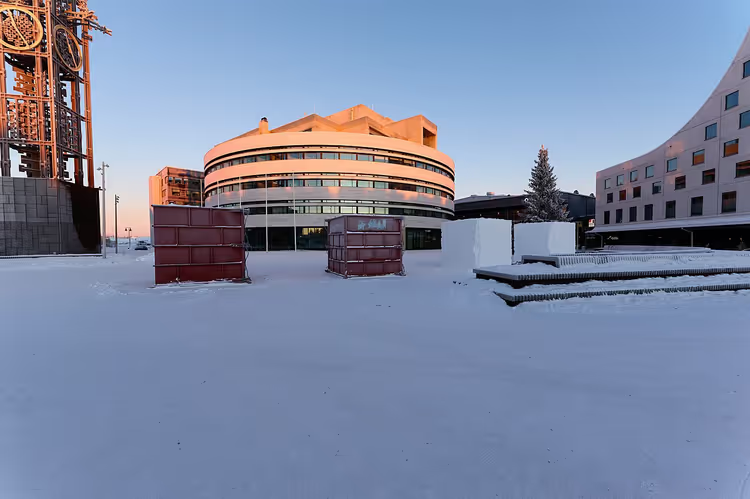
If you are going for several nights, staying in Abisko itself is more convenient: you step out to the lake and do not spend the night on the drive back. If time is short, a base in Kiruna gives you more flexibility and a wider choice of tours.
Both points lie in Swedish Lapland, so the lights are accessible from either. The only difference is logistics and how many nights you are willing to spend in the dark. We cover tour and accommodation options in more detail below.
Aurora Sky Station: how to get up and what's there
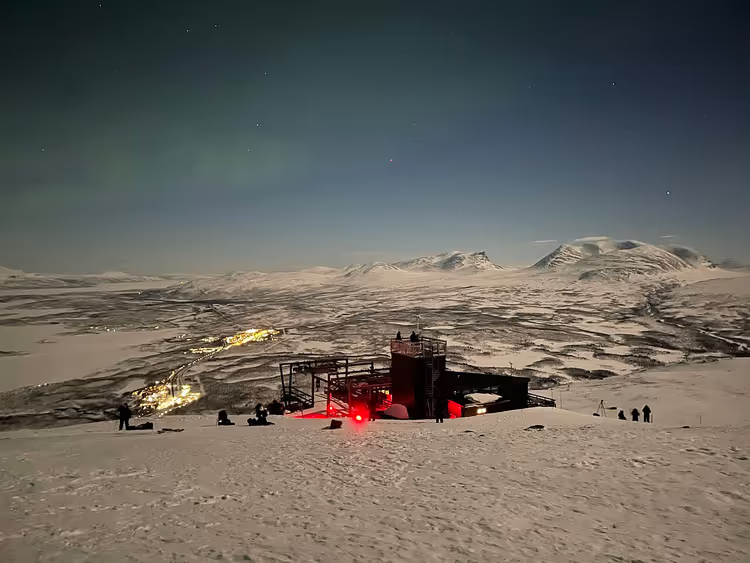
Aurora Sky Station sits on Mount Nuolja at an elevation of 900 m (as of 09/2026, station page). It's a viewing platform above the tree line with a 360-degree view of the horizon. This vantage point lets you track the aurora without changing locations.
 © Mohsen Ramezanimofrad · CC BY-SAPhoto: Mohsen Ramezanimofrad, CC BY-SA (https://creativecommons.org/licenses/by-sa/4.0), Wikimedia Commons
The station was built for one purpose: to give guests the best conditions for viewing and photographing the aurora. It operates in the evenings, when the sky is dark, and the ride up plus viewing takes several hours.
How to book and get up
The station is very popular, so you should book evening visits in advance. This is especially true from November through March, when demand peaks.
Key planning details:
- Booking: in advance, through the station's official website or regional tour operators. During peak season, open slots are almost impossible to find.
- Getting up: a 20-minute chairlift ride from Abisko Turiststation. In the evening, it runs only for station guests.
- Clothing: the station provides warm coveralls and boots for the duration of the ride and viewing.
- Hours: evening visits, with the last descent late at night (according to the official website).
You spend several hours at the station itself. The aurora often comes in waves, so a long wait increases your chances of catching a bright phase.
 © US Embassy Sweden · CC BYPhoto: US Embassy Sweden, CC BY (https://creativecommons.org/licenses/by/2.0), Wikimedia Commons
What's at the station
Aurora Sky Station is more than just an open-air platform. Inside, there's everything you need to warm up and not miss a burst of activity:
- Warm lounge: a room with large windows where you can warm up and keep watching the sky.
- Cafe and restaurant: hot drinks and light snacks, and some packages include a dinner made from local ingredients.
- Exhibition: displays explain how the aurora forms and how the Arctic works.
- Viewing terraces: several platforms at different angles for photography.
- Souvenir shop: a small shop with themed souvenirs.
The lighting at the station is kept dim and low. This helps your eyes stay adapted to the dark longer, so you see the aurora more vividly. For an observer, this matters more than it seems: bright light makes faint bands disappear.
How to photograph the northern lights
The station offers ideal conditions for photography, but the aurora requires preparation. Here's what you'll need:
- Gear: a camera with manual settings, a sturdy tripod, spare batteries, and a remote shutter release.
- Camera settings: ISO 1600-3200, aperture f/2.8-4, shutter speed 5-15 seconds. Adjust values based on the aurora's brightness.
- Lens: a wide-angle 14-24 mm with a fast aperture. It captures the entire sky in one frame.
- Composition: include Mount Nuolja or Lake Torneträsk in the frame to give the shot a sense of scale.
- Focus: set focus to infinity during the day or on a distant light before you start shooting.
The station sometimes runs photography workshops where a guide helps with settings for that specific evening. If it's your first time, this kind of help saves time and stress.
A full evening at the station
The station works as a ready-made itinerary for several hours. First, the chairlift ride up, then time on the terraces, and between outings you warm up in the lounge. This rhythm is comfortable: you're not freezing the whole time, and you don't miss any bursts of activity.
The aurora almost always comes in waves. A bright phase lasts a few minutes, then the sky quiets down for a while and flares up again. That's why it's worth staying on the mountain for more than an hour. Over the course of an evening, you'll most likely see both a calm arc and sharp, fast-moving bands.
Who the station is for
The station suits those who want to see the aurora without spending time hunting for a viewing spot. Families and guests who get cold quickly also come here: there's a place to warm up. The catch: it's the most popular spot, so during peak season the terraces are crowded, and tickets cost more than heading out to the lake on your own.
If you want to visit the station with a guide, check out Aurora Sky Station tours on GetYourGuide. This is more convenient when you're traveling without a car and don't want to deal with the chairlift schedule.
Aurora Sky Station is the most reliable option for those who want to see the aurora in comfort. The combination of altitude, dark skies, and ready-made infrastructure makes it the best spot in Sweden for viewing.
What to wear for aurora hunting in Abisko
Bring a warm windproof jacket, cold-weather boots, merino wool base layers, a fleece, gloves, a hat with ear flaps, hand warmers, and a tripod. In Abisko, you stand in one place for hours, so layers save you, not a single warm item.
Kit for a night under the aurora
Standing in the cold for several hours is the main challenge of the trip. Dress in layers so you can regulate warmth:
- Windproof jacket, the outer layer against wind and snow.
- Fur-lined boots, you'll be standing on snow and ice.
- Merino wool base layers, wick moisture away from your body.
- Fleece or sweater, an insulating layer between your base layer and jacket.
- Warm gloves, keep thin gloves separate for shooting.
- Hat with ear flaps, covered ears are essential in freezing weather.
- Hand warmers, a cheap way to endure the long wait.
- Tripod, long-exposure shots won't work handheld.
If you're given coveralls and boots at the station, still bring your own base and mid layers. Several thin layers keep you warmer than one thick one, and more importantly, you can remove or add them depending on the weather. For a first trip, this kit is enough to get you through a night in the Arctic comfortably.
When to go for the northern lights in Sweden: season by month
The northern lights season in Sweden runs from late September to early April. Within that window, some months offer noticeably better odds. Plan your trip around those months, not at random.
Best season and peak activity
The core months for hunting are mid-November to mid-March. During this period, all the conditions for viewing come together (according to Visit Sweden):
- Long dark nights: in winter, Northern Sweden enters polar night. From early December to mid-January, Abisko gets almost no daylight, so there are more hours for viewing.
- Plenty of clear nights: weather statistics show that February and March have the most clear skies. In these months, the chance of open sky is higher.
- Milder conditions: October and April bring less cold and a special quality of light, but the nights are shorter.
December and January offer the darkest nights, but also the hardest frosts. Late March adds daylight, but aurora activity is often still high. Pick your month based on what matters more to you: maximum darkness or a comfortable temperature.
Ideal viewing conditions
The season alone is not enough; conditions have to line up on a specific night. Here is what you are looking at:
- Clear sky: the main factor. Even a strong aurora is invisible through clouds, and Abisko's microclimate is exactly what raises the chance of clear windows.
- Dark moon: during the new moon and the weeks around it, the sky is darker, so faint bands show up better. During a full moon, only bright bursts are visible.
- Solar activity: the aurora is caused by solar wind, and its strength is measured with the Kp index on a scale from 0 to 9 (as of 09/2026, NOAA). For Abisko, a weak value around Kp 2-3 is enough, because you are standing under the oval.
- Time of night: the aurora most often appears late in the evening and after midnight. But bright bursts can happen at other hours too.
Many hotels and operators in Abisko wake guests when activity starts. You can sleep without risking missing the aurora.
The shoulder months work too. In October and April the nights are shorter, but the aurora is still possible and the frost is milder. For a first trip, many people choose March: the night is dark, the day is already long, and the cold is easier to handle.
How to track the forecast
Modern forecasts make the hunt more predictable. Three sources help:
- Apps: "My Aurora Forecast" and similar apps show a forecast for your location.
- Space weather prediction center: NOAA publishes data on the solar events that cause the aurora (as of 09/2026, space weather prediction center).
- Local weather: Swedish weather services give a cloud cover forecast for the Abisko region more accurately than general apps.
A forecast helps, but it does not replace time. A guide will tell you the same thing: stay for 3-4 nights. The more attempts you make, the higher the chance of catching a clear night. At the peak of the season, almost all guests in the Abisko area see the aurora within that timeframe.
Do not plan a trip around one specific night. Weather changes fast, and the "blue hole" window may open exactly on the second or third evening. Extra days matter more here than any app.
Month | What it offers | Is it worth going |
|---|---|---|
October | mild weather, start of season | yes, for a relaxed trip |
November-December | long dark nights | yes, but cold |
January-February | long dark nights, more clear nights in February | yes, best balance |
March | many clear nights, longer days | yes, for combining with daytime |
April | mild, shorter nights | for mixed programs |
Northern lights tours in Swedish Lapland: options and prices
Swedish Lapland has tours for every need, from a short evening outing to a multi-day trip. The guide handles the driving, finding clear skies, and explaining the science. All you have to do is dress warmly and look up.
A tour isn't just for beginners. Even experienced chasers book an outing so they don't have to find a viewing spot and monitor the forecast all night on their own.
Evening northern lights outings
This is the simplest format. A group is driven to a chosen location for 3 to 4 hours, based on that evening's weather. The guide helps with photos, talks about the aurora, and often brings hot drinks and snacks. Outings depart from Abisko, Kiruna, and other points in the region.
Photo tours
For those who want to bring home great shots, there are photo tours. The guide explains camera settings, composition, and working with light. Groups are smaller, and tripods are sometimes provided. On these outings it's easier to get a sharp image on your first try.
Minibus "chase"
A flexible format using a minivan or bus. The driver monitors the weather and forecast and heads to wherever there's a break in the clouds, sometimes dozens of kilometers from the base. This option is a lifesaver on nights with variable cloud cover.
Multi-day packages
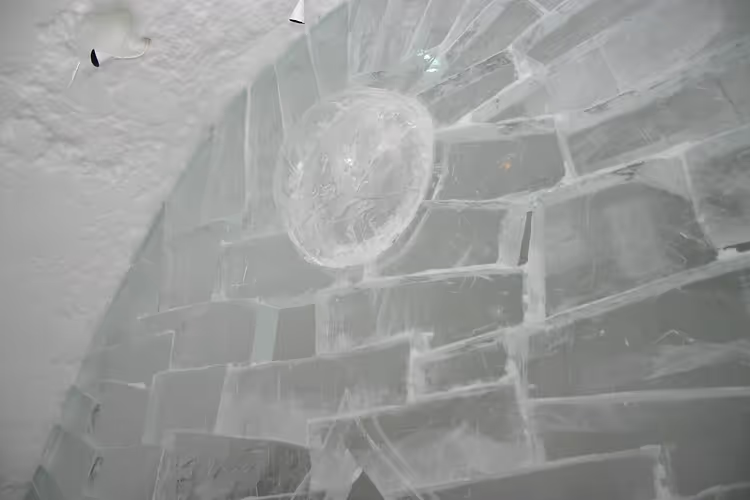
Multi-day packages include accommodation, meals, transfers, and daytime activities. They often combine aurora viewing with daytime excursions and overnight stays in unusual places, such as the ice rooms at the hotel in Jukkasjärvi.
 © Stephan Herz ( User:Stephan_Herz ) · CC BYPhoto: Stephan Herz ( User:Stephan_Herz ), CC BY (https://creativecommons.org/licenses/by/2.5), Wikimedia Commons
Tours with Sami culture
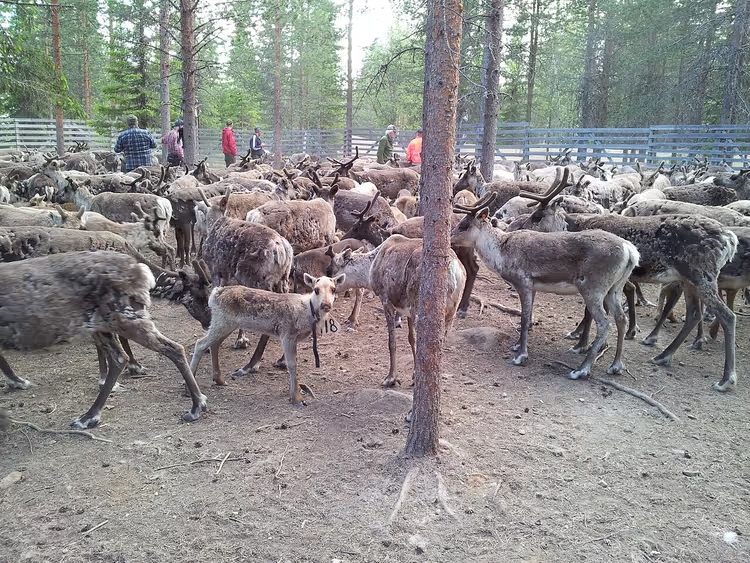
A separate format combines the aurora with Sami culture. Guests visit a reindeer farm, try local food, and hear the indigenous people's stories about the northern lights. The guide explains the significance of the aurora in Sami tradition.
 © Andersw2 · CC BY-SAPhoto: Andersw2, CC BY-SA (https://creativecommons.org/licenses/by-sa/4.0), Wikimedia Commons
How to book a tour
Keep a few practical points in mind when planning:
- Check the group size: small groups get more individual attention but cost more than large bus outings.
- Check the cancellation policy: reputable operators offer another day or a partial refund if the weather is bad.
Prices depend on the format and what's included. An evening tour with dinner costs around 2,690 SEK per person (as of 09/2026, Camp Ripan). A basic evening outing costs less, while a multi-day package costs several times more because it includes accommodation and meals.
Tour format | Duration | What's included | Price level |
|---|---|---|---|
Evening outing | a few hours | transfer, guide, hot drink | basic |
Photo tour | a few hours | photographer guide, camera help | mid-range |
Minibus "chase" | evening | transfer, guide, clear-sky search | mid-range |
Tour with dinner | about an evening | transfer, guide, dinner | mid-range and up |
Multi-day package | several days | accommodation, meals, program | high |
What's usually included in a tour
Understanding what's included helps you compare offers and avoid overpaying:
- Standard: transfer from the meeting point, guide services, hot drinks and light snacks.
- Gear: winter overalls, boots, hats, and gloves are often provided on evening outings.
- Knowledge: guides talk about the science of the aurora, local legends, and photography. Many are photographers themselves.
- Food: basic tours stick to drinks, while premium formats include dinner or cooking over a campfire.
Ask about gear separately. Overalls and boots are provided on most evening outings, but your size may run out, and then you'll have to stay warm with your own layers. Bring your own tripod and remote shutter release: they're rarely provided even on photo tours.
The guide usually explains how the aurora works and shares local legends. Many take photos and help you set up your camera or send you their shots after the tour. Confirm this when booking if photos matter to you.
Combine with winter activities
There's plenty to do in Lapland during the day, and in the evening you head back out under the sky:
- Dog sledding: by day or evening across frozen lakes and through forests.
- Snowmobiles: a guide takes you to places you can't reach by car.
- Ice fishing: traditional fishing on a frozen lake, with your catch cooked over a campfire.
- Snowshoeing: a peaceful walk through the winter forest with stories about northern nature.
- Sami culture: a visit to a reindeer herding community, crafts, and stories.
Many operators put together combined packages: an activity by day, aurora viewing by night. That way you get the full Arctic experience and don't depend on a single night.
To book tours, check out options in Abisko on GetYourGuide. You can see prices, duration, and reviews for each outing there.
Tours and tickets in Abisko
Guided tours, skip-the-line tickets and activities — most offers can be cancelled free of charge.
See offers on GetYourGuideThe widget loads once you give your consent.
Practicalities: getting there, accommodation, and nights in the Arctic
Abisko is far north, but getting there is easier than it seems. The route goes through Kiruna, there's accommodation for every budget, and most importantly, everything is close to dark skies. In this section we'll cover the practical side: how to get there, where to stay, and what to check before booking.
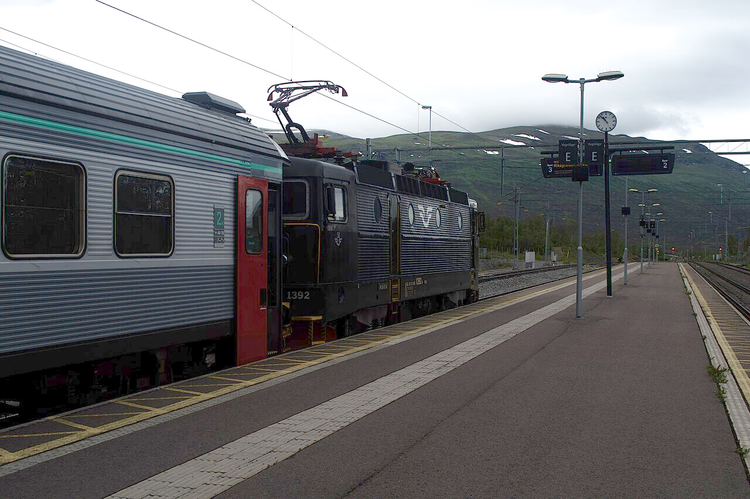 © Phil Richards from London, UK · CC BY-SAPhoto: Phil Richards from London, UK, CC BY-SA (https://creativecommons.org/licenses/by-sa/2.0), Wikimedia Commons
How to get to Abisko
The most convenient route goes through Kiruna. The city has an airport with daily flights from Stockholm. From there, trains and buses run to Abisko, and the trip takes about an hour (as of 09/2026, train schedule).
When taking the train, choose the right station. Abisko Östra is closer to the village, while Abisko Turiststation sits right by the national park and the chairlift. You want the latter if you're heading to the Aurora Sky Station (according to SJ).
Important: winter train schedules are shorter than summer ones. Check times before buying your ticket, and leave a buffer for the connection in Kiruna.
Where to stay in the Abisko valley
There aren't many options right by the park, but they're convenient for evening outings:
- STF Abisko Turiststation: a mountain station at the foot of the chairlift. It has dorm beds and private rooms with facilities.
- Abisko Guesthouse: small family-run accommodation with personal service and cozy rooms.
Accommodation near Kiruna
If you base yourself in Kiruna, you can reach the park by train or transfer:
- Icehotel in Jukkasjärvi: the famous hotel made of ice and snow near Kiruna. You can spend the night in an ice room or take a warm room in the adjacent building.
- Camp Ripan: cabins with access to Aurora Spa, where you can watch the northern lights from a warm outdoor hot tub under the open sky.
- Hotell Bishops Arms: a central hotel in Kiruna, convenient for tours that depart from the city center.
Cabins in the wilderness
For complete silence, there are options far from settlements:
- Aurora Safari Camp: lavvu-style tents with stoves and open views of the sky.
- Fjellborg Arctic Lodge: private cabins on the shore of a frozen lake, far from roads.
- Arctic Retreat: private cabins with hot tubs facing the aurora.
What to check when choosing accommodation
When booking, don't look only at the price. Ask about three things: whether there's an aurora wake-up call, which direction the windows face, and how far it is to the viewing area. Many properties in Swedish Lapland are built with large north-facing windows or glass roofs specifically for aurora viewing.
Also confirm transfers. If the hotel is far from Abisko, an evening outing can add an extra hour each way. For a short trip that's critical; for a longer one it matters less.
Small things that save you in the cold
In Abisko, the cold gets to the little things. Camera and phone batteries drain faster, so keep spares in a warm inner pocket. A thermos of hot tea warms you up faster than an extra scarf.
Bring spare socks too: if your feet get wet, you'll freeze before you get tired.
Not every hotel offers an aurora wake-up call, even if it promises north-facing views. Ask about this in advance if you don't want to keep watch by the window all night.
You can compare options in the region on Trip.com. Filter by map to see the distance to the park and the lift.
⁉️🤔 Frequently asked questions
Where is the best place to see the northern lights in Sweden?
The best place is Abisko National Park in Swedish Lapland. Its "blue hole" keeps the sky clear, there is almost no light pollution, and the valley itself lies under the auroral oval. The main viewing point is the Aurora Sky Station on Mount Nuolja, and Kiruna and the rest of Lapland are also good for hunting.
When is the best time to go aurora hunting in Sweden?
The season runs from late September to early April, with the best chances from mid-November to mid-March. Clear skies are most common in February and March, while the darkest nights occur in December and January. Plan for 3-4 nights to catch an open sky.
Why Abisko specifically, and not another northern destination?
The "blue hole" microclimate creates windows of clear sky over the valley when it is cloudy all around. Add minimal light, a location under the oval, and an easy road from Kiruna. That is why the aurora is seen here more often than in most places at the same latitude.
Which should I choose: Abisko or Tromsø?
Both towns are good for hunting. Abisko (Sweden) wins on clear skies and quiet, so it is more reliable for viewing. Tromsø (Norway) is bigger: more flights, tours, and entertainment, but the coastal weather is cloudier. Choose Abisko for clear skies, Tromsø for city life.
How much does an aurora tour in Swedish Lapland cost?
The price depends on the format. An evening tour with dinner costs about 2,690 SEK per person (as of 09/2026, Camp Ripan tour with dinner). A basic evening outing is cheaper, while a multi-day package with accommodation and meals costs several times more. A visit to the Aurora Sky Station is booked separately, and tours sell out months in advance during peak season.
Is there a guarantee that I will see the aurora?
Nobody can guarantee it; the aurora depends on the sun and the weather. But Abisko improves your chances: clear windows are more frequent here, and the activity threshold is lower. Stay for several nights and take a guided outing with someone who knows how to find clear skies. Then your probability of seeing the aurora will be high.
In short: what to book
Plan your trip around three decisions: season, accommodation, and tour format. If you are short on time: take a tour from Kiruna with a transfer. If you are going for photos: choose a photo tour and a tripod. If you want comfort: stay near the park and go up to the Aurora Sky Station. If your goal is quiet: look for a cabin in the wilderness with north-facing windows.
The season from mid-November to mid-March gives the best balance of darkness and clear nights. Book your accommodation and tour in advance, leave at least 3-4 nights in your plan, and do not count on one specific date. Then you will come back with a memory, not with regret about a missed sky.
Check hotels in Abisko and Kiruna on Trip.com and compare prices before your trip.

A small editorial team writing guides for independent travel. We travel ourselves, but we haven’t been everywhere, so we check prices, opening hours and how to get there against official sources.