





Bulgaria's coast in July: where silence awaits and where the crowds are
Bulgaria sells its coastline with a single word: cheap. The reputation is honest, but it applies to roughly fifteen kilometers out of almost four hundred. The rest of the Black Sea coast looks different: fishing towns with Ottoman architecture, river mouths in nature reserves, long empty arcs of sand. Since 2026, the country pays in euros, and doing the math on vacation has become easier.
July shows these differences better than any other month. The water is warm, the sun is reliable, and how crowded it is ranges from completely packed to deserted, sometimes within a stretch of thirty kilometers.
We compared six sections of the coast in July: Sunny Beach, Golden Sands, Sozopol, Sinemorets, Irakli, and Kamchia. By how crowded they are, water temperature, prices, and accessibility, and also by the answer to the question of who each section suits.
Bulgaria has been paying in euros since 2026
💡 In short:
- Since January 1, 2026, Bulgaria pays in euros, and the lev left circulation in February (as of 09/2026, decision on joining the eurozone).
- In July, the water stays around 23-26 °C, the air around 28-31 °C, but Sunny Beach and Golden Sands are overcrowded.
- The calmest sections: Sinemorets, Irakli, and Kamchia, but they are hard to reach without a car.
- Beach access and infrastructure: 09/2026, according to the Burgas tourist portal.
The most noticeable practical shift: on January 1, 2026, Bulgaria switched to the euro and became the 21st member of the eurozone. The lev was converted at a fixed rate of 1.95583 per euro, and since February 2026 it is no longer a means of payment.
On a trip, you get less hassle. Exchange offices with opaque rates and leftover levs in your wallet are a thing of the past. Old banknotes are accepted at banks and at the Bulgarian National Bank, and the deadlines depend on the location. Keep in mind a side effect: when switching to the euro, prices in restaurants and cafes usually creep upward. Bulgaria is still cheaper than Croatia and Greece, but no longer by as much as in the stories from a decade ago.
Water and weather in July
The Black Sea in July is noticeably warmer than the Adriatic in early summer. The average values along the Bulgarian coast look like this:
Indicator in July | Value |
|---|---|
Water temperature | around 23-26 °C |
Daytime air | around 28-31 °C |
At night | around 19-21 °C |
Hours of sunshine per day | around 11-12 |
Rain | rare, mostly short thunderstorms |
Two particularities. First: the Black Sea is less salty than the Mediterranean, roughly by half. You float less well, but your skin dries out less, and for children that is a plus. Second: on the northern coast there can be an onshore wind with waves, while the south between Sozopol and the Turkish border is usually calmer.
A July day is hot. If you are traveling with small children, schedule beach time for the morning and after 4:00 PM. Ultraviolet radiation on the coast is strong, and there is almost no shade outside the equipped areas.
Six sections of the coast compared
Section | How crowded in July | Character | Who it suits |
|---|---|---|---|
Sunny Beach (Slanchev bryag) | very high | anthill hotels, a promenade with clubs, eight kilometers of sand | package holidays, all-inclusive, families |
Golden Sands (Zlatni pyasatsi) | very high | like Sunny Beach, but by the forest and close to Varna | those who want to combine city and beach |
Sozopol | high, but mixed | old town on a peninsula, two town beaches | couples, culture lovers, modest budgets |
Sinemorets | low to medium | two natural beaches, a river mouth, Strandzha Park | nature lovers, hikers, quiet seekers |
Irakli | low | a wild beach with no development, almost no infrastructure | backpackers, campers, those who need nothing |
Kamchia | low | a river mouth, longoz forest, long sand | families, birdwatching, quiet |
The profiles of the sections and the beach lengths were checked against the official Burgas guide.
Sunny Beach: what you get for the package
Sunny Beach near Nessebar stretches for almost eight kilometers and remains the country's largest beach resort. It was built for mass tourism, and it delivers exactly what it promises: wide fine sand, a gentle entry into the water, water parks, water attractions, all-inclusive hotels, and an evening promenade with bars and entertainment.
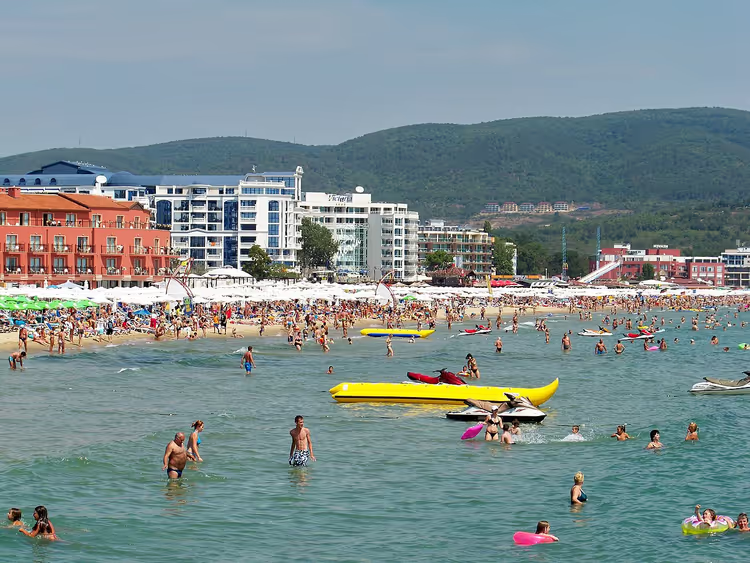 © www.vacacionesbulgaria.com · CC BY-SAPhoto: www.vacacionesbulgaria.com, CC BY-SA (https://creativecommons.org/licenses/by-sa/4.0), Wikimedia Commons
That is not a criticism. For families with children aged four to twelve and for those who want a predictable beach vacation with a clear budget, the offer is hard to beat in Europe. A week per person with flights and all-inclusive meals in July usually costs up to €1,000.
What you should know:
In July it is crowded here: sun loungers stand in dense rows, and the promenade does not quiet down until late at night.
Hotel quality varies more than in Western Europe. The number of stars says little about the actual level.
Nessebar, five kilometers to the south, is a UNESCO World Heritage site: an old town on a narrow peninsula with temples from late antiquity and the Middle Ages. During the day it is very crowded, but before nine in the morning the place looks different.
If you are traveling with children and want quiet, choose the northern part toward Sveti Vlas; it is calmer than the center.
The catch: in the central part, the promenade hums until late at night, and street-facing rooms hear all of it.
Golden Sands: the same principle, a different location
Golden Sands north of Varna works on the same model as Sunny Beach, but with two differences. The resort sits in a nature park, the forest begins right behind the hotels, and Varna is about eighteen kilometers away.
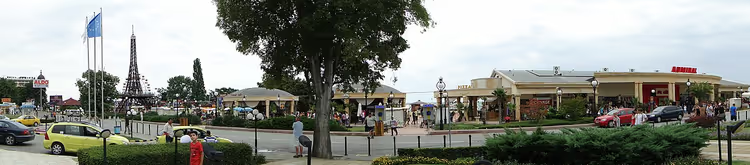 © Nikolai Karaneschev · CC BYPhoto: Nikolai Karaneschev, CC BY (https://creativecommons.org/licenses/by/3.0), Wikimedia Commons
For those who find a week of beach without a city hard to take, this is the better of the two big options. Varna offers Roman baths, a cathedral, the Sea Garden, and ordinary Bulgarian cuisine away from the hotel strip.
Two nearby sites are worth a separate trip:
The rock monastery of Aladzha in the nature park above the resort: it was carved into the cliffs, and in the 13th-14th centuries hermit monks lived here.
Balchik is about fifty kilometers north of Varna, with a botanical garden and the summer palace of Romanian Queen Marie.
The catch: the resort is built up even more densely than Sunny Beach, and the beach strip is shorter.
Sozopol: the compromise that usually works
Sozopol is recommended to those who ask where on the Bulgarian coast it is beautiful but not dead. The old town occupies a peninsula: two-story 19th-century houses on stone foundations, narrow lanes, a fortress wall, and a small fishing port.
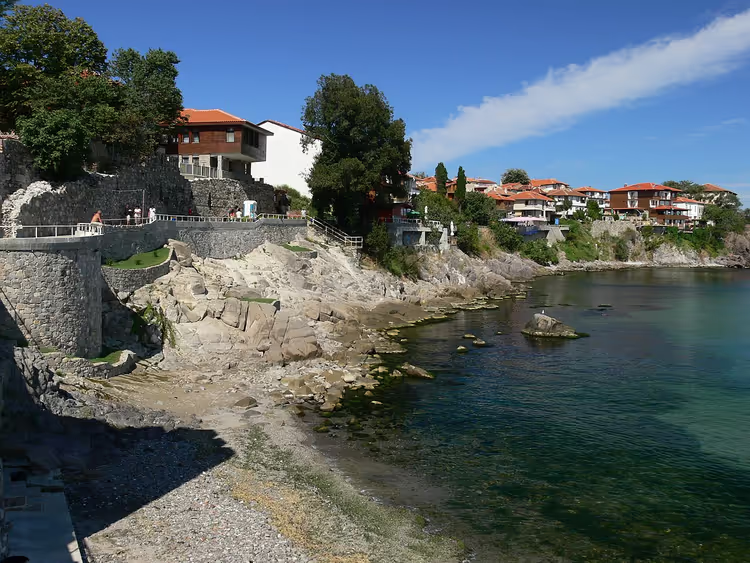 © Nenko Lazarov · CC BYPhoto: Nenko Lazarov, CC BY (https://creativecommons.org/licenses/by/2.5), Wikimedia Commons
The city was founded as the Greek colony of Apollonia in the 7th century BC (as of 09/2026, Wikipedia). It is considered one of the oldest cities in Bulgaria.
The city has two beaches. The Central Beach lies by the old town; it is small and packed in July. Harmani Beach to the south is larger and calmer. A few kilometers further on stretch the long beaches of Kavatsi and Smokinya, and both are noticeably less developed.
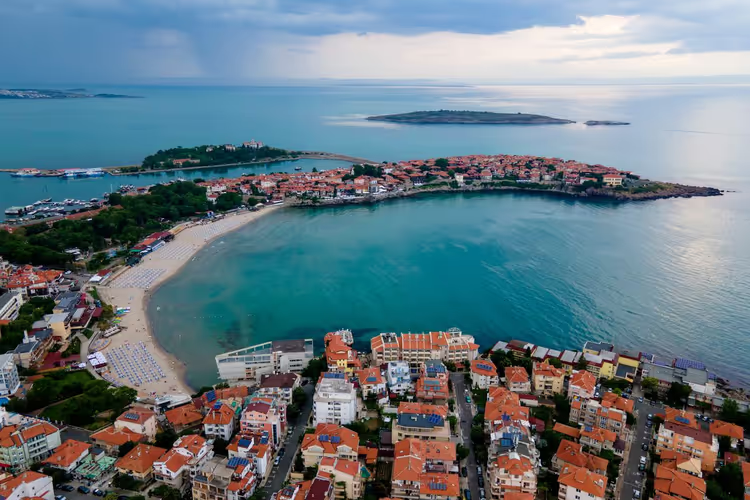
In July Sozopol is busy, but not in the same way as Sunny Beach. Bulgarians themselves love the place, the crowd is mixed, and in the evening people go to restaurants with sea views rather than to big discos. Price-wise the city sits in the middle of the range: fish restaurants in the port are noticeably more expensive than places two streets back from the sea.
How to get there: Sozopol lies about 35 kilometers south of Burgas, about 45 minutes by bus, half an hour by rental car (as of 09/2026, Burgas city tourist office).
- The catch: there is practically no parking in the old town in summer; leave your car in the lots at the entrance.
Sinemorets and Veleka beach: the southern point
Sinemorets lies at the very south, about ten kilometers from the Turkish border, in the Strandzha nature park. This is Bulgaria's largest protected area. The village itself is small and has grown somewhat in recent years, but it is still far from being a resort.
 © Andrei Stroe · CC BY-SAPhoto: Andrei Stroe, CC BY-SA (https://creativecommons.org/licenses/by-sa/4.0), Wikimedia Commons
Many people come to Sinemorets for Veleka beach. The sand spit is bounded on one side by the Veleka River and on the other by the Black Sea. You can swim in both the river's fresh water and the sea's salt water, with only ten steps between them. Loungers, umbrellas, a few beach bars and lifeguards are available, but there is no hotel strip. Just to the south begins the quieter Butamyata beach.
Seclusion comes at a price. From Burgas to Sinemorets is about 90 kilometers along a winding road, a drive of one and a half to two hours (as of 09/2026, Burgas tourist office). Getting there without a car is difficult: buses exist, but they are infrequent. If you are spending a week here, you will need a rental car or a willingness to walk constantly between the beach, the river and the village.
Hikers will appreciate Strandzha park itself: oak and beech forests with undergrowth found nowhere else in Europe in this form, and the river mouth as a bird area.
Irakli: a beach with nothing
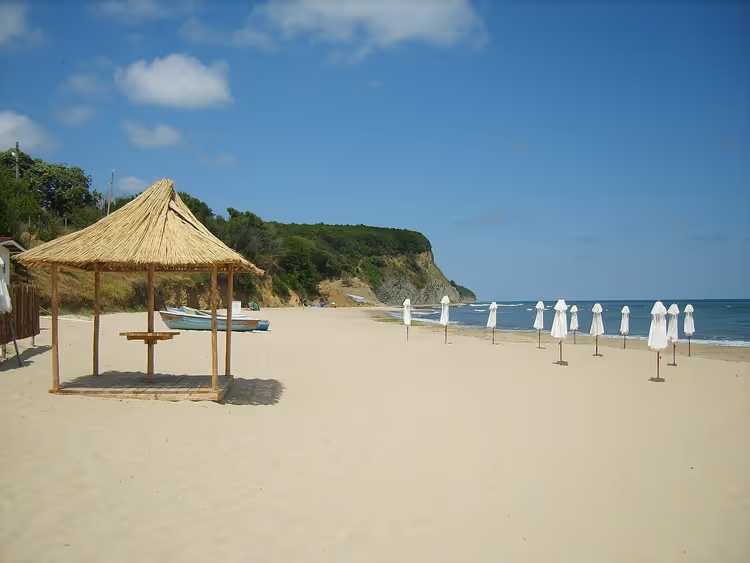
Irakli lies between Obzor and Sveti Vlas, north of Nessebar, and is considered the country's most famous undeveloped beach. There is no village, no hotels and no umbrella rental, just a few simple beach bars and toilets. The sand is coarse, vegetation starts right behind it, and even in high season it is comparatively empty here.
 © www.vacacionesbulgaria.com · CC BY-SAPhoto: www.vacacionesbulgaria.com, CC BY-SA (https://creativecommons.org/licenses/by-sa/4.0), Wikimedia Commons
Who should come: campers, backpackers, Bulgarians with tents and day visitors from Obzor. Who should not come: anyone who wants to rent an umbrella, have lunch and return to their room.
Practicalities: Irakli is reached by a dirt access road from the coastal road. Bring everything with you: water, shade, food. And keep an eye on where you park, the access road becomes difficult after rain.
- The catch: there is no infrastructure apart from a couple of bars, and for groceries you drive to Obzor.
Kamchia: river, longoz forest, long sand
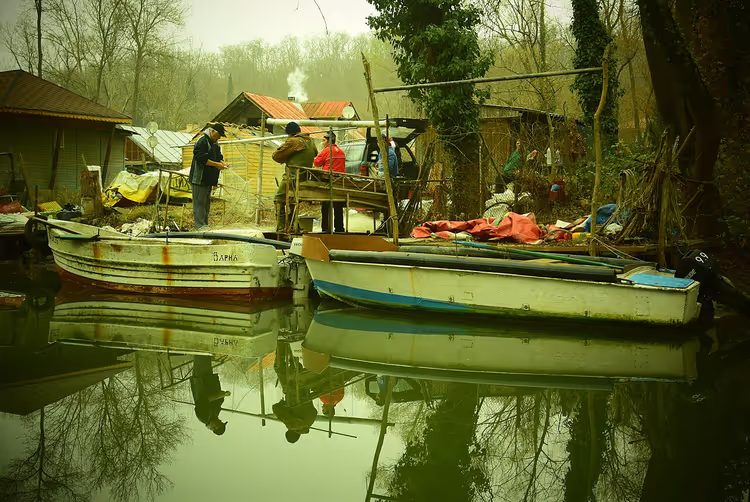
About twenty-five kilometers south of Varna, the Kamchia River flows into the sea. The surrounding area is part of a biosphere reserve: a longoz forest of ash, elm and oak with lianas, home to more than two hundred bird species (as of 09/2026, Varna tourist office).
 © Dilianakiryakova · CC BY-SAPhoto: Dilianakiryakova, CC BY-SA (https://creativecommons.org/licenses/by-sa/4.0), Wikimedia Commons
The beach nearby is long, wide and surprisingly empty in July. There are a few apartment buildings and campsites, but no hotel strip. Boat trips up the river into the longoz forest are organized: a classic activity in these parts, and for children it is noticeably more interesting than yet another water slide.
What to keep in mind: water quality at the river mouth changes after heavy rains, so swim a couple of hundred meters away from the river. And mosquitoes: longoz forest means plenty of them, especially in the evening, so pack repellent.
Prices on the ground (as of 09/2026)
We checked prices and availability on 12.09.2026 via the official Burgas portal. Approximate ranges are as follows:
Item | Price range |
|---|---|
Umbrella and lounger on an equipped beach | depends on the beach, usually from ~€5 per set per day |
Main dish at a simple local eatery | depends on the place, usually from ~€8 |
Fish at a harbor restaurant | depends on the restaurant, usually from ~€15 |
Large beer | usually from ~€2 |
Coffee | usually from ~€1.50 |
Rental car in July, per day | depends on car class and season, usually from ~€35 |
Bus Burgas-Sozopol | a few euros |
Prices for umbrellas and loungers on concession areas must be posted. Many beaches have zones where you can lay out your own towel for free. If in doubt, ask before you sit down: a typical argument on a Bulgarian beach starts precisely over someone else's lounger.
Getting there from Germany, Austria and Switzerland
In summer, charter and scheduled flights connect both coastal airports, Burgas and Varna, with numerous airports in Germany, Austria and Switzerland. The flight takes about three hours. Burgas serves Sunny Beach, Nessebar, Sozopol and the entire south. Varna covers Golden Sands, Kamchia and the north.
By car from Munich it is about one thousand seven hundred kilometers through Austria, Hungary, Serbia and Bulgaria, realistically two days on the road. Keep in mind: Serbia is not in the EU, summer border queues can be long, and Bulgarian roads require an electronic vignette, which you buy online or at the border. There are individual toll sections on the coastal road, check before you travel.
Within the coast, the main variable becomes a rental car. With a car, everything between Kamchia and Sinemorets is accessible to you. Without a car, you are limited to the resorts and the well-connected Nessebar, Sozopol and Varna.
⁉️🤔 Frequently asked questions
When is the best time to go to the Bulgarian coast, July or September?
In July the water is warmest, around 25 °C, but crowding is also at its peak, especially on Sunny Beach and Golden Sands (as of 09/2026, average water temperature in July). In September the water stays around 22-24 °C, beaches are freer and prices are lower. For quiet and budget, take the first half of September; for the warmest water, July works well.
Do I need a car to see the Bulgarian coast?
Without a car it is realistic to stay in Sunny Beach, Golden Sands, Nessebar, Sozopol and Varna: these have bus connections. Sinemorets, Irakli and Kamchia are almost unreachable without a car, and from Burgas to Sinemorets is about 90 kilometers along a winding road (as of 09/2026, Burgas portal). Rental in July costs roughly from 35 euros per day and depends on car class and season; book in advance.
How much does a lounger and umbrella cost on the beach?
On equipped sections, a set of umbrella and lounger usually costs from ~€5 per day. Many beaches have free zones where you can lay out your own towel. Prices on concession areas must be posted; otherwise ask the lounger owner before you sit down.
Are waves and jellyfish dangerous on the Black Sea?
There are no mass jellyfish on the Bulgarian coast, and the water is almost half as salty as the Mediterranean. The northern part near Varna and Golden Sands more often gets onshore wind and waves; the south between Sozopol and the Turkish border is usually calmer. With small children, still choose the morning or the time after four in the afternoon.
What changed after Bulgaria switched to the euro?
Since January 1, 2026, the country pays in euros; the lev was converted at a rate of 1.95583 and went out of circulation from February 2026 (as of 09/2026, confirmation of the euro switch). Exchange offices and dual price tags disappeared, but prices in restaurants rose slightly. Bulgaria remains one of the most affordable seaside destinations in the EU.
In short: what is worth booking
The choice is simple. If you want a predictable beach vacation with kids and an all-inclusive setup, go for the northern part of Sunny Beach. If you cannot survive without a city, choose Golden Sands: Varna is about eighteen kilometers away. A compromise between the old town, the beach, and the price is Sozopol. For quiet and nature, head to Sinemorets or Kamchia, and leave Irakli to those who are ready to bring everything with them.
Book a rental car for July in advance: without it, the southern coast and the wild beaches will remain out of reach.

A small editorial team writing guides for independent travel. We travel ourselves, but we haven’t been everywhere, so we check prices, opening hours and how to get there against official sources.