













Car rental in Croatia: from €22.62 per day and 9 booking mistakes
Renting a car in Croatia costs from €22.62 per day for a small class and from €28.06 for a compact, using Zadar as an example (as of 09/2026, ADAC comparison). In summer, the same compact costs several times more, and the price changes every day. What matters far more is how you book and which add-ons you accept at the counter.
This guide brings together real prices by season, the nine most expensive booking mistakes, road rules, ferries to the islands, and roadside assistance. That way you pay for your vacation, not for someone else's mistakes.
Ad: this article contains affiliate links, we earn a commission if you book through them, at no extra cost to you.
How much a car rental costs in Croatia
💡 In short:
- Book two to three months ahead: in summer this is noticeably cheaper than at the last minute.
- Take full coverage with no deductible online, not at the counter.
- Bring a real credit card: debit cards are usually not accepted.
- Prices and rates: 09/2026, checked on ADAC Autovermietung.
Prices depend on the season, the booking date, and the pickup location. The benchmark below is for a compact class (Polo or Fabia) with full insurance and no deductible. This is an approximate scale by season, not a price list: the comparison shows the exact price for your dates. At the height of July and August, cheap cars are already gone by March.
Season | Book early | Last minute |
|---|---|---|
January-March | yearly low | slightly more expensive |
April-May | higher than winter | noticeably more expensive |
June | high level | often several times more than winter |
July-August | yearly peak | maximum, cheap classes sold out |
September-October | lower than summer | more expensive than early booking |
November-December | yearly low | slightly more expensive |
An automatic transmission adds noticeably to the daily price. In Croatia, most cars are manual, and there are few automatics. If you want an automatic, book early, otherwise you will be left without a choice.
Nine mistakes that cost you money
1. Buying insurance at the counter
The most common and expensive mistake. You book a cheap rate online, you arrive, and the agent convinces you that your insurance covers nothing. Then you sign up for a daily surcharge that is sometimes comparable to the rate itself. In reality, full coverage with no deductible already includes glass, tires, underbody, and roof. That insurance just duplicates yours. Bring a printout of your booking and calmly say: "No, thank you, my insurance covers everything."
2. Forgetting your credit card
Without a credit card, you will not get the car. The rental company blocks a deposit on it, for regular cars usually €250-1,500 (as of 09/2026, ADAC). Debit cards are usually not accepted, prepaid cards work only sometimes. Bring a real credit card with a sufficient limit. The deposit is not charged but blocked: after you return the car undamaged, it is usually released within a few days, but the bank may add a few more days.
3. Not declaring the Neum corridor
From Split to Dubrovnik you drive 9 km through the territory of Bosnia and Herzegovina. This is the Neum corridor. Since 2022, the Pelješac Bridge bypasses it, but the old road is shorter and more scenic. The problem is different: many rental contracts prohibit crossing the border. Without a note in the contract, you lose your insurance coverage. Ask about this when booking, even if you plan to take the bridge.
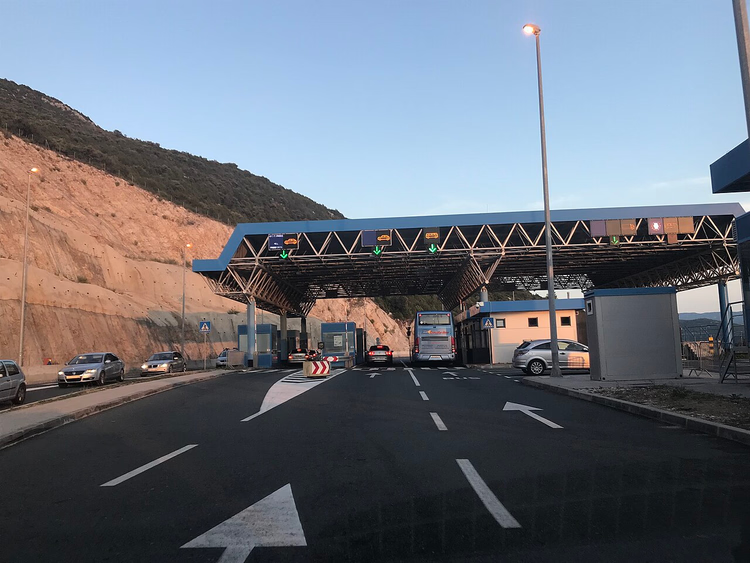 © Petr Vilgus · CC BY-SAPhoto: Petr Vilgus, CC BY-SA (https://creativecommons.org/licenses/by-sa/4.0), Wikimedia Commons
4. Underestimating one-way returns
Picking up a car in Zagreb and dropping it off in Dubrovnik is convenient. But returning in a different city comes with a separate fee, and on long routes it can be three figures. Sometimes it is cheaper to return the car in Zagreb and buy a separate bus ticket. Calculate the full amount before booking.
5. Not checking the fuel policy
The fair option looks like this: you get a full tank and return it full. Some rental companies work on a "full/empty" basis, and then you pay for fuel at their rate. It is noticeably higher than at a regular gas station. Always take "full/full". Fill up near the airport before returning the car.
6. Not photographing the car at pickup
Scratches, dents, chips: document everything at pickup. Shoot all four sides, the roof, the wheels, and the interior. If the report does not mention a dent and you have no photo, the bill will be sent to you. Take photos in daylight and email them to yourself right away.
7. Choosing the wrong car class
For the coast, a compact is enough. For the interior and gravel roads to konobas, a crossover is better: ground clearance and seating position matter there. For the islands, take the smallest class, because the streets are narrow and parking is tight. Do not pay for a large SUV if you are only driving on the highway.
8. Not booking a child seat
Children under 1.35 m must ride in a certified car seat (kroatien.de). At the rental company, the seat is charged separately for each day. Almost all airlines carry your own seat free of charge as special baggage. Bring your own if you are flying with a child.
9. Not budgeting for toll roads
Croatian motorways are toll roads. The Zagreb-Split route will cost you €26.40 for a passenger car (as of 09/2026, Hrvatske autoceste rates). Some cars come with an ENC transponder, ask about this in advance. Without it, you pay at the toll booth in cash or by card. Keep small change handy.
Which rental company to choose
The market is divided into three parts: local companies, international chains, and aggregators. Below we break down who each suits. For comparing prices and booking, the easiest option is to find a car online.
Pop Car (Zadar, Split, Zagreb)
If you are looking for a local rental company that operates honestly, take a look at Pop Car. This is a family-run company from Zadar with a strong reputation in Google reviews. The car is delivered at the airports of Zadar, Split, or Zagreb. There are no hidden fees here, and no pressure at the counter. The fleet is small but well maintained, and the full insurance is transparent. Trips to other EU countries are possible by arrangement. A separate convenience is that the company does transfers: in the evening they will take you to your hotel, and the car will be delivered in the morning.
International chains
Sixt has the newest fleet and the best online service, but it also costs the most. Counters are at all major airports: Zagreb, Split, Dubrovnik, Zadar, Pula, Rijeka. A compact at Sixt in peak season costs noticeably more than at local companies. Europcar is in the middle on price, and its counter at Split airport works quickly. Hertz and Avis rarely have the lowest prices, but they are convenient for regular customers with discounts and upgrades.
Local rental companies
Oryx Rent a Car is Croatia's largest rental company with desks in all cities and airports. Peak-season prices are usually lower than the international chains, and online booking works smoothly. Carwiz often shows the lowest price on aggregators, but its basic coverage comes with exclusions. Read the terms and take full coverage. Fleet Rent a Car operates mainly in Dalmatia and is convenient for Split-Dubrovnik returns: the drop-off fee here is lower than the chains. Nova Rent specializes in Istria and is a good fit if you are based in Pula.
Aggregators for comparing prices
CHECK24, billiger-mietwagen.de and Sunny Cars compare prices from all rental companies and include full coverage with no deductible right away. You book through the aggregator and pick up the car from a local partner. The upside is that if disputes arise, you have support in a language you understand. The catch with Sunny Cars is that you only find out which rental company you are getting when you pick up the car.
Where to pick up the car: airport or city
The airport is more convenient, but a counter inside the terminal charges an airport fee. On the other hand, you can drive straight to your hotel from here, and no separate transfer is needed. The counters are easy to spot and stay open longer. In the city it is cheaper, but first you have to get from the airport, and the counters often close at 6 or 7 p.m., so if your flight is delayed you will not get the car. Pick up at the airport if you arrive in the evening. Booking a car in advance is cheaper than deciding on the spot.
Route | Where to pick up | Which company |
|---|---|---|
Istria loop | Pula | Nova Rent |
Dalmatia from Zadar | Zadar airport | Pop Car |
Split-Dubrovnik | Split, drop-off in Dubrovnik | Fleet or Oryx |
Zagreb and Plitvice | Zagreb airport | Oryx or Sixt |
Islands from Zadar | Zadar, then ferry | Pop Car |
Kvarner and Krk | Rijeka airport | Carwiz |
Driving rules in Croatia
Speed
Road | Limit | For drivers under 24 |
|---|---|---|
In built-up areas | 50 km/h | 50 km/h |
Rural road | 90 km/h | 80 km/h |
Expressway | 110 km/h | 100 km/h |
Motorway | 130 km/h | 120 km/h |
Cameras are frequent, especially at city entrances. Police measure speed with laser. The fine for exceeding the limit by 10-20 km/h in built-up areas and by 10-30 km/h outside them is 60 €. For exceeding by more than 50 km/h the fine is 660-1,990 € outside the city and 1,320-2,650 € in built-up areas, where arrest of up to 60 days is also possible (as of 09/2026, Croatian Ministry of the Interior).
Alcohol
For drivers over 24, 0.5 per mille is allowed. For young drivers and beginners with less than two years of experience the limit is zero (bussgeldkatalog.org). Checks are strict, especially at night and on weekends. Do not get behind the wheel even after one glass of wine.
Lights
From October to March low beams are mandatory even during the day, and in summer they are not mandatory but useful: there are many tunnels and winding roads. Turn on your headlights and you will be more visible to oncoming traffic.
What you must have in the car
You need reflective vests for every passenger, a warning triangle, a first aid kit, and a set of bulbs (except LED and xenon). A rental car usually already has these, but check when you pick it up. Not having a vest can cost you a fine.
Parking
Parking in Croatian cities is a challenge of its own. Zones are marked by color. The red zone in the center is the most expensive and often limited to 1-2 hours. The yellow zone is cheaper. Each city has its own rates, check them on the machine. The green zone on the outskirts is cheap or free. You can pay by machine or SMS, which requires a Croatian SIM or roaming. The fine for parking incorrectly depends on the city and the violation.
Fuel
Maximum fuel prices are set by the government, and in September 2026 they were revised every week (Novi list). At highway gas stations the pumps work around the clock, in villages they close around 8 p.m. From September 15, 2026 the maximum price for Eurodizel is 1.85 €, Eurosuper 95 1.73 € per liter (as of 09/2026, Novi list). Calculate your fuel consumption in advance if you are going far.
Do you need a car at all
Not always. Here is an honest assessment.
Get a car if you want to explore Istria with its weak public transport, reach the countryside and national parks, drive along the coast, carry kids and luggage, or get to beaches without crowds.
You do not need a car if you are staying only in Split or Dubrovnik: the center there is pedestrian, and parking is a nightmare. You also do not need one for a stay at a single resort or for Zagreb, where trams and buses are enough. For the islands, people rent a car only with a specific plan.
Road conditions and what to expect
Motorways
A1 (Zagreb-Split) and A6 (Zagreb-Rijeka) are in excellent condition: wide lanes, clear signs, rest areas every 30-40 km. The Sveti Rok tunnel, 5.7 km long, is lit and modern. You pay at toll booths with cash, card, or via ENC. The rate depends on distance: Zagreb-Rijeka is about 10 € for a passenger car (as of 09/2026, Hrvatske autoceste).
Coastal highway
The old Magistrala, or D8, is beautiful but tough. It is narrow, winding, and in summer full of trucks and motorhomes. Average speed ends up being 60-70 km/h instead of the permitted 90. The stretch between Senj and Zadar is the most desolate and wild: the Velebit mountains drop to the sea, and the road runs along the edge. There is almost nowhere to overtake, so be patient. In July and August the Split-Dubrovnik route along the coast is exhausting, and the route via A1 and the Pelješac bridge turns out faster.
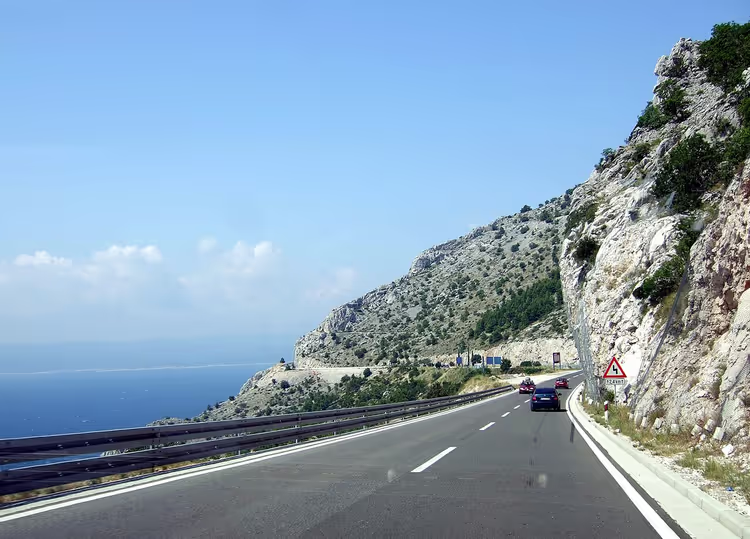 © Jos. · CC BYPhoto: Jos., CC BY (https://creativecommons.org/licenses/by/3.0), Wikimedia Commons
Countryside and islands
Dirt roads to hidden coves and mountain konobas are common. A compact car gets through almost everywhere, but ground clearance helps. On the islands the roads are narrow, and with oncoming traffic you will sometimes have to reverse to a passing point. Sheep and goats also wander on island roads. Slow down at dusk.
Roadside assistance and accidents
The Croatian assistance service HAK answers at 1987, and the call-out price depends on the situation and distance. ADAC members can call the assistance center at +49 89 22 22 22. In an accident, call the police at 112, even if the damage is minor. Without a police report you will have problems when returning the car. Photograph everything, fill out the form, and write down the other party's details.
Taking your car on the ferry: to the islands
To most islands you transport your car by ferry. The main routes depart from Split and Zadar.
Ferry | Time | Price (car and 2 people) |
|---|---|---|
Split-Supetar (Brač island) | 50 minutes | about 39 € |
Split-Stari Grad (Hvar island) | 2 hours | more expensive than to Brač, higher in summer |
Zadar-Preko (Ugljan island) | 25 minutes | cheaper than long routes |
Jablanac-Mišnjak (Rab island) | 15 minutes | short route, among the cheaper ones |
Orebić-Dominče (Korčula island) | 15 minutes | short route, among the cheaper ones |
On the Split-Supetar route in 2026 a car up to 5 m costs 26.10 €, an adult passenger 6.50 € (as of 2026, Pokret otoka based on Jadrolinija rates), for other routes check the Jadrolinija website. In summer, on the Split-Stari Grad and Split-Supetar routes in July and August, book your spot online. Without a booking, waiting in line reaches three to four hours. The state company Jadrolinija opens summer sales from June. On the islands themselves a car is not always needed. In the old towns of Hvar and Korčula it is superfluous, and buses run between villages. On Brač you can hardly manage without a car, as transport there is infrequent. Before your trip, check with the rental company whether the contract allows ferry transport. Not all companies permit it.
Renting an electric car
Electric cars are appearing more and more often in rental fleets, and the charging network is growing: on highways, in cities, at hotels. But in the countryside and on the islands there are still few stations. For a trip around Istria or the Zagreb-Split route an electric car works well, but for the Velebit coast and the islands it does not yet. Plan your charging in advance if you take an electric car.
⁉️🤔 Frequently asked questions
How much does a rental car cost in Croatia in 2026?
In the off-season, a compact starts at €28.06 per day, using Zadar as an example (as of 09/2026, ADAC), and in July and August it costs several times more. The final price depends on the booking date, pickup location, and coverage. Full coverage with no deductible is already included in the aggregator rate, so you don't need to pay extra at the counter.
Do I need a credit card for a car rental?
Yes, you almost always need a real credit card with available limit. The rental company blocks a deposit, usually €250-1,500 for regular cars (as of 09/2026, ADAC), and releases the hold after you return the car. Debit cards are rarely accepted, and prepaid cards work only sometimes.
Can I drive through the Neum corridor in a rental car?
Technically yes, but check your contract first. Many rental companies prohibit driving into Bosnia and Herzegovina, and then your insurance won't apply. If there's a restriction, take the Pelješac Bridge instead: it stays within Croatia.
Can I take the car on a ferry to the islands?
Yes, if your rental agreement allows it. Jadrolinija ferries carry cars and passengers, and in summer it's best to book a spot in advance. In the old towns on the islands, a car gets in the way, so only take one if you're planning to drive around the island.
What happens if I speed or drink and drive?
The fine for speeding 10-20 km/h over the limit in a city is €60, and over 50 km/h is from €660 outside cities and from €1,320 in built-up areas (as of 09/2026, Croatian Ministry of the Interior). Alcohol is allowed up to 0.5 per mille, but young drivers and beginners can't have any at all. Checks are frequent.
Find hotels
Compare prices across booking sites and filter for rooms with free cancellation.
Compare prices on Discover CarsThe widget loads once you give your consent.
In short: what to book
If you need one car for your entire vacation, pick it up at the airport and book two to three months in advance. If you arrive in the evening, get the car at the airport: city counters are already closed by then. For a Split-Dubrovnik route, factor in the one-way drop-off fee and consider the Pelješac Bridge. If price matters to you, a compact with full insurance and no deductible is a good fit. Compare rental prices so you don't overpay at the counter.

A small editorial team writing guides for independent travel. We travel ourselves, but we haven’t been everywhere, so we check prices, opening hours and how to get there against official sources.