
















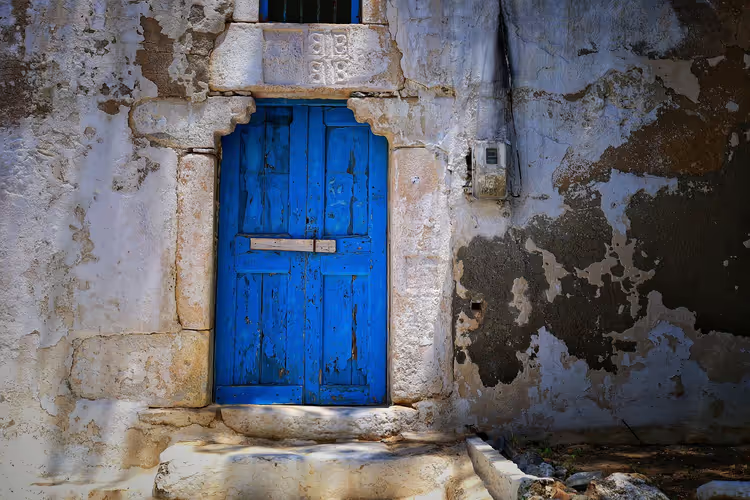
Car rental in Greece: how to rent a car without a deposit
In Greece you won't see even half the country without a car. Buses run along the coast and hardly ever go inland on the islands. Car rental solves this problem, but runs into the security deposit: the bank blocks several hundred euros on your card for the duration of the trip.
Below we've put together how to rent a car with no deposit or with a minimal hold, what documents you need, how much fuel costs, and what to watch out for on the road. We checked the terms and prices against official sources as of 09/2026.
Ad: this article contains affiliate links, we earn a commission if you book through them, at no extra cost to you.
What you need to rent a car in Greece
💡 In short:
- Bring a license held for at least one year, a passport, and a bank card in the driver's name.
- Drivers from non-EU countries need an International Driving Permit (IDP), otherwise the car won't be released.
- Book in advance: in high season the cheap classes go first.
- Look for bookings with a "no deposit" filter if you don't want funds frozen on your card.
The list of documents for renting a car is short. You need a valid license, a passport, and a bank card in the driver's name. The license must have been issued at least one year before you pick up the car.
Drivers from the EU and EEA don't need an international permit; a national license is enough. If you're coming from a non-EU country, bring an IDP along with your national license. Without it, the rental company has the right to refuse to release the car, and the police will issue a fine.
Age matters too. Small classes are available from 21, while other groups require a minimum of 25 (according to driver age requirements, 09/2026). Drivers under 25 are charged a young driver surcharge. It noticeably raises the daily rate, so calculate the total upfront.
If you only have a debit card, some local companies will still rent to you. But they'll ask for extra insurance or a larger deposit in return. Clarify these terms before paying for the booking so you don't have to sort things out at the pickup counter.
Make sure the name on the card matches the driver's name. Otherwise the deal will be canceled on the spot. Pick up the car at the airport or a city office, whichever is more convenient for starting your route.
International company or local rental
 © Jean Housen · CC BY-SAPhoto: Jean Housen, CC BY-SA (https://creativecommons.org/licenses/by-sa/4.0), Wikimedia Commons
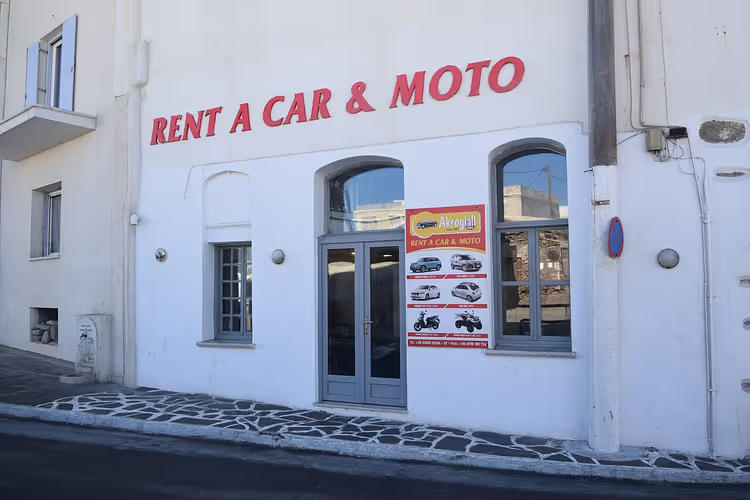
You have two paths. Large international companies keep offices at airports and operate to a single standard. Local Greek outfits charge less but require attention to detail.
You can book a car with a major brand online in advance. Take your time reviewing the rental and insurance terms, then compare price and quality. Payment happens when the contract is signed, and a deposit amount remains held on your card.
The deposit covers the rental company's minimum risks. If you drive carefully, the company returns the full deposit amount. For international companies this is standard practice, and it's almost always transparent.
A local outfit doesn't require a cash deposit as often. But the low rate may hide incomplete insurance coverage or a tired car. Choose a company with its own website and clear reviews, not the first counter by the port.
Greek companies have modest fleets. Popular models get booked up in season, so order a class with some buffer. If the specific model isn't available, the contract usually allows a replacement in the same class.
For highways and the mainland, an international company is more convenient. It will exchange the car in another city without hassle and return the deposit. For the islands, a local outfit is better: the office is near the port, and you agree on pickup terms on the spot.
Deposit and card hold
The deposit scares many travelers. In reality, you can arrange a trip without one; you just need to understand the mechanics.
Formally, the deposit freezes an amount on your card. The bank doesn't charge the money; it temporarily reserves it until the car is returned. If you return the car clean and with the same fuel level, the hold is released within a few days.
That's exactly why rental companies ask for a credit card. A debit card has less available limit, and some companies refuse it. Clarify this rule with your chosen company in advance, otherwise you'll be left without a booking at the counter.
There are several ways to find a car with no deposit. First: the "no deposit" filter on booking search sites. Second: small local companies that accept cash. Third: a rate with full insurance, where the deposit is reduced to zero or a minimal amount.
A zero deposit doesn't cancel your liability. If an unfamiliar broker offers such a rate, check what the coverage includes. Full insurance is often more expensive, but it removes the risk of a large surcharge for a scratch.
You can find a car with no deposit in advance and compare terms across all companies at once. That way you'll see the final amount before the trip, not at the pickup counter.
What determines the rental price
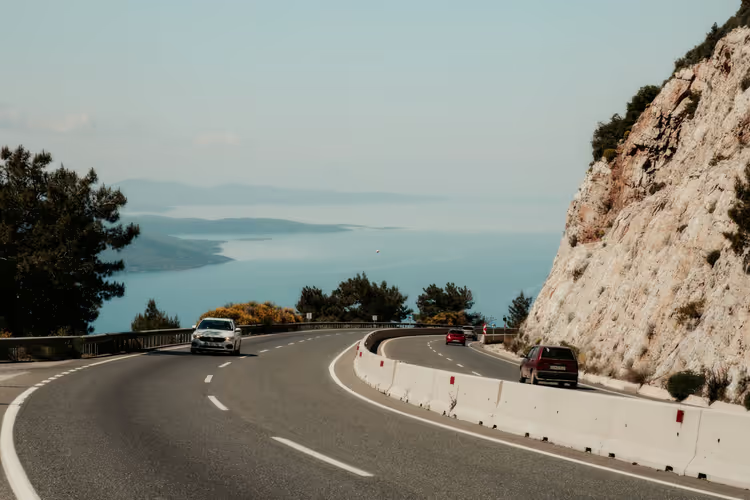
It's hard to name an exact daily price in advance. In high season a compact in Greece costs noticeably more than in the off-season. The total is made up of several factors that are already visible in the booking.
Season drives the price up the most. In July and August rates are at their peak; in May and October they drop by almost half. Next comes the car class: a subcompact is cheaper than a crossover. Another factor: the airport pickup fee.
Then come the contract terms. Some companies offer unlimited mileage, others set a daily kilometer limit. Exceeding the limit incurs a surcharge, sometimes a large one. Check this item before booking.
Returning the car in another city also changes the price. The one-way rental fee can reach a significant amount. If your route is a loop, you pay only the base rate.
And finally: insurance and fuel policy. Full coverage and a "full tank on departure" option raise the total but remove some hassle. Don't calculate the daily rate; calculate the total amount for the whole trip.
Rental agreement and insurance
The rental agreement determines what you pay for and what you get back. Read it in full before signing.
All companies include mandatory minimum insurance in the total. Without it the car won't be released; this is a requirement of Greek law. For an additional fee you can extend the coverage and remove some of your liability.
Types of insurance
The basic insurance is called Third Party Insurance. It covers damage caused to third parties. The renter is responsible for the damaged car itself, so basic insurance alone isn't enough.
Next comes Collision Damage Waiver, or CDW. This package is purchased separately, and this is where the deductible appears. It represents the maximum amount you guarantee to pay if the car is damaged.
Third level: full insurance (Full Insurance). It covers rare risks, including earthquakes, rockfall, flooding, and collisions with animals. But it also has exclusions.
Deductible and full coverage
Full coverage often doesn't reimburse broken windshields and rear windows. Undercarriage damage and tire punctures are also excluded from coverage. Clarify this when signing up so you don't argue after the trip.
You can separately insure the car against theft, fire, and parts theft. Add-ons are also available for headlights, wheels, and windows. These are added to the contract as separate types of insurance.
No reimbursement is due if the driver was drunk or under the influence of drugs. This is a standard condition of any policy. Inspect the car together with an employee before paying, and record all scratches in the contract.
Don't forget the fuel policy. Often the car is handed over with a full tank, and you need to return it at the same level. The fuel level is recorded in the contract, and a surcharge applies for a shortfall.
Check that the options you ordered are present: air conditioning, navigation, child seat. Confirm that they work. This way you'll avoid disputes at the end of the rental.
Driving rules in Greece
 © JTE Dimandix · CC BY-SAPhoto: JTE Dimandix, CC BY-SA (https://creativecommons.org/licenses/by-sa/3.0), Wikimedia Commons
Greek traffic rules are close to European standards, and road signs follow the international system. Intersections are controlled by traffic lights or the right-hand rule. There are no particular surprises for you, but there are some local specifics.
Everyone in the car must wear a seatbelt. Talking on the phone without a hands-free device is prohibited. Children under three must ride in a proper child seat, and parking is allowed only in designated areas. Low beams are required in poor visibility.
Speed limits
The limits in Greece are as follows: up to 50 km/h in cities, up to 90 km/h outside cities, and up to 130 km/h on motorways. Some sections have additional signs.
Speed is monitored by cameras and patrols. Sticking to the limit matters even more because fines for serious violations increased significantly starting in 2025. Put your phone down well in advance and keep your seatbelt fastened.
Fines and payment
Fine payment is strict. Police do not accept cash: the officer issues a ticket, which you pay at a bank in the district where the violation was recorded.
Violation | Fine |
|---|---|
Talking on the phone without a hands-free device | €350 and a 30-day license suspension (as of 09/2026, Greek Road Traffic Code) |
Not wearing a seatbelt | €350 (as of 09/2026, Greek Road Traffic Code) |
Alcohol over 0.5 g/l | depends on blood alcohol concentration |
Speeding | from €150 (as of 09/2026, Greek Road Traffic Code) |
Driving without an international driving permit | a fine applies |
Source: overview of the new Road Traffic Code, 2026.
It pays to settle fines quickly. If you pay within 10 days, the amount is cut in half. Late payment incurs a penalty, so do not put off paying until you return from vacation.
Formally, the alcohol limit is 0.5 g/l in blood, and the threshold is stricter for new drivers. Never get behind the wheel after wine at dinner: in Greece, checks are set up right at the exits of resort towns.
Gas stations, parking, and toll roads
 © Nikolai Bulykin · CC BY-SAPhoto: Nikolai Bulykin, CC BY-SA (https://creativecommons.org/licenses/by-sa/4.0), Wikimedia Commons
Road costs in Greece consist of fuel, parking, and toll sections. All of this has a noticeable impact on your trip budget.
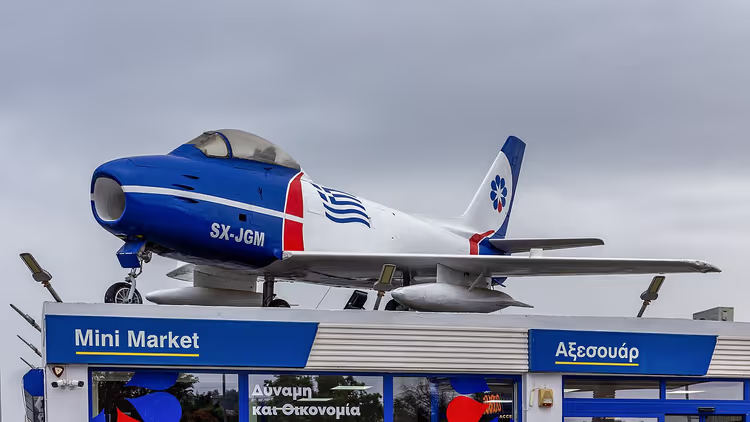
There are plenty of gas stations in major cities, but they are less frequent on highways. Service meets European standards: a station attendant takes care of everything for you. In rural areas, gas stations close by 7:00 PM, and many are closed on Sundays.
Traffic patrols strictly enforce parking. Leave your car only in a permitted spot. In city centers, parking costs a few euros per hour, and finding a free spot is difficult.
Fuel prices
Gasoline in Greece is expensive due to high taxes. The average price for 95-octane is about €2.09 per liter, and diesel is about €2.05 (as of 09/2026, EU weekly bulletin).
On the islands, fuel is slightly more expensive because of transport costs. The difference is small, but it adds up on a long route. Transporting gasoline in canisters is prohibited, so do not bring a canister with you.
Calculate your fuel budget based on your route. A compact rental car uses less fuel, and on the islands that makes a real difference. Choose a car with fuel consumption that matches your mileage.
Toll motorways
Toll roads cover the mainland part of the country, about seven in total. Payment is tied to toll booths: you pay a fixed amount at the barrier. Below are reference points for popular sections.
Section | Car toll |
|---|---|
Athens to Thessaloniki (PATHE motorway) | several tens of euros for the entire route |
Athens to Patras | about €14 |
Attiki Odos around Athens | about €2.80 (as of 09/2026, Attiki Odos) |
Source: overview of toll roads in Greece, 2026.
Payment is accepted in cash at the barrier. An electronic e-pass transponder gives about a 10% discount (according to a toll road review, 09/2026). If you drive a lot on the mainland, it pays for itself quickly.
Ferries and trips to the islands
A significant part of Greece lies on islands. Ferries connect them to the mainland and to each other, and this is the main transport in the archipelago. For a driver, there is an important rule here.
Without written permission from the rental company, taking a car off the mainland is prohibited. If you want to ferry a car to an island, arrange this with the rental company in advance.
Sometimes it is cheaper to pick up a car directly on the island. Transporting a car on a ferry can cost more than a daily rental on site. Consider both options before booking.
On the islands, roads are narrow and winding. A car is often the only transport there: buses run along the coast and do not go inland. Rental conditions on the islands are almost the same as on the mainland.
What to see in Greece by car
 © Berthold Werner · CC BY-SAPhoto: Berthold Werner, CC BY-SA (https://creativecommons.org/licenses/by-sa/3.0), Wikimedia Commons
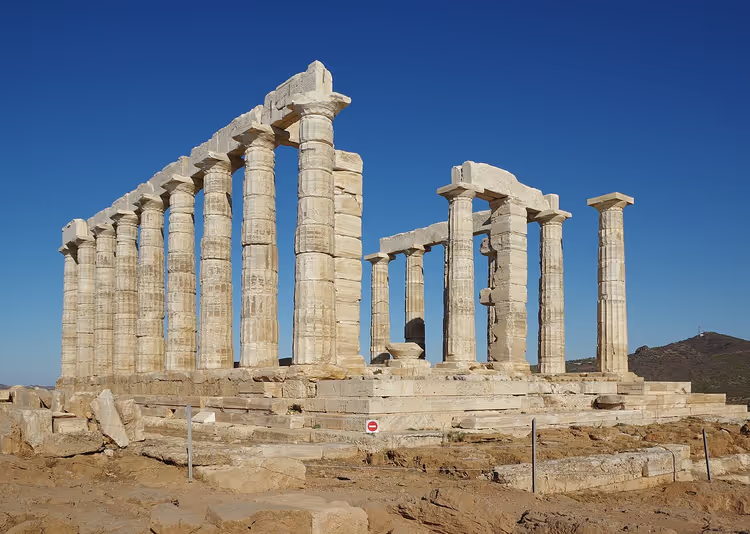
Greece attracts with its nature, ancient monuments, and distinctive culture. With a car, you are not tied to tour buses. Below are routes worth including in your plan.
In Athens, you will see the Acropolis with the remains of ancient temples on a rocky hill. It is the cradle of European civilization, but traffic in the capital is chaotic. Finding a free parking spot in the center is difficult, so it is better to leave the car on the outskirts.
Meteora leaves a strong impression. A narrow, winding road leads to the stone pillars, and monasteries stand on the peaks. The unusually shaped stone giants are worth the drive on their own.
Delphi is called the center of the ancient world. The sanctuary lies at the foot of Mount Parnassus, 2,457 meters high. The ruins of the Temple of Apollo, a stadium, and an amphitheater are preserved here.
Mount Olympus attracts lovers of altitude. By car, you can climb to about 1,100 meters, after which a hiking trail begins. Only the fit will reach Greece's highest point at 2,918 meters.
On Crete, the Samaria Gorge is worth hiking. The scenery along the way changes from rocky to wooded. The route is long, so bring comfortable shoes and water.
Rhodes is famous for the Valley of the Butterflies, Petaloudes. Tens of thousands of butterflies arrive there during mating season, and the sight is worth seeing. Lindos, with its picturesque swimming bay, lies about 50 km from the valley.
Where to book a car
Comparison services save time and money. They show offers from dozens of companies at once.
Discover Cars brings together local and international rental companies in Greece in one search. Here you compare final prices with no hidden fees and book a specific car. Often part of the amount is paid in advance, and the rest is paid on site.
Auto Europe works as a broker. The service does not have its own fleet and negotiates directly with rental companies. Enter the date, pickup location, and car class, then choose from several rental providers.
Rentalcars.com is also a major intermediary. The list of offers is long, and you can calmly review the contract terms. The range of cars is wide, so a suitable class is almost always available.
Find hotels
Compare prices across booking sites and filter for rooms with free cancellation.
Compare prices on Discover CarsThe widget loads once you give your consent.
Compare at least two platforms for your date. The price for the same class can differ, and deposit conditions can vary the most. Choose the option where it is clear how much you pay for insurance.
⁉️🤔 Frequently asked questions
Can I rent a car in Greece without a deposit?
Yes. Some local companies do not block funds on your card, and brokers have a "no deposit" filter. Such rates often have a higher deductible or require full insurance.
Do I need an international driving permit to rent in Greece?
Drivers from the EU and EEA only need their national license. With a license from a non-EU country, you need an international driving permit (IDP) along with your national license.
At what age can you rent a car in Greece?
Small classes are available from age 21, other groups from age 25. Drivers under 25 are charged a young driver fee.
What should I do if I get a fine on the road?
Pay the ticket at a bank in the district where the violation was recorded. If paid within 10 days, the fine is reduced by half.
Can I take a rental car on a ferry?
Only with written permission from the rental company. Sometimes it is cheaper to pick up a car directly on the island.
In short: what is worth booking
A car in Greece gives you freedom: you are not tied to bus and ferry schedules. To keep the trip from hitting your wallet, book in advance and read the contract before signing.
If your route is on the mainland: rent from an international company and get full coverage. If you are going to an island: compare local rentals with taking the car on the ferry. If you want no deposit: choose a rate with the "no deposit" filter and check the deductible.
See car rental prices in Greece and compare terms across all agencies in one search.

A small editorial team writing guides for independent travel. We travel ourselves, but we haven’t been everywhere, so we check prices, opening hours and how to get there against official sources.