
















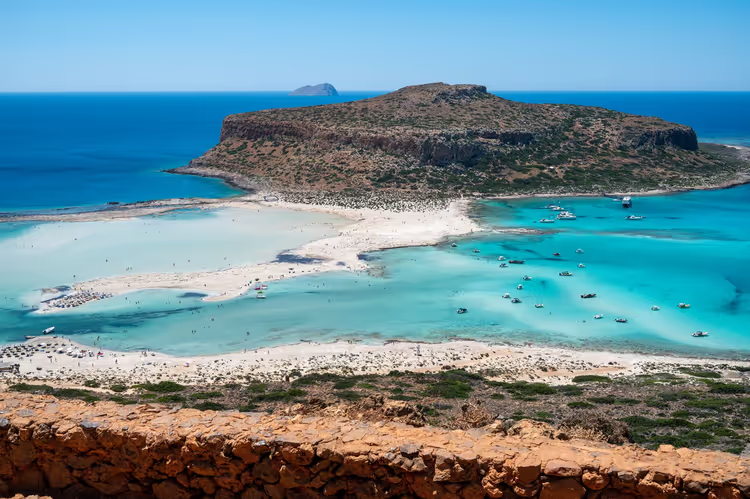
Greece in May: when the sea warms up and which resort to choose
May in Greece is a compromise between spring and summer. It's already warm enough for walks and sightseeing, and the sea gets warmer every day. Hotel and tour prices stay below summer levels, beaches are uncrowded, and museum lines are short. Below we'll look at what to expect from the weather, which resort to choose, and how much a trip costs.
The main question about May is simple: can you swim? The short answer: yes, but not in the first days of the month. By the end of the month, the water warms up to temperatures that are comfortable even for children.
Ad: this article contains affiliate links, we earn a commission if you book through them, at no extra cost to you.
What to know about May
💡 In short:
- Fly in the second half of the month: the air is consistently warm, the water is mild, and the crowds haven't arrived yet.
- Ask the driver for the fare and have them turn on the meter.
- Bring a sweater for the evenings and footwear for pebble beaches.
One rule will save you money on your very first day. If you get into a taxi, check the meter: in private cars, drivers name the price off the top of their head. Agree on the amount before the ride.
In villages on the mainland, customs are more conservative than at island resorts. If you're traveling alone, stick to larger cities and tourist centers.
Weather in May and sea temperature
The climate in Greece is not uniform. Mountain ranges and the sea divide the country into three zones: Mediterranean, temperate, and alpine (according to the Greek tourism office, 09/2026). The east of the country is drier, the west is wetter.
During the day in May, the air warms up from +19 to +28 °C depending on the region (as of 09/2026, Rough Guides). It's warmer in the south and on the islands, while nights in central and northern Greece are still cool. Rain showers are short and rare, but possible in the west.
The sea warms up week by week. Based on long-term observations, water temperatures in May stay in the 18-21 °C range (as of 09/2026, SeaTemperature.info), and the warmest bays are near the southern islands. Plan your swimming for the second half of the day: after lunch the water is milder and the wind is weaker.
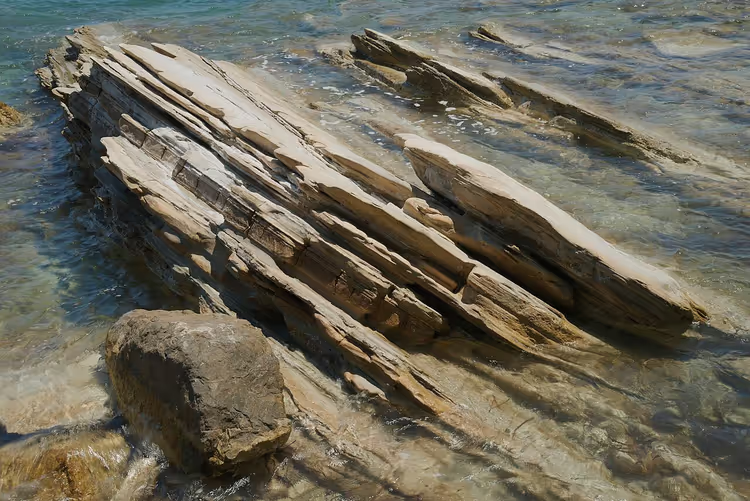
The type of beach also affects the experience. Sandy beaches with a gentle slope are more convenient for children and for long swims, while pebble and rocky beaches offer clear water and good snorkeling. The true peak season falls in summer, but May is already close: the water is warming up, the sun isn't as intense, and loungers are available.
If you get cold easily, start with sheltered bays. The water warms up there earlier than in the open sea, and waves are barely a factor.
Which resort is right for you
Choose a resort based on the kind of vacation you want. Greece has beach centers and cities with strong sightseeing programs.
Resort | Who it's for | Main highlight |
|---|---|---|
Crete | families and history lovers | the Palace of Knossos and the pink sand of Elafonisi |
Kos | families in the south, surfers in the north | green valleys and hot springs |
Rhodes | those who combine beach and sightseeing | a medieval city under UNESCO protection |
Thessaloniki | divers and city travelers | festivals and shipwrecks |
Thasos | those who love quiet | marble and the beaches of Glyfada, Makryammos |
Sithonia | couples and pine lovers | Vourvourou beach and the forests of Nikiti |
Kassandra | those looking for nightlife | the waterfronts of Hanioti and Kallithea |
Athos | pilgrims | the Simonopetra monastery on a cliff |
Peloponnese | road-trippers | Loutraki and ancient cities |
Below, each resort is covered separately: what to see, who it suits, and what to know in advance.
 © Sidvics · CC BY-SAPhoto: Sidvics, CC BY-SA (https://creativecommons.org/licenses/by-sa/4.0), Wikimedia Commons
Crete: the Palace of Knossos and three seas
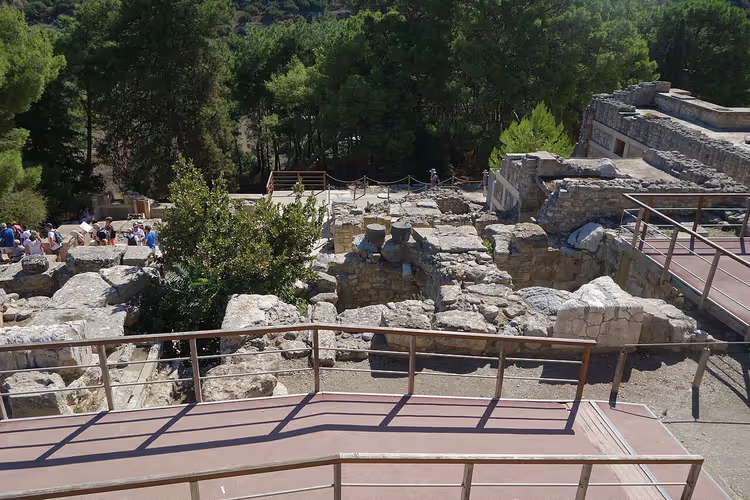
Crete, the largest island in Greece and the birthplace of the Minoan civilization. We'll leave the excavations to archaeologists, while the island offers you palaces, gorges, and beaches of three seas.
 © Александр Спиридонов · CC BYPhoto: Александр Спиридонов, CC BY (https://creativecommons.org/licenses/by/3.0), Wikimedia Commons
The island is divided into four parts. Rethymno preserves its Venetian and Turkish character: tiled roofs, mosques, cobbled streets. Heraklion suffered heavy damage during the war, but the Palace of Knossos with the Minotaur's labyrinth lies nearby. In Lasithi to the east you'll find hotels, the salt lake of Voulismeni, and Vai beach with date palms. Chania is the greenest: the White Mountains descend to the Samaria Gorge, and nearby lie the wild beaches of Sfakia and the pink sand of Elafonisi.
Getting around the island is simple if you choose one base. Rethymno sits between Chania and Heraklion, so it's convenient for trips in both directions. If you don't want to move around often, split your vacation into two parts: west and east. A car is useful for trips to gorges and remote beaches, while buses run between the major cities. Keep the island's size in mind: driving from east to west takes half a day, so don't plan too many stops in one day.
- Who it's for: families with children and anyone who wants to combine beach time with history.
- Hotels: Crete hotel prices on Trip.com
Kos: the green garden of the Aegean
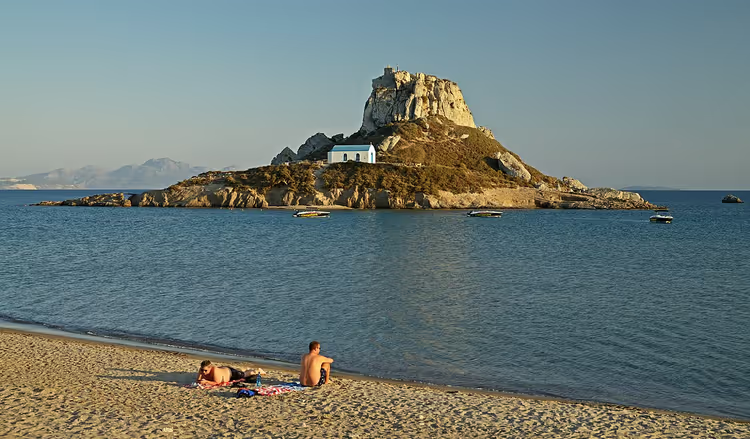
Kos is called the garden of the Aegean, and it's perhaps the greenest island in the archipelago. There are enough sights for several days: monuments from the Greco-Roman era, Byzantine basilicas, and port towns with shops and narrow streets.
The beaches here vary. Along parts of the coast, bubbles rise from the seabed, and locals call these spots natural jacuzzis. Nearby, hot springs rich in sulfur bubble up.
 © Ввласенко · CC BY-SAPhoto: Ввласенко, CC BY-SA (https://creativecommons.org/licenses/by-sa/4.0), Wikimedia Commons
Families choose the south of the island: the sea is calmer there. Surfers love the north because the Aegean winds give them consistent conditions.
It's worth setting aside a day for the island's capital: ancient ruins, a fortress, and an old town with shops and Byzantine-style lanes survive there. Those who love quiet bays will like Kefalos: sandy beaches lie nearby, and in the evening you can walk to the tavernas by the water. The island is compact, so you can see it in a few days and still leave time for the beaches. If you want to combine your stay with trips to neighboring islands, look for hotels near the port.
- Who it's for: families with kids in the south, surfers in the north.
- Hotels: Kos hotel prices on Trip.com
Rhodes: medieval city and long beaches
Rhodes is one of the most visited Greek islands. Its medieval city is a UNESCO World Heritage Site surrounded by fortress walls, so you can easily spend a whole day here without a car.
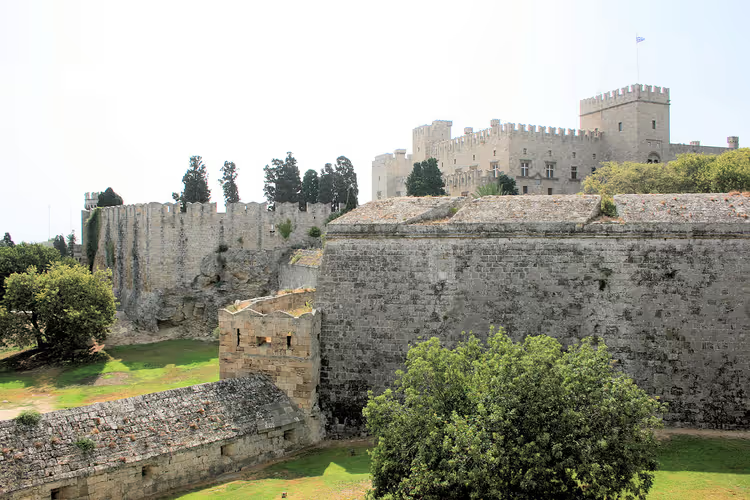 © Olbertz 23:14, 21. Dez. 2010 (CET) · CC BY-SAPhoto: Olbertz 23:14, 21. Dez. 2010 (CET), CC BY-SA (https://creativecommons.org/licenses/by-sa/3.0), Wikimedia Commons
The north of the island is packed with lively resorts, while the south is quieter. South of the capital lies Faliraki: a nightlife hub, a large water park, and good family beaches. Beyond it starts Lindos, with its acropolis above the bay. Further on, a strip of beaches stretches for dozens of kilometers: less infrastructure, but clean and uncrowded. For your stay, choose Ixia or Ialyssos.
The catch: many beaches are pebbly, so kids will need water shoes.
Hotels: Rhodes hotel prices on Trip.com
Thessaloniki: festivals, the waterfront, and diving
Thessaloniki remains the cultural center of Macedonia. Byzantines, Ottomans, and Romans all left their mark here, and there are almost no high-rises: many hotels offer sea views from their windows.
The city beach loses out to the islands because of the large port. But in the suburbs and on Halkidiki the sand is good and the water entry is gentle. Divers also have plenty to do here: the city has dive centers, and the surrounding waters include reefs and shipwrecks.
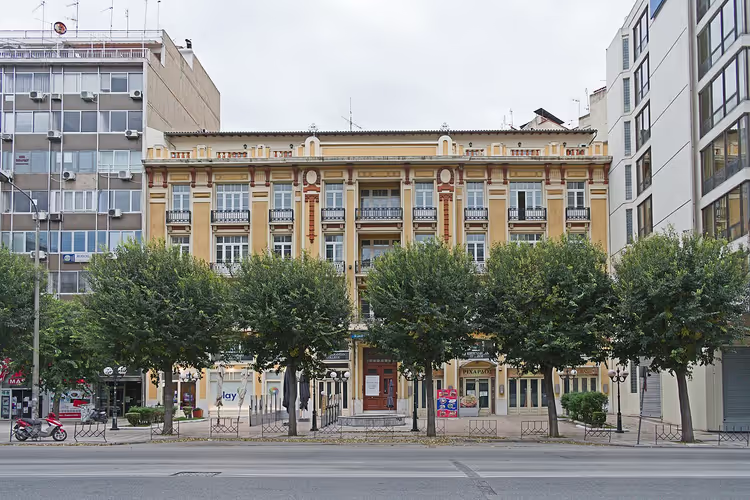 © Ymblanter · CC BY-SAPhoto: Ymblanter, CC BY-SA (https://creativecommons.org/licenses/by-sa/4.0), Wikimedia Commons
The sand on Halkidiki has a small amount of pebbles mixed in, so it's comfortable for families with kids. It's easy to head out to the sea for the day and return by evening. If you want to combine city and beach, pick a hotel near the waterfront: from there you can walk to the main streets. In the evening, head down to the sea: the Thessaloniki waterfront is long, lined with cafes and views of the bay.
- Who it's for: those who want to combine city, festivals, and sea.
- The catch: beaches within the city limits are weaker than those at island resorts.
- Hotels: Thessaloniki hotel prices on Trip.com
Thassos: a marble island with pine beaches
Thassos lies directly across from the coast of Eastern Macedonia. Near the modern town, the ruins of an ancient polis with the same name have been found.
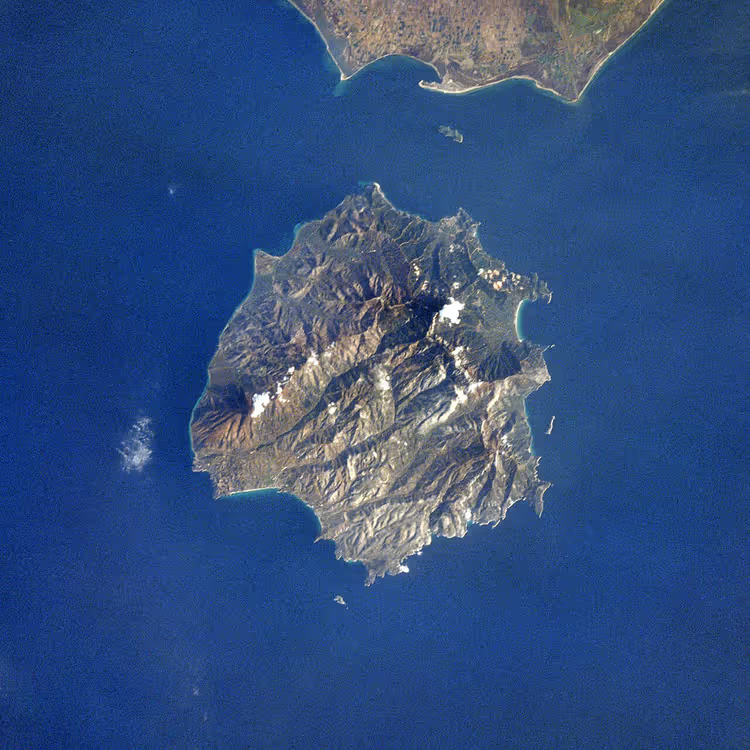
The island looks like a green hill rising out of the waves: firs, cedars, lindens, pines, and olives climb all the way to the mountain peaks. The white marble from the local mountains has been used in construction around the world, which is why Thassos is often called the marble island.
The best beaches, Glyfada and Makryammos, are surrounded by hotels, restaurants, and bars. Between Potamia and Panagia lie the Golden Sands, with transparent water and a gently sloping shore, sheltered from the wind by Mount Ypsario. Pefkari beach is ringed by a pine forest, and Potos is a popular choice for camping.
- Who it's for: lovers of quiet, greenery, and ancient ruins.
- Hotels: Thassos hotel prices on Trip.com
Sithonia: pines, Vourvourou, and fishing villages
Sithonia, the middle "finger" of Halkidiki. Myths link this place to Persephone, and the peninsula got its name from the Titan Sithon.
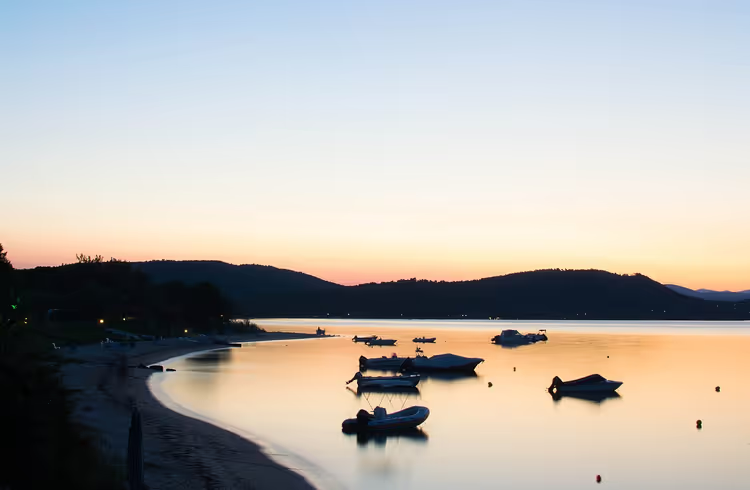 © Sprint28 · CC BY-SAPhoto: Sprint28, CC BY-SA (https://creativecommons.org/licenses/by-sa/3.0), Wikimedia Commons
The western coast is lined with hotels: the strip runs from Neos Marmaras to Nikiti. Nikiti is known for its pine forests, good beaches, and old houses with bright roofs and unusual chimneys. The main natural highlight is Vourvourou beach and the bay of the same name with transparent water. Inland, fishing villages still preserve their traditional way of life.
In the evening, life shifts to the waterfronts of Neos Marmaras, where tavernas, bars, and shops stay open. If you want a quiet beach, base yourself closer to Vourvourou and get to the water in the morning. Head to Nikiti for the pine forests and the old town. The peninsula is small, so in a couple of days you can drive around it and pick a beach to your liking.
- Who it's for: couples and anyone looking for pine-backed beaches without city noise.
- Hotels: Sithonia hotel prices on Trip.com
Kassandra: nightlife and tavernas
Kassandra, the western "finger" of Halkidiki and the busiest one. It has everything: from traditional Greek tavernas to fusion bars on the waterfront.
Kallithea is considered the liveliest part of the peninsula, and the noise doesn't stop even at night. Nea Potidea grew up on the ruins of a Corinthian colony and looks like a small, romantic town. Pefkochori in the south is known for its special microclimate and green courtyards. Hanioti is chosen for its tavernas, water sports, and leisurely strolls along the waterfront.
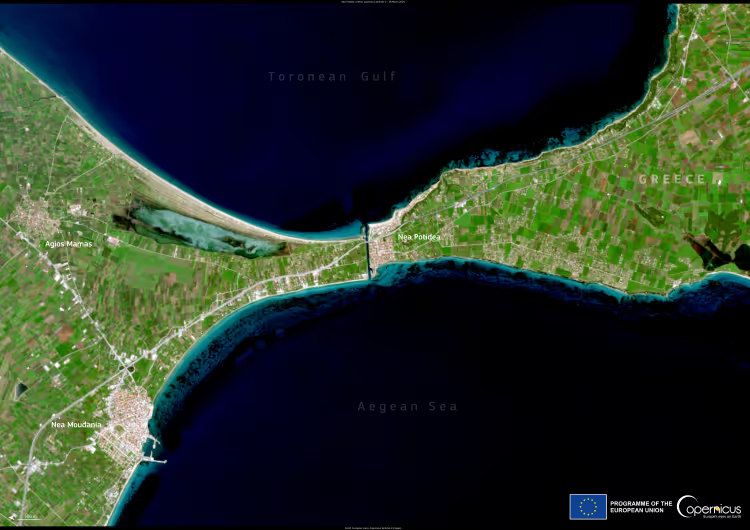 © European Union, Copernicus Sentinel-2 imagery · CC BYPhoto: European Union, Copernicus Sentinel-2 imagery, CC BY, Wikimedia Commons
People come to Kassandra for different reasons: nightlife lovers, families, and older tourists looking to improve their health. That's why the hotels here vary, from lively complexes next to bars to quiet hotels with pools tucked into the greenery. If you're traveling with children, stay away from Kallithea: it's noisy even at night, and the beaches in neighboring villages are calmer. It's convenient to rent a car for a couple of days so you can drive around the peninsula and find a cove with no neighbors.
- Who it's for: nightlife lovers, couples, and those who want to combine the sea with health treatments.
- Hotels: Kassandra hotel prices on Trip.com
Athos: monasteries and special rules
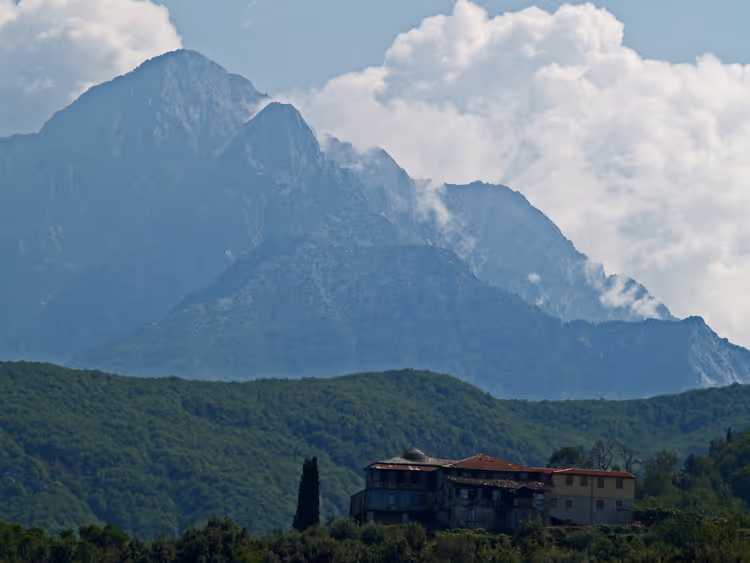
Athos, the third "finger" of Halkidiki and a place of pilgrimage. There are almost no hotels here: a few guesthouses stand in Ouranoupoli and Nea Roda, away from the monastery buildings.
 © Dave Proffer · CC BYPhoto: Dave Proffer, CC BY (https://creativecommons.org/licenses/by/2.0), Wikimedia Commons
The peninsula's main treasure is its monasteries. The most architecturally striking is Simonopetra: the majestic building stands on a sheer cliff and continues to amaze visitors. Time on Athos is counted differently, because each monastery sets its own start of the day. Distances here are also measured not in kilometers but in the number of prayers you manage to say along the way.
- Who it's for: pilgrims and lovers of Byzantine architecture.
- Not for: women are not allowed on the peninsula, and men need to obtain a permit in advance.
- Hotels: hotel prices near Athos on Trip.com
Peloponnese: Loutraki, antiquity, and quiet
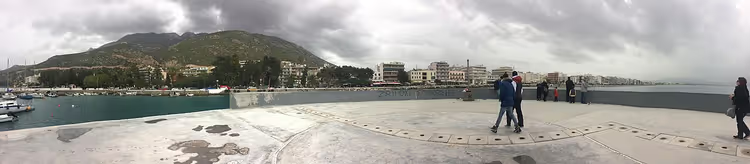
The Peloponnese lives at a calmer pace than other regions of Greece. It's far from the main airports, so transfers take longer and cost more. In return, there are no huge hotel complexes here, and the hotels feel more like resort villages.
 © Anna loutraki · CC BY-SAPhoto: Anna loutraki, CC BY-SA (https://creativecommons.org/licenses/by-sa/4.0), Wikimedia Commons
The region's largest resort is Loutraki: clean sea, calm beaches, and proximity to mineral springs. Ancient history lovers should stop in Elis with its historical monuments. Laconia, the former Sparta, greets visitors with rocky and almost wild beaches, while in towns like Archangelos the sand is softer. Some villages can only be reached by ferry.
- Who it's for: road trippers and those looking for a quiet vacation without crowds.
If you're traveling by car, the Peloponnese offers what the islands lack: short drives between beaches and ancient cities. From Loutraki, it's easy to take a day trip to Athens. Plan your route in advance, because you'll need to fit the ferry schedule around your trip. In return, you'll find quiet beaches and a calm sea without the crowds.
- The catch: the drive from the airport will tire the kids out.
- Hotels: Peloponnese hotel prices on Trip.com
What to see in spring
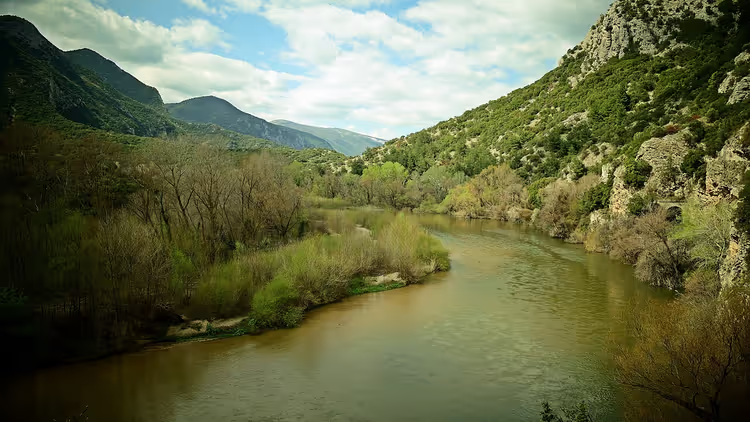
In spring, Greece bursts into bloom: with the first March warmth, fields become covered in flowers. Nesting season also begins around this time, so trips through the north of the country and the Peloponnese offer rare bird sightings.
 © Zsolyomi · CC BY-SAPhoto: Zsolyomi, CC BY-SA (https://creativecommons.org/licenses/by-sa/4.0), Wikimedia Commons
Walking around Greece in spring is comfortable: the sun is not yet at its peak, and the crowds only arrive in summer. You can choose camping, a cycling trip, or a hiking route through the hills. Horseback riding enthusiasts should check out Pelion: the local trails along the coast are well suited for riding.
A separate topic is the gorges overgrown with shrubs and flowers: Red Butterflies, Ha, and Milona. The caves are no less interesting, especially the Cave of the Apocalypse. Among the lakes, Voulismeni, Kournas, and Orestiada stand out. Add the ancient amphitheaters in Athens and Larissa to your itinerary, as well as the temples, cathedrals, mosques, synagogues, and ancient fortresses of Argos, Chios, and Gardiki.
Holidays and festivals in May
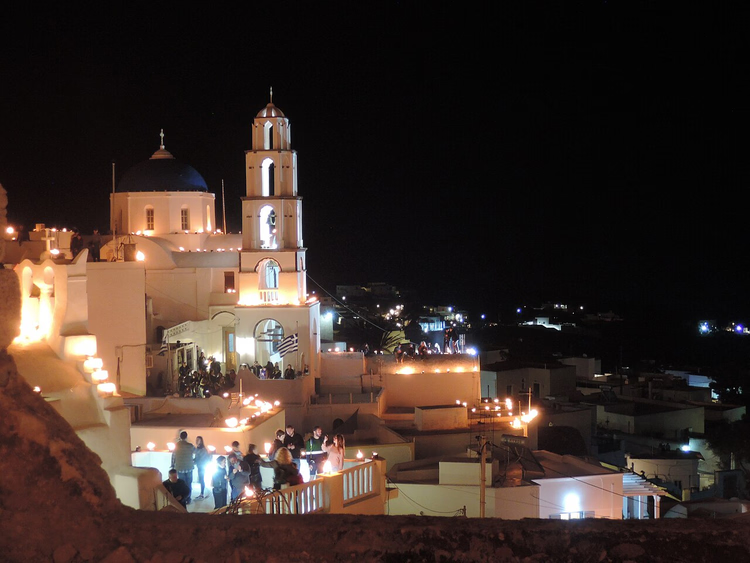 © Georgios Michos · CC BY-SAPhoto: Georgios Michos, CC BY-SA (https://creativecommons.org/licenses/by-sa/4.0), Wikimedia Commons
May is packed with events. The month opens with May Day: parades and public celebrations take place across the country. Many cities hold a flower festival that traces back to the cult of Demeter.
On May 18, International Museum Day, admission to state museums and archaeological sites is free. This is an official free day (verified 09/15/2026 on the Ministry of Culture website). Young people under 25 from EU countries get in free year-round with a passport, which is a significant saving on tickets.
On May 21-23, Anastenaria takes place in Northern Greece: in Agia Eleni, Kerkini, and Langadas, people dance on hot coals on the feast day of Saints Constantine and Helen (as of 09/2026, Greek Expedition). You can attend the ritual, but confirm the place and time locally.
On Rhodes, the Medieval Rose festival is held in the medieval city. In 2026 it was announced for October 9-11 (We Are Rhodes, 09/2026), so you won't catch it in May. Check the festival website for exact dates.
Traveling with kids
The second half of May is the best time to travel with children. Mainland Greece is better suited for sightseeing, the islands for beaches.
When choosing a hotel, check whether the kids' club is running and whether there is a children's menu. The national cuisine can be heavy for little travelers. Also look at the distance to the airport: the Peloponnese is great in every way except for the drive, which will tire a child out.
 © Jules Verne Times Two · CC BY-SAPhoto: Jules Verne Times Two, CC BY-SA (https://creativecommons.org/licenses/by-sa/4.0), Wikimedia Commons
If you're going to Crete, don't miss Knossos and the pink beach of Elafonisi. The town of Bali is a good fit for traveling with toddlers: a quiet bay with a gentle slope into the water. Nearby, it's worth seeing the beaches of Livadi, Limani, and Varkotopos.
Rethymno works well as a base: from here it's easy to reach any corner of the island, and the old town is an attraction in itself. In Chania, kids will be kept busy by Little Venice, the harbor with boats, and Kissamos beach, where there are almost no waves.
If your kids love active recreation, choose Hersonissos: it has a large water park, several theme parks, and an aquarium.
How to choose a tour and hotel in May
May opens the resort season, so it's better to book your tour and hotel in advance. Last-minute deals don't guarantee savings: the price may not drop, and hotel availability will become limited.
A package usually includes accommodation, flights, transfers, insurance, and breakfasts, sometimes dinners. Compare offers by what's included, not just by price.
Hotel prices depend on several factors: the line (first, second, or third), class, room type (standard, suite, bungalow, villa), and meal plan (breakfasts, half board, all inclusive). The first line costs more but saves you time walking to the sea. Find a hotel on Trip.com
How much food costs in Greece
Greek cuisine is considered one of the richest in the Mediterranean. Thick yogurt with cucumbers, homemade sausages with vegetables, pies with feta and spinach: the flavor combinations seem unusual, but they're worth it.
Plan your budget in advance. A hot dish at a budget taverna costs in the low double digits in euros. Lunch for two with three dishes and a drink comes to a few dozen euros, dinner costs more. Seafood tavernas are usually pricier than meat ones.
A simple rule of thumb: choose places where the tables are filled with locals. That way you'll try authentic cuisine and won't overpay for a tourist spot. If you prefer a fixed budget, take a package with breakfasts and dinners.
Excursions and tickets
Greece has so many attractions that choosing excursions can be overwhelming. It's convenient to browse and book programs for each resort online in advance: excursions and tickets on GetYourGuide.
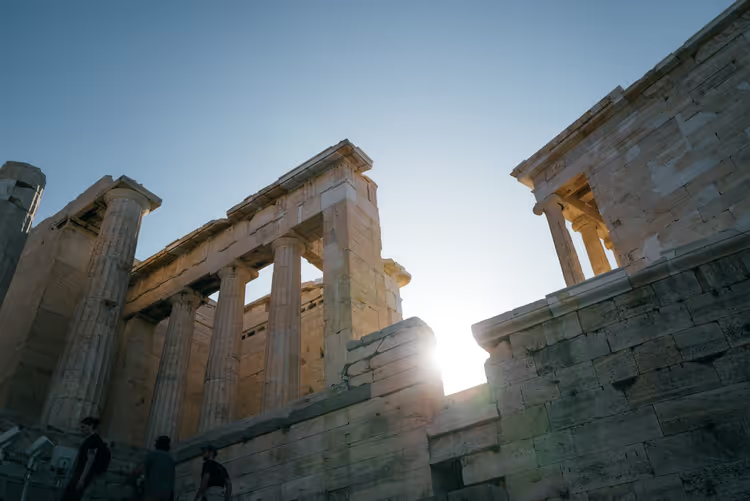
Tickets for major sites (the Acropolis in Athens, the Palace of Knossos on Crete, the Acropolis of Lindos) are best booked with a time slot in high season. That way you won't stand in line or plan your day around the ticket office.
Current programs are available for almost any resort: Crete, Rhodes, Thessaloniki, Corfu. Check what's included in the tour, how much time you'll spend on the road, and what language the guide speaks. For boat trips, bring a hat and water, and for archaeological routes, wear comfortable shoes: the trails are rocky and exposed. Morning groups move faster because the sites aren't hot yet. If you're traveling with children, choose short programs: long drives in the heat will wear them out.
Traveler reviews
Travelers generally rate the value for money of a May trip highly. They most often praise the food, the clean sea, and the spring greenery. There's one main complaint: on some islands the beaches are pebbly, not sandy.
For many, a trip to Greece feels like returning to childhood: the islands are tied to myths and pictures from history textbooks. The pebbly beaches are partly offset by the lack of crowds in May. Those who come back tend to pick one island and stay there without moving around, so they can both relax and see the surroundings.
What to bring and how to prepare
It's worth comparing insurance in advance: compare options.
In May the sun is already strong, so bring high-SPF sunscreen and a hat. Evenings in central and northern Greece are cool, so a light sweater will come in handy.
For pebbly beaches you need special water shoes: going into the water barefoot is uncomfortable and painful. Keep some cash on hand, because small tavernas and ferries don't accept cards everywhere.
Greece resorts on the map
The map below shows where the resorts from this article are located. Open it on your phone to check distances between the islands and the mainland.
Holidays in Greece in May
Places on the map
- 1Crete Knossos Palace and the pink sand of Elafonisi, four parts of the island
- 2Kos Green island with hot springs, quiet south
- 3Rhodes Medieval UNESCO town, long beaches in the south
- 4Thessaloniki Cultural centre of Macedonia, diving among sunken ships
- 5Thasos Marble island with the pine-fringed beaches of Glyfada and Makryammos
- 6Sithonia Middle finger of Halkidiki, Vourvourou beach and pine forests
- 7Kassandra Western finger of Halkidiki, nightlife of Kalithea
- 8Athos Pilgrimage site, Simonopetra Monastery perched on a cliff
- 9Peloponnese Loutraki resort, ancient towns, quiet holiday away from the crowds
⁉️🤔 Frequently asked questions
Can you swim in Greece in May?
Yes, but it's better in the second half of the month. In early May the water is still brisk, but by the end it warms up to comfortable levels. Swimming is more pleasant in sheltered bays and in the south than on open northern beaches.
Which resort should you choose for a first trip to Greece?
Crete and Rhodes are good for a first trip: they have both beaches and a strong excursion program. On Crete you'll see the Palace of Knossos, the Samaria Gorge, and the pink sand of Elafonisi. On Rhodes, the medieval town, the Acropolis of Lindos, and the beaches of Faliraki. With children, choose the south of Kos or the town of Bali.
How much does a trip to Greece cost in May?
A package usually includes accommodation, flights, transfers, insurance, and breakfasts. Sellers give the exact amount, so we recommend booking early while hotel availability is wider. Hotel prices depend on the line, class, room type, and meal plan. For food, estimate this way: a hot dish at a budget taverna costs in the low double digits in euros.
What to see in Greece in May?
In May it's worth going for nature and antiquity. Fields are in bloom, it's nesting season, and the gorges of Red Butterflies, Ha, and Milona are open. Include the Cave of the Apocalypse, Lakes Voulismeni, Kournas, and Orestiada, and the ancient amphitheaters of Athens and Larissa in your itinerary. On May 18, state museums are free, and young people under 25 from the EU get in free year-round.
When is museum entry free in Greece?
There's one official free day in May: May 18, International Museum Day. On that day, entry to state museums and archaeological sites is free. Young people under 25 from EU countries also get in free year-round with a passport. The full list of dates and categories is published on the Ministry of Culture website.
In short: what's worth booking
If you're traveling with children: choose Crete or the south of Kos. If you want excursions: pick Rhodes or Thessaloniki. If you're looking for quiet: look at Thasos and Sithonia. If you plan to move around a lot: the Peloponnese by car.
May gives you warm air, uncrowded beaches, and prices below summer levels. Book your hotel and tour in advance, and time your free museum entry for May 18. Check hotel prices in Greece on Trip.com

A small editorial team writing guides for independent travel. We travel ourselves, but we haven’t been everywhere, so we check prices, opening hours and how to get there against official sources.