











Carnival in Binche: three days of Gilles, oranges and wax masks
For three days in February, Binche lives by the carnival, not by the schedule. In 2027, these are February 7, 8, and 9: Gilles in wax masks walk through the streets, throw oranges into the crowd, and in the evening fireworks thunder over the city (as of 09/2026, Binche city website).
Binche is located in the Walloon province of Hainaut, and its carnival is on the UNESCO intangible cultural heritage list (UNESCO). It is a living tradition, not a museum piece: the city prepares for the festival starting in January, and thousands of local residents take part in the processions. The streets are open to everyone during the parades; you only need to pay at the MUMASK museum, where an adult ticket costs €10 (as of 09/2026, official museum website). From Brussels, you can get there by SNCB train; timetables and tickets are available on the SNCB website).
Ad: this article contains affiliate links, we earn a commission if you book through them, at no extra cost to you.
What the Binche carnival is
The carnival runs for three days before Lent and ends on Tuesday. For the city, it is the main holiday of the year: spectators come from all over Belgium and from neighboring countries.
The main participants are called Gilles. In the morning, before the parade, they drink champagne and eat oysters, then walk through the streets and throw oranges into the crowd. Oranges have become part of the carnival mythology: people catch them, take photos with them, and bring them home as souvenirs.
Preparations for the carnival begin well in advance. On the four last Sundays before the festival, "soumonces" take place: drummers and brass bands rehearse right in the streets. If your visit coincides with the soumonces, you will see the carnival up close and almost without the crowds.
💡 In short:
- The Binche carnival takes place on February 7, 8, and 9 in 2027.
- The main characters are called Gilles: wax masks, wooden clogs, and oranges thrown into the crowd.
- Watching the street parades is free; tickets are only needed for the MUMASK museum.
- Dates and program: 09/2026, verified on the official carnival program.
Gilles: wax mask and feathered hat
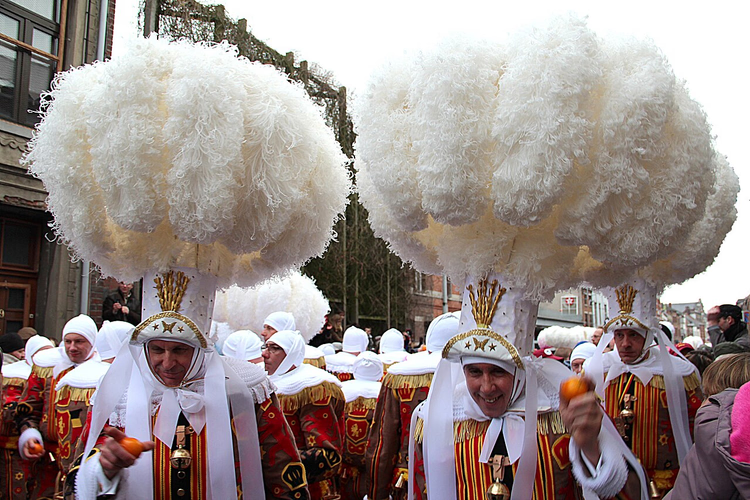
The Gilles costume is recognizable by three details. A white cotton cap called a "barrette" sits under the mask. Wooden clogs clatter on the cobblestones all day long. The hat with ostrich feathers is worn only for the main Tuesday parade, so on other days you will see Gilles without their ceremonial headwear (as of 09/2026, program page).
 © Jean-Pol GRANDMONT · CC BY-SAPhoto: Jean-Pol GRANDMONT, CC BY-SA (https://creativecommons.org/licenses/by-sa/3.0), Wikimedia Commons
The feathers are replaced every year, and they number in the hundreds.
Oranges fly into the crowd along the entire parade route: this is not a symbolic gesture but part of the celebration. The crowd along the sidewalks stands packed together, so people arrive at the route early. Take your spot at the Grand Place an hour before the Tuesday parade starts: that way you will see both the rondeau and the final pass.
Where the Gilles came from
Nobody knows the exact date the carnival was born. The name of the main character is linked to the Italian Commedia dell'arte: traveling theater troupes roamed the towns of Hainaut with Pierrot and Arlequin figures, and Gilles is considered a distant relative of one of those characters.
There is also a legend with a specific date. In 1549, Mary of Hungary hosted her brother, Emperor Charles V, and his son Philip II in Binche. The court ladies supposedly appeared at the festival in costumes "in the manner of the Incas," inspired by accounts of Francisco Pizarro's conquests in Peru. According to tradition, this is where the Gilles costumes originated (as of 09/2026, city carnival dossier).
There is no evidence for the legend, but it explains the main point. The Binche carnival has always been theater with its own roles, not just a street celebration.
Three-day program
The city's day-by-day schedule looks like this (as of 09/2026, Binche city website).
Day | Main event | Time | Where |
|---|---|---|---|
Sunday, February 7 | First parade, Gilles without ceremonial costume | 3:30 PM-6:00 PM | Avenue Burlet and Avenue Wanderpepen |
Monday, February 8 | Children's day and fireworks at the station | 9:30 AM-7:00 PM | Grand Place and station |
Tuesday, February 9 | Main parade, oranges, and two fireworks displays | 7:45 AM-9:30 PM | Grand Place and Place de Battignies |
Sunday, February 7
From 8:00 AM, costumed figures with viols and drums move through the city. The parade starts at 3:30 PM at the junction of Avenue Burlet and Avenue Wanderpepen and disperses at 6:00 PM on Avenue Charles Deliège. On Sunday, the Gilles do not wear the traditional costume.
Monday, February 8: children's day
Monday in Binche is called children's day. From 9:30 AM, youth groups with viols come out, around 11:00 AM a confetti apero begins in the cafés, and between 1:00 PM and 2:00 PM folklore groups join the celebration. At 4:00 PM, children walk through the city with music and hand out oranges; at 4:30 PM, the Rondeau de l'amitié is danced on the Grand Place; at 7:00 PM, fireworks are launched at the station.
Tuesday, February 9: the main day
From dawn, Gilles, Paysans, Marins, Pierrots and Arlequins walk through the streets. At 7:45 they gather on the Grand Place and take part in a reception at the Hôtel de Ville, where Gilles and Paysans put on their wax masks. At 15:00 the main procession sets off from Place de Battignies to the Grand Place, and the feathered hats appear on the streets for the first time in a year. At around 17:30 the procession reaches the Grand Place, at 20:00 a lit parade departs from Avenue Charles Deliège, and at 21:30 the fireworks begin (as of 09/2026, City of Binche program).
Getting there from Brussels
Binche station is 650 m from the MUMASK museum, an easy walk (as of 09/2026, MUMASK page). Check SNCB train schedules and tickets in the SNCB journey planner, and it is convenient to buy train tickets for Belgium in advance on Trip.com.
Within the region, Binche is connected by buses 21, 22, 108, 132, 133 and 136. Their schedules are on the TEC website.
By car, head for the Saint-Paul, de la Gare and des Pastures parking lots; the last one is designed for buses. The center has a blue zone: on the Grand Place and neighboring streets you can park free for 1 hour 30 minutes with a parking disc (as of 09/2026, MUMASK museum website).
During carnival days the center is closed to traffic and the procession routes change: the city publishes the traffic plan on its website (as of 09/2026, binche.be).
Belfry and Grand Place
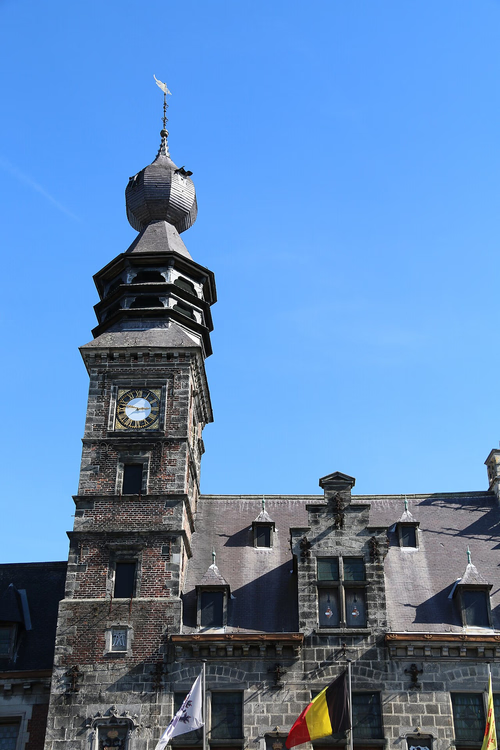
Binche sits on a rocky outcrop encircled by the Samme river. As early as the 11th-12th centuries, the Counts of Hainaut built a powerful keep here. Today the belfry of Binche is part of the UNESCO World Heritage list together with other belfries of Belgium and France (as of 09/2026, Binche city guide).
 © FrDr · CC BY-SAPhoto: FrDr, CC BY-SA (https://creativecommons.org/licenses/by-sa/4.0), Wikimedia Commons
The city center is compact, so you can walk to the museum and the main square. The tourist office is at Grand-Place 5: weekdays from 9:30, Saturday and Sunday from 10:00 (as of 09/2026, tourist office hours). There you can pick up a city map and the procession route.
MUMASK: tickets and hours
The MUMASK museum occupies the old building of an Augustinian monastery. Its collection includes hundreds of masks from around the world, including the Binche carnival masks: here you can see how the tradition has changed over the decades (as of 09/2026, museum website).
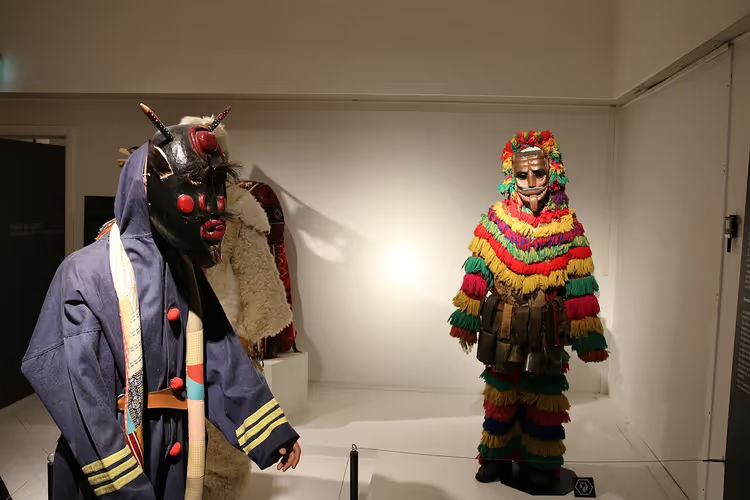 © FrDr · CC BY-SAPhoto: FrDr, CC BY-SA (https://creativecommons.org/licenses/by-sa/4.0), Wikimedia Commons
Ticket | Price |
|---|---|
Adults | 10 € |
Seniors 60+ and students | 9 € |
Children 6-12 | 5 € |
Children under 6 | free |
Day | Hours |
|---|---|
Tuesday-Friday | 9:30-17:00 |
Saturday and Sunday | 10:30-17:00 |
Ticket office | until 16:30 |
(as of 09/2026, MUMASK prices and hours)
The museum is closed on Mondays, January 1 and 2, Ash Wednesday, May 1, and December 25-26. On the first Sunday of every month admission is free, and it's better to buy tickets in advance on the museum's website. A guided tour costs 80 € for a group of up to 15 people during opening hours and 90 € outside them; school groups pay 60 € from September 2026 (as of 09/2026, MUMASK prices and hours).
Museum address: Rue Saint-Moustier, 10. You can walk there in a few minutes from both the train station and Grand-Place.
Tours and tickets
Guided tours, skip-the-line tickets and activities — most offers can be cancelled free of charge.
See offers on GetYourGuideThe widget loads once you give your consent.
⁉️🤔 Frequently asked questions
When is the Carnival of Binche in 2027?
The carnival runs for three days before Lent. In 2027, that is Sunday, February 7, Monday, February 8, and Tuesday, February 9. There is one main day: Tuesday, when the Gilles in feathered hats walk from Place de Battignies to the Grand Place and throw oranges. The city publishes the program for each day on its website (as of 09/2026, City of Binche website).
Do I need to buy a carnival ticket?
The streets are open during the processions, so no separate ticket is needed for the parades. You only pay at the MUMASK museum: an adult ticket costs 10 €, a child ticket starts at 5 € (as of 09/2026, MUMASK museum). If you want to photograph the Gilles up close, claim a spot along the route early: by 3:00 PM on Tuesday, the approaches to the Grand Place are already packed.
Who are the Gilles and why do they throw oranges?
The Gilles are the main participants of the carnival. They wear wax masks, wooden clogs, and hats with ostrich feathers, and in the morning before the procession they traditionally drink champagne and eat oysters. Oranges fly into the crowd along the entire route of the Tuesday procession (as of 09/2026, procession schedule).
What else is there to see in Binche besides the carnival?
Besides the carnival, the town has the MUMASK museum with a collection of masks from around the world and an 11th-12th century belfry that is a UNESCO World Heritage site. The museum is open Tuesday through Sunday, and the ticket office closes at 4:30 PM (as of 09/2026, MUMASK tickets). The town center is compact, so you can walk between the museum and the square.
How do I get to Binche without a car?
From Brussels, the easiest option is an SNCB train: Binche station is 650 m from the MUMASK museum (as of 09/2026, MUMASK on transport). You can plan your trip on sncb.be and buy your ticket there too. Within the region, Binche is connected by buses 21, 22, 108, 132, 133, and 136; their routes are listed on infotec.be.
In short: what to book
Binche hosts the carnival for three days a year, and the best time to visit depends on what you want.
- If you are coming for the main spectacle, go on Tuesday, February 9, and be at the Grand Place by 7:45 AM.
- If you are traveling with children, plan for Monday, February 8: they can enjoy the orange-throwing procession at 4:00 PM.
- If you want to see the carnival without the crowds, come for the Sunday soumonces in January and February.
- If you are visiting in another month, set aside a day for the MUMASK museum, the belfry, and the town center.
Train tickets for Belgium are easy to book in advance on Trip.com, and you can find group tours of Brussels and Wallonia on GetYourGuide.

A small editorial team writing guides for independent travel. We travel ourselves, but we haven’t been everywhere, so we check prices, opening hours and how to get there against official sources.