
















Climate of the Maldives: temperature, monsoons and weather by month
In the Maldives, it is almost always around 30 °C year-round. The equator passes directly through the archipelago, so the average temperature stays in a narrow range of 25-32 °C (as of 09/2026, Maldives Meteorological Service).
The real question is not about heat, but about rain and wind. The weather on the atolls is driven by two monsoons, and they determine whether you get a dry week or a sudden downpour.
Below, we break down the climate by season, show a month-by-month table, and suggest when to go for sun and when for a deal. We also cover what is new on the islands in 2026.
Maldives climate: steady 30 degrees year-round
💡 In short:
- The Maldives lies on the equator, and the average temperature stays in a range of 25-32 °C (as of 09/2026, Maldives Meteorological Service).
- The dry season is the northeast monsoon from January to March, and the wet season is the southwest monsoon from mid-May to November.
- Climate and seasons: 09/2026, verified on the official website of the Maldives Meteorological Service.
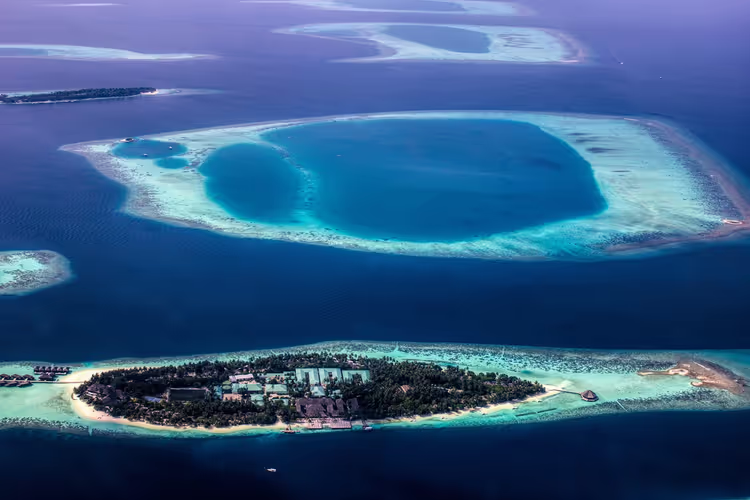
 © Hansueli Krapf · CC BY-SAPhoto: Hansueli Krapf, CC BY-SA (https://creativecommons.org/licenses/by-sa/3.0), Wikimedia Commons
What sets the Maldives apart from other tropical destinations? There is almost no difference between the "summer" and "winter" seasons here. The warmest months, March and April, differ from the rest by only a couple of degrees, and it is hard to feel that difference.
What you will feel is something else: humidity and wind. The air is saturated with moisture, but the ocean works like an air conditioner. Breathing is easier on the shore than inland among the palm trees.
Rain here is usually short. A downpour starts in the afternoon and ends twenty minutes later, and then the sun comes out again. A prolonged overcast week is possible, but it is rare even during the wet season.
Rainy season: when the wet monsoon arrives
Rainfall here is unevenly distributed (according to the Maldives Meteorological Service, 09/2026). In the north, about 1,779 mm falls per year, in the central atolls 1,966 mm, and in the south as much as 2,218 mm.
The single-day record is also impressive: in Addu on November 24, 2015, 228 mm fell (as of 09/2026, Maldives Meteorological Service). A typical tropical downpour lasts only minutes, not hours.
The wet season runs from mid-May to November and coincides with the southwest monsoon. The water stays warm during this time, while the air becomes humid and heavy. During a thunderstorm, stay out of the water and off the open shore.
Best time to visit the Maldives
The warm and dry months come with the northeast monsoon. From January to March, the sun shines 10-11 hours a day (as of 09/2026, Maldives Meteorological Service). In the other months, you get 7-9 hours of sunshine.
Period | Season | Rain | Sun per day |
|---|---|---|---|
January-March | northeast monsoon | minimal | 10-11 hours |
December and April | transition months | moderate | 8-9 hours |
Mid-May-November | southwest monsoon | maximum | 7-9 hours |
High season is December, January, and February. The weather is excellent, but hotels are more expensive and need to be booked in advance. If you want a transition period, look at April: there is still plenty of sun, and prices are lower.
The cheapest time is summer, the middle of the wet season. The rains are short, so the savings are significant. Choose this option if budget matters more to you than guaranteed dryness.
The catch with high season is that popular islands are overcrowded.
New Maldives resorts: what arrived in 2026
The luxury segment of the archipelago is growing, and several projects have been announced on the islands that affect hotel choices.
Chedi Hospitality, together with JIH Global Investments, is building its first Maldivian hotel: an overwater boutique property and private residences (as of 09/2026, official Chedi Hospitality release).
The SIX & SIX PRIVATE ISLANDS collection promises six islands, each with its own character (as of 09/2026, SIX & SIX website). The first announced is RAH GILI MALDIVES in South Male: 74 villas with private pools next to a dolphin sanctuary.
Geography: where the Maldives atolls are located
The Republic of Maldives is a chain of atolls stretching from north to south in the Indian Ocean. The equator crosses the country, so the sun stays high here and the warmth lasts all year.
The only way to get there is by plane. The main gateway is Velana International Airport near Male. From there, a speedboat or seaplane takes you to your specific island, and travel time depends on how far the atoll is.
For planning, something else matters: the temperature is almost the same on all atolls, but there is more rain in the south.
⁉️🤔 Frequently asked questions
When is the best time to go to the Maldives?
The dry season runs from January to March: the sun shines almost all day and rain is minimal. This is high season, so prices are higher. Transitional April offers a compromise: there is still plenty of sun, and costs are lower. The cheapest option remains summer during the wet monsoon.
What is a monsoon in the Maldives?
Two seasonal winds change direction, and with them the weather. The southwest monsoon brings humid air from mid-May to November, while the northeast monsoon makes the months from January to March dry. December and April sit between them and are considered transition months.
Does rain ruin your Maldives vacation?
Usually not. Downpours here are short and last only minutes, and the sun returns between them. Plan swimming for the morning, and keep shelter ready after lunch.
Is the weather the same on all atolls?
No, there are differences. The south gets noticeably more rain than the north, while the temperature is almost the same everywhere. The seasonal difference is also small, so the island is chosen based on budget and transfer, not weather.
In short: when to go to the Maldives
The Maldives works for a vacation year-round, but the season changes the price and the amount of rain.
- If your vacation is in January-March: take the dry season and book in advance.
- If you are on a tight budget: take July or August, the rains are short and prices are lower.
- If you want a compromise: take April, there is plenty of sun and hotels are cheaper.
January suits those who care about sun, and August suits those who want to save. The sea stays warm in any month, and the downpours stay short.

A small editorial team writing guides for independent travel. We travel ourselves, but we haven’t been everywhere, so we check prices, opening hours and how to get there against official sources.