
















Dancing house in Prague: what is inside and how to see the city from the roof
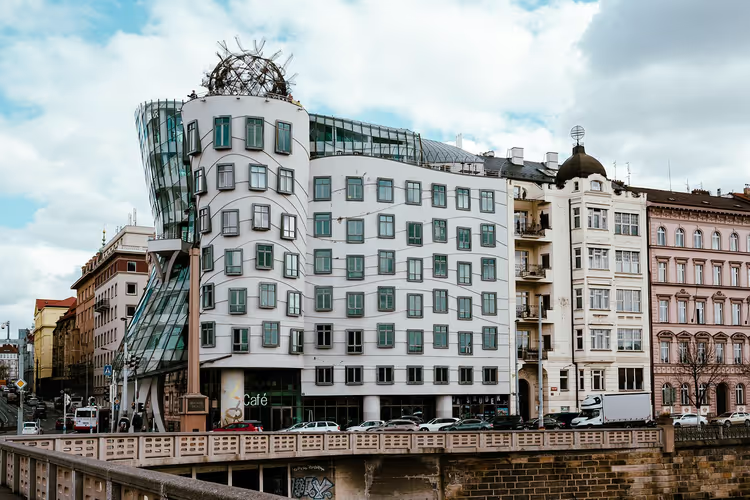
Dancing House stands on the Vltava embankment in Prague 2. From the river side, it looks as if two towers are frozen mid-waltz, although the building is actually completely still.
Behind this shape lies a turbulent history: the 1945 bombing, President Havel's idea, and Frank Gehry's design. The building opened in 1996 (as of: official history of the building).
Ten minutes at the building gives you the essentials: a futuristic silhouette, a terrace overlooking Prague Castle, and the Ginger & Fred restaurant on the top floor. Let's dig into the history and practical details.
Ad: this article contains affiliate links. We earn a commission if you book through them, at no extra cost to you.
History of the house on a vacant lot
💡 In short:
- Dancing House (Tančící dům) stands in Prague 2, at the corner of Rašínovo nábřeží and Jiráskovo náměstí.
- It is a deconstructivist building, opened in 1996.
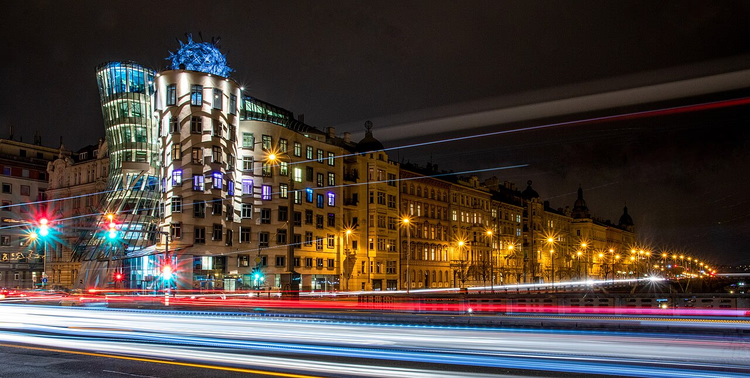
The name is misleading. The house does not rotate or sway, although you probably imagined exactly that. Its silhouette is what makes it dance: two towers, one stone and static, the other glass and leaning, like partners in a dance.
 © MiroRosa · CC BY-SAPhoto: MiroRosa, CC BY-SA (https://creativecommons.org/licenses/by-sa/4.0), Wikimedia Commons
The building's style is called deconstructivism. It is characterized by deliberately impossible forms that challenge conventional geometry. Old stone houses stand nearby, and the contrast works both ways: the historic buildings look older, and Gehry's house looks newer than it actually is.
The site has a dramatic backstory. Before the war, an ordinary apartment building stood here, destroyed by the 1945 bombing of Prague. The vacant lot right by the Vltava remained undeveloped for decades (as of: official website).
Václav Havel came up with the solution. His own house stood next to the vacant lot, and the future president, while still a dissident, discussed a cultural building with architect Vlado Milunić. The project only moved forward after 1989, when Havel was already head of state (as of: history page).
The money for construction came not from the city but from a bank. The Dutch company Nationale-Nederlanden bought the plot and agreed to the bold project, although disputes around it went on for years.
How the house was built
Havel wanted to see a world-renowned architect's work on the vacant lot. French architect Jean Nouvel was invited first, but he declined. Then Canadian Frank Gehry took on the project, joined by Vlado Milunić.
The house was conceived as two parts, static and dynamic. The towers' lean toward the intersection was meant to show that Czechoslovak society was moving again after decades of rigidity. That is how Milunić himself explained it.
Technically, the house was an experiment. It was designed in the 3D software Catia, which made it possible to calculate the inclined surfaces in advance. The interiors were done by British architect of Czech descent Eva Jiřičná. Immediately after opening, the house won Time magazine's award in the Best Design of the Year category (see building history).
How locals received the house
The house was not accepted right away. The official history describes the public reaction as heated, and disputes about the project delayed construction for years. Some residents felt that deconstructivism had no place among historic buildings.
The critics' argument was simple: old buildings all around, and here you have glass and concrete. Time passed, and the debate lost its point. Today it is one of the symbols of the new Prague.
Tourists settled the question faster than locals. The official website calls the house one of the most photographed buildings in the country, so your camera will come in handy here.
Where the house got its second name
Locals call the house "Ginger and Fred," after dancers Ginger Rogers and Fred Astaire. The stone and glass towers read as dance partners, and the nickname stuck.
The name also entered official life. The restaurant on the top floor is also called Ginger & Fred, and in documents the house is listed as the Nationale-Nederlanden building.
The viewing angle changes the perception. From the embankment, the silhouette reads as a couple dancing; from the square, the glass tower is more prominent. You can walk around the house in a few minutes, and that is the easiest way to pick your shot.
What's inside: hotel, restaurant, and gallery
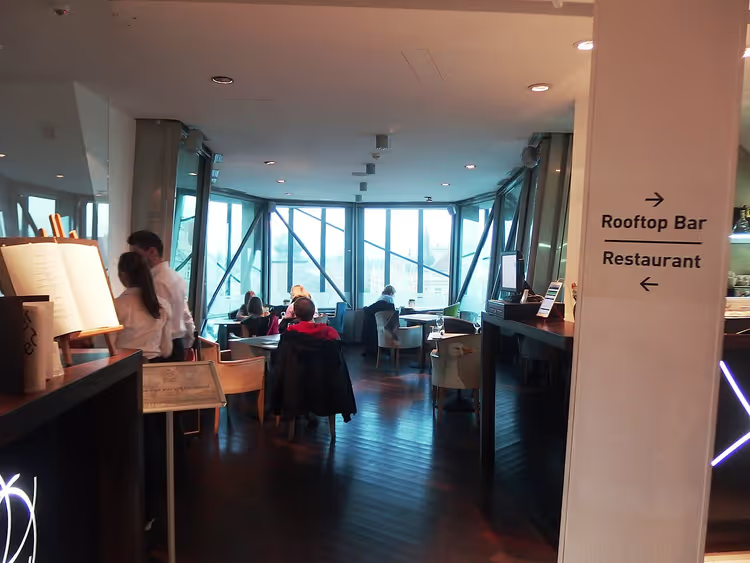
Inside, the house serves several roles at once. The top floor houses the Ginger & Fred restaurant with views of Prague Castle and Hradčany, and above it a glass bar with a rooftop terrace overlooking the National Theatre and the river.
 © Palickap · CC BY-SAPhoto: Palickap, CC BY-SA (https://creativecommons.org/licenses/by-sa/4.0), Wikimedia Commons
Most of the building is occupied by the Dancing House hotel, with 40 rooms overlooking Prague, Prague Castle, and the Vltava (as of: the house's official website). Staying overnight in Gehry's building isn't possible for everyone: check Dancing House Hotel prices on Trip.com well in advance.
The building also houses the Dancing House Gallery. It runs guided tours, lectures, and workshops, so it's more than just an exhibition space.
Prague nearby: cruises and walks
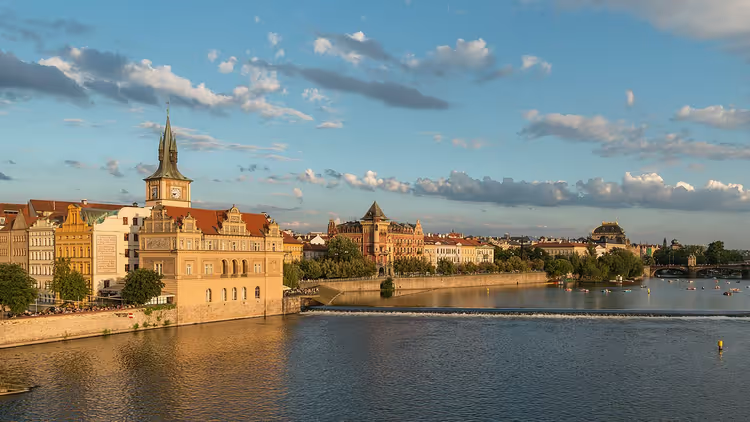
From the terrace and the windows you can see Prague Castle, the National Theatre, and the Vltava. It's a convenient starting point for a route: the embankment leads toward Charles Bridge, and from Jiráskovo náměstí it's an easy walk to the Old Town.
From the water you can see the whole building, including the tilt of its towers. Booking a Vltava river cruise is a good option: it passes the islands and goes under Charles Bridge, taking about an hour.
Tours and tickets in Prague
Guided tours, skip-the-line tickets and activities — most offers can be cancelled free of charge.
See offers on GetYourGuideThe widget loads once you give your consent.
Dancing House on the map
The building stands at the corner of Rašínovo nábřeží and Jiráskovo náměstí in Prague 2. The Jiráskovo náměstí tram stop is right next to the building, and Karlovo náměstí metro station on line B is about a five-minute walk away.
 © DXR · CC BY-SAPhoto: DXR, CC BY-SA (https://creativecommons.org/licenses/by-sa/4.0), Wikimedia Commons
You can view the building from outside for free at any time. In the morning there are fewer tourists on the embankment; in the evening the lighting comes on and the silhouette stands out more sharply.
Dancing House in Prague
Places on the map
- Dancing House Deconstructivist building on the Vltava embankment, housing a hotel, restaurant and gallery
⁉️🤔 Frequently asked questions
Can you go inside the Dancing House?
You can get inside as a guest of the Dancing House hotel, a visitor to the Ginger & Fred restaurant, or a gallery guest. The rooftop terrace belongs to the glass bar, not to a separate observation deck. Plan your visit through the hotel or a restaurant reservation.
How much does it cost to enter the Dancing House?
Viewing it from outside is free: the building stands on an open embankment, and you can walk around it at any time. You only pay for what's inside: a hotel room, dinner at the restaurant, or a gallery ticket. Check current prices on the official website.
Why is the building called Ginger and Fred?
The name honors dancers Fred Astaire and Ginger Rogers. The building's two towers, one stone and one glass, read as a dancing couple.
Who built the Dancing House?
The project was designed by Vlado Milunić and Canadian architect Frank Gehry, with interiors by Eva Jiřičná. The client was the Dutch bank Nationale-Nederlanden, and the idea was championed by Václav Havel. The building opened in 1996 (see the history of Dancing House).
When is the best time to visit the Dancing House?
The best time to visit is morning or evening. Ten minutes is enough, and the walk is easy to combine with a stroll along the embankment to Charles Bridge.
In short: what to book
If you're coming for the architecture and the view, the plan is simple: the Dancing House hotel for a night right inside Gehry's building, the Ginger & Fred restaurant for dinner with a view of Prague Castle, and a river cruise to see the building from the water.
If you only have one evening, start with photos on the embankment and finish with dinner on the top floor. If you're on a short trip with kids, viewing the building from outside and walking to Charles Bridge will be enough.
You can find a room with a view on Trip.com, and Prague tours and cruises on GetYourGuide.

A small editorial team writing guides for independent travel. We travel ourselves, but we haven’t been everywhere, so we check prices, opening hours and how to get there against official sources.