
















Walking route through Nove Mesto: eighteen spots in one day
Nove Mesto is usually planned as a half-day stop, and then people end up spending a whole day here. The district was founded in the mid-14th century by order of Charles IV, but it lives in the present: the metro, museums, theaters, and old churches stand within a short walk of each other.
We put together a walking route through Nove Mesto that you can cover on foot in one day. Eighteen stops, from Wenceslas Square to the Vltava embankment and Charles Square. You will see where the country's largest museum operates, where to view the Dancing House from, and how to cover architecture across four styles, from Neo-Renaissance to Cubism.
Ad: this article contains affiliate links, we earn a commission if you book through them, at no extra cost to you.
One-day route through Nove Mesto
💡 In short:
- Start at the Muzeum metro station (lines A and C), then walk downhill toward the embankment.
- The route is entirely walkable: eighteen sights, about six kilometers, no tram or metro needed.
- Set aside a full day, because museums and churches open around ten in the morning and close by evening.
- Opening hours and prices: 09/2026, verified on the museum's tickets and schedule page.
The logic is simple. You start at Wenceslas Square, walk down through Nove Mesto to the river, and then return along Charles Square to the metro. The route is easy to split into parts: for example, walk only the upper half and come back to the museum in the evening. You will not need public transport.
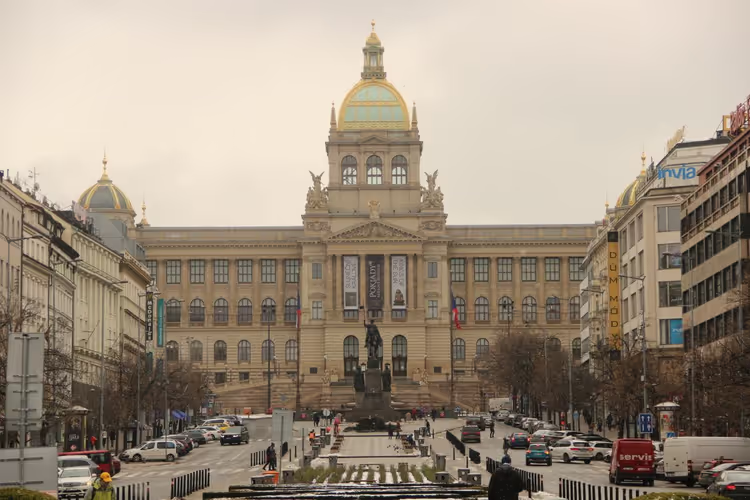
National Museum
The route starts at Wenceslas Square, the former Horse Market. The green and red Prague metro lines bring you here; you need the Muzeum station. Right by the exit stands the largest museum in Czechia.
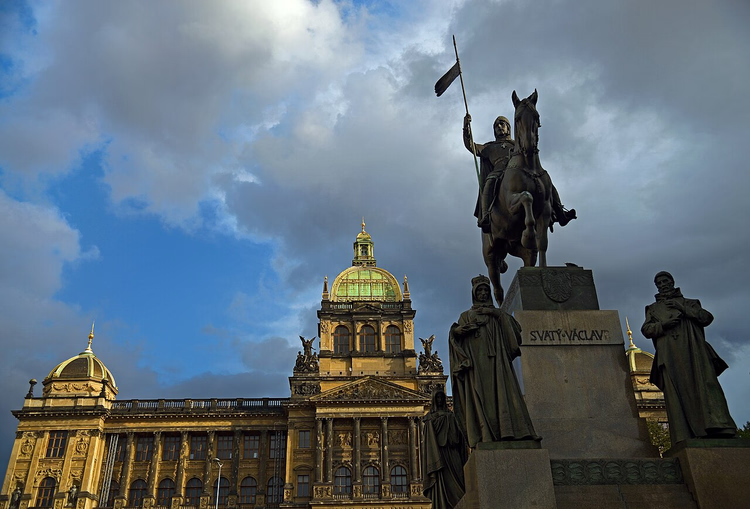
The monumental Neo-Renaissance building was designed by Professor Schulz, and construction took several years. The facade is decorated with marble plaques bearing the names of prominent figures in national science, art, and politics. A fountain with allegorical statues of the Vltava, the Elbe, and the three Czech lands operates at the entrance, and in front of the building stands the equestrian monument to Saint Wenceslas.
Inside, the exhibitions cover all stages of the country's development, from ancient artifacts to music and nature. Without a ticket you can see the facade and the square; with a ticket, allow at least two hours.
Opening hours and prices change by season, so check them on the official National Museum website (verified 14.09.2026). If you want to explore the district with a guide, Prague tours on GetYourGuide start at the National Museum.
Phoenix Palace
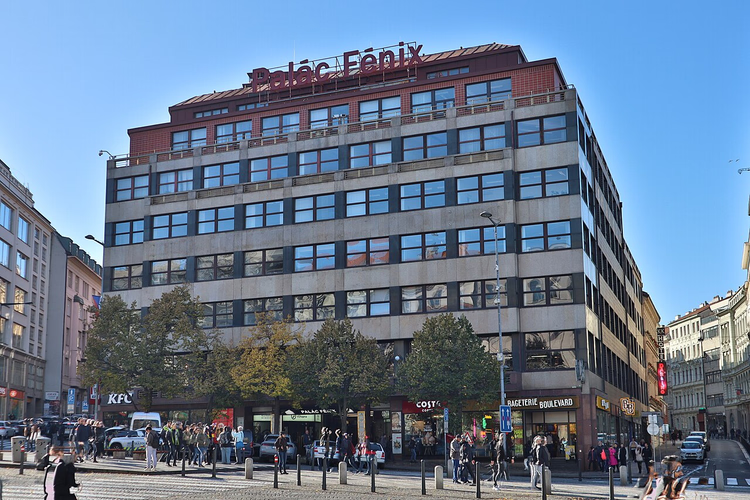
Across the street, on Smečky Street, stands Phoenix Palace, an example of the Constructivist era in architecture. The seven-story building is hard to miss: inside there is a shopping center, a cinema, and other establishments. You will walk past it in a couple of minutes, but the facade is worth a quick look.
 © Jklamo · CC BY-SAPhoto: Jklamo, CC BY-SA (https://creativecommons.org/licenses/by-sa/4.0), Wikimedia Commons
Hotel Jalta
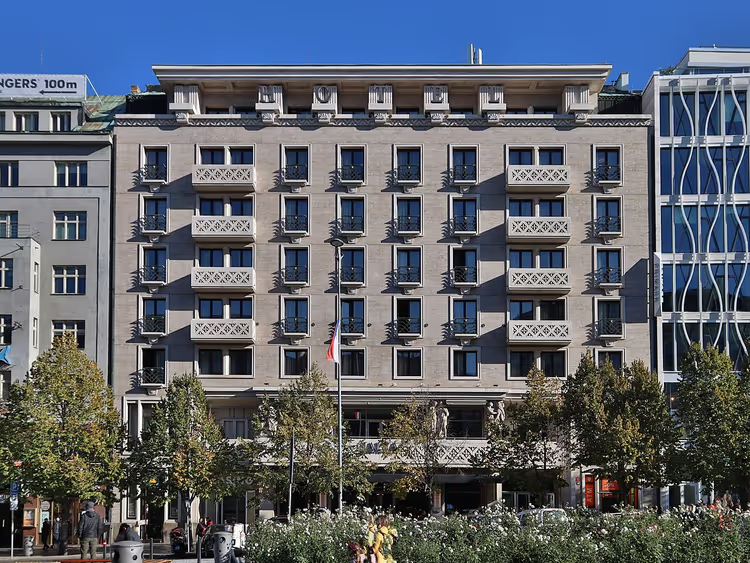
Hotel Jalta was built in the 1950s to a design by Tenzer. Your attention will be held by the display windows, the stucco work on the piano nobile, and the balcony railings: the facade looks more ornate than the neighboring buildings on the square. Use this point as a landmark if you are looking for the entrance to the arcades and coffee shops nearby.
 © Jklamo · CC BY-SAPhoto: Jklamo, CC BY-SA (https://creativecommons.org/licenses/by-sa/4.0), Wikimedia Commons
Lucerna Passage
Lucerna Passage occupies the left side of the square. It was designed by Matěj Blechta in the Art Deco style, and it is one of the first reinforced concrete buildings in Prague.
Inside you will see columns, classical faces, busts, and stucco work, as well as the original roof structure. Today it houses restaurants, bars, clubs, art studios, and shops. The passage belonged to the grandfather and full namesake of President Vaclav Havel, so you are walking through a building with history.
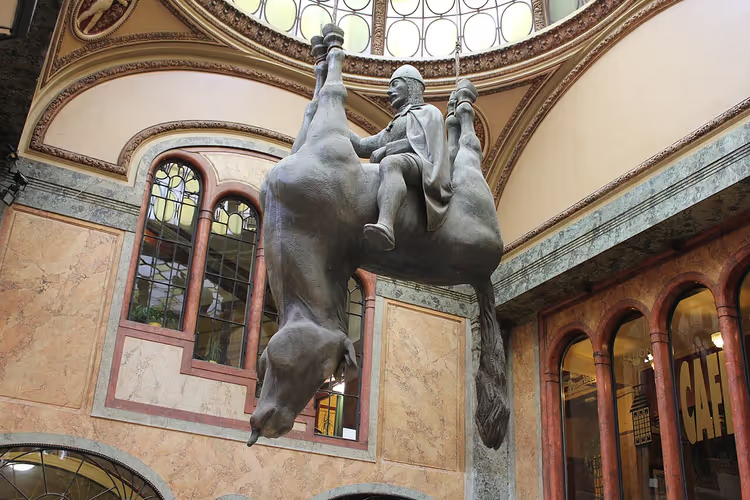
David Cerny's "Horse" sculpture
Tourists' attention is drawn to this parody sculpture of Myslbek's famous monument. Here Saint Wenceslas sits on the belly of an upside-down horse.
 © Ввласенко · CC BY-SAPhoto: Ввласенко, CC BY-SA (https://creativecommons.org/licenses/by-sa/3.0), Wikimedia Commons
The author of the joke, the scandalously famous Prague sculptor David Černý, installed the work opposite the original in the late 20th century. The sculpture was later moved to Lucerna, so look for it inside the passage, not on the square.
Grand Hotel Europa
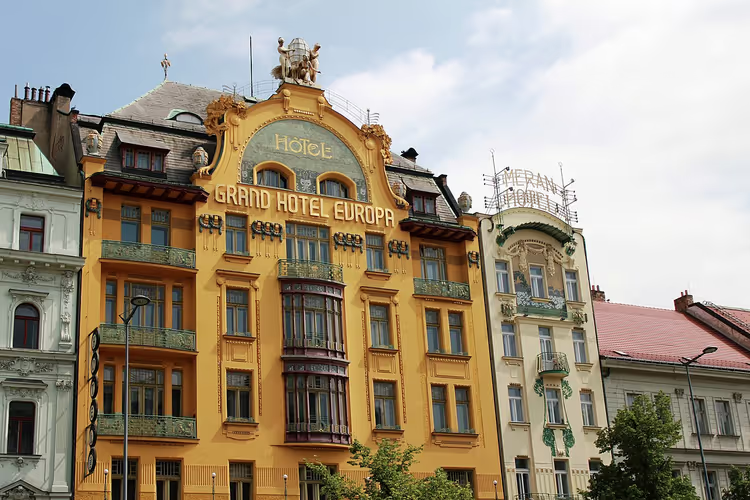
Grand Hotel Europa was built in the early 20th century as a collaborative project by three architects in the Art Nouveau style. The central part of the bright yellow facade is crowned with a figured pediment with sculptures and stucco ornamentation.
You will notice the elegant balcony railings and the patterns of the window casings even from the square. This is one of the most photographed spots on Wenceslas Square, so get your camera ready in advance.
 © Øyvind Holmstad · CC BY-SAPhoto: Øyvind Holmstad, CC BY-SA (https://creativecommons.org/licenses/by-sa/3.0), Wikimedia Commons
Church of Our Lady of the Snows
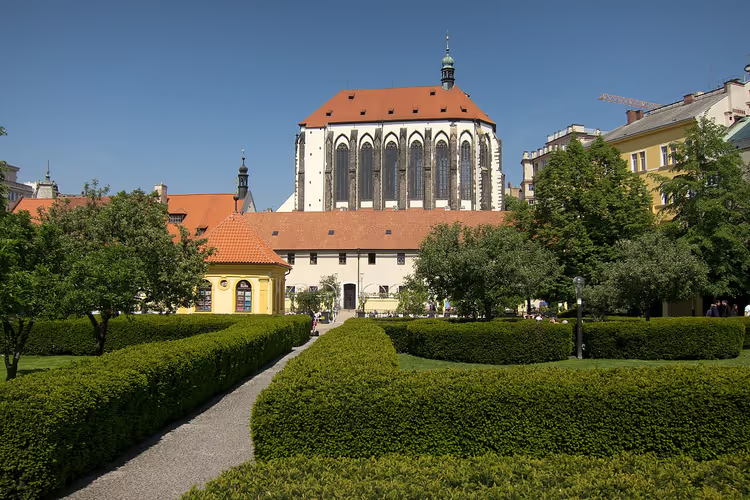
From the Czech Bank building at the intersection with Vodičkova Street, you will enter the Franciscan Garden. The garden's main attraction, the Church of Our Lady of the Snows, was built to commemorate the coronation of Charles IV in the mid-14th century.
The church has the highest vault in Prague, and the altar is done in the late Baroque style. To the north, it is adjoined by a cemetery with a Gothic sculptural portal; to the south stands a Franciscan monastery with a library of rare books and a garden. Go inside during the quiet morning hours: services here follow a schedule.
 © Thomas Quine · CC BYPhoto: Thomas Quine, CC BY (https://creativecommons.org/licenses/by/2.0), Wikimedia Commons
Jungmann Square
Jungmann Square is surrounded by architectural masterpieces from the first decade of the 20th century. You will see Krejčík's Cubist street lamp, the red-and-white Adria Palace in the Rondocubist style, and a bank building, the former ARA department store.
Across the street from them stands the Mozarteum, a former concert hall in red and black tones. Prestigious competitions, concerts, and theatrical performances took place here. The square is small, but allow about fifteen minutes to explore it.
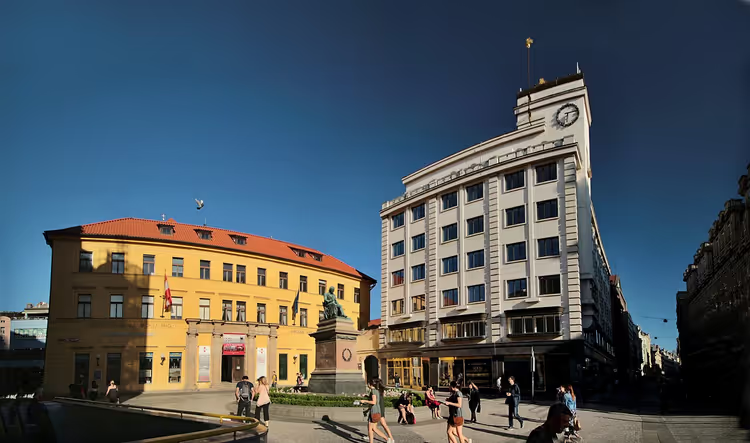 © VitVit · CC BY-SAPhoto: VitVit, CC BY-SA (https://creativecommons.org/licenses/by-sa/4.0), Wikimedia Commons
Church of St. Peter at Poříčí
The route then leads through Republic Square, where historic monuments are everywhere, to Poříčí Street with its numerous shops. It intersects with the short Biskupská Street, and here stands an ancient shrine: the Church of St. Peter.
The church was built at the turn of the 11th and 12th centuries by local German merchants living in the Poříčí settlement. In the first half of the 19th century, two Gothic columns were placed at the entrance. The church, without external grandeur, survived fires and reconstructions, and a restoration at the end of the 20th century gave it new life. For almost seven centuries it has belonged to members of the Order of the Red Star, and sacred and classical music still resounds within its walls.
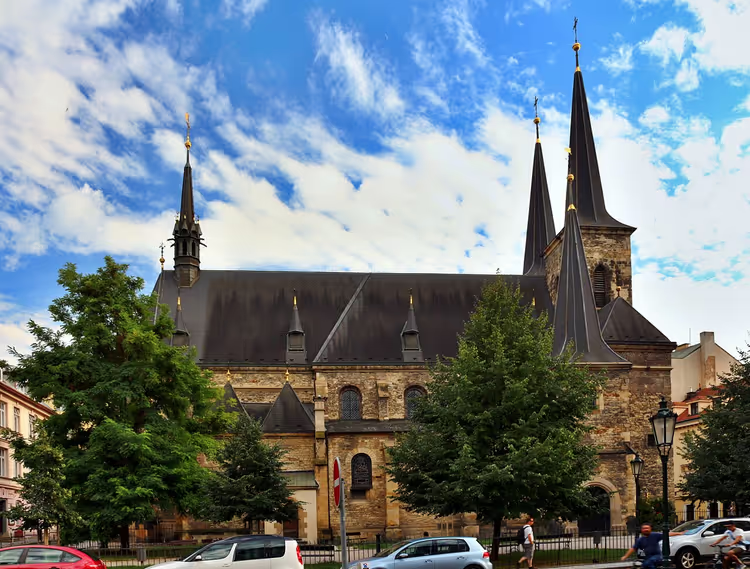 © VitVit · CC BY-SAPhoto: VitVit, CC BY-SA (https://creativecommons.org/licenses/by-sa/4.0), Wikimedia Commons
Church of St. Henry
To the left of the church is Peter's Square, the center of the northern sector of the New Town. From here you will come out onto Zlatnická Street, and along Truhlářská you will reach Republic Square.
After crossing it, you will find yourself on Senovážná Street: the Hay Market, an important site in the district, once bustled here. On the square stands the old Church of St. Henry, built in the mid-14th century. A 19th-century reconstruction added Gothic features. The cathedral entrance is decorated with statues of John of Nepomuk and Jude Thaddaeus, and the massive bell tower with its bells stands apart.
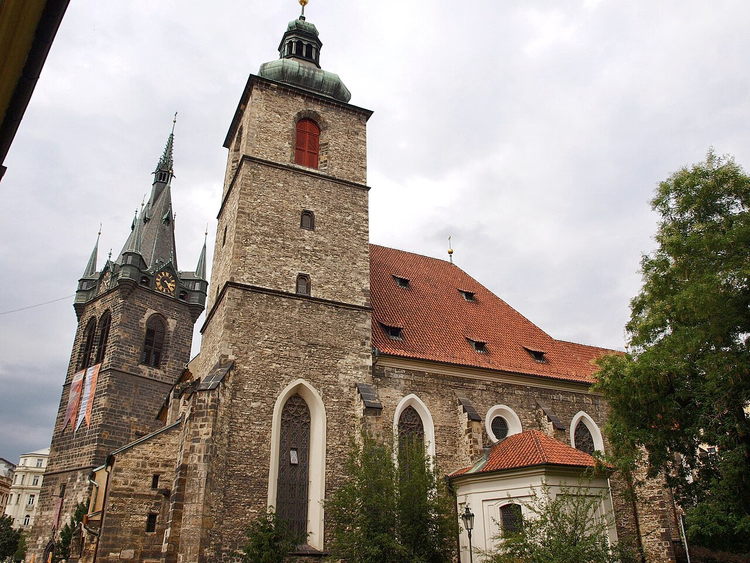 © VitVit · CC BY-SAPhoto: VitVit, CC BY-SA (https://creativecommons.org/licenses/by-sa/4.0), Wikimedia Commons
Main Post Office
From Senovážné Square, walk along Jindřišská Street. A building with yellow flags at the intersection with Politických vězňů Street will catch your attention: this is the Main Post Office.
From the outside, the building looks fairly ordinary, but inside you will enter a hall with rich interiors. Until the late 1860s, this site was an inner courtyard where postal stagecoaches stopped. Later the courtyard walls were joined with a roof, creating a three-story space with a glass ceiling and Art Nouveau paintings based on works by Alphonse Mucha. Benches stand among exotic plants, where you can sit and study the wall murals.
- The catch: the building's exterior is nothing special; everything interesting is inside.
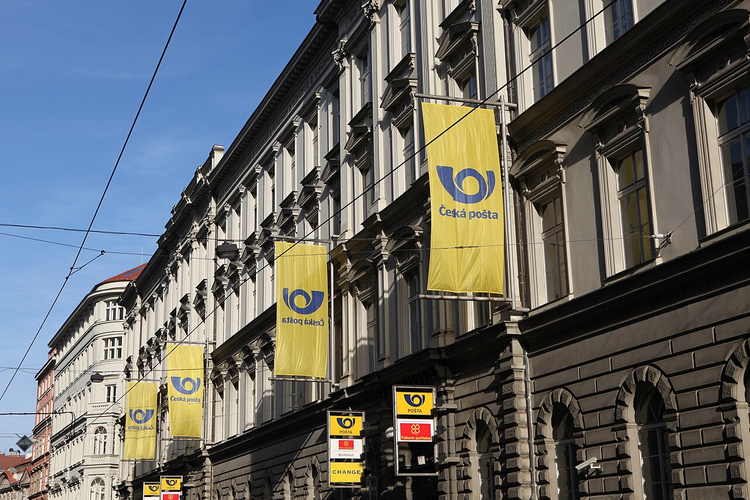 © Česká pošta · CC BY-SAPhoto: Česká pošta, CC BY-SA (https://creativecommons.org/licenses/by-sa/4.0), Wikimedia Commons
Porges of Portheim Palace
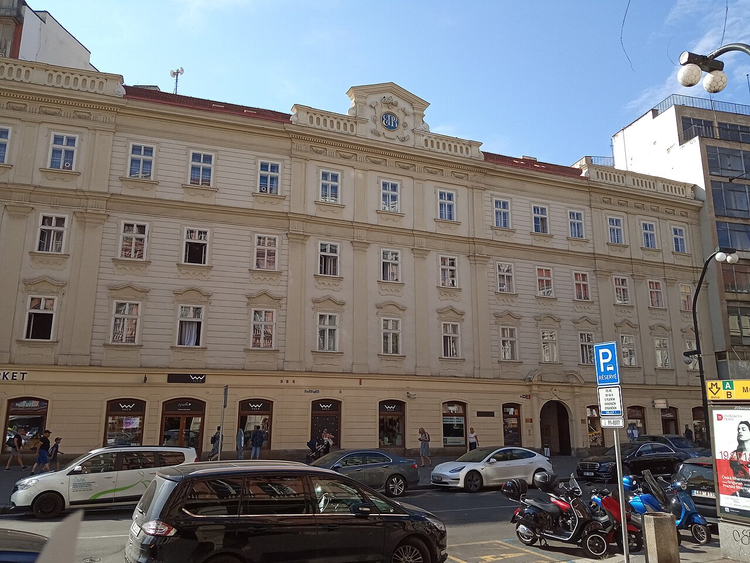
On Národní Avenue stands the Porges of Portheim Palace, at number 38. The name of Alexander Suvorov is associated with it: according to legend, the military commander spent one night here. In the mid-20th century, a bust of him was installed at the building for this reason.
Look at the palace from the opposite side of the street: this way you can see the entire facade and the memorial plaque at the entrance.
 © JiriMatejicek · CC BY-SAPhoto: JiriMatejicek, CC BY-SA (https://creativecommons.org/licenses/by-sa/4.0), Wikimedia Commons
The old National Theater building
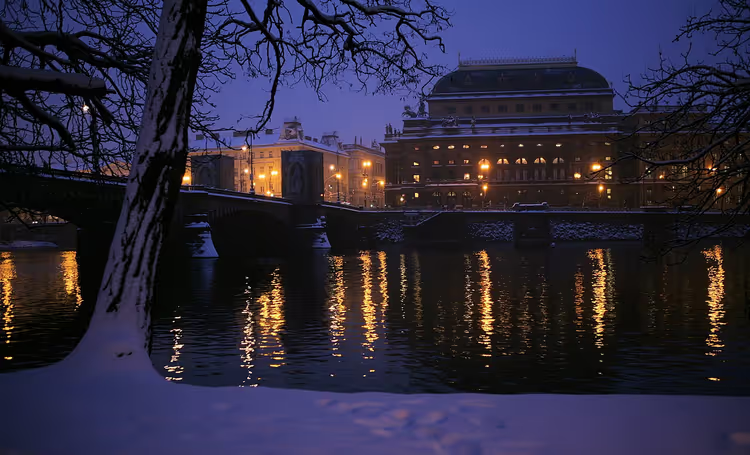
On the opposite side of the avenue stands the old National Theater building. It is a monument to the development of Czech theatrical art and the patriotism of the city's residents.
In the mid-19th century, a broad fundraising campaign was launched, architect Zítek won the design competition, and construction lasted thirteen years. The opening had to be postponed: shortly before it, a fire almost completely destroyed the building. For the residents it was a tragedy, but they raised money again, and the theater was reborn under the direction of Josef Schulz. The Neo-Renaissance building, with its many sculptural decorations and a hemispherical roof topped with a "crown," faces the Vltava embankment.
Tours of the halls run regularly; schedules and tickets are available on the theater's official website (checked 09/14/2026).
 © Miroslav Hurt · CC BY-SAPhoto: Miroslav Hurt, CC BY-SA (https://creativecommons.org/licenses/by-sa/3.0), Wikimedia Commons
The new National Theater building
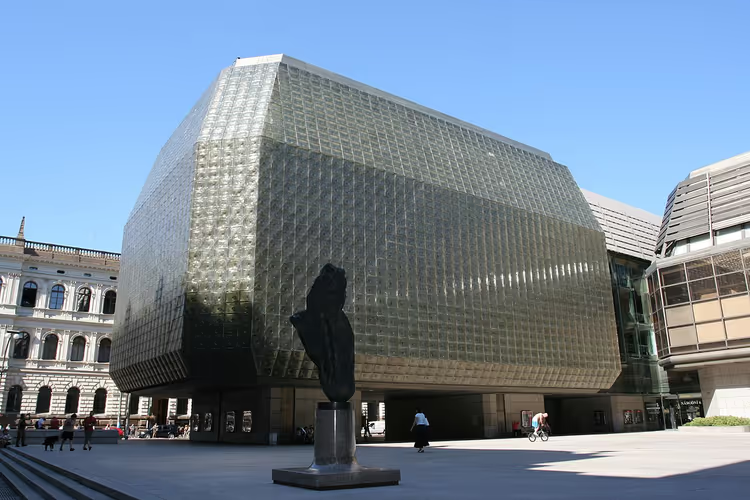
Next door is the new National Theater building, opened for the centenary of the old one. A huge glass structure on massive concrete supports embodied the avant-garde design by Prager. The architectural community considers it the finest example of the socialist construction period in Czechoslovakia.
The best way to view the building is from the embankment: from there you can see the glass reflecting the river and the sky.
 © che · CC BY-SAPhoto: che, CC BY-SA (https://creativecommons.org/licenses/by-sa/2.5), Wikimedia Commons
Dancing House
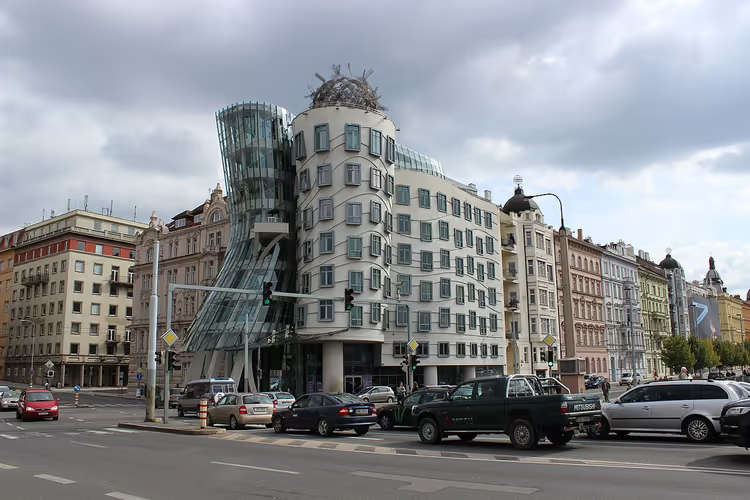
From the National Theater, walk along Masaryk Embankment to Jiráskův Bridge. From it you can see the Dancing House, a joint project by Croatian architect Milunić and American architect Gehry.
Two towers seem to have merged in a dance, recalling the popular Hollywood dancers Ginger and Fred. Spend ten minutes here: the view of the house from the bridge is better than from the opposite bank.
 © Jan Polák · CC BY-SAPhoto: Jan Polák, CC BY-SA (https://creativecommons.org/licenses/by-sa/3.0), Wikimedia Commons
Church of St. Wenceslas
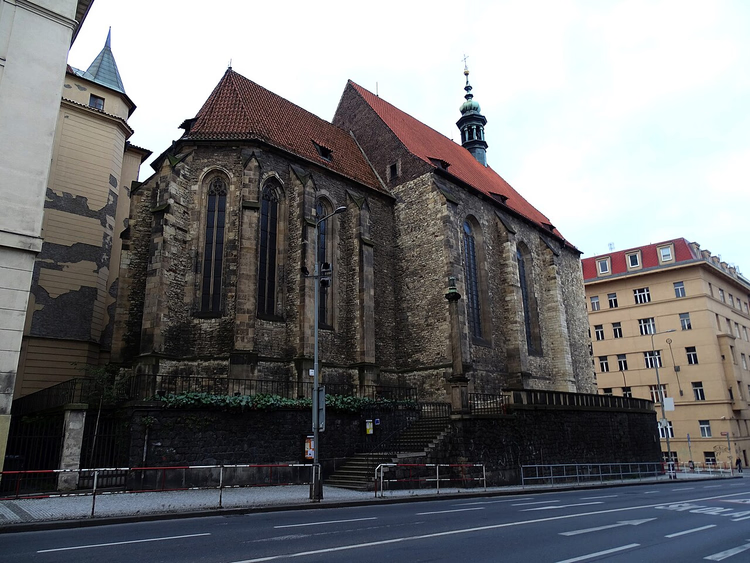
On the neighboring Resslova Street stands the Church of St. Wenceslas. It was built back in the 12th century as a parish church for the residents of the small village of Zderaz.
 © ŠJů · CC BYPhoto: ŠJů, CC BY (https://creativecommons.org/licenses/by/4.0), Wikimedia Commons
Later the church was rebuilt with Gothic elements added, and the reconstruction in the first half of the 19th century emphasized the Baroque style of the ancient monument. This site is easy to miss, so keep the street name in mind: the stone facade is almost hidden by trees.
Faust House
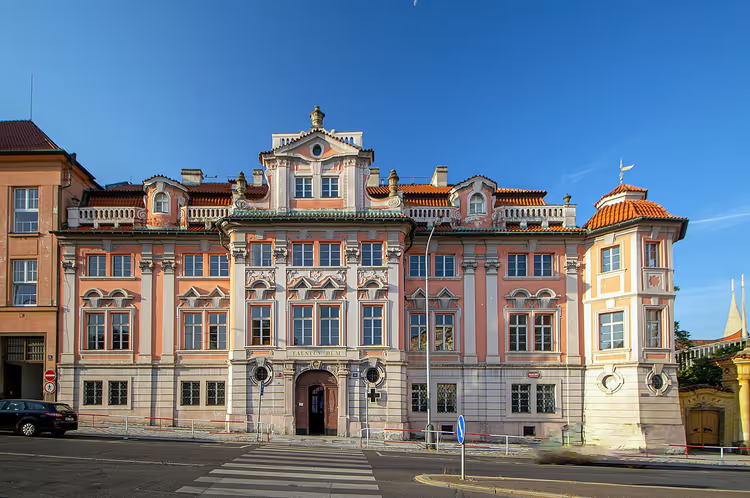
Along the same street you will come to Charles Square. Here stands Faustův dům, shrouded in legends about Doctor Faust. Many mysterious stories from the lives of its former residents are connected with the house.
Today the building with the pink facade houses a pharmacy and a university library, but the name of Faust has stuck to it forever. Step into the courtyard if the gate is open.
 © VitVit · CC BY-SAPhoto: VitVit, CC BY-SA (https://creativecommons.org/licenses/by-sa/4.0), Wikimedia Commons
Church of St. John of Nepomuk
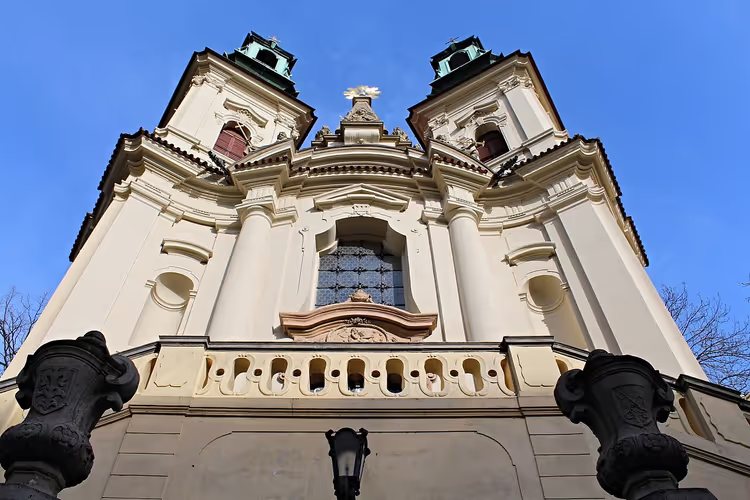
Next to Faust House, on a rock, stands the Church of St. John of Nepomuk. The memory of the great martyr and patron of the Czech people was expressed by Dientzenhofer: he placed the Baroque church on an elevated terrace.
You climb to the church by a staircase with sculptures of religious figures. Inside the altar stands a wooden statue of John. From here you have a view of Charles Square, and it is a good spot to end the walk and check the map.
 © VitVit · CC BY-SAPhoto: VitVit, CC BY-SA (https://creativecommons.org/licenses/by-sa/4.0), Wikimedia Commons
New Town sights on the map
All the points of the route are collected on the map below. You can walk the entire route or choose one section: for example, only from Wenceslas Square to Charles Square. The distances here are walkable, and the order of the points matches the text of the article.
Walking route through Nové Město
Places on the map
- 1Wenceslas Square Former Horse Market and starting point of the route, Muzeum metro station
- 2National Museum The largest museum in Czechia in a Neo-Renaissance building, two hours to view
- 3Phoenix Palace Constructivism on Smecky Street, a shopping centre and a cinema inside
- 4Yalta A 1950s hotel with display windows and mezzanine stucco
- 5Lucerna Passage Art Deco and Prague's first reinforced concrete, restaurants, bars and shops
- 6Myslbek Monument in Lucerna David Černý's parody of an equestrian monument, standing inside the passage
- 7Grand Hotel Europa Art Nouveau of the early 20th century, a yellow facade with a shaped gable
- 8Church of Our Lady of the Snows The highest vault in Prague, next to the Franciscan garden and monastery
- 9Jungmann Square Krejcar's cubist lantern, the Adria palace and the former ARA department store
- 10Church of St Peter on Poříčí Gothic architecture about eight centuries old, sacred music concerts
- 11Church of St Henry Mid-14th century on Senovážné, the bell tower stands apart
- 12Main Post Office A hall with a glass ceiling and murals inspired by Alfons Mucha
- 13Porges of Portheim Palace 38 National Avenue, a bust of Suvorov at the entrance
- 14National Theatre Zítek's Neo-Renaissance building on the embankment, guided hall tours by schedule
- 15New Stage of the National Theatre Prager's glass structure, best viewed from the embankment
- 16Dancing House Milunić and Gehry's project, the best view from the Jiráskův bridge
- 17Church of St Wenceslas Early Baroque on Resslova Street, the facade hidden by trees
- 18Faust House Pink facade by Charles Square, legends of Doctor Faust
- 19Church of St John of Nepomuk Dientzenhofer's Baroque church on the terrace, a view of Charles Square
If you still have energy after the walk, from Charles Square it is easy to reach Old Town Square and Charles Bridge. That is a different district, but it is very close on foot.
Tours and tickets in Prague
Guided tours, skip-the-line tickets and activities — most offers can be cancelled free of charge.
See offers on GetYourGuideThe widget loads once you give your consent.
⁉️🤔 Frequently asked questions
Are Nové Město and Staré Město the same thing?
No, they are two different historic districts of Prague. Staré Město is older and lies to the north, around Old Town Square. Nové Město was founded by Charles IV in the mid-14th century, and at the time it really was a new town with its own markets and walls. Today the two districts are connected by streets, and you pass from one to the other almost without noticing.
How much time does the whole route take?
A full day if you go into museums and churches. The walk without interiors takes about four hours: the eighteen points are close together, but each one holds you for ten or fifteen minutes. Many tourists split the route into two parts and return to the embankment in the evening, when the crowds thin out.
How do you get to the start of the route?
The start is on Wenceslas Square, at the National Museum. Two Prague metro lines, the green and the red, go to Muzeum station; that is the exit you need. From Praha hlavní nádraží station you can walk to the square through the park in ten minutes. You will not need a tram; the entire route is on foot.
What should you see if you only have three hours?
Take the upper half of the route. The National Museum from the outside, the Lucerna Passage, the Phoenix Palace, the Church of Our Lady of the Snows, and Jungmann Square. Then go down to the embankment and look at the Dancing House from Jiráskův Bridge. That way you will see four different styles and spend no time on transfers.
Can you see Nové Město for free?
The streets, squares, and facades are open around the clock, and that is most of the route. A ticket is needed for the National Museum, and tours of the National Theater are also paid. Check prices and schedules on the official websites of the sites: they change by season.
In short: what is worth booking
If you have one day: walk the entire route, from the museum on Wenceslas Square to Charles Square. If you have three hours: see the museum from the outside, the Lucerna Passage, the Phoenix Palace, the Church of Our Lady of the Snows, and Jungmann Square, and view the Dancing House from the bridge. If you are traveling in winter: plan the walk for daylight hours, because church interiors close at nightfall.
Accommodation closer to the center gets booked in advance, so choose a hotel in central Prague on Trip.com and compare travel insurance options here before your flight.

A small editorial team writing guides for independent travel. We travel ourselves, but we haven’t been everywhere, so we check prices, opening hours and how to get there against official sources.